
A Councilmember Attempts to School the Planning Commission
A reminder why an independent Planning Commission is crucial

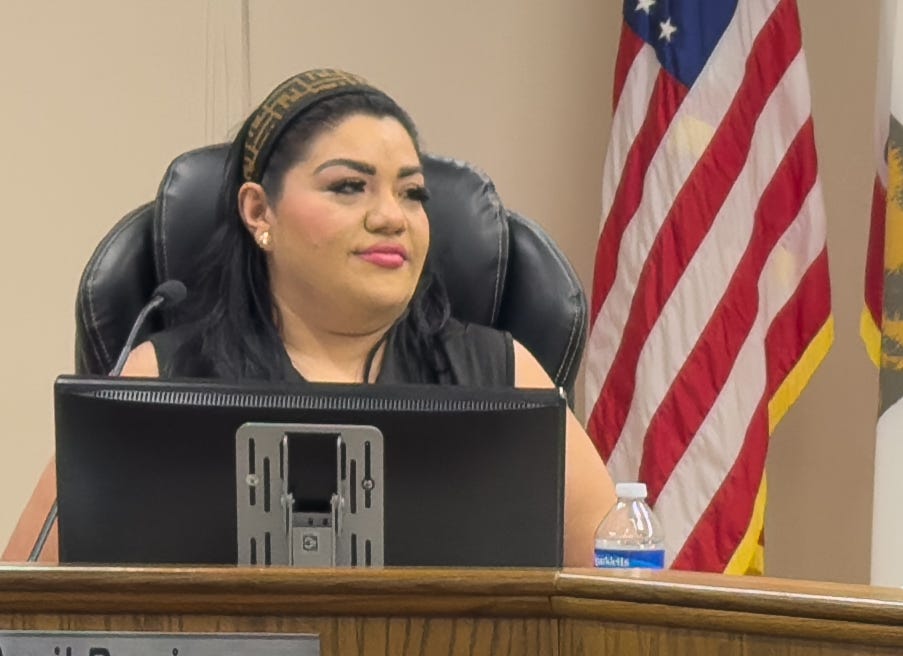
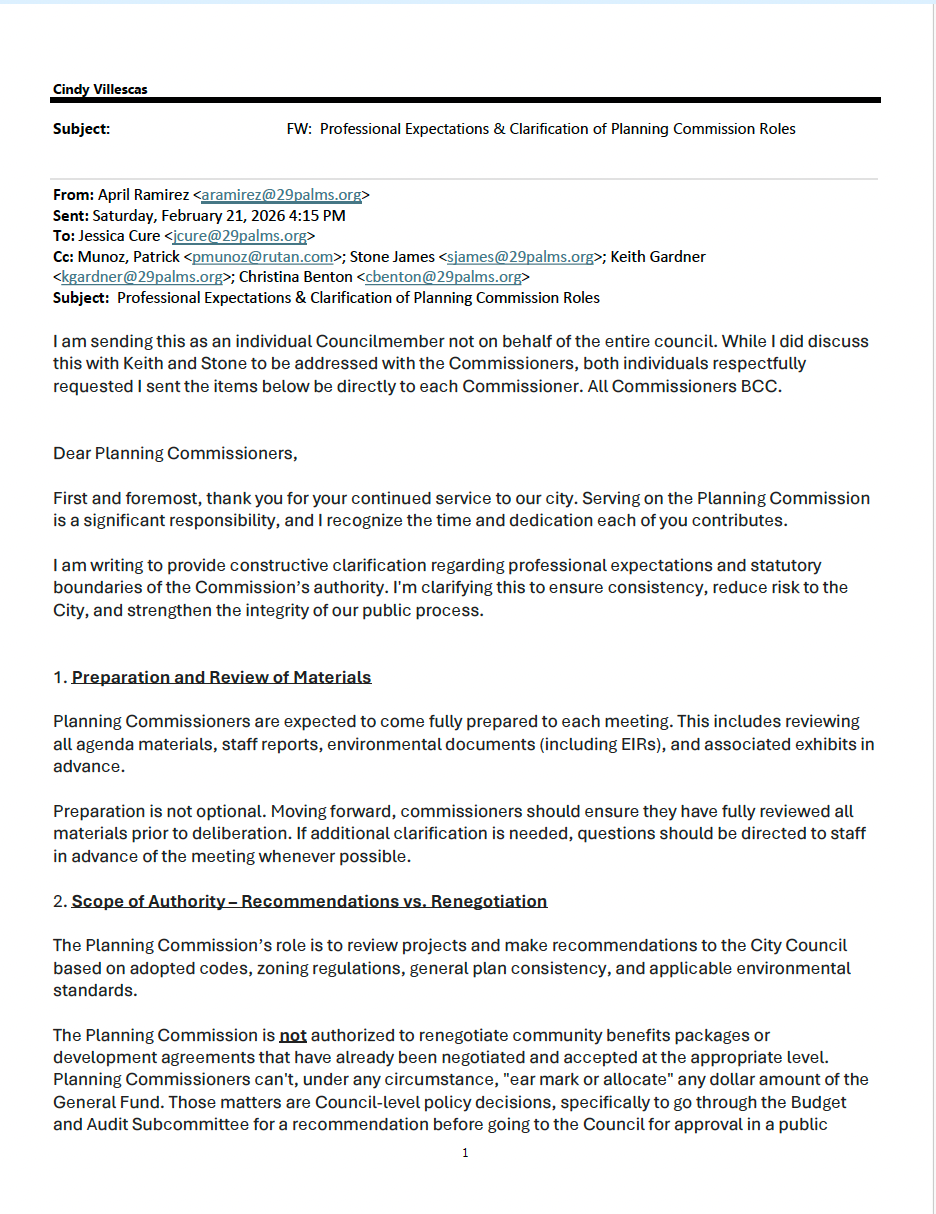
On Saturday, February 21, 2026, just four days after the Planning Commission decided to continue their discussion of the E-Group Solar Project to March 3, City Councilmember April Ramirez emailed all five Planning Commissioners and cc’d the City Attorney, City Manager, City Clerk and the Executive Assistant to the City Manager. The subject line read: “Professional Expectations & Clarification of Planning Commission Roles.”
In the email, although Ramirez thanks the Commissioners for their service, she goes on to imply that they don’t understand their roles:
I am writing to provide constructive clarification regarding professional expectations and statutory boundaries of the Commission’s authority. I’m clarifying this to ensure consistency, reduce risk to the City, and strengthen the integrity of our public process.
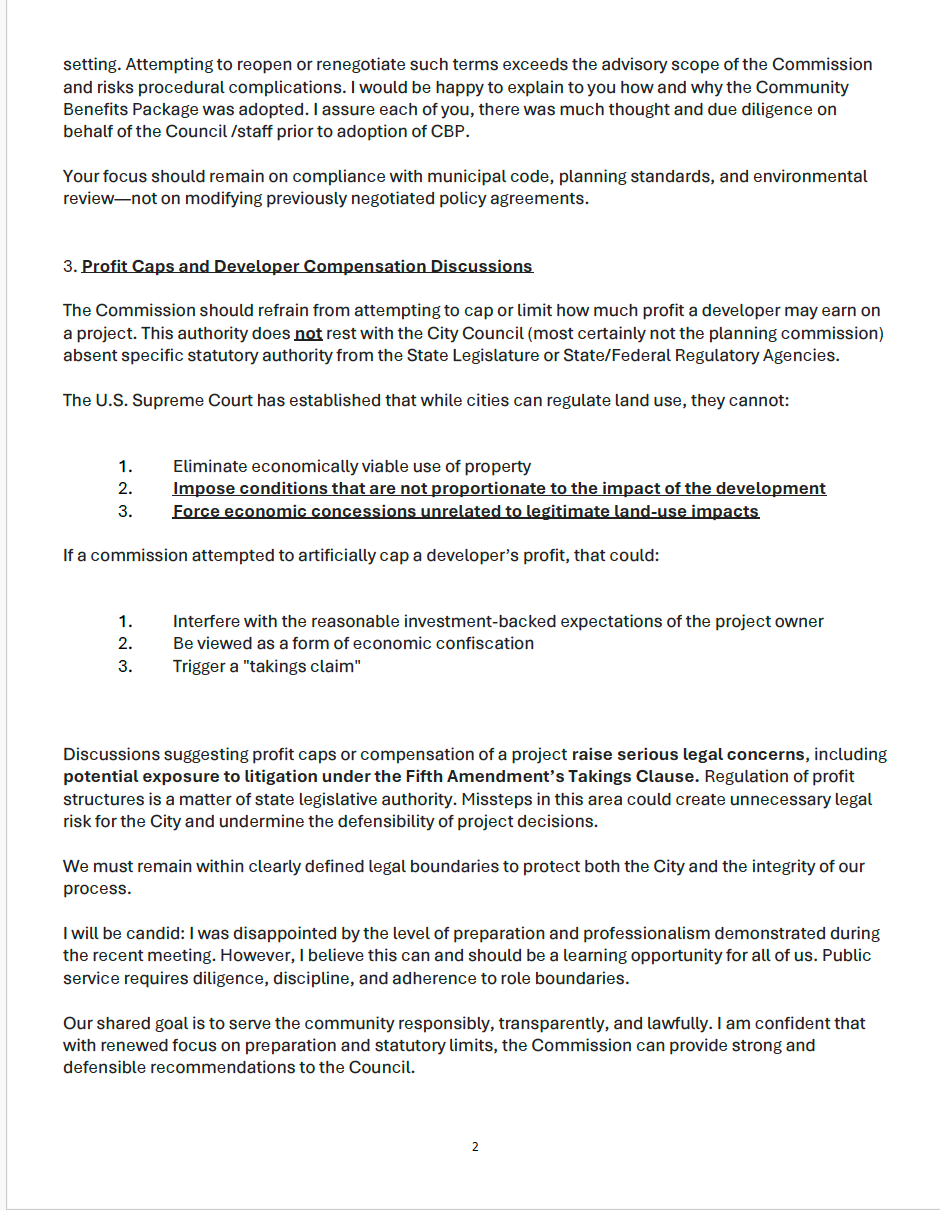
She then goes on to cite case law and outline what the Commission should and should not discuss, expressing her disappointment:
I will be candid: I was disappointed by the level of preparation and professionalism demonstrated during the recent meeting. However, I believe this can and should be a learning opportunity for all of us. Public service requires diligence, discipline, and adherence to role boundaries.
What could possibly prompt a new City Councilmember, just 13 months into their first term, without any prior service on a City Commission or Committee, to school five experienced Planning Commissioners in this manner?1
As we reported in our February 17 Planning Commission recap Part 1 and Part 2, Commissioners had a contentious conversation regarding the E-Group Solar Farm, with a particular focus on whether the community benefits package was adequate compensation for the permanent leveling of 244 acres of pristine desert that the construction would entail. Commissioner Jim Krushat summarized the concerns, “The juice just ain’t worth the squeeze” while Commissioner Max Walker questioned whether discussion of the benefits package came under the purview of the Commission. Oddly, no one caught that E-Group and Community Development Director Keith Gardner appeared to mislead Commissioners by failing to make clear that the package was considered in a pre-meeting workshop and no vote had taken place.
Staff who were recommending approval of the project were surprised when the Commissioners choose to continue the meeting to March 3. As revealed in an agenda released Thursday, February 26, they reacted by attempting to pull the issue from the Commission entirely and take it straight to Council without a Commission vote. Planning Commissioners rejected that recommendation and sent the E-Group Solar Project to City Council with a split vote of two against, two for, and one neutral. The project will be presented at City Council on Monday, March 23 at 6 pm.
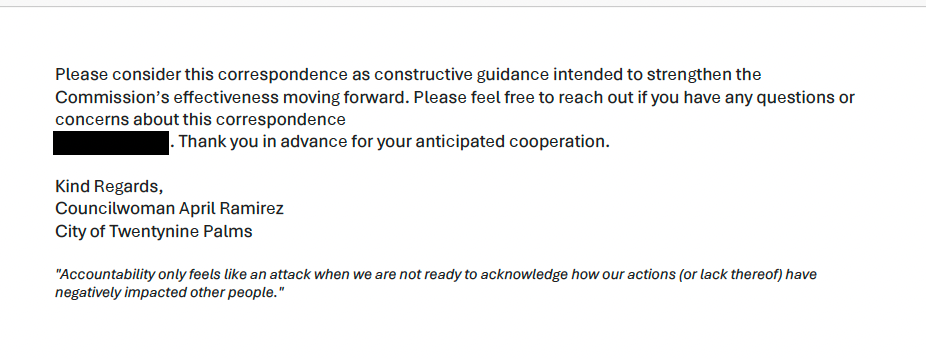
We acquired Ramirez’s letter via a public information request, and we reproduce it here in full and as a download because we believe in the importance of an independent Planning Commission. The email arrived when Commissioners were mid-way through quasi-judicial deliberations.2 We are refraining from further comment — while we question the validity of some of her assertions, we feel our readers should judge for themselves. Note: we have redacted the Councilmember’s personal phone number.

We reached out to members of the Planning Commission, Mayor Daniel Mintz, City Manager Stone James, Community Development Director Keith Gardner and City Attorney Patrick Muñoz. No one replied.
We also emailed Councilmember Ramirez to ask if she stood by the email or had any comment:
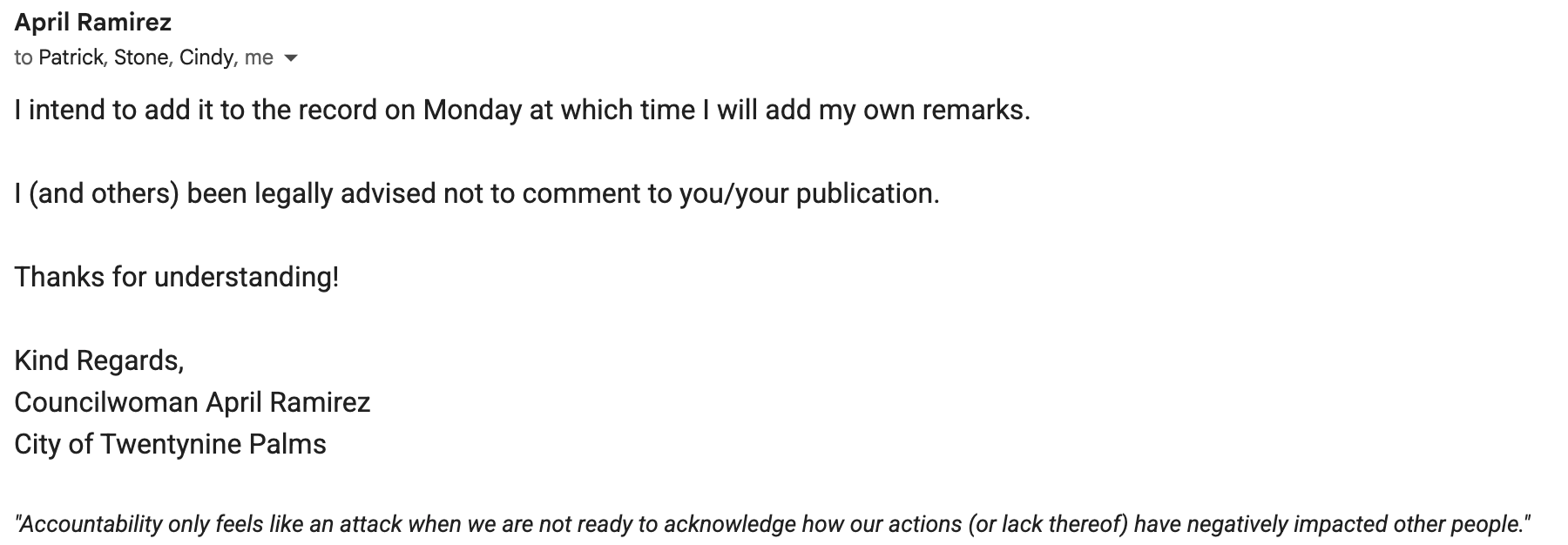
Ramirez’s signature line includes this phrase, “Accountability only feels like an attack when we are not ready to acknowledge how our actions (or lack thereof) have negatively impacted other people.” The phrase is an unattributed, slightly modified version of a January 2019 quote by Tamara Renaye, a Canadian motivational speaker and author, which reads “Accountability feels like an attack when you're not ready to acknowledge how your behavior harms others.” The phrase has been widely circulated on social media, often without attribution.

Spring has arrived but winter isn’t far behind. Be secure in the knowledge that local accountability journalism will be here when you need it and become a paid subscriber to the Desert Trumpet for $5 per month or $50 per year!
Want to make a one-time donation or are you able to give more than $100? Donate via Paypal!
Leave your thoughts in the comments below. Please note that we do not allow anonymous comments. Please be sure your first and last name is on your profile prior to commenting. Anonymous comments will be deleted.
Since publishing this piece, we’ve done additional analysis in order to repond to comments on social media. Here is that analysis:
We also recommend watching the video of the February 17 Planning Commission meeting and asking if the Councilmember‘s characterization of the discussion is accurate. Here are some specific questions we had:
Under point one, she implies that Commissioners were not prepared for the discussion — there is always going to be varying levels of preparation when several hundred pages are dumped on a primarily volunteer body 4-5 days prior to a meeting. However most of the Commissioners asked detailed questions indicating preparation. Isn’t the true issue for the Councilmember that some those questions indicated skepticism of a project she appears to support?
Under point 2, the Councilmember implies that the benefit package “was accepted at the appropriate level” — this isn’t accurate. The benefits package was never presented as a discussion and action item at Council and was never voted on, the package will not be final until it is voted on at Council on Monday., March 23 Also Planning Commission members were not “renegotiating” the package — they were questioning whether the package was adequate given the amount of destruction and upheaval the land use was going to require -- why isn’t that discussion under their purview?
Under point 3, the Councilmember implies that the Planning Commission was attempting to “cap or limit” profit. We again disagree with this characterization. Commissioner Krushat asked how much revenue the project was expected to generate. Asking about potential revenue is not the same as attempting to cap profit.
We also want to emphasize the Councilmember’s letter was sent as an independent government body was mid-way through a quasi-judicial hearing -- no votes had been taken and the discussion was not completed at the point when the email was sent. So what is the true function of the email? Is it to school the Planning Commissioners on their roles or is it to suppress free speech that was questioning a project the Councilmember appears to support?
But again, we encourage residents to watch the meeting video and come to your own conclusions about whether the Councilmember’s had legitimite basis for her “disappointment”: “I will be candid: I was disappointed by the level of preparation and professionalism demonstrated during the recent meeting.”
Link to meeting video:
“The email arrived when Commissioners were mid-way through quasi-judicial deliberations.” was added on March 21 after publication, to clarify that Planning Commissioners were still in the midst of a public hearing, which is a quasi-judicial function, when the email arrived.
I find it funny that the same council woman who says that accountability only feels like an attack when you are unwilling to acknowledge your impact on others has repeatedly ignored citizens calling 5 times now to review the Flock contract. Does it only hurt others when the person in question is a rich landowner? Or does she also include harm done to citizens by failing to include the impact on them? Because it seems like she only cares about being accountable if there's a profit to be made.
I’m a little at sea here without more details and analysis. Does the person who sent the letter support the solar project? What’s really going on?