
AGENDA PREVIEW: City Council to Vote on Controversial Solar Project
The meeting on the 184-acre Geneva solar project, proposed by E-Group PS, takes place this Monday, March 23, at 6 pm.

This upcoming Monday, March 23rd, the Twentynine Palms City Council will hold a meeting on the E-Group Solar Project (aka Geneva Solar Farm project) slated for Harmony Acres. As of the agenda publication date of March 19, 2026, City staff recommends that Council approve the project.
The agenda, clocking in at 1,008 pages, and a history of previous City meetings on the topic, show that the project is deemed to be highly controversial.
Approving the project requires the Council to vote on and approve eight items, which include several resolutions and new ordinances:
Item 1 (Resolution): The City would update its General Plan to reclassify some of the two parcels proposed for the solar project from low-density rural residential (minimum 5-acre lots) to single-family residential with smaller minimum lot sizes (1-acre minimum).
Item 2 (Resolution): The City would update its General Plan to create a new “Renewable Energy” land use category and reclassify some of the land that was previously designated for low-density rural homes (minimum 5-acre lots) as Renewable Energy land.
Item 3 (Ordinance): The City would rezone land from low-density residential (minimum 5-acre lots) to Renewable Energy.
Item 4 (Ordinance): The City would rezone land from low-density rural residential (minimum 5-acre lots) to single-family residential (minimum 1-acre lots).
Item 5 (Ordinance): The City would add two new chapters to its Development Code establishing new rules and standards related to solar energy development.1
Item 6 (Resolution): The City would approve a permit allowing a 184-acre commercial solar energy facility to be built.
Item 7 (Ordinance): The City would approve a formal development agreement with the solar project applicant covering the 184-acre commercial solar facility.
Item 8 (Resolution): The City would certify the Environmental Impact Report for the solar project and formally declare that the project’s benefits outweigh its identified environmental harms.
These items revise the City’s General Plan and convert residentially zoned land into a new land use category designation—Renewable Energy. The ordinances also subdivide parcels from five acres to one acre to accommodate requirements in SB 330 to offset zoning changes to ensure adequate land for housing. Project passage would mean a reversal of a previous industrial solar farm ban that Council approved back in 2013, signaling a citywide policy shift with much broader development implications.
At the time, Councilmembers Jay Corbin, Jim Harris, Cora Hesier, Joel Klink, and Daniel Mintz, the current mayor, approved the industrial solar ban 5-0.
Though the meeting is regularly scheduled, it is being held on a Monday at 6 pm rather than the typical meeting time of Tuesday. Commenters will have only two minutes to discuss this topic due to the likelihood that Monday’s proceedings will exceed typical meeting times.
One other agenda item involves the project closeout of the affordable Veterans housing project on Elm Avenue.
The meeting will take place at 6136 Adobe Road. Attendees are encouraged to anticipate a long meeting.2
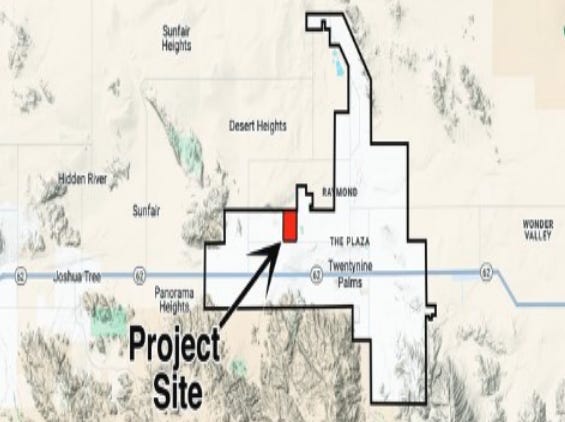
The project's proposed location is north of Two Mile Road, west of the northernly extension of Noels Knoll Road, and east of Canyon Road.
We will spare details of the meeting minutiae and delve right into the primary discussion topic with arguments from those in favor and those against.
Notable individuals or entities in favor of the project:
Planning Commissioner Max Walker
Planning Commissioner Leslie Paahana
George Mulopulos, part-time resident and principal of Proactive Properties LLC, who is leasing the land intended for solar plant development to E-Group PS
Sanctuary Church/Hope Center 29, a local religious nonprofit and community food bank that was the recent recipient of a community donation of $4,000 for food distribution and $3,600 sponsorship for a color run to be held by the Hope Center.3
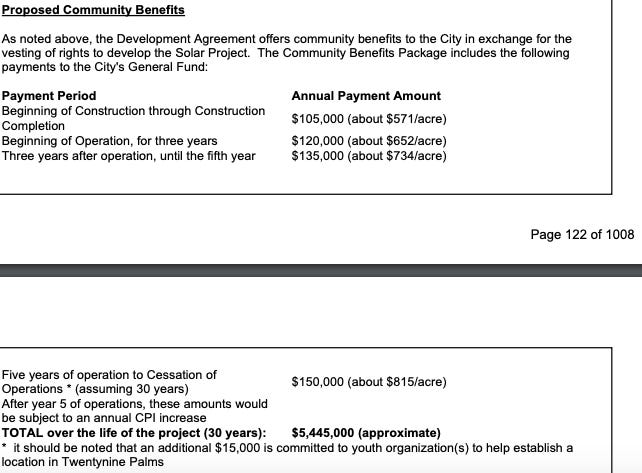
Arguments in favor of the solar project - presented as stated without independent verification.
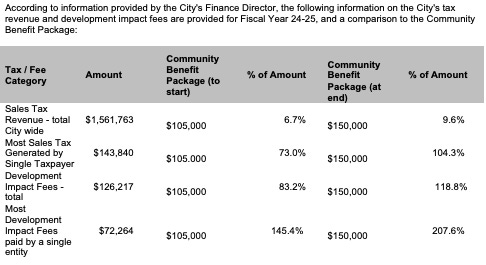
The project and community benefits package, if economically viable, would boost annual City revenue by 7 to 10% when compared to existing sales tax revenue.
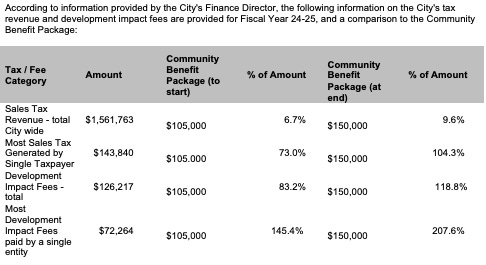
A chart compares the Community Benefits Package amount based on percentages of annual City revenue. Screenshot from agenda packet page 123. Construction will bring in much-needed temporary jobs to the area
A community benefits package will bring in over $100,000 of city revenue annually with upward of $5 million depending on long-term project viability (for 30 years):
The Solar Project would generate approximately $5,445,000 in projected General Fund revenue for the City over the anticipated 35-year life of the project, in addition to sales tax and property tax revenue.4
Failure to approve the project opens the city to potential litigation from the developer through the State of California via Assembly Bill 205, a renewable energy bill with approval authority regulated by the California Energy Commission.
The project’s adjacency to the Carodean Substation makes the land suitable for solar connection tie-ins, and, according to Mulopulos, no residential developers have expressed interest in building homes on the land since it has been acquired.
Donations to the Hope Center and a community benefits contingency requiring the developer to pay $15,000 toward the formation of a Boys & Girls Club within city limits show the developer’s willingness to work with community partners. Per the staff report:
It should be noted that an additional $15,000 is committed to youth organization(s) to help establish a location in Twentynine Palms.5
Notable individuals and entities against the project:
Planning Commissioner and long-time local Jim Krushat
Planning Commissioner and long-time local Alexander Garcia
Heidi Grunt, long-time local and part owner of the historic 29 Palms Inn
Pat Flanagan, ecologist and biological advisor for native historical site, the 29 Palms Oasis of Mara
Suzanne Lyons, science educator and adjacent property owner
Peter Lang, adjacent property owner
Ash Maharaj, real estate agent, owner of the Harmony Motel and former board member of the Twentynine Palms Tourism Business Improvement District (TBID); her opinion piece for the Desert Trumpet is here.
Arguments against the solar project - presented as stated without independent verification:
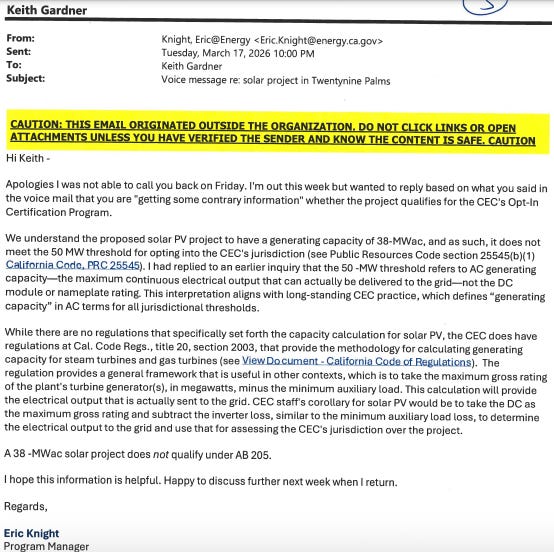
The project does not qualify for AB 205, which has been twice confirmed by the California Energy Commission (CEC), as it fails to meet the required AC wattage criteria by over 20%. Just six days before the City Council vote is to take place, a March 17 email from the CEC to Community Development Director Keith Gardner shows that any arguments from developer representatives contending project qualifications under AB 205 are essentially moot. The CEC letter, and all correspondence City Staff has received since the March 3 split vote at the Planning Commission, are located on pages 889 through 902 of the 1008-page agenda packet.
To qualify for AB 205 and reach the 50 MW AC generating capacity required under AB 205, the project would require an additional 52 inverters and increased environmental scrutiny in the form of additional CEQA review. Essentially, an entire redesign of the project would be required with additional upfront costs likely to be in the millions of dollars. The applicant’s response to the DEIR and City Staff Report both fail to acknowledge this.6
As acknowledged by Planning Commissioner Jim Krushat, the primary City argument in favor is that if Council does not approve this project, developers will go through the state, with the City losing local control of the project development. The above email from the CEC implies that the City staff either failed to properly research the project’s qualifications for AB 205 before forwarding this to Planning Commission and Council, or that the City staff and City legal representatives had been misled by developer representatives on AB 205 requirements and upfront costs associated with additional inverter requirements.
The project lacks a buyer: no Power Purchase Agreement (PPA) exists so potential project revenue is speculative at best. Though the project would be tied into Southern California Edison’s Carodean substation, this does not entail a formal PPA between Edison and the developer.
No local hiring contract exists within the Development Agreement, so the argument that the project will create local jobs is not guaranteed.
The land is leased, meaning if the owner terminates the lease, the project is null.
The Community Benefits package negotiated by City Council’s Budgets and Audits subcommittee (which consists of Councilmembers Steven Bilderain and April Ramirez), is potentially negligible, given long-term health and environmental concerns, administrative and legal costs likely to arise from the project, and speculative figures for potential sales tax revenue, given that the project lacks a buyer to purchase energy generated.
Once graded the land is permanently damaged, native vegetation such as creosote cannot be replanted and, once completed the project is only returned to it’s “undeveloped state.”
The grading will result in considerable blowing dust creating a health hazard.
Other Project Implications and Concerns
In a February Planning Commission meeting on the project, Commissioner Jim Krushat commented on the community benefits package, saying, “The juice isn’t worth the squeeze.”
$15,000 upfront toward the formation of a Boys & Girls Club means the City would have to find funding elsewhere to cover other significant club formation (and building or renovation) costs, with Boys & Girls Club directors typically earning upward of $62,000 per year, and fails to include other potential overhead and employee costs.
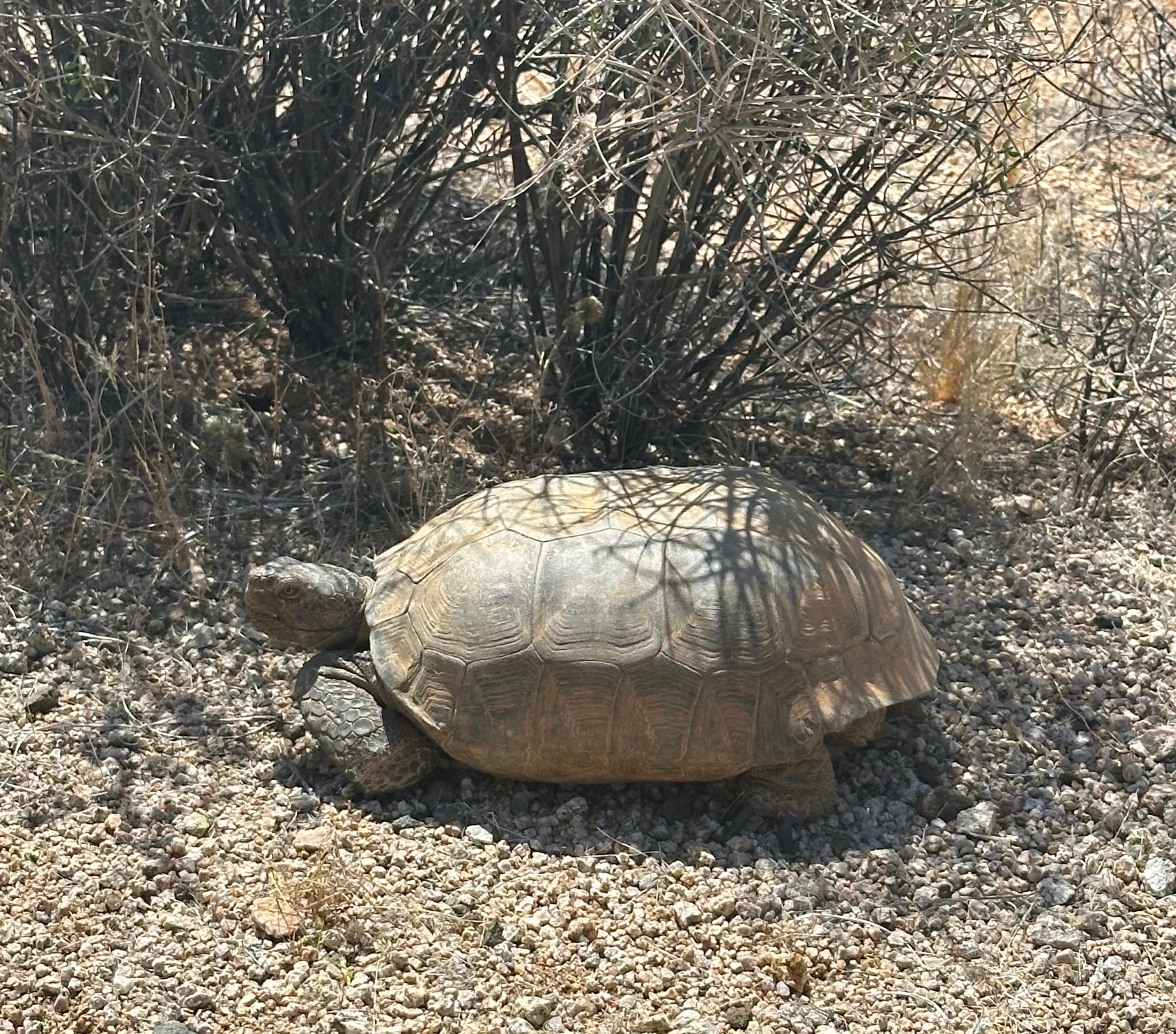
Destruction of undisturbed and undeveloped desert soil will have long-term health and environmental implications, including permanent destruction of endangered desert tortoise habitat, dust storms due to mass grading required by the project, and potential exposure of residents to Valley Fever, a fungus caused by disturbed desert soil that causes severe upper respiratory side effects.
To mitigate this, the developer has offered to provide HEPA filters to residents downwind and eastward of the project within 1.5 miles, but this is not formally guaranteed in the project’s Conditions of Approval.
Desert Trumpet posted video footage of two desert tortoises seen on the parcel in October, 2023, linked here.
In the agenda packet, the California Department of Fish and Wildlife also raised concerns on the project’s mass grading, and questioned why the draft Environmental Impact Report had not considered low-impact grading that was environmentally appropriate for the solar panel sizes being used. Per the CDFW:
As proposed, the current project does not fully meet the DEIR’s stated Project objectives and requires extensive grading of approximately 140 acres of land with approximately 264,000 cubic yards of cut and fill.
The DEIR does not identify an alternative that includes a terrain following solar panel arrangement that would allow for greater ability for the solar facility to utilize the existing terrain, thereby reducing both the grading necessary to fulfill the remaining Project objectives and associated impacts to hydrology and biological resources.
Traditional construction methods for solar fields require extensive grading to uniformly level the construction site. Terrain-following solar arrangements better conform with existing terrain, often reduce project grading costs, minimize habitat disturbance, facilitate habitat recovery, minimize changes in hydrology, and potentially reduce erosion issues.
The DEIR should include and analyze a Project alternative incorporating terrain-following construction methods that meet Project objectives while minimizing Project related impacts.7
Longterm Policy Implications & A Changing City Identity
If the Council approves this project on Monday, it would give the solar project developer vested rights, meaning the City forfeits any further jurisdiction over the project’s development agreement moving forward. In other words, if new information arises between now and construction, or thereafter, the City cannot change the development agreement, and they cannot amend the development agreement. Essentially, this would be a permanent policy implication, with no room for retroactive action.
Further, establishment of a Renewable Energy land use designation now opens the City to further renewable energy projects going forward, which would make Council denial of such projects much more difficult. This opens the door to further potential solar projects, industrial scale wind farms, and other forms of renewable energy projects.
In 2013, residents and City Council members—which included now-Mayor Daniel Mintz—were in consensus that industrial-scale solar projects were not aligned with the City’s General Plan and small-town identity. Hence, a citywide ban on industrial scale solar developments. This shift, just 13 years later, signals a change in tone with far broader implications, that cannot be reversed once approved.
Are you in support of the solar field or against? Make your comments known. Here’s the list of Council email addresses to write if you can’t get to the meeting — be sure to email them prior to 2 pm on Monday, March 23 so they have time to read your email prior to discussion. You can also copy the clerk at cvillescas@29palms.org and ask that your letter be made part of the public record.
The meeting takes place at 6 pm— see you there.
* Author’s note: Correction made Monday, March 23, 2026 to fix error in title of Suzanne Lyons, science educator.
Leave your thoughts in the comments below. Please note that we do not allow anonymous comments. Please be sure your first and last name is on your profile prior to commenting. Anonymous comments will be deleted.
Please consider supporting our efforts, and help us reach our $10,000 goal! Upgrade your subscription from free to paid today for just $50 per year or $5 per month.
Want to make a one-time donation or are you able to give more than $100? Donate via Paypal!
Thanks for reading! This post is public so feel free to share it.
The short version of the new ordinances, outlined on p. 665 of the agenda packet: In 2016, Twentynine Palms adopted a Development Code to regulate how land in the city can be used. A law firm representing E-Group Solar LLC later applied for multiple permits and code changes to build a 184-acre commercial solar field and rezone 60 acres for housing on two parcels north of Two Mile Road and west of Noels Knolls Road. The city prepared an Environmental Impact Report, held public meetings, and published notices in the Desert Trail. The Planning Commission split 2-2 on a recommendation. The City Council approved the project on March 23, 2026, and completed final adoption on March 30, 2026.
In the past, the City has held meetings with larger-than-expected turnouts at the gymnasium in Freedom Plaza and the multipurpose room at Twentynine Palms High School.
The color run was scheduled for March 14 and has been rescheduled for May 9.
Source: Agenda packet page 123
Source: Agenda Packet, page 375 of 1,008
If the council accepts this recommendation as written, what further steps would be required for the zoning ordinances to move forward? The language here says “first reading” which implies there might be another.