
AGENDA PREVIEW: Yucca Valley Town Council, June 2, 2026
A 2,762-page packet dropped four days before the meeting asks Council to approve a two-year budget, a $7.4 million sheriff's contract, fee hikes, and a Walmart gas station—in one night.

Editor’s note: Welcome to our first agenda preview for Yucca Valley Town Council. The Desert Trumpet is taking the first steps toward expanding coverage of local government by covering Yucca Valley Town Council meetings. Yucca Valley residents deserve the kind of accessible civic reporting that empowers more effective engagement with their elected representatives.
Agenda summaries are assembled and reviewed by the Yucca Valley Resident Review Committee, a volunteer group of Yucca Valley residents with knowledge of local government and community affairs. Committee members are known to Desert Trumpet staff and to one another, but have chosen to remain anonymous due to concerns about retaliation. We respect that decision and are grateful for their participation.
This preview was produced with AI assistance, consistent with the approach described in our AI Policy. As noted there, we are exploring how AI-assisted summaries can allow us to extend coverage to governing bodies beyond the current scope of our budget for paid staff. We treat this as a bridge toward fuller coverage, not a substitute for it, and we are disclosing it explicitly here.
The packet for the June 2 meeting runs to 2,762 pages. It was generated, according to its own metadata, in the early hours of Friday, May 29 — four days before the Tuesday meeting, and over a holiday-adjacent stretch when Town Hall is closed Friday through Sunday. That leaves residents, and arguably the Council members themselves, roughly two business days to read it.1 Download it here, if you dare.
It is also the Council's first meeting in four weeks: the regularly scheduled May 19 session was cancelled. That gap matters, because routine business that would normally have been spread across two meetings is now folded into the same night that already carries the year's heaviest recurring items such as the biennial budget, the assessment and solid-waste public hearings, and the call for the November election.
When a body releases a document no one can reasonably read before they’re asked to vote on it, the practical effect, whatever the intent, is to narrow the window for public review to the vanishing point.
It is, in our opinion, not physically possible for an average citizen, or a part-time, $950-a-month council member with a day job, to meaningfully digest a packet of this size in that window. The Walmart fuel station item alone accounts for well over 1,700 of those pages. The biennial budget book adds nearly 200 more. Making matters worse, the staff reports and supporting documents are not hyperlinked from the agenda — unlike neighboring Twentynine Palms, whose agendas let a reader click an item and jump straight to its backup. To find anything in Yucca Valley's packet, you have to scroll through the full 2,762-page PDF.
When a body releases a document no one can reasonably read before they’re asked to vote on it, the practical effect, whatever the intent, is to narrow the window for public review to the vanishing point. We think that effect is worth naming directly: agendas assembled at this scale and on this timeline function, in practice, to mute citizen scrutiny rather than invite it.
Compounding the problem, several of the evening’s largest financial commitments are justified by pointing to a budget that doesn’t exist yet. The $7.4 million sheriff’s contract (Item 18), the $460,000 in community contracts (Item 19), and the November election costs (Item 21) all describe their fiscal impact as already “accommodated” in the “Adopted FY2026-27 Budget” — but that budget isn’t adopted until Item 28, later the same night. The spending is being approved before the document authorizing it is on the books.2 And the budget itself rests on the same kind of paper foundation: it repeatedly invokes the Town's "adopted Strategic Plan," yet the most recent minutes in this packet show that plan was still an unadopted draft, and the meeting that might have adopted it was cancelled (see Item 28). That sequencing deserves a public explanation.

A note on what we could not verify in the time available: at 2,762 pages, this preview covers the items the packet itself flags as most consequential. It is not a line-by-line audit, and it cannot be. That limitation is itself part of the story.
A Note on Public Comment
You can comment on agenda items and issues important to you at every Town Council meeting. Comments on agenda items take place during discussion of that item, while comments on non-agenda items take place near the end of the meeting. The Brown Act prevents Council from commenting on non-agenda items. To comment, just pick up a form at the desk to the left of the mic, fill it out, and hand it to the Clerk, who sits at a table, also to the left of the mic.
Here’s the list of Council email addresses to write if you can’t get to the meeting3 — be sure to email them prior to 2 pm on the date of the meeting so they have time to read your email prior to discussion. You can also copy the clerk at townclerk@yucca-valley.org and ask that your letter be made part of the public record.
The meeting also offers two-way remote participation by Zoom, comment time is limited to three minutes. (Zoom Link, Meeting ID: 995 7960 6104, Passcode: 093185).
Presentations, Introductions, Recognitions
The meeting opens with the introduction of new employees and an invocation led by Anne Fernandez of the Yucca Valley Center for Spiritual Living. The agenda’s only scheduled presentation is the new-hire introduction; the substantive presentations this cycle are folded into the Department Reports section at the back of the agenda (Items 25–29), which is where the budget adoption itself lives.
Consent Agenda
The Consent Agenda consists of items usually approved with a single vote. The public is given a chance to make public comment on these items prior to the Council motion. Fill out a comment form specifying the item you wish to address and submit it in person, or send an email in advance regarding any of the items on this meeting’s Consent Agenda.
The Consent Agenda this month runs from Item 3 (approval of the May 5 minutes) through Item 21, and it is doing a great deal of heavy lifting. The April warrant registers total $3,404,664.94, alongside payroll registers of $334,197.69 and $305,831.27 (Item 8).
Usually consent items are routine. Several here are not, and two warrant a closer look:

11. Authorization to Purchase a Fleet Vehicle. Staff asks the Council to waive competitive bidding under Municipal Code §3.12.060(G) — the "inefficient, impractical, and unnecessary" exception — and authorize purchase of a 2026 Ford truck for the new Community Engagement and Homelessness Coordinator. The bid waiver itself is unremarkable: vehicle waivers are common in small cities, where procurement timelines and dealer inventory don't line up, and by the time a formal bid closes the truck is sold.
The Council approved an identical §3.12.060(G) waiver for a GMC Sierra ($62,776) at its May 5 meeting, and Item 16 tonight waives formal bidding again for the museum re-plumbing. What earns a closer look is the money. The staff report's own quote table lists four prices, the highest being $57,865 — yet the requested authorization is "not to exceed $60,000," above every quote on the page.4 And the report asks the Council to move $150,000 from capital project reserves for a roughly $50,000 truck, explaining that the balance will "backfill" earlier vehicle and equipment purchases. The report also states there has been "no prior review of this matter." An authorization ceiling above the quoted prices and a six-figure reserve transfer bundled into a single vehicle purchase are the kind of thing that belongs in open discussion, not a single omnibus vote.
17. Master Fee Schedule Update / Phase II Adjustments. This item asks the Council to do two things at once: implement the previously adopted “Phase II” fee increases and layer a 5.5% Consumer Price Index (CPI) adjustment on top. The combined effect on some fees is steep. By the schedule’s own table, an administrative hearing fee rises from $244 to $430 (about 76%),5 a public-nuisance investigation goes from $162 to $199, and a notice-of-admin-hearing fee jumps from $35 to $58. Stacking a phased increase and an inflation adjustment in the same resolution makes it hard for a resident to see how much any single fee is actually going up. A fee package of this breadth is a policy decision, not a housekeeping item.
The remaining consent items are mostly routine, but not trivial:
Item 4 — a second amendment to the vector-control contract with the County of San Bernardino Department of Public Health, primarily focused on mosquito management, bringing the total to $288,475.50 through 2028.
Item 5 — a first amendment to the Southwest Networks IT contract, raising the not-to-exceed to $180,500 and $190,500 over two years.
Item 6 — an audit contract extension to RAMS LLP, not to exceed $176,575.
Item 7 — the AB 1234 reporting schedule. AB 1234 mandates that that local agency officials receive at least two hours of public service ethics training every two years.
Item 9 — Waste Disposal Agreement Amendment #9 with the County.
Item 10 — the FY2026-27 spending (Gann) limit resolution.6
Item 12 — the CFD No. 11-1 special-tax levy across eight improvement areas.
Items 13 & 14 — a Notice of Completion for the Senior Center roof, and a $90,000 extension of the Valley Pipeline emergency debris-cleanup contract.
Item 15 — release of an RFP for on-call concrete repair.
Item 16 — a $60,000 budget amendment from Measure Y for the Hi-Desert Nature Museum re-plumbing, with formal bidding waived.
Item 20 — the Q3 budget report.
Three more consent items deserve to be set apart, because each commits real money against a budget the Council hasn't adopted yet — that adoption is Item 28, later the same night. Two of them—Item 19, $460,000 in community contracts for the Chamber of Commerce and the Desert Regional Tourism Agency, and Item 21, the calling of the November 3 election for Districts 1, 3, and 5 — each call their cost already "accommodated" in the "Adopted FY2026-27 Budget" that won't be adopted until later that night. The third is the sheriff's contract, big enough to take on its own:
18. FY 2026-27 Public Safety Contract Amendment. The Council is asked to approve a one-year amendment to the San Bernardino County Sheriff’s Department contract for $7,435,821 — an increase of $526,605 over the current year. Staff attributes the jump primarily to personnel costs and to rising liability and insurance expenses tied to “recent Department litigation jury awards and/or settlements.” The report candidly notes that Schedule A costs have risen roughly 6% annually over the past decade, outpacing the Town’s revenue growth and consuming a larger share of the General Fund each year. This is the single largest recurring expenditure the Town makes, and the staff report’s own framing, that without state tort reform “these cost drivers will continue to challenge local municipal budgets,” is worth public attention.
Public Hearings
22 & 23. Assessment Districts and Solid-Waste Charges (Public Hearings). Item 22 confirms the Engineer’s Reports and authorizes the FY2026-27 levy of Street & Drainage and Landscape & Lighting assessments; Item 23 places FY2026-27 solid-waste handling charges on the property tax roll. Both are annual but both are public hearings and are the moment for residents to question the amounts before they land on a tax bill.
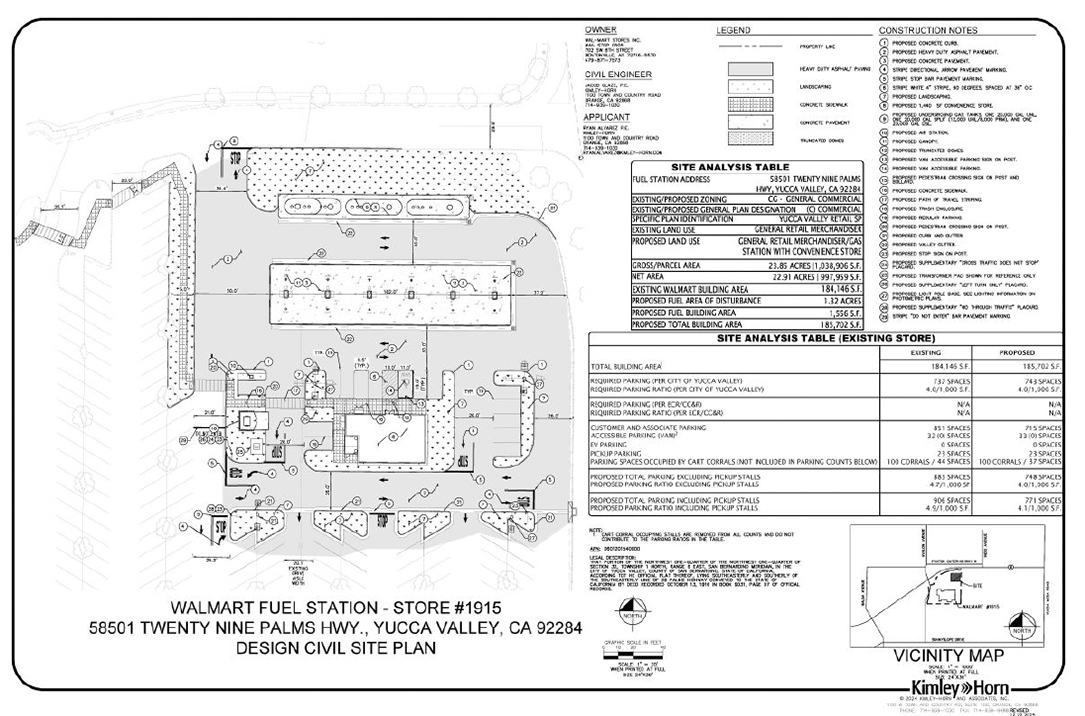
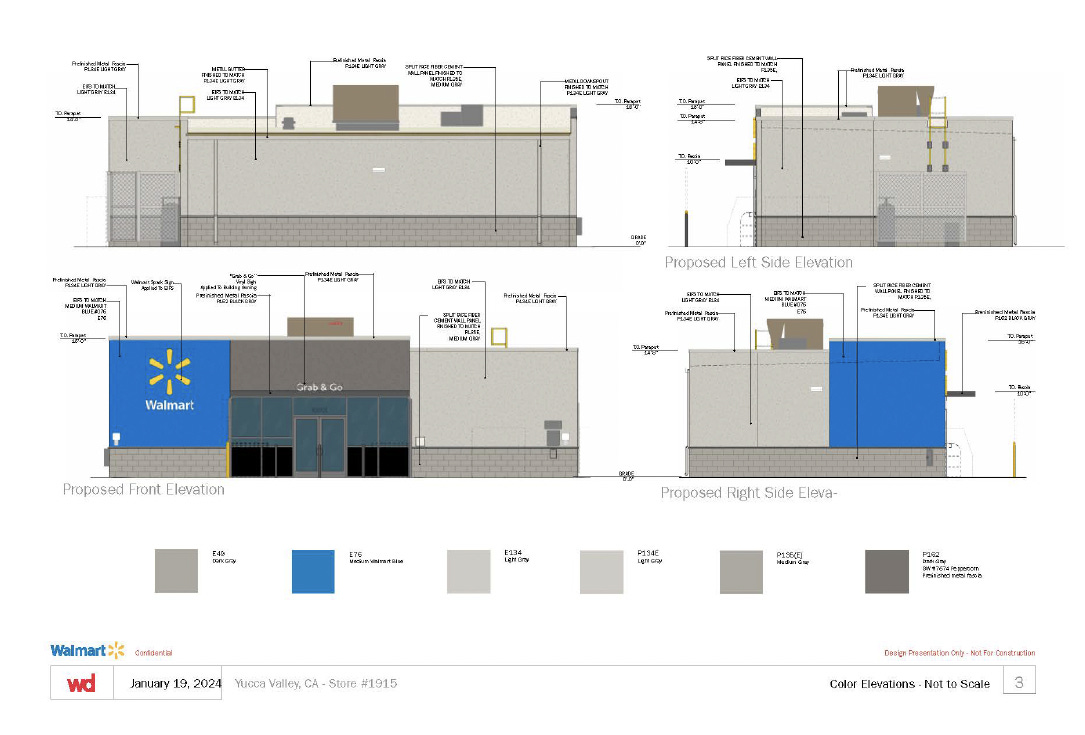
24. Walmart Fuel Station — EA 02-25, Specific Plan 01-04 Amendment #2, CUP 01-25. This is the largest item in the packet by far. The applicant (Kimley-Horn, on behalf of Walmart Stores Inc.) seeks to build a fuel station with six pumps and twelve dispensers, a 4,950-square-foot canopy, underground fuel storage, and a 1,556-square-foot convenience store in the northeast corner of the existing Walmart lot at 58501 Twentynine Palms Highway. The gas station would operate 24 hours a day, seven days a week; the convenience store would sell alcohol and mirror Walmart’s 6 a.m.–11 p.m. hours. Several features deserve scrutiny:
The environmental review relies on a 2008 EIR. Rather than a new environmental impact report, staff recommends an “Addendum #1” to the EIR adopted by the Council on October 14, 2008, for a retail-specific plan now 18 years old. The findings repeatedly acknowledge that the original EIR identified “significant and unavoidable impacts” requiring a statement of overriding considerations, and lean on CEQA §15164 to avoid further analysis.7 Whether an 18-year-old EIR adequately captures a 24-hour fuel station with underground storage tanks is a fair question for the public hearing.
“Fiscal Impact: None.” The staff report lists no fiscal impact, which is plausible for a privately funded project but tells residents nothing about sales-tax or fuel-tax revenue, fire/hazmat response implications, or long-term costs.
A parking-standard reduction is buried in the amendment. The Specific Plan amendment quietly lowers the anchor tenant’s required parking ratio from 1 space per 200 square feet (920 spaces) to 1 per 250 (737 spaces). It’s framed as a technical adjustment but is a real loosening of the standard.
22 existing trees would be removed, replaced with desert-appropriate landscaping. The site sits within the Yucca Valley Airport influence area and a Part 77 safety review area.
The Planning Commission recommended approval on April 14, 2026, adding lighting conditions in a nod to residents’ repeated dark-sky concerns, but the potential light pollution posed by a 4,950-square-foot canopy running 24 hours a day warrants consideration beyond capping lighting temperature at 3000 Kelvin.
Department Reports
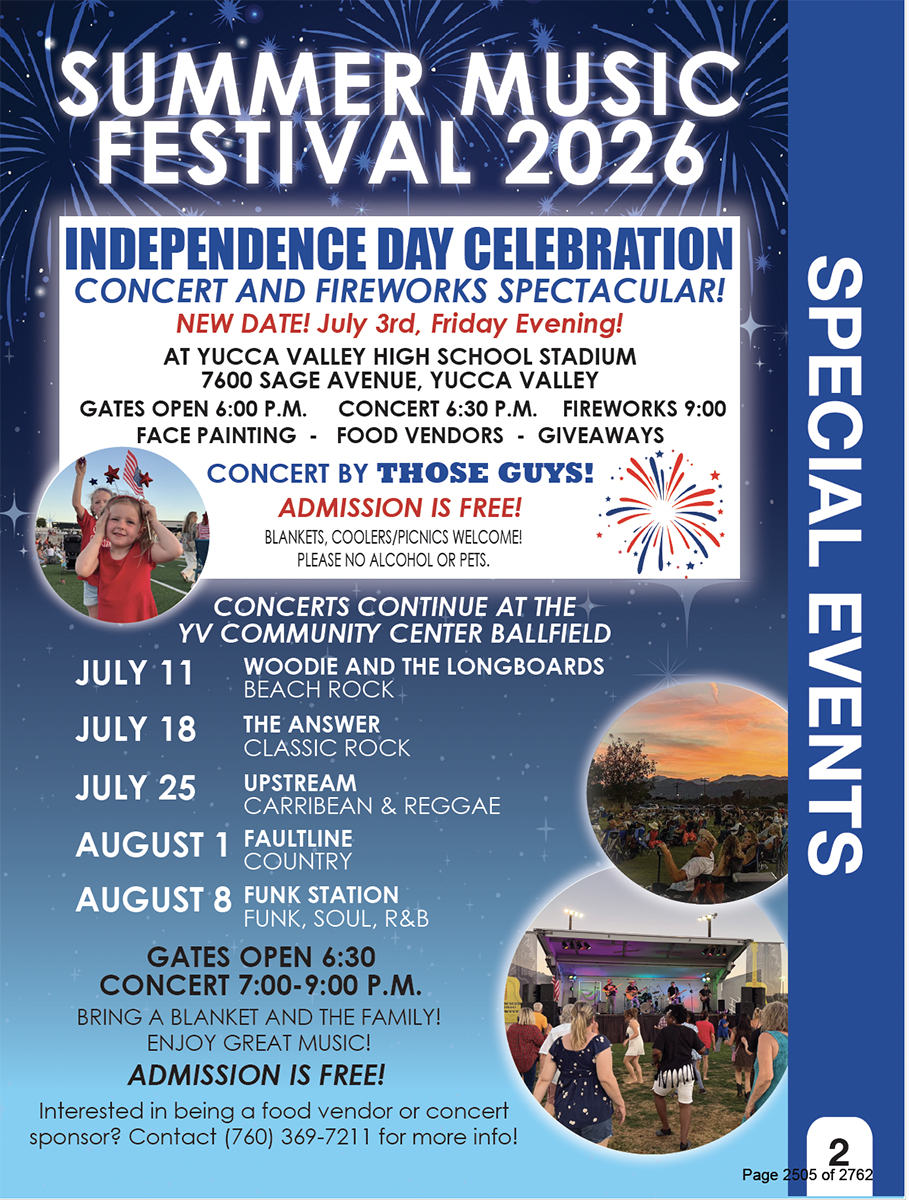
25 & 26. The Youth Commission end-of-term report (Item 25) and a report on the 2026 Summer Music Festival and Independence Day fireworks (Item 26) round out the back of the agenda.
27. Active Transportation Program Cycle 8 Applications. The Council is asked to authorize grant applications for curb, gutter, sidewalk, and ADA-ramp improvements near Yucca Elementary, Yucca Valley High, Onaga Elementary, La Contenta Middle School, and along Barron Drive, a rare item squarely about pedestrian safety around schools.
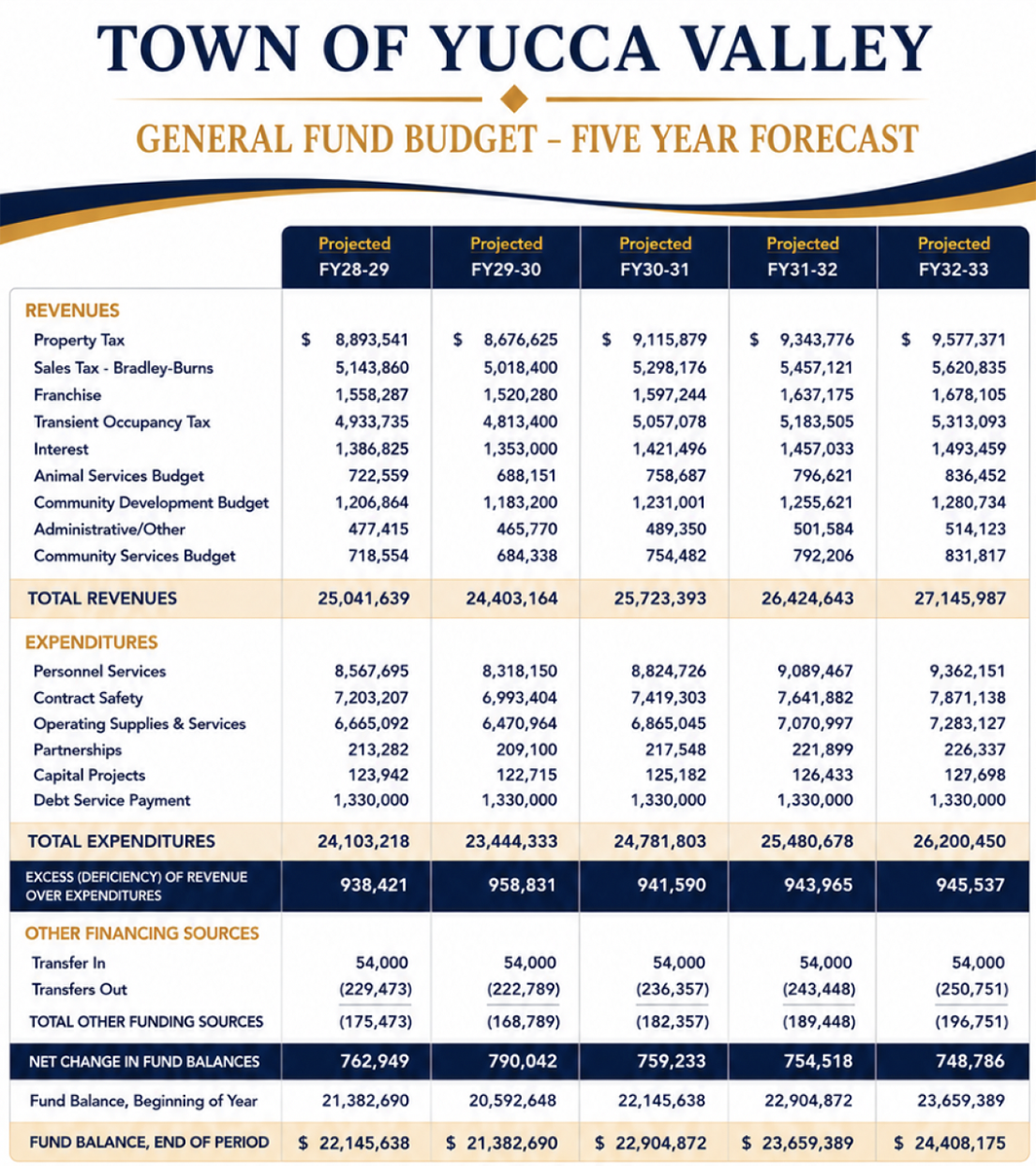
28. FY2026-28 Proposed Budget Adoption. Staff projects a $22.93 million General Fund with roughly $22.65 million in expenditures for FY2026-27, an operating surplus near $286,000, and ending reserves around $20.2 million (about 60% of operating expenditures). The Town Manager’s transmittal letter is dated June 2, 2026, the day of the meeting. The Council “reviewed” the proposed budget in May, but the document residents would need to evaluate the final figures is part of this 2,762-page packet released four days out. As noted above, multiple earlier items on tonight’s agenda already treat this budget as adopted.
A note on language: staff reports routinely describe a budget as "adopted" before the Council votes, which is technically premature, but common shorthand across California municipalities when the vote is expected later that night. We flag it here not to nitpick, but because it sets up a more serious problem: the budget applies the same word — "adopted" — to the Strategic Plan, where it cannot be explained the same way. There is no vote scheduled tonight to adopt the plan, no resolution number on record, and the most recent public minutes show it was still an unfinished draft. With the May 19 meeting cancelled, there was no opportunity to adopt it between then and now. Calling the budget "adopted" before a vote is a shortcut. Calling the Strategic Plan "adopted" when the public record shows no adoption ever occurred is something else.
The transmittal letter and General Fund summary repeatedly ground two years of spending in the Town's "adopted Strategic Plan priorities." But unlike every other adopted instrument cited in the packet, each carrying a resolution number and a date (Resolution No. 25-19 on August 19, 2025; Resolution No. 05-60 on October 27, 2005; Specific Plan 01-04 on October 14, 2008, and so on), the Strategic Plan is invoked with no adoption date and no resolution number attached. The most recent minutes in this same packet, from the May 5 meeting, show the plan was still a draft: Town Manager Yakimow "presented the staff report for the draft 2026-28 strategic plan review and requested input and comments to prepare the final draft," after which no motion was made.
Calling the budget “adopted” before a vote is a shortcut. Calling the Strategic Plan “adopted” when the public record shows no adoption ever occurred is something else.
With the May 19 meeting cancelled, there was no public meeting between the May 5 draft and the June 2 budget. That leaves no public meeting at which the strategic plan could have been adopted — yet the budget calls it adopted. The copy of the plan circulating in the packet is itself labeled "Final Review," not "Adopted." Either the adoption happened somewhere not reflected in the public record, or the Town has built a $22.9 million biennial budget on a plan the Council never formally voted to adopt. The Town should be able to produce the resolution and date; the budget doesn't.8
29. SB 707 Disruption Policy. A state-mandated housekeeping item: the Council must adopt, by July 1, 2026, a policy for how it handles internet or telephone disruptions that cut off remote public access during hybrid meetings. The proposed policy explicitly “implements, and does not expand upon” the minimum state requirement: a one-hour recess and good-faith restoration efforts, after which the Council may proceed without remote access on a roll-call finding. Worth knowing for anyone who relies on the Zoom option to participate.
FUTURE AGENDA ITEMS
The agenda reserves time for Future Agenda Items but lists none in advance. At the May 5 meeting, no future items were requested. Residents who want an issue calendared should note that this is the mechanism and that, at present, nothing is queued.
From May 5, public comment worth tracking: a medical-cannabis business owner (Christian Garcia) asked the Town to update its cannabis regulations to permit adult-use sales; a resident (Alexandria Brener) pressed again on unresolved lighting at Machris Park, saying the Town acknowledged the problem but gave no timeline, a thread directly relevant to the lighting conditions attached to the Walmart item tonight. Neither has yet produced a future agenda item.
The meeting concludes with Public Comments, Staff Reports and Comments, Mayor and Council Member Reports and Comments and Announcements.
The Yucca Valley Town Council meeting will be held on Tuesday, June 2 at 5 p.m. at the Yucca Valley Community Center, Yucca Room, 57090 Twentynine Palms Hwy, Yucca Valley, CA 92284
Hi, new subscribers! Desert Trumpet understands you might not be interested in all of our coverage. That’s why it’s divided into separate newsletters allowing you to opt out of reporting that’s not important to you. For instance, you may want our Education news but not City Hall 29.
Here’s how to opt out: go to your Substack settings, scroll down to “subscriptions,” and select “Edit” for the Desert Trumpet. Simply uncheck the box next to the newsletters you don’t want to receive in your email inbox. You’ll still be able to access all coverage online if you change your mind.
Help us cover Yucca Valley Town Hall — Become a paid subscriber!
Not a paid subscriber yet? Did you know that paid subscribers receive discounts on our DT Social events and invites to DT Front Porch, intimate discussions featuring local officials and notable residents?
Upgrade to a $50+ paid subscription for a 10% discount.
Upgrade to $100+ for a 25% discount.
Sustaining subscribers at the $250+ level and above receive complementary tickets
Leave your thoughts in the comments below. Please note that we do not allow anonymous comments. Please be sure your first and last name is on your profile prior to commenting. Anonymous comments will be deleted.
This coverage is free - please share!
Packet size and timing. Page count (2,762) and the May 29, 2026 creation/modification timestamps are drawn from the PDF’s own metadata and pagination. Town Hall hours (Monday–Thursday) are per the Town’s published schedule.
Budget-sequencing note (Items 18, 19, 21 vs. 28). Each of the three cited staff reports describes its fiscal impact as accommodated within the “Adopted” FY2026-27 budget; the budget is adopted under Item 28 at the same meeting. Characterizing the budget as “adopted” in reports voted on earlier in the evening is the basis for the concern noted in the introduction.
This will be replaced by a Yucca Valley Resource Page on the Desert Trumpet website…soon.
Budget-sequencing note (Items 18, 19, 21 vs. 28). Each of the three cited staff reports describes its fiscal impact as accommodated within the “Adopted” FY2026-27 budget; the budget is adopted under Item 28 at the same meeting. Characterizing the budget as “adopted” in reports voted on earlier in the evening is the basis for the concern noted in the introduction.
Item 17 fee figures. Specific fee amounts ($244→$430, etc.) are taken from the Animal Control “Implementation Schedule” table in the draft 2026 Master Fee Schedule attached to Item 17, which lists the 7/1/2026 Phase II amount and the 5.5% CPI-adjusted final amount side by side.
A Gann Limit Resolution is a formal action taken annually by California government entities (such as cities, counties, and school districts) to legally establish their maximum appropriations limit from tax proceeds. Mandated by the 1979 Proposition 4 (Article XIIIB), this resolution ensures that public spending growth does not exceed adjustments for inflation and population.
Item 24 environmental review. The reliance on Addendum #1 to the October 14, 2008 EIR, the “significant and unavoidable” impact language, and the parking-ratio reduction (920→737 spaces) are stated in the Item 24 staff report and CUP/Specific Plan findings.
Strategic Plan “adopted” status. The budget transmittal and General Fund summary (within the Item 28 budget book) reference the “adopted Strategic Plan” without a resolution number or date, in contrast to every other adopted instrument cited in the packet. The May 5, 2026 minutes (attached to the June 2 packet under Item 3) record the plan as a draft presented for input “to prepare the final draft,” with no motion made. The May 19, 2026 Town Council meeting is shown as cancelled on the Town’s CivicClerk meeting calendar. The plan as circulated in the packet is labeled “Final Review.”
Thanks for doing this research and sharing it with us, the residents of all communities here in the Morongo Basin. We're collectively affected by each individual decision of city, village, town and unincorporated area. Thank you for doing the hard work of gathering and presenting a cohesive view of what's going on in this huge, 50-mile long stretch of desert we're in.
You're doing the Lord's work.