
California District 23 and District 25 Congressional Primary Election Preview 2026
Voter and candidate information. District 23 candidatesTessa Lynn Hodge and Pat Wallis respond to our candidate questionnaire about issues impacting the Morongo Basin.

The 2026 California Primary Election will be held on Tuesday, June 2. Mail ballots were delivered to the U.S. Post Office on May 4 and early voting began the same day.
Due to California’s redistricting with the passage of Prop 50 last fall, the Morongo Basin now falls into two congressional districts for the US House of Representatives. The majority of the Morongo Basin is in District 23, currently represented by Republican Jay Obernolte. A slice of Twentynine Palms, along with much of the low desert, is now located in District 25, represented by Democrat Raul Ruiz. To see how your district changed, you can use Cal Matter’s election district look up map.
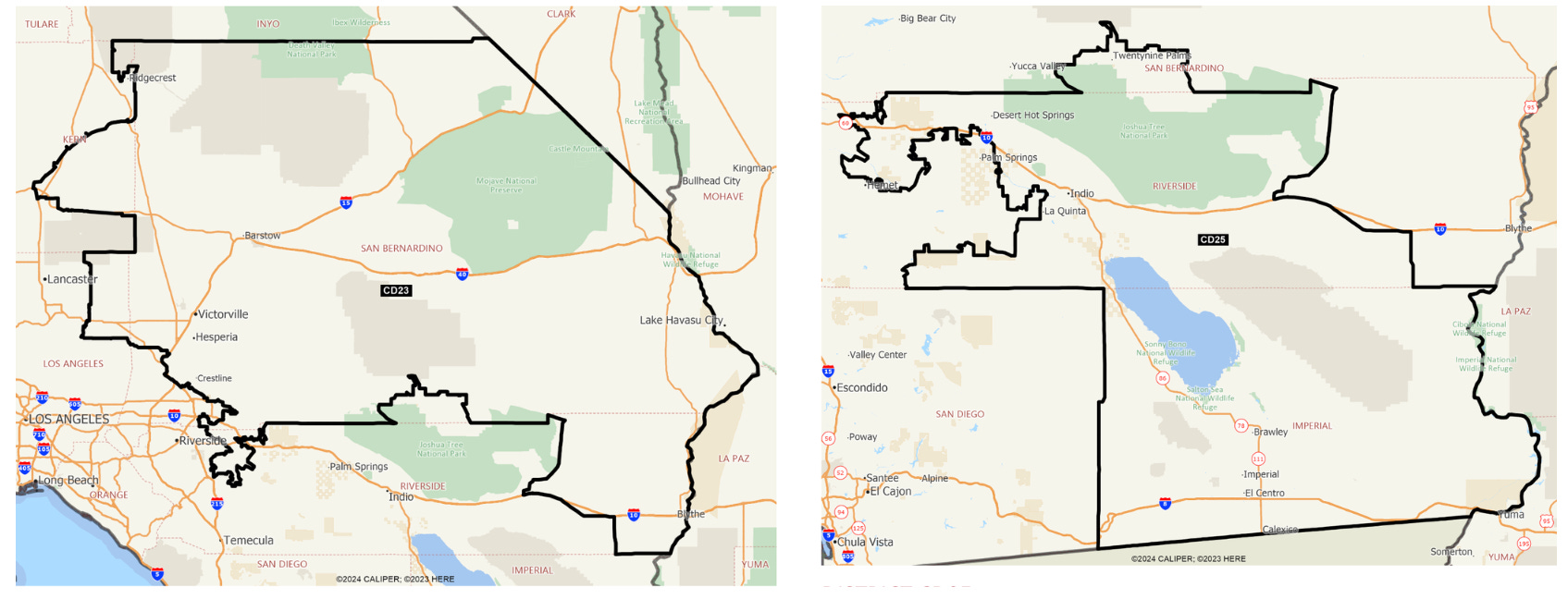
Below we’ll share basic voting information, brief background on the candidates for the US House in both District 23 and 25, and responses from Tessa Lynn Hodge and Pat Wallis, both Democrats running in District 23, to a questionnaire sent to all candidates about issues affecting the Morongo Basin.
Voting information and resources
You should have already received your voter guides and mail ballot. To check your voter registration status, register to vote, find your polling place and other election information, use the following links:
Check if you’re registered to vote, find your polling place, and get election information on the California Secretary of State’s website.
Register to vote by May 18. If you miss the deadline, you must complete same day voter registration.
For more detailed information, CalMatters also produced a comprehensive guide of voting FAQs and resources.
California holds an open primary, meaning that you can vote for a candidate of any party, and the top two candidates receiving the most votes will move on to the general election.
Voting deadlines
The following deadlines apply to the primary election, which takes place on June 2:
May 4: Mail ballots are sent, voters may pick up a ballot or vote early at an early voting site.
May 5: Secure ballot boxes open. Here is a link to ballot box locations.
May 18: Last day to register to vote online. After you must complete same day voter registration.
May 28: Vote centers open for early in-person voting. The County Registrar lists these locations here. The closest location is 6171 Sunburst St. in Joshua Tree. Voting takes place in this location from May 28 to June 2, 10 am to 6 pm.
June 2: Primary Election, mail-in-ballots must be postmarked on or before election day.
District 23 Candidates
Since 2021, District 23 has been represented in Congress by Jay Obernolte, who lives in Big Bear. Obernolte is a Republican who often sides with President Trump on issues including immigration, environmental regulation, and defense. His 2025 Town Hall in Yucca Valley drew more than 200 people, many who came to express their dissatisfaction with his policies and approach to governance.

Including Obernolte, there are six candidates running to represent District 23:
Jay Obernolte (Republican, Incumbent) Owner of Farsight Studios, a software development company and resident of Big Bear. Former mayor of Big Bear and representative to the California State Assembly. Endorsements include the Police Officers’ Defense Coalition, San Bernardino County Sheriff’s Employees’ Benefit Association, and the United States Chamber of Commerce.
Tessa Lynn Hodge (Democrat) Clinical social worker and business owner and lifelong district resident. Endorsements include the California Democratic Party, Teamsters 1932, California Young Democrats, San Bernardino County Young Democrats, United Food and Commercial Workers 1167, and many local mayors.
Karsten Nicholson (Democrat) Freelance journalist based in Crestline. No endorsements listed on his website.
Pat Wallis (Democrat) Army veteran and software developer based in Yucca Valley. Endorsed by Denise Davis, City Council Member, Redlands, California and Paul Dulisse, Captain, NYFD LTC, US Army (Ret.).
Karen Lee Matthews (No Party Preference) Navy veteran, doctor, and small business owner. Endorsed by the Forward Party, Former Republican California State Senator William Emmerson, and Independent Candidates Action.
Eli C. Owens (No Party Preference) Tech industry leader and early leader of California’s cannabis economy. No endorsements listed.1
District 25 Candidates
Democrat Dr. Raul Ruiz, who is based in Indio, has represented the 25th district since redistricting in 2022. He has been in office since 2012, when he beat Mary Bono Mack in the 36th district in a highly competitive race. In the 2024 primary he received 82% of the vote.
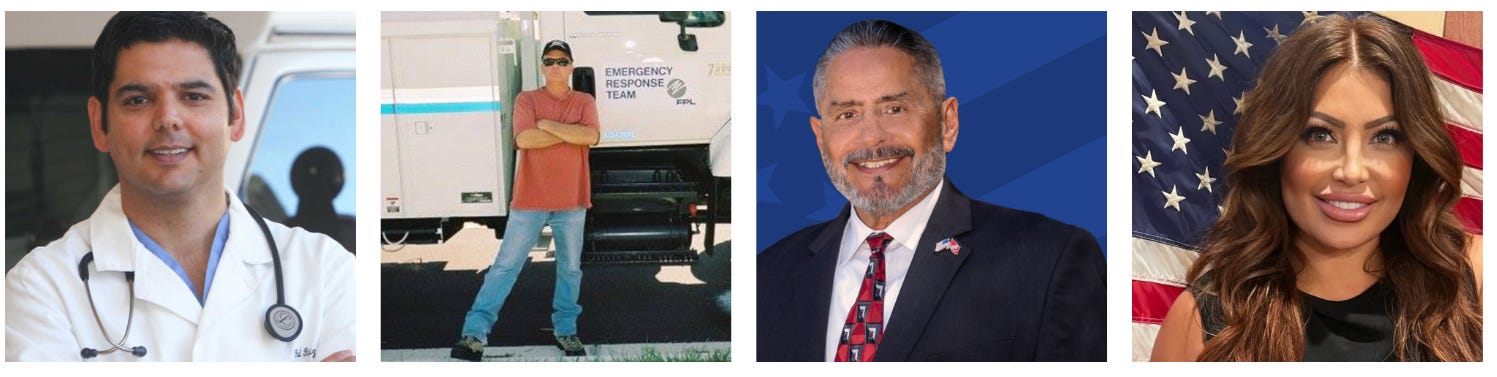
Including Ruiz, there are five candidates running in the 25th district:
Dr. Raul Ruiz (Democrat, Incumbent) Emergency physician, founder and director of the Coachella Valley Healthcare Initiative, serves on the House Energy & Commerce Committee.
Ronald Huffman (Republican) Journeyman Electrical Worker and Control Operator, as well as a union steward.
Joe Males (Republican) Marine Veteran, small business-owner, Hemet city council member. Endorsements include the Republican Party of Riverside County and the San Bernardino Republican Party.
Ceci Andrade Truman (Republican) No profession or endorsements listed.
All candidates regardless of party were sent a questionnaire with the same eight questions pertaining to how they would approach issues impacting Morongo Basin residents. We received responses from two Democratic candidates in the 23rd District, Tessa Lynn Hodge and Pat Wallis. We are publishing the answers as we received them, with edits to spelling or grammar as needed. If we receive more responses, we will include them here.
Candidate responses on issues impacting the Morongo Basin: Tessa Lynn Hodge and Pat Wallis, Democratic Candidates, District 23
1. Jobs and the Local Economy
The Morongo Basin economy depends heavily on Joshua Tree National Park, and on the Marine Corps Air Ground Combat Center. Federal workforce reductions and shutdowns are already affecting both. In addition, the changing economy has caused slowdowns and softening in the tourist economy the Morongo Basin depends on. What concrete steps would you take to protect and diversify the economic base of communities like Twentynine Palms, Yucca Valley, and other Morongo Basin communities?
Tess Lynn Hodge: As a lifelong resident of the district and small business owner I know how difficult it can be to make ends meet in a rural community. What we have seen under this administration and others is Congress governing through crisis. Instead of working collaboratively, negotiating in good faith, and passing budgets that fund our schools, healthcare, and needed services, members in both parties are using budgets, and the American people, as bargaining chips.
While I can’t guarantee that I can get all 435 members of the House to play nice, what I can do is introduce legislation that protects national park workers and the surrounding communities during a government shutdown. This legislation would include funding to keep our beloved national parks, like Joshua Tree, open, and federal employees like our national park workers paid when a shutdown happens. The legislation would also include that no member of Congress shall be paid if a shutdown occurs. I’ve yet to hold a position where I get paid to not do my job and I don’t intend for my position as your representative to work that way either.
We also need stronger programs to help small businesses. Small businesses are more likely to reinvest into their own communities, provide entry-level employment opportunities, and create around two-thirds of all new jobs. Ensuring small business owners have access to SBA microloans, grants specifically targeted to small businesses, and programs to help build technical skills is vital to ensuring that the Morongo Basin has a robust economy.
We should also seek to create additional partnerships with the Marine Corps Air Ground Combat Center. By creating new partnerships and programs we can help veterans start small businesses after leaving the military and encourage them to stay local, and create training and apprenticeship programs for veterans and their family members in healthcare, clean energy, or the trades.
Pat Wallis: The economy of the Morongo Basin must diversify if we are to create the types of jobs families can build a future on. A strong regional economy can’t be built around a single pillar, whether that’s federal payrolls, defense contractors, or tourism. When any one of those softens, families here feel it immediately. Rising to the challenge of building a future where our kids can imagine living and thriving here means doing something we haven’t actually done, and that is to deliberately build a regional economic development plan.
Community colleges like Copper Mountain exemplify excellence. The rub is that they are training people for the economy we have today. That’s necessary and hard work, but it’s not enough. As a former city planner [in the town of Moraga, CA] and military master planner, I understand what it takes to build the future our region deserves. Together, we must design an economy to sustain our shared vision for the future of our region — and work backward from there. That’s planning 101.
Where do we want the Morongo Basin and the wider Hi-Desert to be in 20 years? Once we can answer those questions honestly, the obstacles to reaching our shared future become clear.
What types of high-tech jobs in engineering and science do we need to support to realize this future?
Do we need a four-year higher education presence to train and educate the workforce we need?
What anchor institutions (hospitals, universities, government centers, …) do we need to seed?
What modes of regional manufacturing make sense given our water, land, and workforce?
How many mouths can regional agriculture realistically feed?
What kinds of light manufacturing and high-skilled jobs can we genuinely attract?
Finding answers to these questions changes the game in how we talk about jobs here. Without a map, we drift and lose our way. This is exactly how our region became a dumping ground for warehouse sprawl, data centers, logistics hubs, solar farms, and other extractive industries that don’t serve our desert communities and don’t pay a living wage.
My vision is for a regional economy that’s self-reliant and self-resilient.
I’m fighting for a future where our kids can afford to live here because the jobs are good, where wealth circulates locally instead of being siphoned away by absentee investors.
I’m fighting for a future where the Marine Corps Air Ground Combat Training Center and Joshua Tree National Park are pillars of a diversified economy — not its entirety.
As your US Representative, I’ll propose laws and policies that build toward that shared future, with the planning rigor it deserves.
2. Affordable Housing
What federal funding or policies would you support to bring more affordable housing to the Hi-Desert communities like Yucca Valley, and Joshua Tree?
Tessa Lynn Hodge: The housing issue is multi-layered with several factors affecting the rising costs of both rent and home ownership. What we all know is that many of us are being priced out of the communities we love, and members of our community entering adulthood after graduating high school and college are increasingly unable to move out of the family home.
A significant issue in the Morongo Basin is the high number of homes that have been turned into short term vacation rentals. We must protect housing for actual residents by working across local, state, and federal jurisdictions to place limits on short term vacation homes and corporations who buy up homes as investments.
An issue I believe we all know all too well is the red tape and bureaucracy that exists when trying to build. There is a big difference between protecting our environment with smart policy and the bureaucratic nightmare that currently exists. It’s interesting that across the country AI Data Centers have been able to go up in the blink of an eye, but affordable diverse housing seems to be at a standstill. Again, at the local, state, and federal level elected officials must work together to address bureaucratic barriers to building the housing we need. I will work with our local and state officials to identify those barriers and identify federal assistance to streamline building processes.
At the federal level I would support and expand the Low-Income Housing Tax Credit which incentivizes the development of affordable rental housing. I would also support rural housing grants which provide low interest loans and grants for those in rural areas looking to buy or even repair their homes. I also support the expansion of first time home buyer assistance programs and low interest loan programs.
Pat Wallis: Housing in the Morongo Basin is broken. In some communities, a third to half of residential homes have been pulled off the long-term market by hedge funds, speculators, and short-term rental operators. I’ve seen the aerial maps of the homes yanked from the market, and it paints a devastating picture. Don’t believe the lies that we can just build our way out of the problem when investors are buying faster than we build.
This leads to another critical point. We need to build housing that the people of our district can afford. The core to any solution for our housing affordability and availability crisis is to return existing homes to the people who live and work here. I’ll push to eliminate the “active income” tax loophole that rewards investors for turning homes into hotels, and I’ll support the End Hedge Fund Control of American Homes Act with amendments that would cap how many housing units corporations could own in any zip code. This includes an exemption for portfolios of 10 homes or fewer to protect local mom-and-pop landlords. Our goal should be for local families to build generational wealth. It should be to support Wall Street in building ever-larger monopolies.
I’ll also support federal legislation to encourage investment in shared-equity homeownership models like the Champlain Housing Trust (Burlington, VT), which, when founded with seed money from the City of Burlington, was then led by Mayor Bernie Sanders. In 1984, it was the largest community land trust in the U.S. In 2008, it won the UN World Habitat Award. This is a model for affordable housing we should replicate far and wide.
Other measures include first-time homebuyer assistance and zoning that allows multigenerational housing, so seniors can age in place near family. For renters, I support rental-market standards that prevent predatory increases and federal matching grants to expand affordable student and workforce housing partnerships.
But none of this works if the communities most affected have no formal voice in their own future. The Morongo Basin Municipal Advisory Council was dissolved in 2021 and never reconstituted, and that’s not a great outcome for hearing people’s voices. No community should ever be surprised by major development or infrastructure decisions in its own backyard.
Federal economic development law already requires regional planning that engages community leaders, residents, and stakeholders — through the Comprehensive Economic Development Strategy, or CEDS, process administered by the Economic Development Administration. I’ll fight to amend the federal CEDS regulations so unincorporated communities can elect their own representatives to the planning process — directly. Federal infrastructure and housing dollars shouldn’t flow through plans that don’t give residents of the Morongo Basin a voice.
3. Social Security, Medicare & Medicaid
Many residents here depend on Social Security, Medicare, and Medi-Cal to survive. Recent federal budget proposals threaten to cut these programs. Will you commit to protecting them — and how will you use your seat in Congress to do so?
Tessa Lynn Hodge: Unequivocally, yes. We are all just one bad day away from needing social supports like Medicare, Medi-Cal, and Social Security. In my time as a social worker in this community I have met far too many residents who did “everything right”; they worked hard, got a good job, saved, and because of one bad day like an accident at work, a car accident, a severe medical diagnosis, a job loss, etc. they lost everything. We must protect these safety nets for all of us, because goodness forbid it’s the day you need them but don’t qualify because of some “T” that isn’t crossed or “I” that isn’t dotted, or because someone judged you as “undeserving”. Matthew 25:40 says “The King will reply, “Truly I tell you, whatever you did for one of the least of these brothers and sisters of mine, you did for me”.
In Congress I will fight to ensure that Social Security remains solvent, and that benefits are not cut and the retirement age is not raised. We must do away with the Social Security Tax cap. Currently the cap sits at $185,500 which means that the working and middle class are disproportionately propping up the Social Security system, and it is not sustainable. For Medicare and Medicaid I will never vote for a budget that cuts these programs. In our rural areas our hospitals depend on Medicaid and Medicare funds to survive and stay open.
I will also fight for a single payer healthcare system like Medicare for all. The fact of the matter is that when people have stable access to preventative healthcare, dental care, and mental health services, they are more successful, miss less work, are able to spend more in the economy, and our hospitals have less emergency room visits, and are able to focus on treatment instead of fighting with insurance companies. Ensuring that people have affordable access to healthcare is a rising tide that lifts all boats, especially economically.
Pat Wallis: I will protect Social Security, Medicare, and Medicaid without qualification.
Social Security and Medicare are earned benefits. Working Americans pay into them their entire careers, and the deal is simple: contribute now, draw on it later. Cutting them to finance tax cuts for the wealthiest is a betrayal of that compact. Medicaid is different — it’s not something workers pay into and earn back. It’s a commitment we make as a society to make sure people who can’t afford care still get it. In a working-class district like ours, it’s not just a solemn commitment to one another; it’s a lifeline.
In CA-23, 48% of residents depend on Medicaid, and roughly 20% of families rely on SNAP. Yet Jay Obernolte voted for the One Big Beautiful Bill Act (OBBBA) — the largest Medicaid cut in the program’s 60-year history at $900+ billion, including the most severe SNAP cuts on record. He didn’t just vote for it; he called it a “generational opportunity.” In a working-class district where the median income is just $77,000, his betrayal is a direct hit on those who can least afford it.
In Congress, I will vote against any budget that cuts Medicare, Social Security, or Medicaid benefits, eligibility, or provider reimbursements that keep rural hospitals open. I’ll fight to roll back the cuts to Medicaid and SNAP from the OBBBA, and I’ll fight to lower drug prices through direct Medicare negotiation.
I’ll also use the seat itself to push for change and hold our government to account. This includes committee testimony, floor speeches, and public hearings in the district. It’s vital to express the human cost of these cuts on the record.
Buy tickets - just two left!
4. Veterans’ Services
Many veterans live throughout the Morongo Basin, yet veterans here have lost their local VA representative and must drive over an hour for help. What will you do to restore in-person VA services and fully staff the Veterans Crisis Line in our district?
Tessa Lynn Hodge: This is a topic that hit close to home as my grandfather, father, and two of my uncles are veterans, and I have two cousins who are active duty. Too many politicians like to pay lip service to veterans, but their votes in Congress speak for themselves. In Congress I would fight to ensure that the VA is properly funded and staffed. Recruitment and retention within the VA system needs to be improved to ensure veterans have access to the care they need.
This will be especially important in the coming years as the current administration has cut the VA workforce by huge amounts. A recent ProPublica report found that the VA had lost approximately 500 psychologists and psychiatrists, and about 700 social workers. As a Licensed Clinical Social Worker myself I can tell you that these social workers were crucial to supporting veterans in connecting to local services, finding and connecting to supports, providing direct mental health services, running groups, planning medical discharges and aftercare, navigating crises, etc. Additionally, 90% of VA facilities are reporting severe shortages of doctors and 80% are reporting a severe shortage of nurses. Is this how we treat those who served our country?
At the federal level we must also expand mobile VA clinics and increase the VA’s partnerships with local healthcare providers, especially in rural areas. Simplifying access to services should also be a priority to reduce the barriers veterans face when trying to access the support they need.
Pat Wallis: As a disabled veteran who hurt my back in a training accident, this is personal. We are being failed twice—once by the bureaucracy, and again by the representative who’s supposed to fight for them. With over 41,000 veterans in CA-23, roughly double the national concentration, not having a dedicated veteran’s representative and forcing veterans to drive over an hour for help is unconscionable.
The 2024 Inland Empire State of Veterans Report called accessing benefits in our region “taxing if not intimidating.” That was before DOGE tried to fire 83,000 VA employees, totaling 17% of the workforce serving our veterans. Using flawed AI tools, they tried to gut cancer programs, burial services, and the contracts implementing the PACT Act before public outrage forced them to scale back. Still, almost 600 contracts were canceled. Throughout the entire DOGE debacle, Obernolte was a consistent cheerleader of the same reckless cuts that I will fight to reverse.
Specifically, I will fight to rebuild VA staffing and infrastructure, for in-person VA representation in the Morongo Basin, and to fully staff the Veterans Crisis Line in our district. While we’ve gained presumptive coverage for burn pit and Agent Orange exposures, it means nothing if there isn’t anyone left at the VA to process the claims or deliver the care. Another problem in the Morongo Basin is access to care. While the VA’s “Community Care Network” carve-outs may work in urban areas, we’re already in a healthcare ‘desert.’ So, rather than pointing our veterans towards privatized care that doesn’t exist in our rural communities, I will fight for VA facilities closer to where our veterans live.
I’ll also push for integrated wrap-around care. Right now, if a veteran walks in for PTSD treatment, other needs go ignored. We need a system that screens simultaneously for housing, employment, and other health needs and connects veterans without requiring them to navigate a labyrinth of agencies.
And here in CA-23, I’ll work with veteran service organizations to host an annual veterans’ assistance event at different sites in the district, where veterans can navigate benefits, claims, and care without doing it alone.
5. Healthcare & Food Access
Parts of the Morongo Basin are a food desert, and our region ranks among the lowest in California for health outcomes. Many residents rely on SNAP food benefits and need better access to mental health care. How will you protect these programs and improve healthcare access for rural communities to ensure food security?
Tessa Lynn Hodge: As a Licensed Clinician Social Worker I’ve spent my career serving our rural and underserved communities. I’ve worked in community based mental health, school based mental health, and in medical social work in our hospitals and I know the challenges families in our areas face when it comes to both food and mental health. When I first decided to run for Congress in February 2025 I was working for SAC Health, a non profit that provides medical and mental health care in rural and underserved areas. I was hired for their Barstow office, and I was the first clinician hired after they had been attempting to fill the spot for a year. They were unable to find anyone who lived local to Barstow, or who was willing to make the drive. This is the same issue most rural communities, including the Morongo Basin face. A manageable client load for a mental health provider to ensure quality client care is approximately 20-30 (there’s quite a bit of paperwork on the back end to account for outside of client sessions). In community based mental health I had a client load of anywhere from 40-70.
In private practice my client load is lower, but all of the paperwork on the backend is done on unpaid time. The system is set up for provider burnout, not just for mental health providers, but for nurses, doctors, and other healthcare workers as well. In an already underserved area, provider burnout is just one more factor leading to poor access in our rural communities. So how do we address this?
Rural healthcare is increasingly becoming its own speciality. At the federal level increase funding to medical schools like Loma Linda to expand training opportunities into rural communities. This includes lifting the federal funding cap on residency slots.
Create programs beginning in middle and high school and expanding to community colleges to create a pipeline into the medical profession, especially focused on rural and underserved areas. Recruiting people to fill positions in their home communities increases long term buy-in and the likelihood they will stay in their communities past mandatory pay back timelines.
I want to reiterate that I am a strong proponent of a single payer healthcare system like Medicare for all. The United States is in a healthcare crisis and we are quite literally on the verge of healthcare collapse. We must take forceful action to ensure our healthcare system doesn’t just remain in palace, but is improved for all of us.
In Congress I will never vote for a bill that cuts SNAP benefits. Many in our rural communities rely on these benefits including veterans. Again, we are all one bad day away from needing these social security nets.
Pat Wallis: Rural communities like the Morongo Basin face a compounding problem: fewer providers, longer distances, lower incomes, and worse health outcomes — and recent federal cuts are making all of it worse. Almost 20% of district families rely on SNAP. Almost half are on Medicaid. For the people of our district, access to food and healthcare aren’t separate issues.
I will fight to reverse the OBBBA’s SNAP cuts, which are projected to strip CalFresh benefits from almost 400,000 Californians. SNAP is one of the most effective anti-hunger programs we have. Obernolte calls it fiscal responsibility, but cutting it in a food desert is just callous, it’s irresponsible.
Real food security requires planning, and as part of the planned district-wide economic development plan, I support investment in local food economies — regional processing, cold storage, and farm-to-table distribution — so producers aren’t shipping food hundreds of miles only to ship it back.
On healthcare, I support Medicare for All. In the US, we pay ~$14,000 per person for healthcare. In other developed democracies, the totals are half that. To justify these outrageous costs, we’re told we’re getting the best healthcare in the world. If that’s so, why is our average lifespan just 79 years compared to the 83 years in these other countries?
I know firsthand the peace of mind that comes with knowing I will always receive the medical care I need from the Veterans Administration. Every American should have the same access to affordable healthcare that I do.
My other priority is keeping rural hospitals open. They’re already operating at a deficit, and the Medicaid cuts will accelerate closures. I’ll push for federal stabilization funding for rural hospitals and for protected reimbursement rates so providers can continue serving patients here.
As we know, access to healthcare is often an infrastructure problem out here. We hear of telehealth as the rural answer, but that only works if we have reliable broadband and cellular coverage. We are all aware that getting to and from a physical clinic can mean driving on unpaved roads in poor condition. I’ll fight for federal investment in rural broadband, cellular buildout, and road infrastructure as the actual prerequisites for healthcare access here. Without that backbone, every other healthcare promise is just words.
6. Climate & Extreme Weather
The Morongo Basin has seen severe flash floods that damaged homes and roads in recent years. What will you do to help desert communities prepare for and recover from extreme weather?
Tessa Lynn Hodge: First and foremost, protecting our environment and addressing climate change has to be a priority. Investing in new green technologies, shifting away from fossil fuels, and going after corporate polluters will be a priority for me in Congress. Change is hard, and it can be uncomfortable, but we must adapt and embrace new technologies that lessen carbon emissions and truly create energy independence.
To address the immediate need of the severe flash floods in the Morongo Basin the federal government needs to treat disaster preparedness as the priority it should be. I’ve spoken with those who work in the disaster preparedness space and the general consensus is that research is funded, reports are submitted, and the reports with recommendations go into a filing cabinet never to be seen again.
We must start listening to our experts and following the recommendations to avoid loss of life and damage to property. Investing in infrastructure to improve drainage and reinforce vulnerable roads, and having responsible land management can help reduce the impact of extreme weather.
Pat Wallis: Our desert communities face wildfire, high winds and wind damage, earthquakes, and flooding. But our infrastructure and insurance systems weren’t built for any of it at the intensity we’ve seen over recent years.
On preparation, I support significant federal investment in pre-disaster mitigation across all these threats. This includes hardened infrastructure, improved flood control and drainage, defensible space programs, seismic retrofits, wind-resistant building standards, and home hardening grants for the highest-risk properties.
No surprise here, but it’s way cheaper to harden and prepare a home than to rebuild one. The January 2025 LA fires caused tens of billions in damage. The cost of hardening those 13,000 homes would have been a fraction of that. The same logic applies to all the hazards we face in the basin, including flood, wind, and seismic mitigation.
It’s clear the private market is breaking down across CA-23. Personally, my insurer of choice, USAA, quit covering homes in California. My homeowner’s insurance has more than tripled since 2020. Insurers are pulling out, premiums are exploding, and families are being forced from homes they’ve held for generations.
I support a public option for catastrophic disaster coverage backed by a federal reinsurance backstop, with premiums capped so working families and seniors aren’t priced out. Under this proposal, routine home coverage would stay in the private market while catastrophic regional risk would be shared.
During recovery, FEMA and SBA disaster assistance must reach our rural communities. I’ll push for streamlined disaster declarations, faster individual assistance, and federal support for the nonprofits and mutual-aid networks that are usually first on the ground here. Another topic is demanding transparency in insurance risk modeling so homeowners and communities that invest in mitigation see savings on their premiums.
7. Renewable Energy & the Desert Environment
Large-scale solar projects are proposed on desert land near throughout the Morongo Basin. Residents are concerned about grading, dust, and harm to wildlife like the newly endangered Mojave desert tortoise, in addition to the loss of value of their homes. How do you balance the need for renewable energy with protecting desert ecosystems and local communities?
Tessa Lynn Hodge: Too often we have seen large scale projects pushed onto rural communities despite the objections of the residents. The people who live in the Morongo Basin deserve to be heard and respected in these processes. As a born and raised resident of the 23rd who spent the majority of my childhood in the rural community of Phelan, I know why we love our big open desert. The night sky, the quiet, the staring out and being able to see for miles, the seemingly inhospitable desert that we know is full of life. That life, the life of the Mojave Desert Tortoise, the jackrabbits, coyotes, chuckwallas, and so many others deserves to be protected. Protecting them means balancing the need for renewable energy with the need for protecting their habitat.
I support prioritizing renewable energy projects on land that has already been developed or is going to be developed, such as on roof tops, parking structures, or abandoned and idled commercial properties. Additionally, such projects should come with community benefit agreements to ensure that the community is benefitting from these projects. Community benefit agreements would ensure local hiring, investment in infrastructure, and increased protections for homeowners, residents, and small businesses.
Pat Wallis: While I support the transition to clean energy, I will never support turning the Morongo Basin into a sacrifice zone to power someone else’s city.
Renewable projects that fragment the habitats of endangered species, generate dust storms, drain aquifers, and reduce nearby property values aren’t the climate solutions any of us want here. Proposals like this just cost-shift from the urban elite onto rural communities just trying to survive. Moreover, they generate backlash that just delays the broader clean-energy transition we all want.
Any large-scale solar project on desert land must be properly sited, community-informed, and environmentally responsible. It must consider the project’s cumulative environmental impact. This means real local consultation with community representatives. And it means maintaining a preference for using sites on already-disturbed land, like on rooftops, parking lots, brownfields, and degraded sites.
But there’s also a smarter path, one that I’ve personally been researching in my professional work for two decades. Buildings and transportation account for roughly 60% of global carbon emissions. Energy efficiency, passive energy design in buildings, building electrification, and distributed solar on existing structures deliver enormous emission reductions without razing a single acre. It’s our duty to exhaust these paths before sacrificing our desert ecosystems and the home values of the families living here.
8. Public Lands
A Senate budget bill proposes auctioning tens of thousands of acres of BLM public land in and around the Morongo Basin and hi-desert. Public lands are vital to our economy, environment, and way of life. Do you support or oppose these sales, and why?
Tessa Lynn Hodge: I do not support the sale of large amounts of BLM public land in the Morongo Basin and High Desert. Especially when it is done hastily and without the input of local communities. Our desert ecosystem is fragile and is worth protecting, and in our desert environment water conservation must always be a priority.
Selling tens of thousands of acres of BLM land in and around the Morongo Basin could be catastrophic for local water sources which have already experienced overdraft. As climate change continues to become more severe, we are seeing conflicts and disputes over water in many parts of the world, including here in the US. Selling off protected land for development in a water scarce area is not responsible governing.
Pat Wallis: I oppose the proposed sales of BLM public lands in and around the Morongo Basin. However, the auction proposal is just the visible piece of a much larger problem that can’t be understood before we understand where we live.
Roughly 65% of the geographic area of CA-23 is public land — National Park, U.S. Forest Service, Fish & Wildlife, and BLM. That’s not incidental to the 23rd District. It is our district. Over the last 15 years, the budgets for the agencies that manage those lands have been cut by up to 70%. Guess what? The current administration is proposing to slash what remains by another half. That’s problematic for us. The consequences are everywhere we look. We’re seeing more wildfires, and our homeowner’s insurance costs are skyrocketing. On top of that, we’re seeing the abuse of the BLM permitting process and visible degradation of service across the board.
This malign neglect only benefits the deep-pocketed donors who’d like to turn our communities into extraction sites for more solar farms, mining pits, and industrial yards. I’ve been to Keys Ranch in the National Park, and I’ll pass on doing that to the rest of our desert. Selling this land, which is our birthright, is the next step in the same project.
Joshua Tree National Park and the surrounding BLM lands are the engine that drives our local economies. The case for keeping these lands public is obvious. There’s no way to replace that with a one-time auction payment.
On top of that, the excuse for these proposed sales as a housing-affordability fix is a sham. We absolutely do not have a land shortage. If anything, we have a glut of hedge funds, speculators, and short-term rental operators converting existing homes into investment properties.
As your US Representative, I’ll vote against any bill or reconciliation language authorizing these sales. Further, I’ll fight to restore full funding for the agencies that manage our public lands and to require genuine local consent for any BLM disposal in CA-23.
Did you know that paid subscribers receive discounts to DT Social events?
Not a paid subscriber yet?
Upgrade to a $50+ paid subscription for a 10% discount.
Upgrade to $100+ for a 25% discount.
Sustaining subscribers at the $250+ level and above receive complementary tickets
Leave your thoughts in the comments below. Please note that we do not allow anonymous comments. Please be sure your first and last name is on your profile prior to commenting. Anonymous comments will be deleted.
This coverage is free - please share!
On May 22, 2026 Eli C. Owen’s name was updated to include the middle initial “C.” At the time of publication his election website listed the 25th district, but he officially appears on the ballot in the 23rd and we updated our coverage to reflect this.
Wallis for all of us with multiple exceedingly hopeful strategies