

The desert sky in January is crisp and bold, perfect conditions for stargazing. With long, dark nights, the return of brilliant winter constellations, and one of the most overlooked meteor showers of the year, it’s a great month to look up, as long as you bundle up!
Orion and the Brightest Stars of Winter
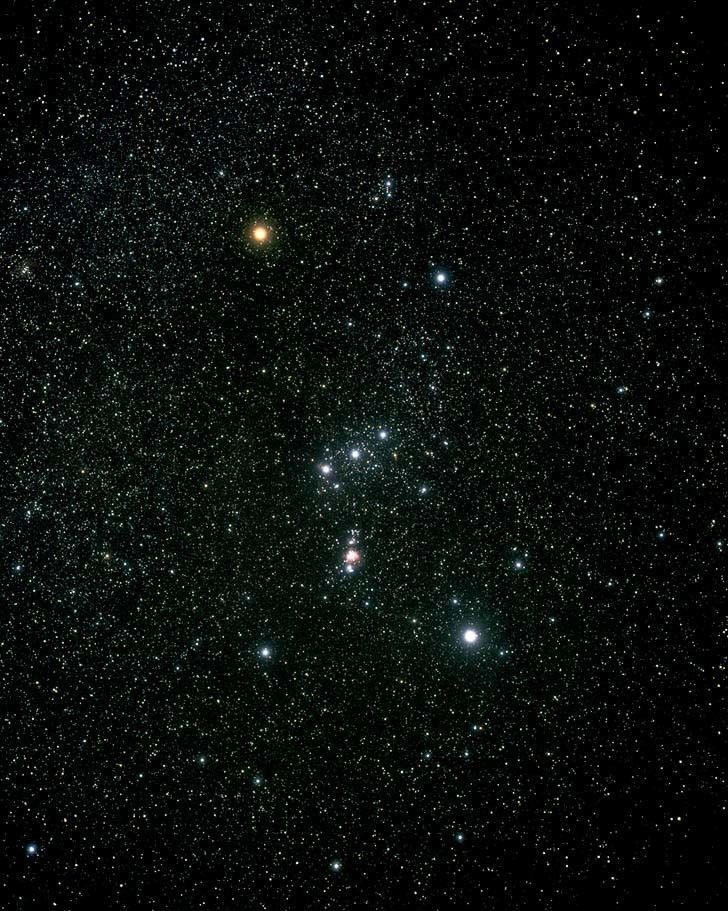
Winter constellations take center stage this month. By nightfall, Orion the Hunter stands high in the east, and under our dark skies, we can see the bow he carries as a lovely arc of stars.
Below Orion, you’ll find Sirius, the brightest star in the Northern Hemisphere, twinkling with rainbow colors while it’s low to the horizon. Because it’s so bright to our view, it’s one of the most entertaining twinkly stars to watch. Dynamic to the naked eye, even better with binoculars or a telescope, Sirius is part of the constellation Canis Major, Orion’s faithful hunting dog.
Orion’s neighborhood is one of the richest areas in the sky for stargazing—especially with binoculars.
From Orion’s belt hangs a sword of three stars. To the naked eye, they have a hazy appearance. What you’re seeing is the Great Orion Nebula (M42), a glowing star-forming region. This is a fun binocular target to share with family and friends, since Orion is one of the most identifiable constellations in the night sky.
A zoom into the Orion Nebula created by NASA with images made by Akira Fujii and David Malin, using the Hubble’s Advanced Camera for Surveys
Planet Watch: Saturn Sinks, Jupiter Dominates, and Mercury Returns
Saturn is wrapping up its visibility for the season. Catch it early in the month, low in the southwest just after sunset. By mid-January, it’s lost in twilight.
Jupiter remains a brilliant beacon overhead. It rises early and shines all night, the brightest thing in the sky besides the Moon. Through binoculars, look for its four Galilean moons (Io, Europa, Ganymede, and Callisto) lined up around it.
Mercury has a brief but nice appearance in the morning sky during the first half of the month. Look low in the east before sunrise starting around January 10.

Thanks to our new paid subscribers, we are $400 closer to our $10,000 goal! Upgrade your subscription from free to paid today for just $50 per year or $5 per month.
January’s Full Moon: The Wolf Moon (January 3)
This month’s Full Moon rises on the night of January 3. Known as the Wolf Moon, it lights up the desert landscape with a soft glow. It historically earned its name from traditions of winter‑time wolf howls. While bright moonlight can wash out faint stars, it’s a great time for a moonlit walk or observing brighter constellations like Orion, Taurus, and Canis Major.
Quadrantid Meteor Shower (Peak January 3–4)
The Quadrantids are a lesser-known but impressive meteor shower. They peak during the night of January 3 into the early hours of January 4, and can produce up to 80 meteors per hour. The Moon will be full on January 3, but don’t let moonlight stop you from stepping outside to enjoy the show.
Unlike other showers, the Quadrantids peak very sharply, over just a few hours, so timing matters. The radiant (the part of the sky the meteors appear to come from) is near the handle of the Big Dipper, rising in the northeast after midnight. Even if you miss the peak, you might catch a few bright streaks earlier in the night.
Milky Way Update: Perseus Arm on Display
In January, the Milky Way’s core remains below the horizon during evening hours. But if you step out and face northeast, you’ll see part of the Perseus Arm of the galaxy. It glows as a fainter band of starlight arcing across the sky. It’s not as bright as summer’s Sagittarius Arm, but it’s elegant light is a beautiful sight under dark desert skies.
Leave your thoughts in the comments below. Please note that we do not allow anonymous comments. Please be sure your first and last name is on your profile prior to commenting. Anonymous comments will be deleted.
Feel free to share this article!
Going into the 2026 elections, Desert Trumpet has sustained a potential 50% cut in funding. Help us provide the coverage you’ve come to expect by becoming a paid subscriber or upgrading your paid subscription today!
Are you able to give more than $100? Donate via Paypal!