
Citizen Astronomer: Milky Way
The Milky Way doesn't suddenly appear. It slowly reveals itself.

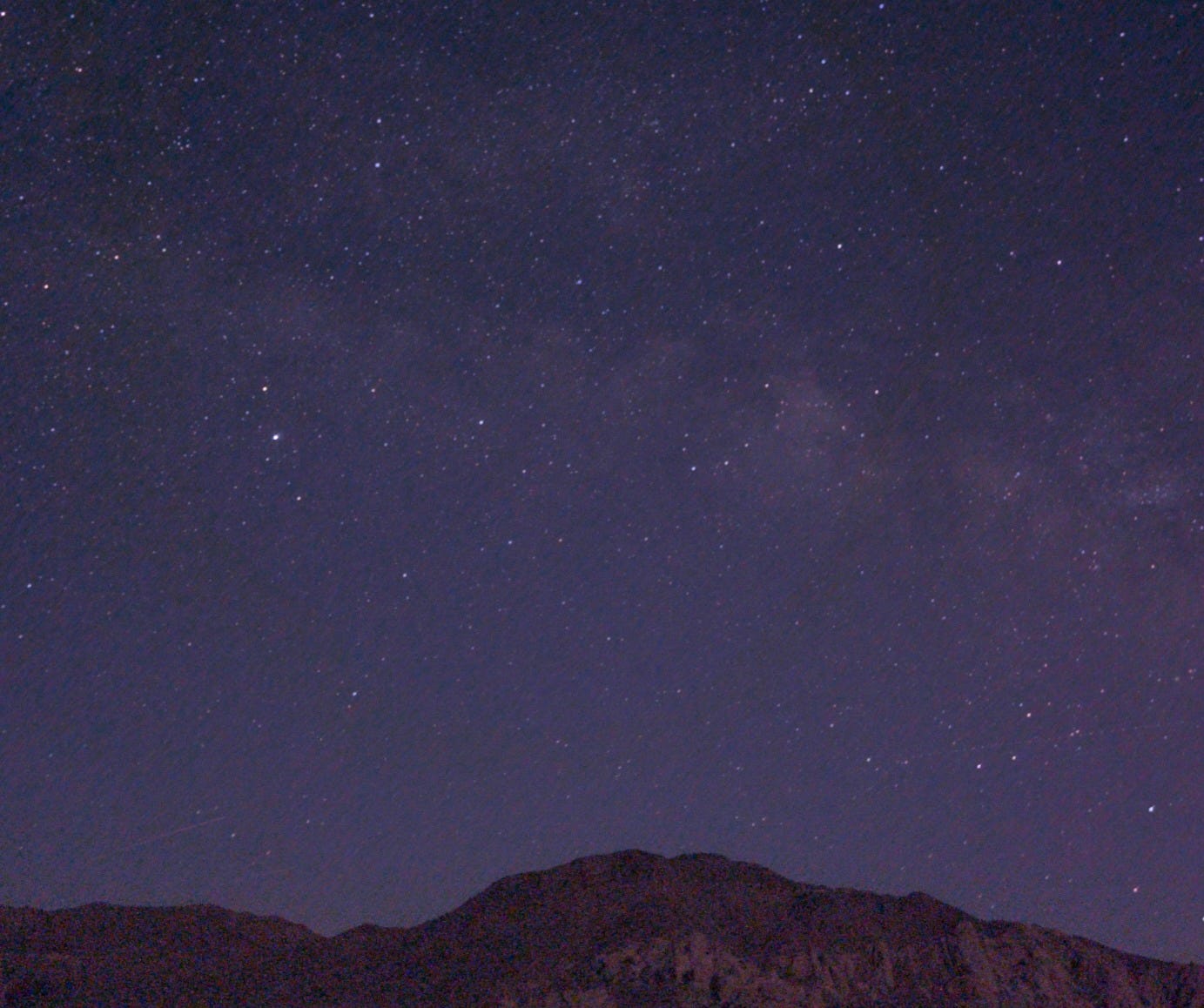
For many visitors, seeing the Milky Way is the reason they come to Joshua Tree after dark. July is one of the best months of the year to experience our home galaxy, when its brightest and richest regions stretch across the desert sky.
If you’ve never seen the Milky Way from a truly dark location, you might be surprised by what you’re looking for. It’s not a sharp band of stars or a glowing ribbon overhead. Instead, it appears as a soft, cloudy river of light arching across the sky. Once your eyes adjust, you’ll realize that the “cloud” is actually made up of countless distant stars.
Give Yourself Time
The single biggest mistake first-time stargazers make is stepping out of the car, looking up for thirty seconds, and deciding there isn’t much to see.
Our eyes need about twenty to thirty minutes to fully adapt to darkness. During that time, avoid looking at your phone or any bright white lights. If you need a flashlight, use a dim red light instead. The difference is remarkable. Stars that were invisible when you arrived slowly begin to appear, and the Milky Way becomes more defined with every passing minute.
Your Eyes Are Part of the Experience
Modern cameras can capture astonishing photographs of the Milky Way. Long exposures reveal vivid colors, glowing nebulae, and millions of stars that our eyes simply can’t detect. Those images are beautiful, but they’re a different experience.
The naked-eye view is something no photograph can replace. You can see incredible pictures of the Milky Way in books, magazines, or on a screen anytime you like. You can only experience the real thing by stepping outside under a dark sky and looking up.
Your eyes won’t see bright pink nebulae or electric-blue star clouds. Instead, you’ll see the soft glow of our own galaxy stretching overhead, just as people have for thousands of years. It’s quieter, more subtle, and, in many ways, more remarkable. You’re not looking at a picture of the universe. You’re standing in it.
Look South
In July, the brightest part of the Milky Way rises from the southeastern sky near the constellations Scorpius and Sagittarius. This is the direction of the center of our galaxy, where hundreds of billions of stars are packed together.
As the night goes on, the Milky Way climbs higher and stretches overhead toward Cygnus the Swan in the northeast. Around 10 p.m. you’ll have one of the year’s best views, and it only gets better as the night goes on.
Binoculars Are Your Secret Weapon
People often assume they need a telescope to enjoy the Milky Way. In reality, binoculars are one of the best tools you can bring.
Don’t underestimate binoculars! Point them anywhere along the bright band of the Milky Way, and you’ll watch the hazy glow resolve into thousands of individual stars. Sweep slowly through the star clouds around Sagittarius and Scorpius, and you’ll stumble across open star clusters and dense fields of stars that seem almost impossible to count.
Your binoculars don’t need to be huge or fancy. Look for sizes like 8×42 or 10×50. They’re ideal for stargazing, useful during the day for wildlife and sightseeing, and one of the most affordable ways to grow a casual interest in astronomy into a lifelong hobby.
Find a Dark Spot
Joshua Tree National Park is famous for its dark skies, but not every location is equally dark.
Try to get away from parking lot lights, campground lighting, and nearby headlights. Even walking a few hundred feet from bright lights can dramatically improve what you see. The farther you can get from artificial light, the more structure you’ll notice in the Milky Way.
Let Your Eyes Wander
The Milky Way isn’t something to study with laser focus. It’s something to experience.
Spend a few minutes looking around instead of staring at one spot. Your peripheral vision is often better at detecting faint light than your central vision. The longer you observe, the more detail begins to emerge. Dark dust lanes cut through the brighter star clouds, and subtle variations in brightness become easier to notice.
Remember What You’re Seeing
That soft band of light isn’t a cloud or a distant nebula. It’s our own galaxy seen from the inside. Every point of light you can resolve is another star sharing our galactic neighborhood.
When you look at the Milky Way, you’re looking at your home.
It’s one of the most humbling sights the night sky has to offer, and July is one of the very best times of year to experience it from Joshua Tree.
Hi, new subscribers! Desert Trumpet understands you might not be interested in all of our coverage. That’s why it’s divided into separate newsletters allowing you to opt out of reporting that’s not important to you. For instance, you may want our Education news but not City Hall 29.
Here’s how to opt out: go to your Substack settings, scroll down to “subscriptions,” and select “Edit” for the Desert Trumpet. Simply uncheck the box next to the newsletters you don’t want to receive in your email inbox. You’ll still be able to access all coverage online if you change your mind.
Thanks to you, Desert Trumpet exceeded our $10,000 paid subscription goal!!!
Not a paid subscriber yet? Did you know that paid subscribers receive discounts on our DT Social events and invites to DT Front Porch, intimate discussions featuring local officials and notable residents?
Upgrade to a $50+ paid subscription for a 10% discount.
Upgrade to $100+ for a 25% discount.
Sustaining subscribers at the $250+ level and above receive complementary tickets.
Leave your thoughts in the comments below. Please note that we do not allow anonymous comments. Please be sure your first and last name is on your profile prior to commenting. Anonymous comments will be deleted.
This coverage is free - please share!
You're absolutely right: while beautiful, long exposure photography can lead to a let-down for many beginners who expect to see with their eyes what is captured on camera.