Flora Friday: Three Rogues of the Apocalypse
Weed before they seed: invasive thistles, mustards, and grasses

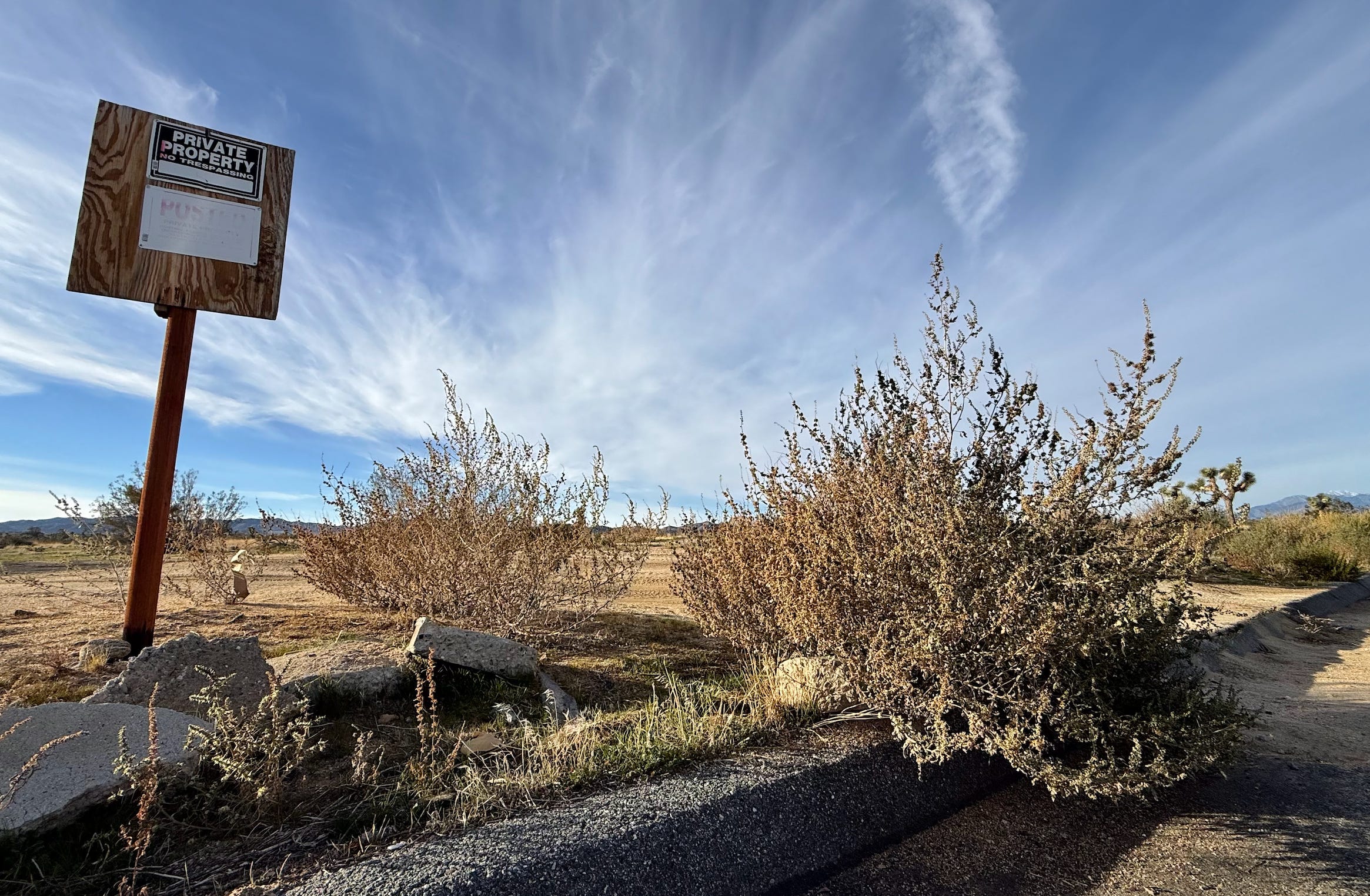
Before the arrival of invasive Russian thistles, Eurasian mustards, and an evil cadre of introduced grasses, when lighting strikes ignited isolated desert plants, the decomposed granite floor of the desert limited the travel of flames. Now continuous fuel beds made up of these invasives add velocity to fires and create pathways from plant to plant, leaving behind a post-fire landscape where those same interlopers gain the upper hand. Affected desert scrub areas can permanently shift to a non-native, highly flammable grassland, making the stakes even higher.
Two helpful photo guides for identifying these and other invasives can be found through Joshua Tree National Park and the Mojave Desert Land Trust. How do we combat their hostile takeover, and who are these plants that embedded themselves in the Mojave?
Legend
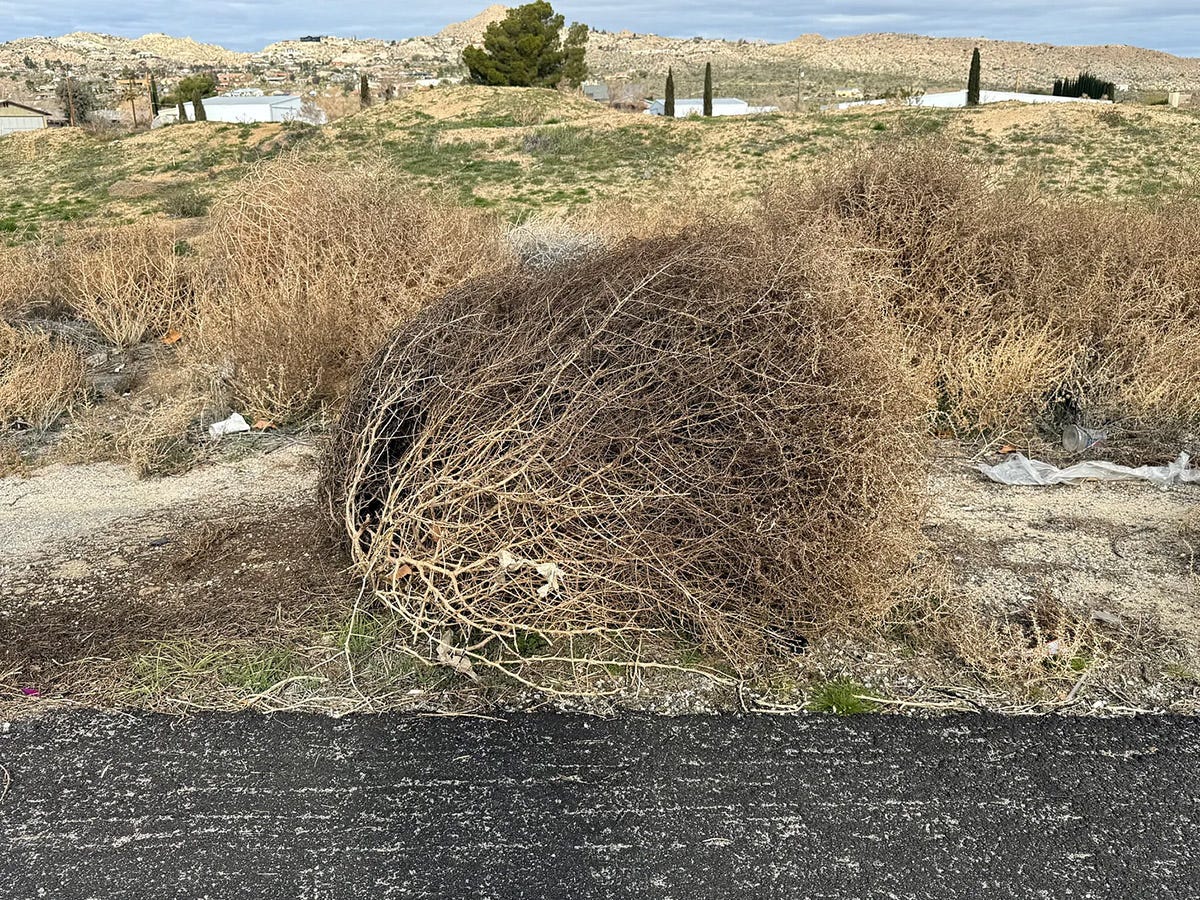
Ah, the romance of the tumbleweed. A great tarot symbol for the Seeker, carried by winds to no particular destination searching out new opportunities in vast lands. As a beloved cliché of western expansion it’s right up there with swinging saloon doors and tin pots rattling underneath wagons. We lift our voices to the tumbleweed—pop music abounds with references, generally used by men to conceptualize cherished independence and less often by women as metaphors for elusive, unrequited love.
And just as tumbleweeds sweetly evoke a song by Willie Nelson, Sylvia, or Afroman, the record makes the cringy sound of a needle scraping across its surface.
The truth is we’ve been conned by this plant. Its real identity is Russian thistle; odd considering its status as a cultural icon of the free-spirited American west. Imported in the late 1800s mixed into crop grain, a single Salsola tragus plant can produce up to a quarter of a million spiky seeds. As we nonchalantly strum guitars, dried plants break away from their five-foot water-sucking root systems to rove the landscape, reborn as laser-focused seed dispersing machines.

Going into the 2026 elections, Desert Trumpet has sustained a potential 50% cut in funding. Help us provide the coverage you’ve come to expect by becoming a paid subscriber or upgrading your paid subscription today!
To further illustrate its hypnotic power over us, we assist its quest for global domination by taking tumbleweeds home as souvenirs or yard art and ship them out globally as Etsy chandeliers or party decor. In these parts, they’ve beguiled us into thinking that the easiest method of dispatch is dragging the ground, while in reality we’re doing their bidding by sprinkling their seeds into the broken soil they so prefer.
Fable
When bringing the Good Word west, Jesuit priests scattered mustard seed to create a ribbon of heavenly gold to mark the path home.
Cue up ecclesiastic music, but this popular account has no basis in fact. One could conjecture that the storied tale was memeified in a game of Telephone since venturing Jesuits upheld the “Parable of the Mustard Seed,” an allegory of something small growing to become all encompassing.
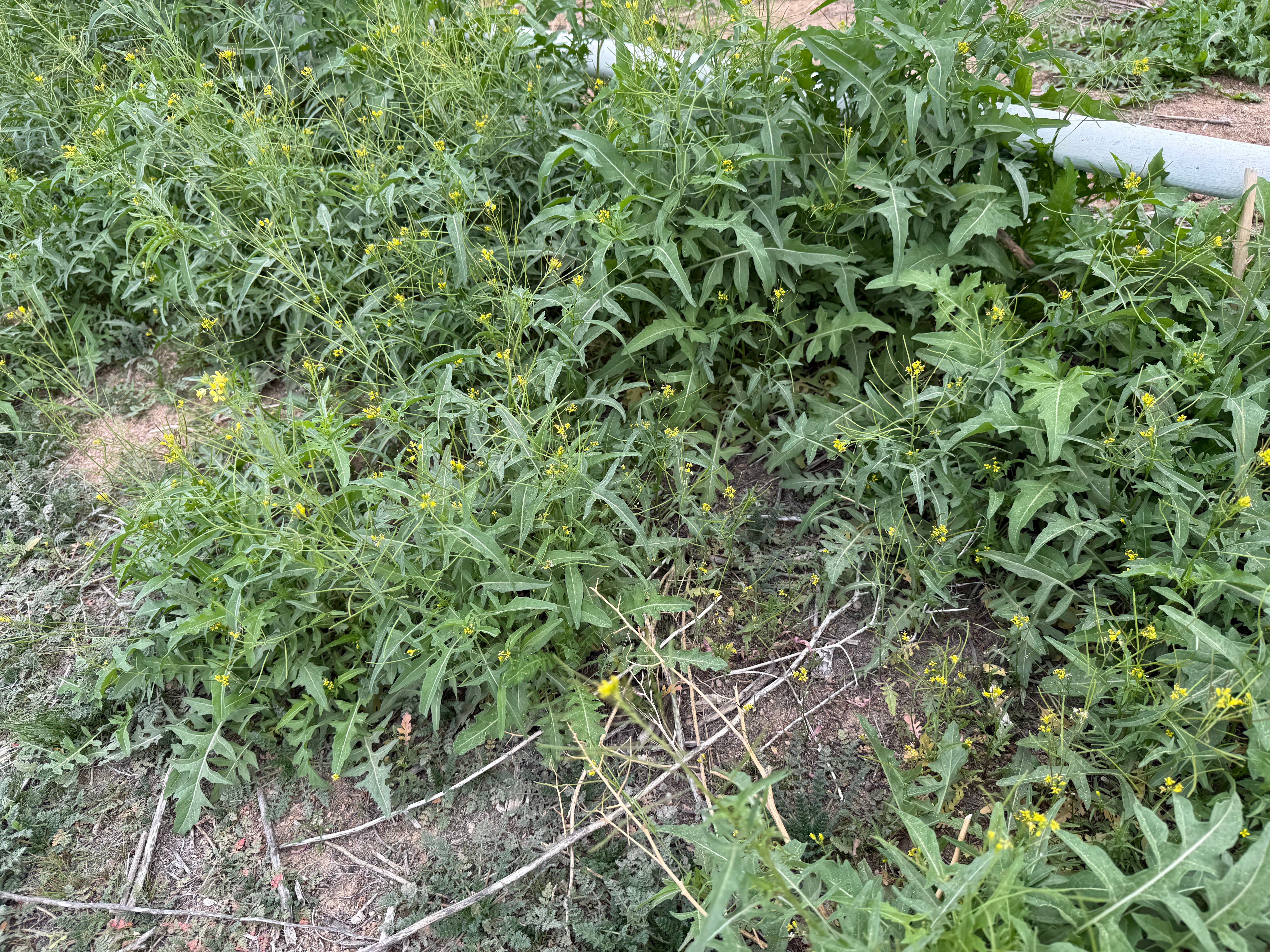
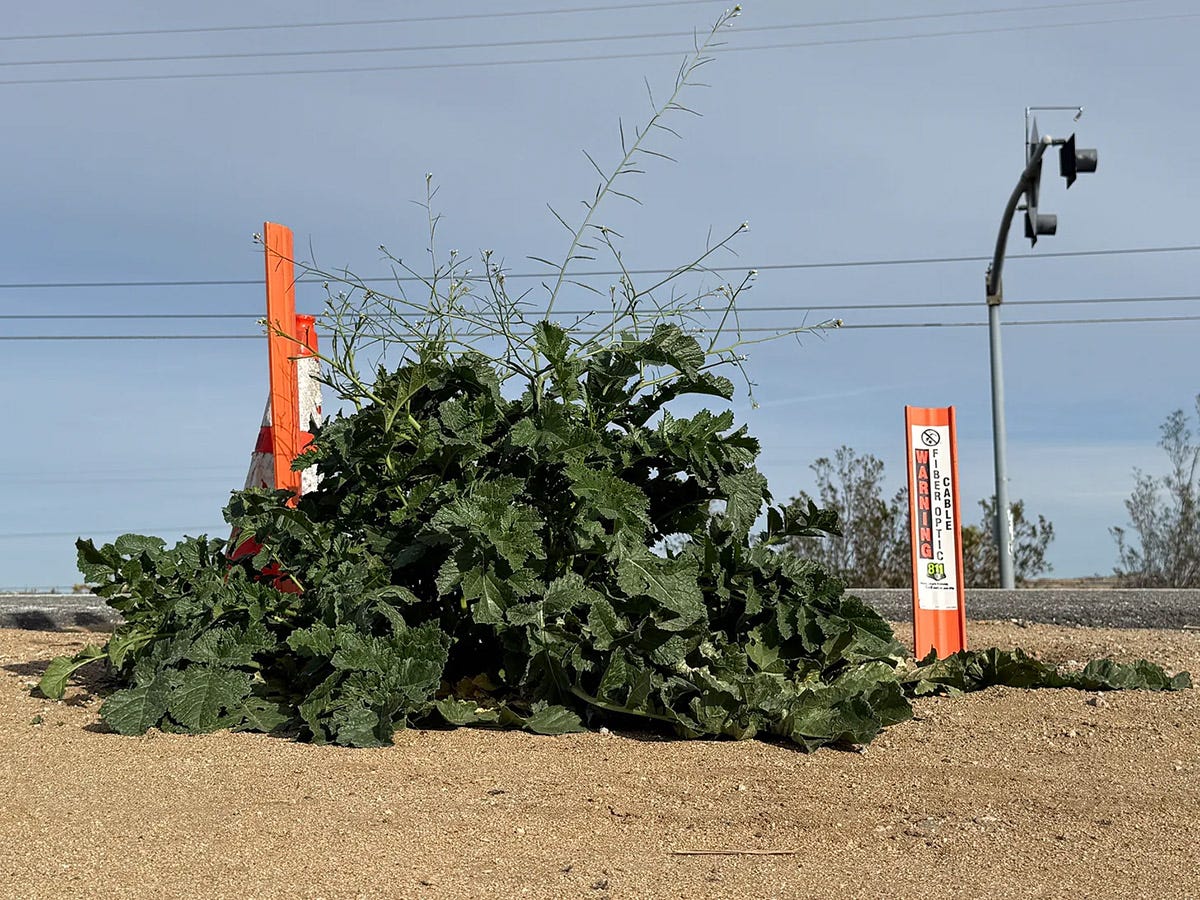
Overwhelming is more like it, given the growing habits of London rocket (Sisymbrium irio) and the behemoth called Sahara mustard (Brassica tournefortii), the two invasive mustards that are ubiquitous in our landscape. Both are adept at colonizing disturbed soil or burn areas by forming dense monocultures before native plants are able to reestablish themselves. Seed count per plant: up to ten thousand. Through a process known as allelopathy, they release chemicals that inhibit other plants and beneficial soil fungi. Seed pods, or siliques, have a sticky coating that allows them to hitchhike on fur, clothing, and tires. Very clingy and uncool.
Two well-behaved native mustards should not be pigeonholed with the Bad Guys: white-blooming native California Mustard (Caulanthus lasiophyllus) and the diminutive, lacy-leaved Western Tansymustard (Descurainia pinnata).
Myth
The American dream. A perfect lawn and a steak on every plate. SFX needle scraping across record.
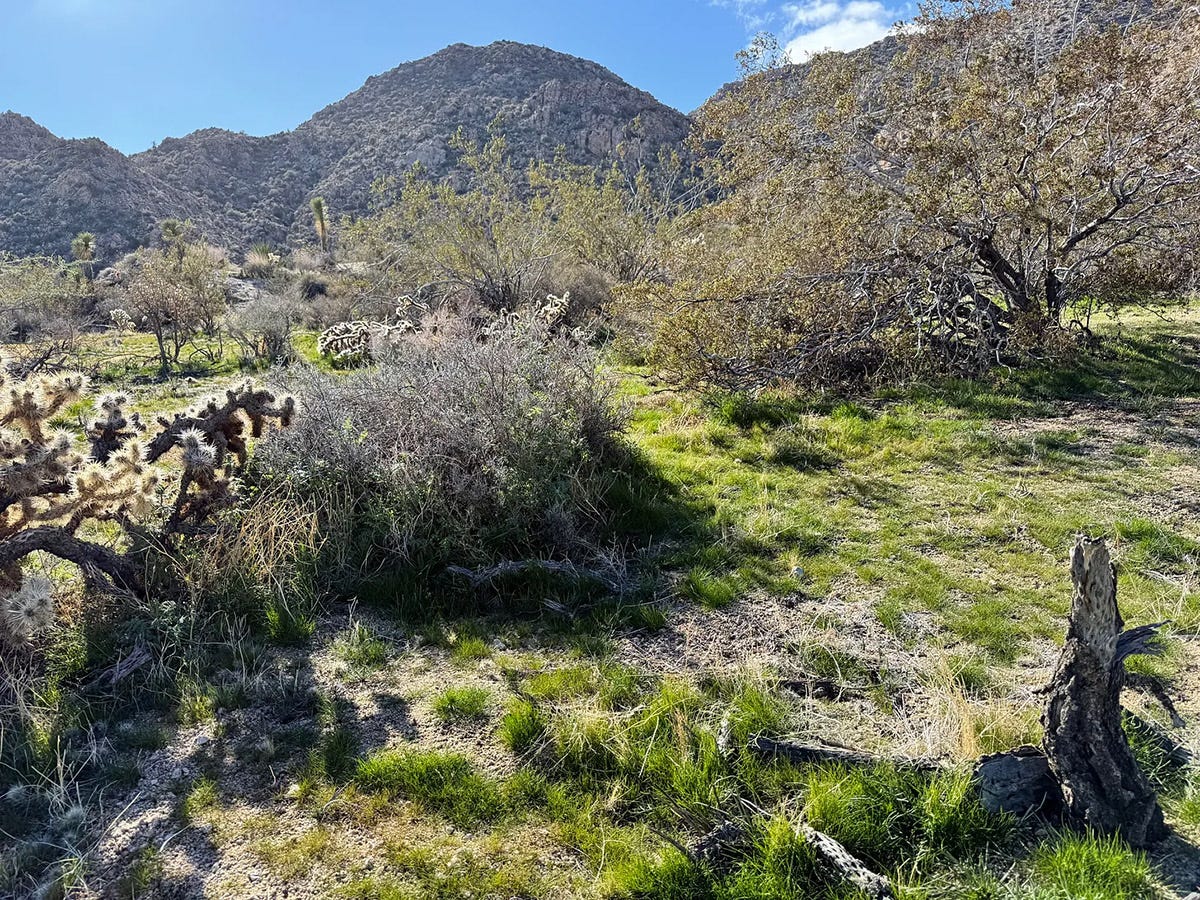
Perhaps the dream is still alive somewhere, but lawns are on the outs. Even self-assured AI can’t estimate the number of times that the phrase “kill your lawn” appears on the internet. We don’t bother with lawns here in the Hi Desert, yet grasses have crept into our lives, as testified by the verdant shadows creeping over the desert floor this winter.
To keep itself plush enough to become a wall-to-wall yard carpet, lawn grasses were selected for their ability to fill themselves in. First they knock down any plant competition by bombing the ground with wind-dispersed seed, then bring it on home with a root system that spreads laterally just below the surface. New growth can pop up anywhere along the root pathways, and the dense subterranean network creates a fibrous mat that prohibits water percolation, effectively starving out other plants.
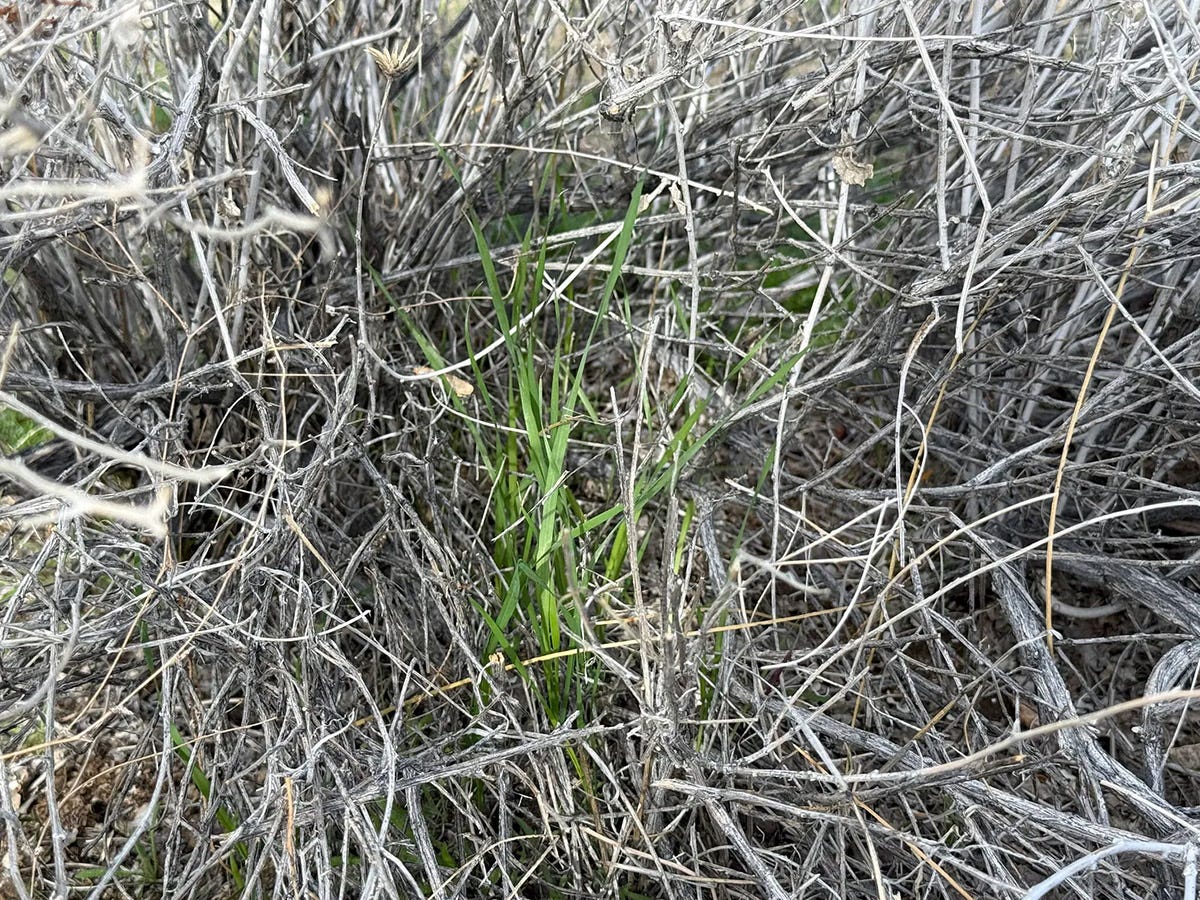
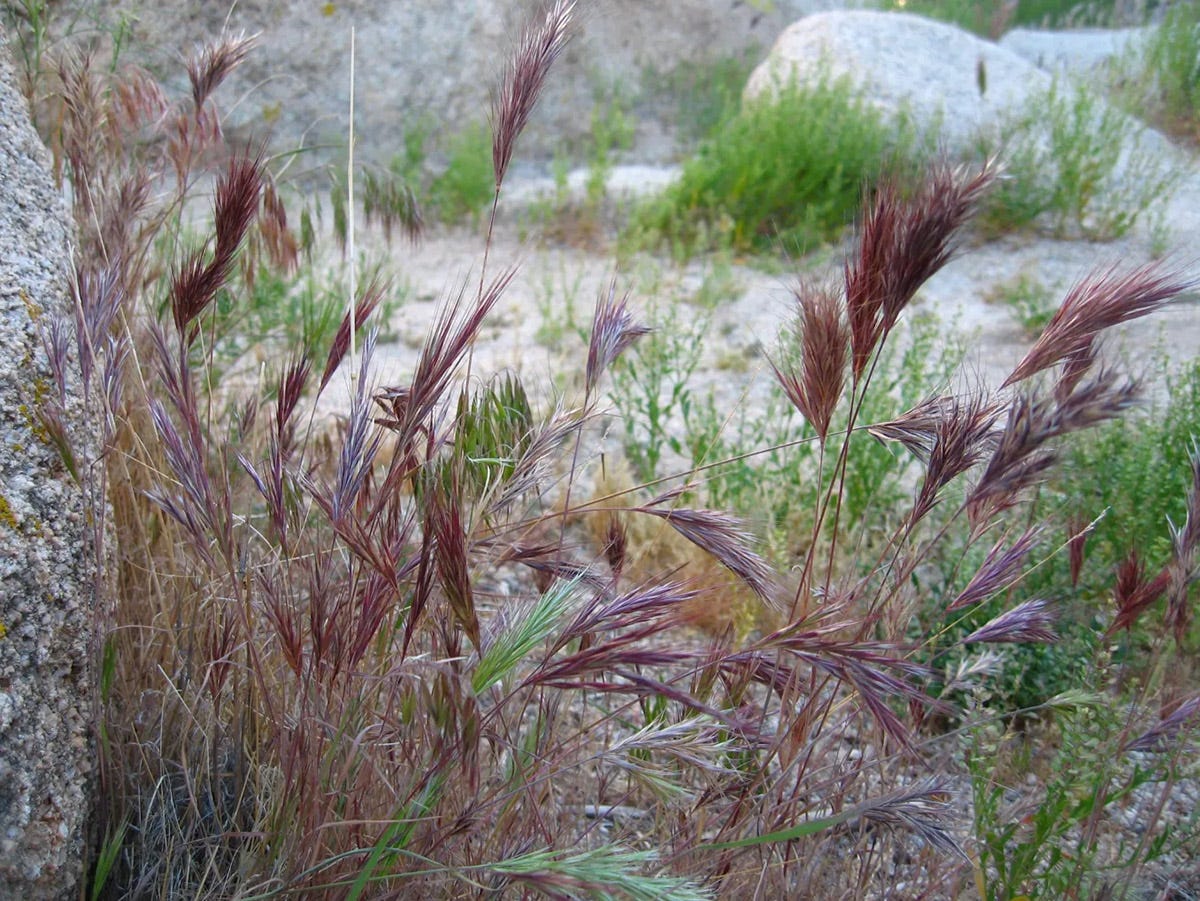
One hundred years before lawns became synonymous with norms, Joshua trees were harvested for livestock fenceposts and cattle roamed the west freely. As these four-legged tractors of yesteryear busied themselves overgrazing and trampling land, three botanical nightmares, red brome (Bromus madritensis ssp. rubens), cheatgrass (Bromus tectorum), and ripgut brome (Bromus diandrus) arrived in California, purportedly in contaminated grain. The bovine- degraded soil was beyond perfection for an explosion of these bromes.
Their seeds masterfully barb socks, worm their way so deeply into pet fur that a wound can form, and tear the mucosal linings of tortoise orifices. It cleverly grows at the base of other plants, remaining unmolested and producing hundreds of seeds per plant. Like fellow black hats Russian thistle and Sahara mustard, bromes have developed resistance to herbicides.
Brimstone
Why the finger-wagging over ugly plants? Because invasives pose several existential threats. For one, they disrupt all levels of the food chain, although the ripple effect hasn’t fully reached us here at the tippy-top. More immediately, the live-fast-die-young credo of invasive plants has been turbocharged by our unusually heavy rainfalls and warm weather. A full season ahead of schedule, early generations are coming up around us—plants that dry to a crisp at the first real heat, and easily curl into flame when coaxed.
Anyone who witnessed the 2006 Sawtooth fire complex east of Pioneertown is left with a montage of unearthly impressions: daytime darkness punctuated by an eerie red halation denoting the sun, confused wildlife fleeing across roadways only to dissipate into clouds of smoke on the other side, emergency vehicles constantly flying past except for an eerie period of quiet when efforts halted because a voyeur sent a up drone to satisfy personal curiosity. These things can’t be unseen.
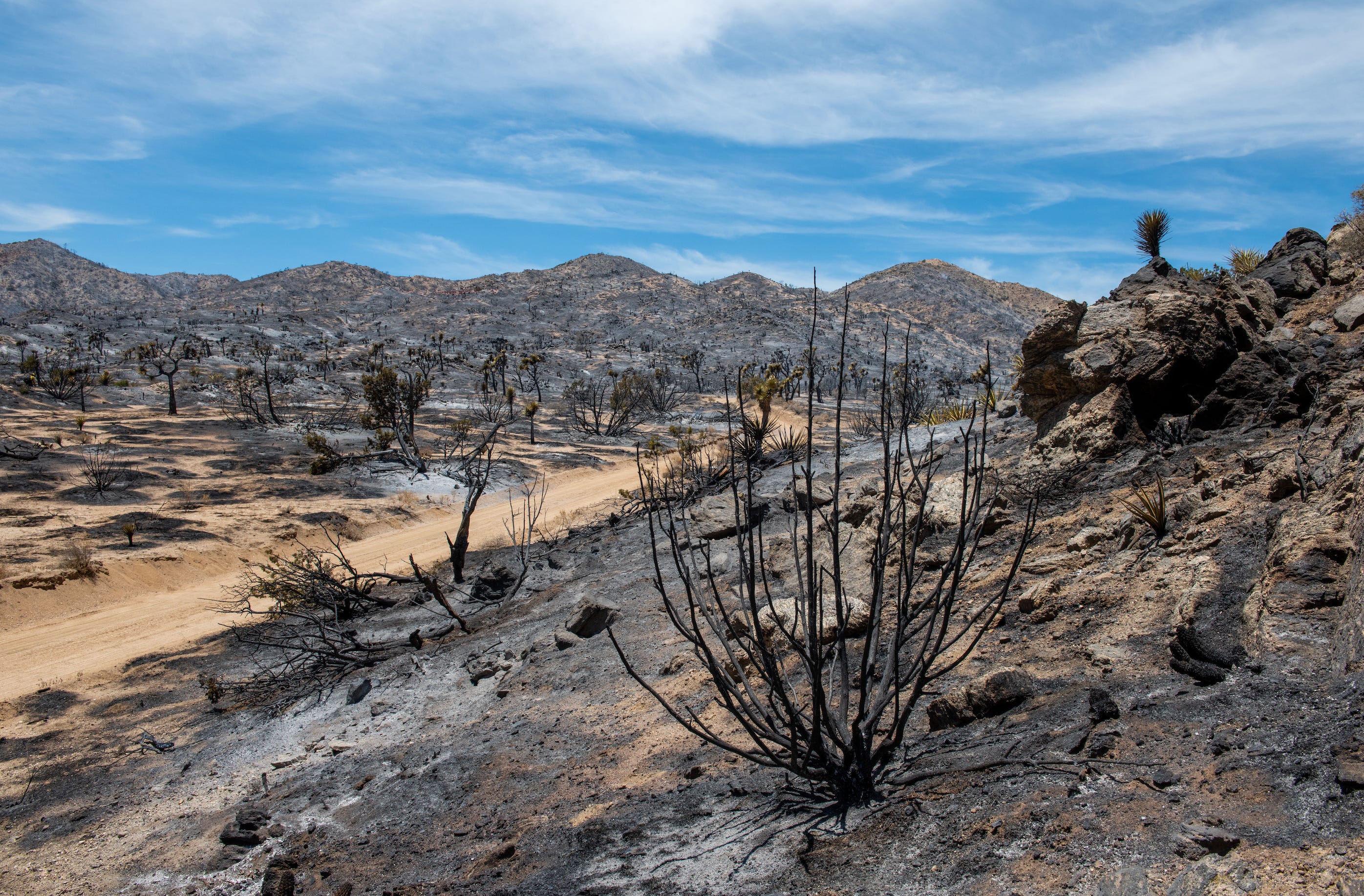
We fertilize invasive plants with nitrogen by burning fossil fuels: whereas desert natives, adapted to nutrient poor conditions, suffer from nitrogen enhancing emissions. We provide disturbed areas to act as invasive seed incubators, and we warp speed evolution by using herbicides that only show these plants how to become chemical-resistant super strains.
In return we get not one single word of thanks, just relentless whispers of gimme more. Blade, pollute, spray. And if you won’t do it for us, we’ll make the desert burn.
Moral of the Story
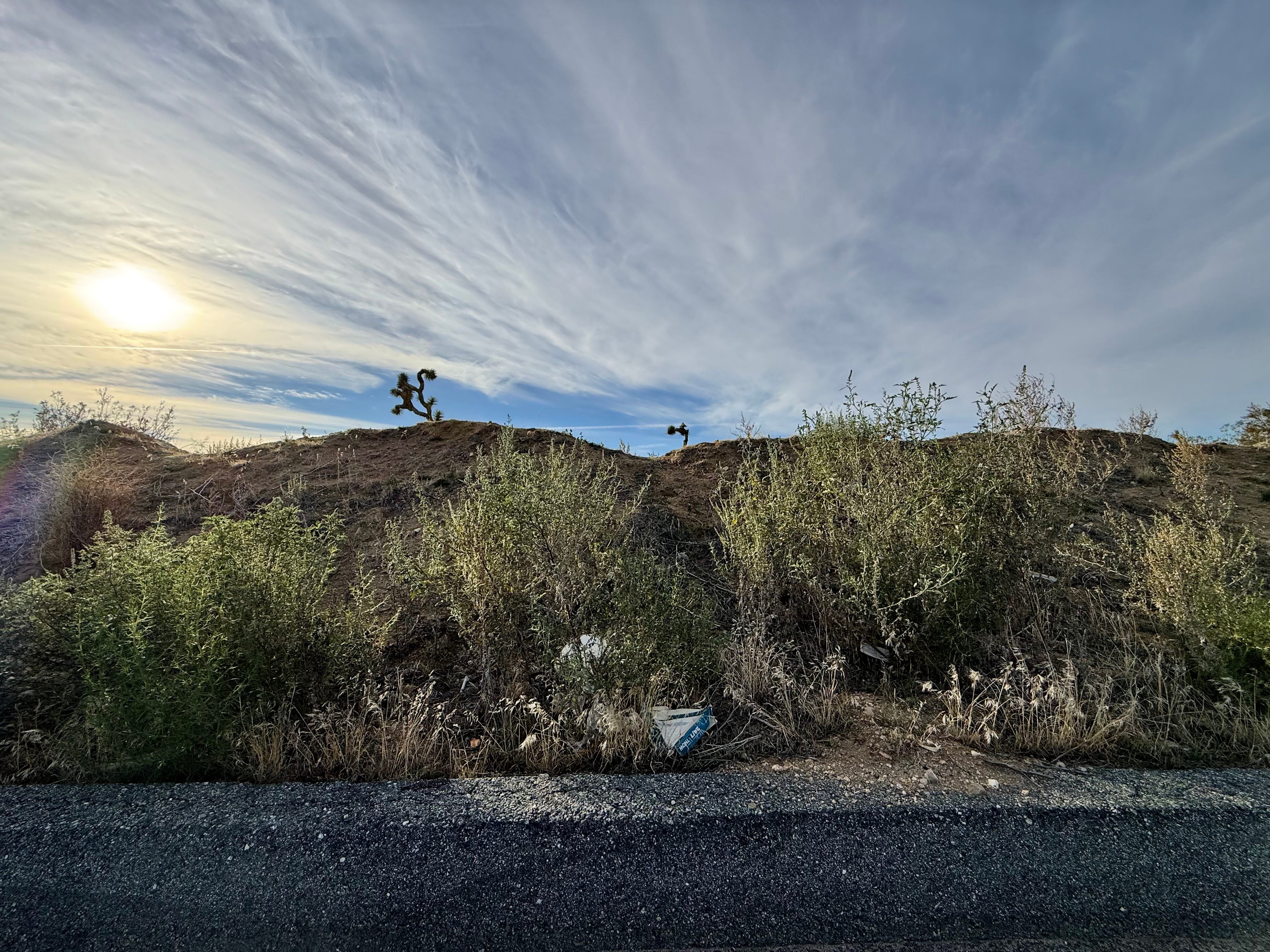
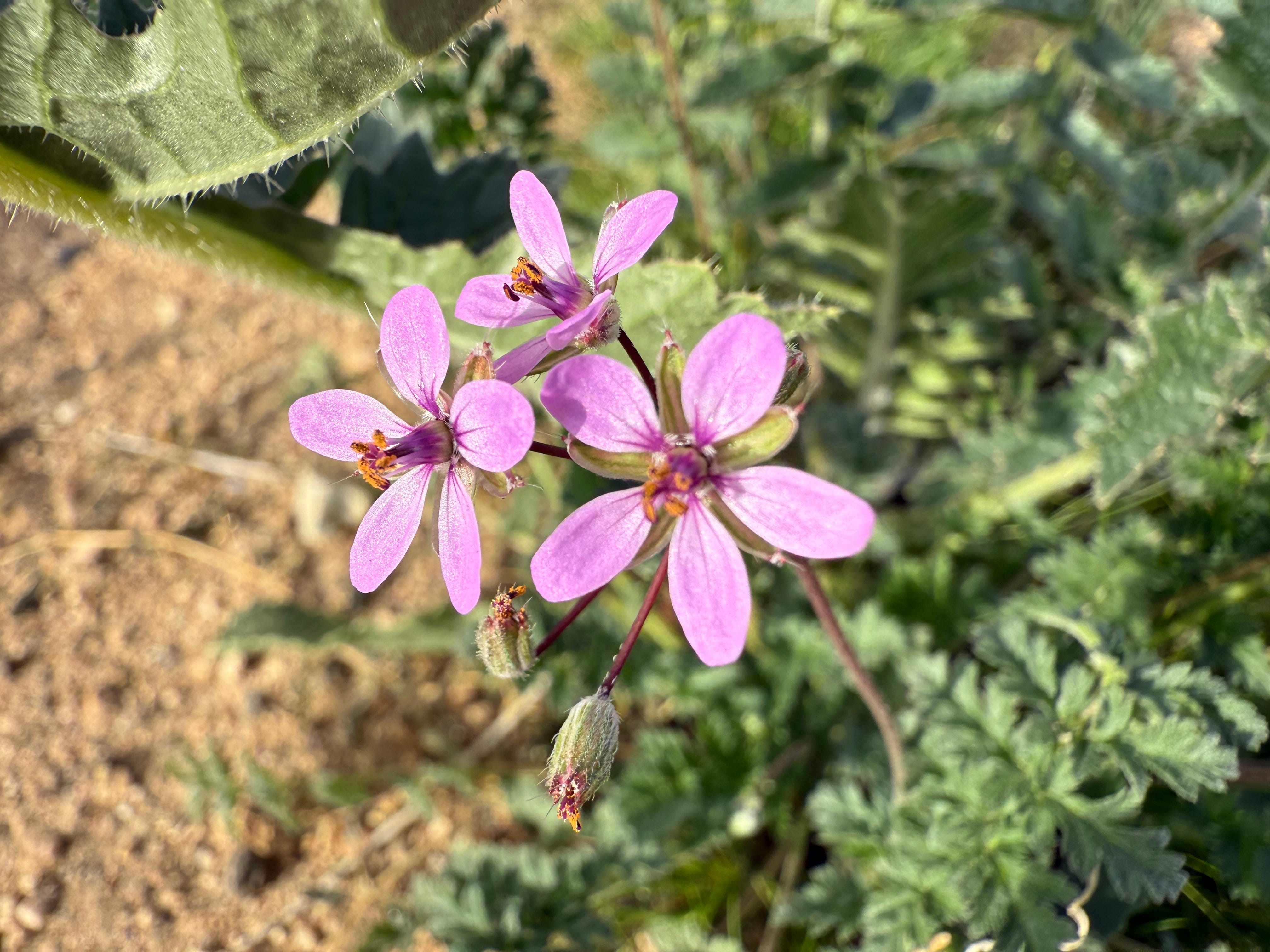
Tender green weeds often feel small and unthreatening…some even start off with a few pretty flowers. But to keep invasive plants from overtaking one’s space, there’s no better time for their removal than now, before they develop into seed silos with deep root systems that monopolize soil moisture. Waiting until summer means toiling in heat to hula hoe the now dry fire fuel, literally planting seeds in the process and giving rise to even bigger populations in years to follow. With well-timed efforts and early removal, the scale of the task will gradually subside over time, allowing native species to again claim their rightful place.
Thanks to our new paid subscribers, we are just $50 away from $8,000!! Be the subscriber to get us there! Upgrade your subscription from free to paid today for just $50 per year or $5 per month.
Are you able to give more than $100? Donate via Paypal!
Leave your thoughts in the comments below. Please note that we do not allow anonymous comments. Please be sure your first and last name is on your profile prior to commenting. Anonymous comments will be deleted.
Feel free to share this article!
Thanks to Miriam for the reminders for us long-term residents and for informing newer desert dwellers. MBCA also has a good page on invasive plants: https://www.mbconservation.org/invasive_plants_2. When pulling them, and especially as invasive plants get close to flowering and seeding, dispose in plastic garbage bags to keep those potential new plants contained!
I so appreciated all of this -- especially given the overwhelming task before all of us in this unusual winter of our weedy discontent.