
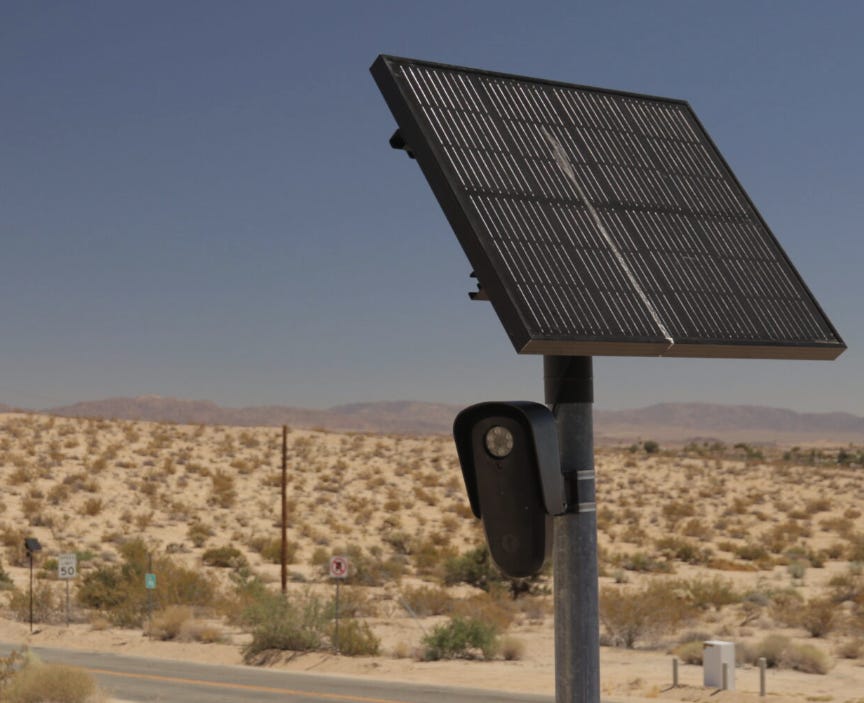
Consider showing up to the Roundtable discussion about AI-powered Flock surveillance cameras, organized by Twentynine Palms Mayor Pro Tem Octavious Scott, Thursday, July 9, 4:30-6pm at the Luckie Park Activity Center, 74325 Joe Davis Drive. (Note the location as it was moved and is NOT being held at City Hall.)
A community group has formed in opposition to Flock cameras, their website is https://deflock29.org/.
Do you have concerns about Flock cameras?
By Stacey Solie
What if the government were to give you a location tracker to put around your wrist and your child’s wrist?
What if the tracker can be upgraded remotely to also record your voice and image?
What if the government says, “If you’re not doing anything wrong, you have nothing to worry about”?
What if the government initially gives it to you for free, but later requires you to pay for the tracking device?
What if the device tracks when you go to the church, the casino, and the shooting range?
What if the government gives data about your child to a corporation that is also selling that data?
What if the tracker seems similar to what phones and watches are already doing, except that for the government to access phone and watch data they have to show probable cause and get a warrant signed by a judge?
What if you are going through a bitter divorce and your soon-to-be-ex-wife pays for access to all of your personal data and sorts through it to make you look bad in the custody battle, but you can’t afford the fee for her data?
What if the storage of this intimate data requires sprawling warehouses that deplete public water and electricity—and are also super loud and your property values plummet?
What if CEOs are revising contracts to claim the right to use and sell your data after the contract ends?
What if providing data access to the feds is against state sovereignty laws and opens your city up to costly lawsuits?
What if in the next election someone you don’t like becomes President, and the tracker is used to arrest your teenager because something they said pissed off somebody in government?
What if your PTSD came from a war fought to protect American values—like the Fourth Amendment right to be secure against unreasonable searches without a warrant?
What if cities like Mountain View and Los Altos, where the people who own Big Tech companies live and work, are cancelling their contracts with surveillance companies? What do they know that we don’t?
Questions for the San Bernardino Sheriff’s Department about Flock
By Elliot Balsey
When the San Bernardino Sheriff’s Department (SBSD) presented information about this system to the Twentynine Palms City Council on November 12, 2024, it was described as a three-phase rollout. Phase 1 is now complete with 31 cameras. How many cameras are planned for Phases 2 and 3, and what is the timeline?
Why has SBSD chosen not to enable the Flock Transparency Portal? Many other agencies have enabled this to help build community trust. Examples: San Diego PD, Kings County SO, Kern County SO
In 2025, Flock announced that all license-plate reader (LPR) cameras would receive a free upgrade to stream live video. Has your agency enabled this feature, or do you plan to?
Is an officer allowed to share their Flock password with a law enforcement officer from another agency? If not, how would you be able to detect if this happened?
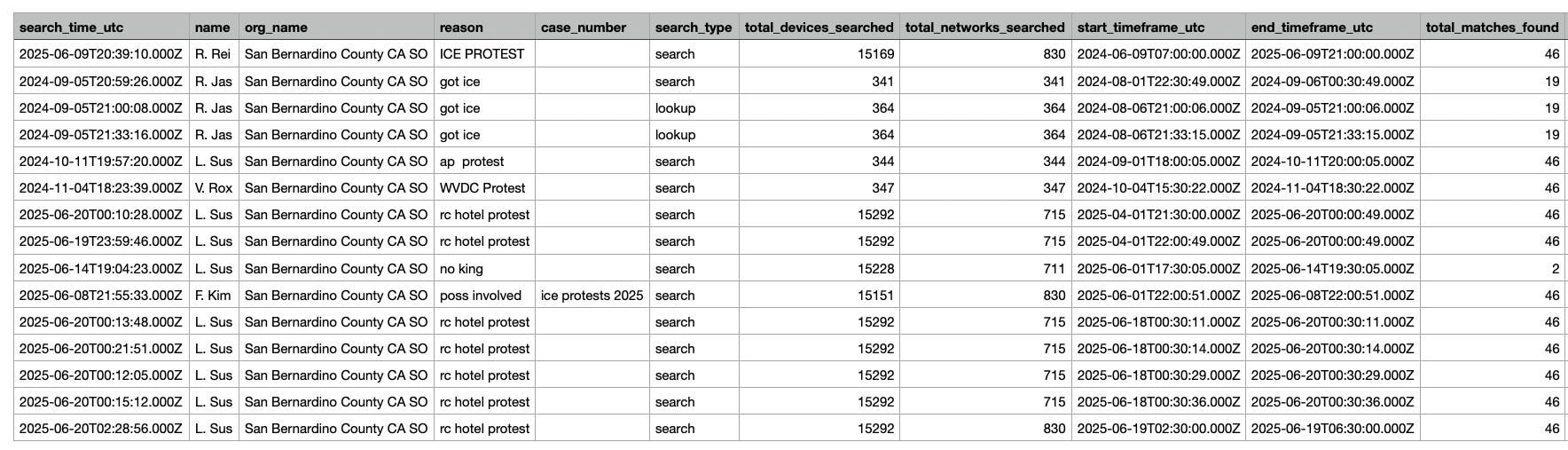
Network audit logs show 57% of searches run by SBSD officers do not include a criminal case number. Why?1
What mechanisms are in place to prevent officers from performing inappropriate searches, and how is this audited? Examples from Institute for Justice. Notably, some of these abuses were discovered only after victims checked the audit logs at haveibeenflocked.com.
What is your agency’s policy on sharing Flock data with other agencies? If you discovered that Flock shared your data in violation of that policy, how would you respond? I found this policy from 2018, but it’s outdated and lacking several required details according to California code § 1798.90.53.
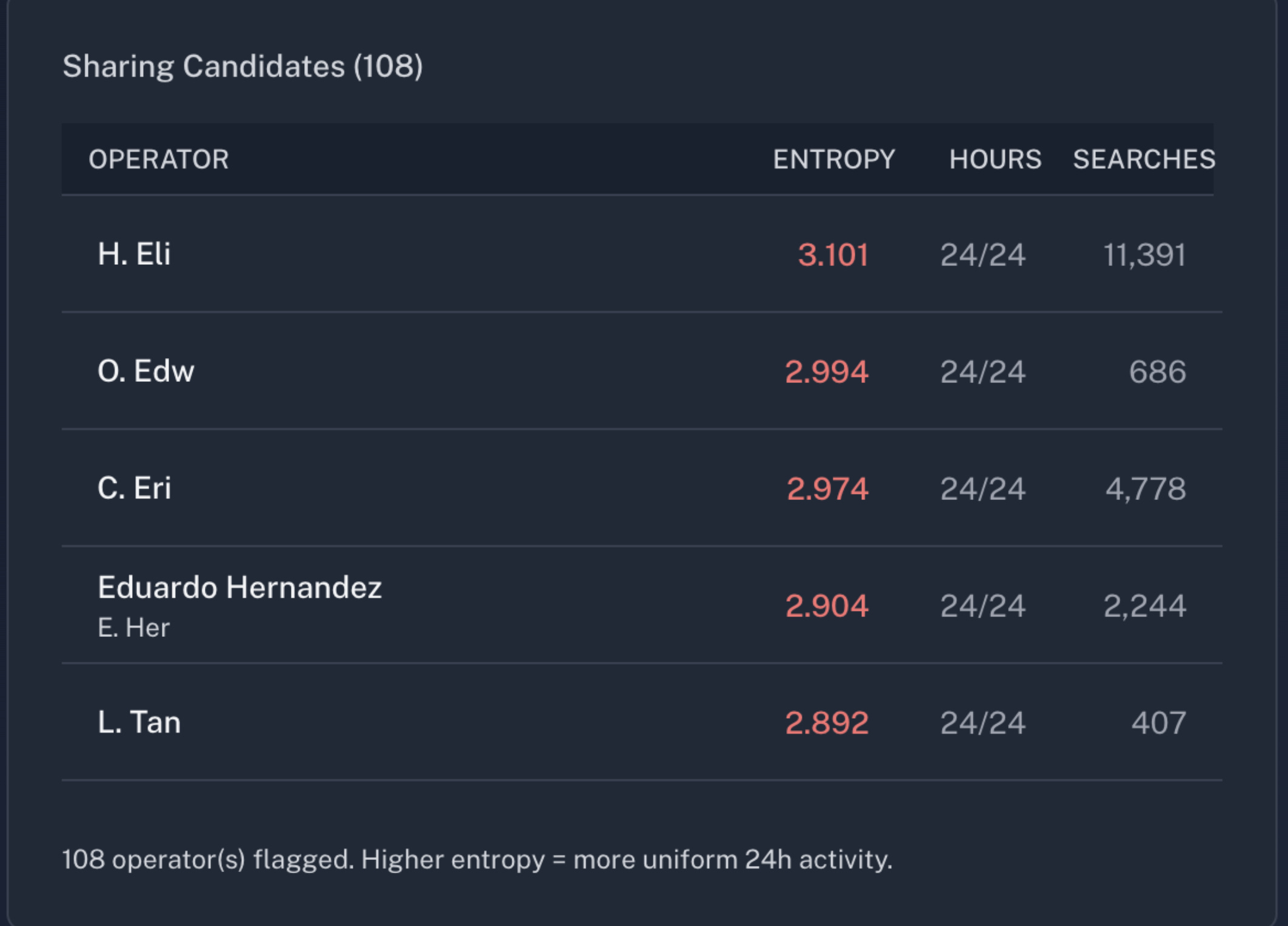
Why do the audit logs show several SBSD officers running searches 24 hours a day?
Why did your agency run a Flock search for “ICE PROTEST” on June 9, 2025 — the same day as a peaceful protest in San Bernardino? And another search for “no king” on June 14? Political protest is legally protected by the First Amendment.
Does the Flock system create a heat map (pattern of life) of a vehicle movement using the multiple aggregated images for a specific searched vehicle? (In April 2026, in Oshkosh, Flock said no. Police Chief Dean Smith proved them wrong by simply looking at the tools. Flock’s own product trainers are on video explaining this feature and calling it “the heat map that you know and love.”)
Assuming SBSD opts out of all data sharing, if federal agencies like the Department of Justice or Department of Homeland Security serve a secret subpoena demanding access to the database, would Flock comply? What if that demand was accompanied by a gag order?2
We have filed numerous records requests with SBSD for Flock network audit logs. Under CPRA government code § 7922.535(a) you are required to respond within 10 days with an estimated date when the records will be available. It’s been over four months, and you have not responded. Why? Without this data, we cannot verify Flock’s claims that they’ve disabled sharing outside California. 26-5814, 26-11951, 26-11952, 26-11970
Possible improvements
If we must have LPRs, here are some potential compromises to make the system safer.
All user accounts must use MFA (multi-factor authentication) to prevent password sharing and hacking
All images and metadata should be end-to-end encrypted so that nobody other than local law enforcement officers can access it (including Flock employees). This is how Apple HomeKit Secure Video cameras work. Encryption is different than a policy choice that is subject to change; it’s a technological design that makes it impossible for any third party (including the manufacturer) to see the video.
All images and derived metadata must be destroyed within 3 minutes unless they match a hot list. New Hampshire has this law like this.
All searches must include a criminal case number.
All searches must be authorized by a judicial warrant.
Random spot checks on 5% of searches to verify case number is valid and relevant, to avoid reusing an old case number.
Data may not be shared with any other agency. If officers need to share information with neighboring agencies, they can use existing tools like APBs (all points bulletins), BOLOs (be on the lookout), radio, etc.
Audit logs shall be publicly available including officer’s name, timestamp, and search reason.
The software vendor shall maintain a warrant canary on its website to help inform the public in case the federal government demands data and issues a gag order.
Thanks to you, Desert Trumpet exceeded our $10,000 paid subscription goal!!!
Not a paid subscriber yet? Did you know that paid subscribers receive discounts on our DT Social events and invites to DT Front Porch, intimate discussions featuring local officials and notable residents?
Upgrade to a $50+ paid subscription for a 10% discount.
Upgrade to $100+ for a 25% discount.
Sustaining subscribers at the $250+ level and above receive complementary tickets.
Share your thoughts in the comments below. Please note that we do not allow anonymous comments. Please be sure your first and last name is on your profile prior to commenting. Anonymous comments will be deleted.
Share this post—it’s free!
The only way to guarantee this doesn’t happen is to not collect the data in the first place. This wouldn’t be the first time.
Excellent questions Stacey and Elliot. Elliot, #5 needs to be point #1 and #4 to be #2.