Next Gen 29: Sara Lyons
The Vice Chair of the PAAC is inspired by Twentynine Palms' legacy as an oasis of murals and is a passionate advocate for creative expression.


How does one mark the generational change in a community?
For many years, Twentynine Palms has been governed by a mix of an “old boys club” consisting of descendants of the City’s founders and early residents and Marines who fell in love with the town in which they were stationed and stayed. But within the last year a shift has taken place as evidenced on the City bodies in which members are appointed by City Council. We thought our readers might want to meet this next generation of leadership, so we’ll be publishing profiles of them over the next several weeks under the heading Next Gen 29: Planning Commission Chair Jessica Cure, PAAC Vice Chair Sara Lyons; and TBID Vice Chair Ashton Ramsey.
Change is here.
Published profiles:
Planning Commission Vice Chair Alex Garcia
PAAC Chair Paul Razo
Public Art Advisory Commission (PAAC) Vice-Chair Sara Lyons is a multi-talented illustrator, muralist, musician, and co-owner of Scorpion Lollipop. She has been a resident of Twentynine Palms since 2022, when she and her husband Josh Grelock moved to the city from Anaheim. A self-taught illustrator, Lyons has done contract illustration and product design work for clients such as Mattel. Lyons was born in Walnut Creek, California, moved to Flagstaff when she was three, and grew up in Northern Arizona before moving to Orange County, where she attended high school. She first remembers coming to Twentynine Palms two decades ago when the city was known as an “oasis of murals in the desert.”
She and Josh opened Scorpion Lollipop—which carries a thoughtful selection of craft beer, wine, and other beverages as well as art and gift items—soon after they moved to the city. While she had had experience on difference sides of running a business, including product design, pop up retail, and wholesale, the store is the couples’ first foray into retail as business owners. Fans of craft beer, Lyons explained that “We had the idea that maybe in a couple years, once we settled in, we would open a beer store.” However, when they got an opportunity to open a shop in the Corner 62 building, they decided to jump on it. They had toyed with the idea of opening a store in Anaheim, but Lyons explained, “It wasn’t viable for various reasons. The community aspect also wouldn’t have been as strong. So we’re very fortunate to be in this space [Corner 62], to share it with this very specific group of people.”
As well as balancing her illustration and mural work, shop owner, and PAAC responsibilities, Lyons also is part of Rediscover 29, Twentynine Palms’ downtown business association. Being involved with the store enabled Lyons to quickly grow friendships and become an integral part of the rich community tapestry of Twentynine Palms. “People would always ask us, ‘How do you make friends when you move out here?’ And we’re like, open a business, because you will very quickly meet everybody,” she quipped.
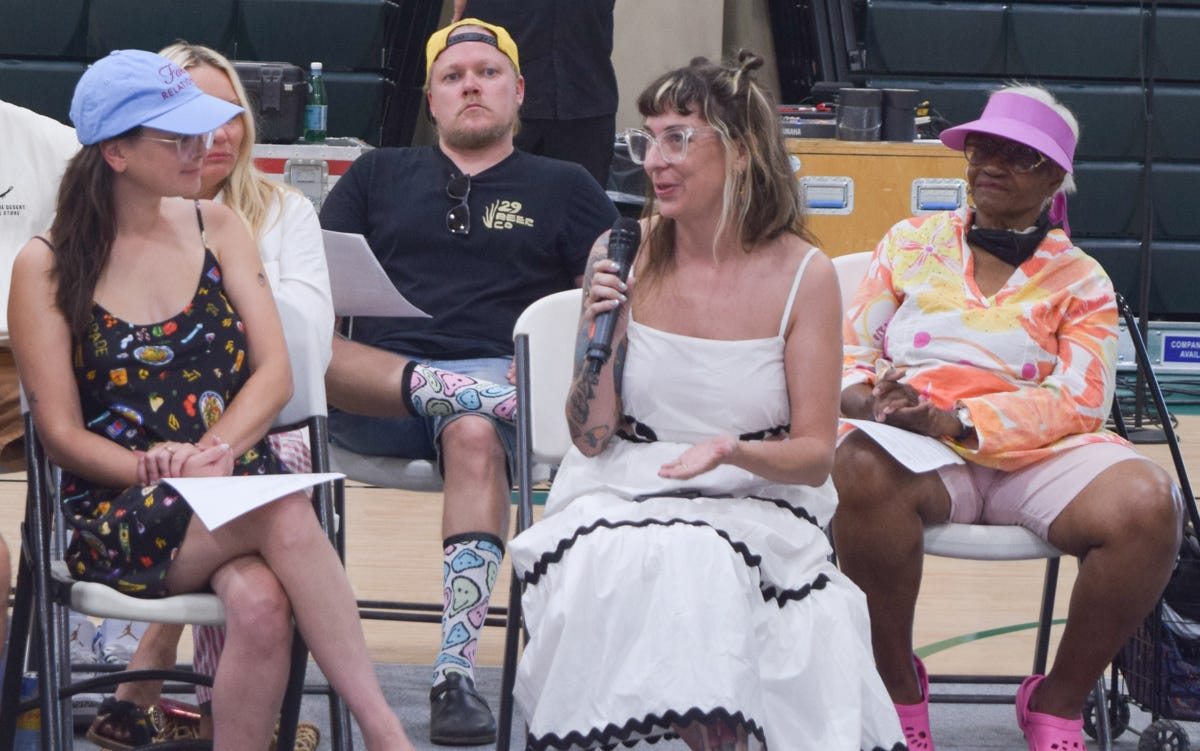
In her various roles, Lyons has been a familiar face at City Council and Planning Commission meetings, as well as Town Hall meetings organized by the Desert Trumpet. She often speaks to the importance of the arts, civic engagement, and the need for sustainable city policies and support for independent businesses to nurture a thriving community. Lyons has been an advocate for local businesses as the city continues to navigate entertainment licenses, speaking at the April 15, 2025 Planning Commission meeting:
I and other business owners would be interested to know how the city plans to use the money that they will be accruing through these fees. For example, like I said, we’re at Corner 62. If the initial permit is $250 that’s $1,000 just from our building to the City. I haven’t heard any discussion about how that money is going to be used as a member of Rediscover and as a PAAC member. I certainly have some ideas about where it could go…where is that money going to go, and how is it going to help our community continue to thrive?
As part of our Next Gen 29 series, the Desert Trumpet caught up with Lyons at Scorpion Lollipop about her role on the PAAC and her vision for public art in Twentynine Palms. Her answers have been edited and condensed for this article.
What motivated you to join the PAAC? Was it a natural outgrowth of being part of the community of Twentynine Palms?
I had been already involved in other community organization roles, like working with our nonprofit small business organization, Rediscover 29. I didn’t anticipate when I moved here I’d become really involved in community organizing. But, when there was an opening on the PAAC and Keith Gardner and Anna Stump suggested I join, it felt like a natural extension of what I was doing here at Scorpion Lollipop, and what I’m doing with Rediscover 29, where I’m currently the president. I’m really interested in getting all of these organizations, and also all of the various city entities, to hold hands and work together, to see more value in public art.
I’m so inspired by what LeeAnn Clark and Action 29 Palms did in the 90s with the murals that spearheaded the Oasis of Murals originally. And it seemed like at that time there was more support for public art coming from the city, though that public art project looks different than what is arresting and engaging and will help a community thrive today. I continue to be hopeful that we can get support from the city and the broader community to add to that patchwork that our community history has woven into it already.
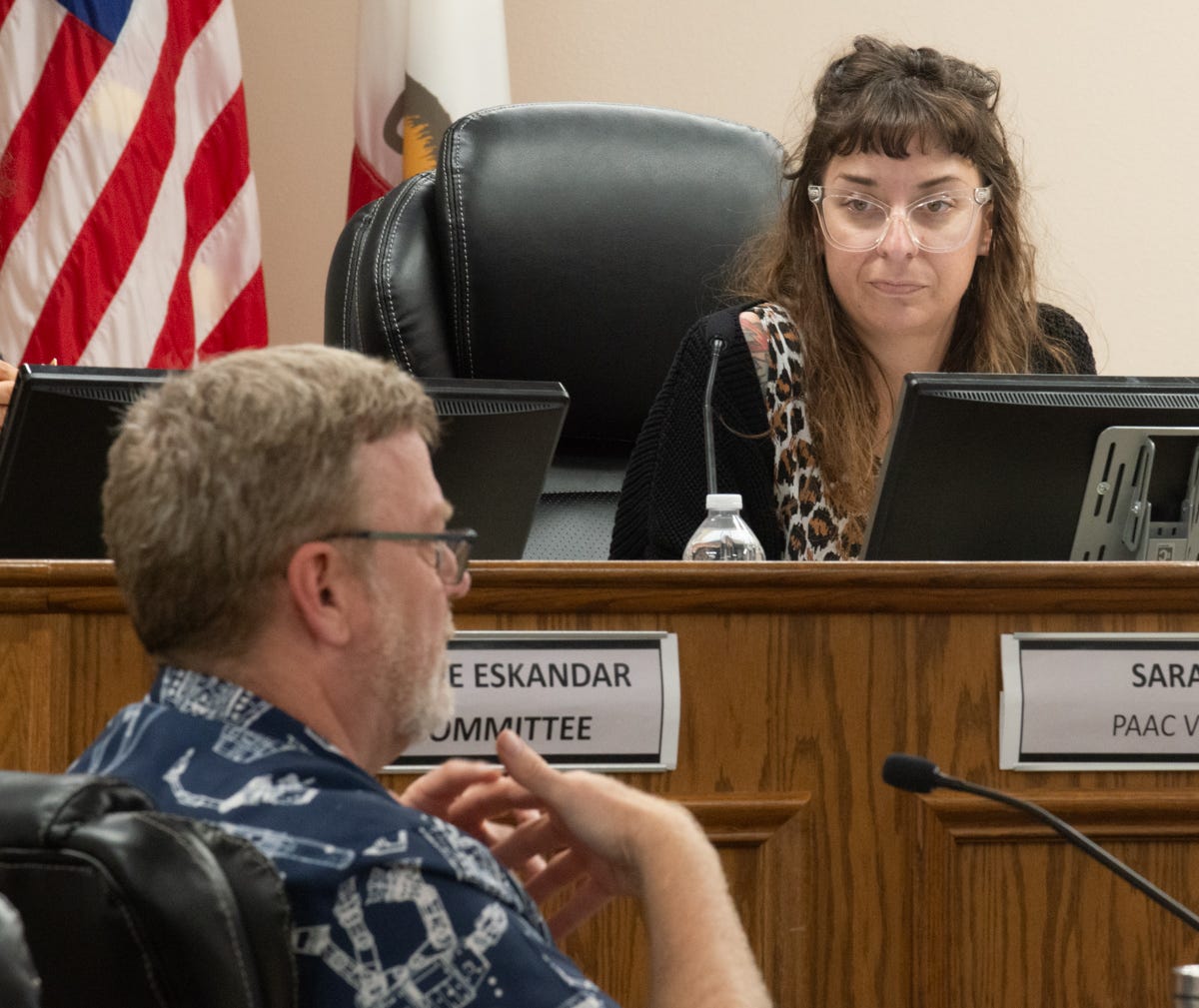
From where you sit, what role do you see the PAAC playing in Twentynine Palms?
We don’t have a ton of money to spend, but a great part of our role is taking that small amount of money that we do have and being able to award it to our various grant applicants every year. The biggest action that the PAAC can do right now is to provide that money back into the community and to let people know that the city sees value in creative arts programming.
Ideally, I think we are here to help facilitate the city and their planning. So, for example, building a more consistent brand identity for the city, making it so that the banners on the flagpoles all match and are beautiful. Branding can feel like a corporate thing, but people take so much pride when their community looks good, and when it feels like we understand the story that we’re telling as a city. And right now, that story is a little bit jumbled because there are a lot of different stories being told.
One of the other long-term goals of the PAAC is to help to amplify the voices of those community members whose stories are not being told. So for example, the drum that I beat is the murals. All of our murals are really beautiful, historic, and interesting, and they’re telling a particular story about Twentynine Palms. And they’re not telling a lot of the other stories about our community, such as our thriving Black community, the indigenous community that the land is on, and the contemporary community that is all of these amazing artists that we have here. Now, I don’t think every single mural that goes up needs to be telling a historic tale or giving you an educational lesson, but I’m really interested in how to weave all of these threads together.
Before being on the PAAC I’d never been involved in a city capacity before. Because as a PAAC member you are a city official, there are so many different hoops that you have to jump through that you don’t have to jump through if you’re just an individual trying to get something done, or if you’re a group trying to complete a project. So because of that, our role is a lot more administrative, like facilitating and strategizing. I do wish that we had more funding, because then we could be doing more actionable projects that you can see in the community.
This is not to say that the PAAC grant awardees aren’t doing impactful, community-based work, but not everyone may know about it. However, they do know about it if a big new mural goes up. And they notice when the Twentynine Palms exclamation point statue goes missing,1 or if it’s being proposed to be moved. And there are a lot of times people who wouldn’t say that public art is something that they care about, but then they’re really passionate about those instances. So, as the PAAC we hear those conversations. We try and make sure that we’re respecting the voices of the people who grew up here and whose families have been here for generations, and the people that just moved here, and the people that are coming here from the base, all of whom are trying to find community here.
How do you feel that the city can work toward all those different voices and experiences being lifted up or supported. Is it possible?
It’s difficult, because in a perfect world public art brings everybody together, because art is fun, being creative is fun, and expressing yourself is exciting. But unfortunately, it’s not that easy. It is a thin line to walk between feeling like you are being patronizing and feeling like you are actually reaching the communities that you’re not necessarily a part of in an effective way. And that’s a tricky path to walk for me as a white person on the PAAC. And so I do my best to try and be inclusive in the choices that we make.
I wish that the city, both as an entity and as a community, had more messaging to let people know about the resources that are available, of what everyone can come and take advantage of and that everybody is really welcome. How do we get people to feel that way?
What else do you hope to achieve with your role on the PAAC?
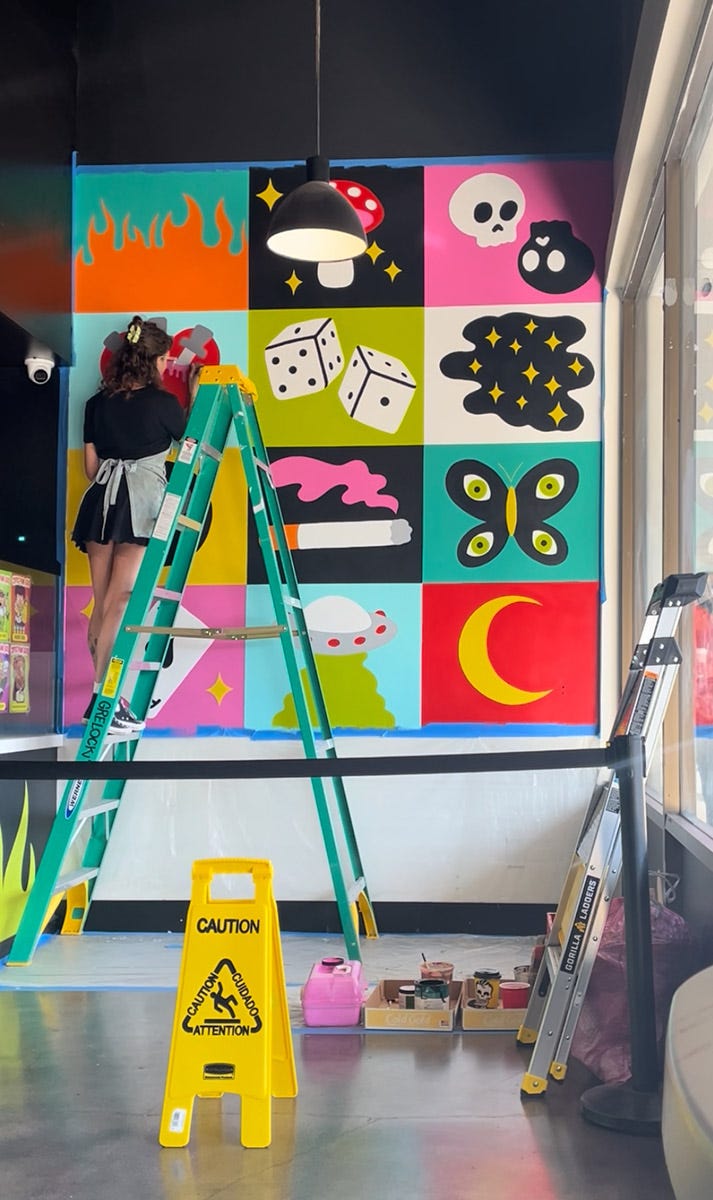
I’m all about small and manageable goals, and that’s what I try to achieve in my role with the PAAC. My goal is really to focus on the murals, because that’s such a huge part of the history of our community in more ways than one.
My dream would be that every year we get a new mural and we get a mural restored. Action 29 used to do things like community mural projects, a mural in a weekend, where the public could be involved. And that is something that is not only fun, but it helps people feel personally invested and feel civic pride. For example, right now the PAAC is trying to work on helping the skate park mural get either restored or replaced, because now we have the skate shop (at Corner 62), and there’s a huge skate community growing. The kids are at the skate park all the time, and they want to feel like they have a hand in this space that they spend all their time in.
That’s how I feel about public art in general. If you see it and you feel proud about it— just people felt like the 29! sculpture—they felt really passionately about it being gone, or it being powder coated, or it potentially being moved to the plaza. If you ask them, just outside of that conversation, what do you think about public art in the city? They would probably say, “I don’t care about it.” But they do care about it. It does enhance your life every day.
So I want to keep that room for expression whether murals, live performance, and entertainment. I think creative expression helps the community thrive.
What’s your vision for Twentynine Palms as a whole?
As a business owner, I walk a fine line between wanting things to really grow and thrive, and wanting things to stay exactly the way that they are. But one thing that I really believe in is connecting our communities between downtown and the Historic Plaza. I would really love to see the Adobe corridor become like an arts district—and that’s something that has to happen organically.
I would love for this city to be more hands-on in letting business owners know they can have a beautiful mural on your business, and they don’t have to have anyone approve it. Or if you are talking to the business owners that have these empty buildings, to see if we can get some open studio and shared creative space situations to be able to give people who don’t normally have the opportunity or the capital to be able to have a retail or studio space outside of their home. I would love for things like that to happen.
What I think makes Twentynine Palms so unique is that it has this creative spirit, and that’s expressed in so many different ways. And I would like that to continue to be a part of the heartbeat of the community. In order to continue to attract people who are also going to give back to the community in ways that bring quality, efficiency, and joy, the city needs to show that it values those qualities.
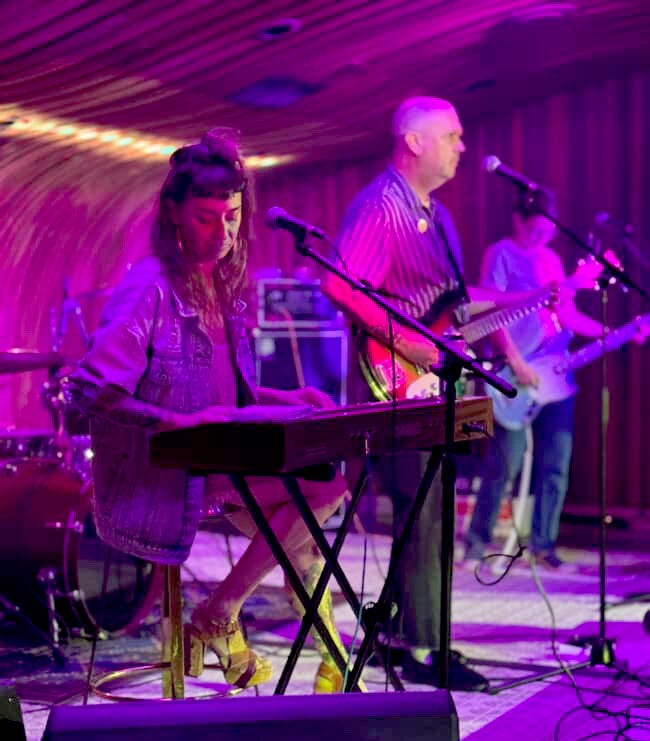
You’re an illustrator, a business owner, and a civic leader. What are you learning about yourself in the process of inhabiting all of these roles?
I don’t think that I would have believed it if you had told me when I moved here in 2022 that three years later I would be so involved in all these aspects of the community. I still think of myself as just a punk artist, but I feel much more positive and effective when I am doing things on a very local level in what feels like a hopeless greater landscape. My activism is very focused in my community in Twentynine Palms and that’s where I feel like I can be effective. Having so many balls in the air for me all the time helps me to feel like I actually am doing something to create actionable change, even if it isn’t something that changes the whole world. Small and manageable goals are my thing, and that’s what I’m trying to do.
For other people who might want to get involved and feel intimidated or overwhelmed, what would you recommend?
I tell people all the time: I have a high school education. I am just getting by. I’m flying by the seat of my pants. I never thought that someone like me would get to be in these roles and not only feel like people respect me, but actually feel like I have opinions that allow me to be worthy of respect.
I think that anybody can be involved on a civic level, and the easiest way to start is to just go to the city meetings. And the PAAC is a really easy one to go to because it’s extremely low drama, and sometimes it’s funny and fun. So I think going to City Hall, going to the City Council meetings, reading the Desert Trumpet and seeing the things that interest you, and then coming out to community events, that’s how to connect with people. If people want to get involved in the community, all you have to do is just go out and find your people.
Leave your thoughts in the comments below. Please note that we do not allow anonymous comments. Please be sure your first and last name is on your profile prior to commenting. Anonymous comments will be deleted.
Feel free to share this article!
Help us reach our 2025 goal of $10,000 in subscriptions! Upgrade to a paid subscription for just $5 per month or $50 per year.
Would you care to donate more than $100? Our Paypal account is up and running!
In 2024, the PAAC arranged for Chuck Caplinger’s 29! sculpture to be cleaned and repaired.
Thank you, Sara. I lived on Yucca Mesa for a few years and found that area, J. Tree and 29 to be filled with creative folks, some of whom had lived there for decades and some who were new-comers.
What a great read. It is awesome to see Sara Lyons and the PAAC getting well deserved attention.
I also liked how Sara mentioned that people often care more about art here than they think they do. Her examples were perfect. Another one that always comes to mind for me is the reaction when the Hastings bus mural came down. That wasn’t in the article, but it’s a great reminder that even when folks say they aren’t all that into art, they usually feel something when it changes or disappears.
And that last paragraph really sums it up. All you have to do is show up and listen. Once you do, you often realize you’ve got a voice in the conversation too.