
Opinion and Analysis: Councilmember Ramirez Answers Critics on the Sanctuary Church Resilience Center Grant. Not Everything Holds Up.
After a 2-2-1 vote, Ramirez took to Facebook to defend her process. We checked her claims against the record.

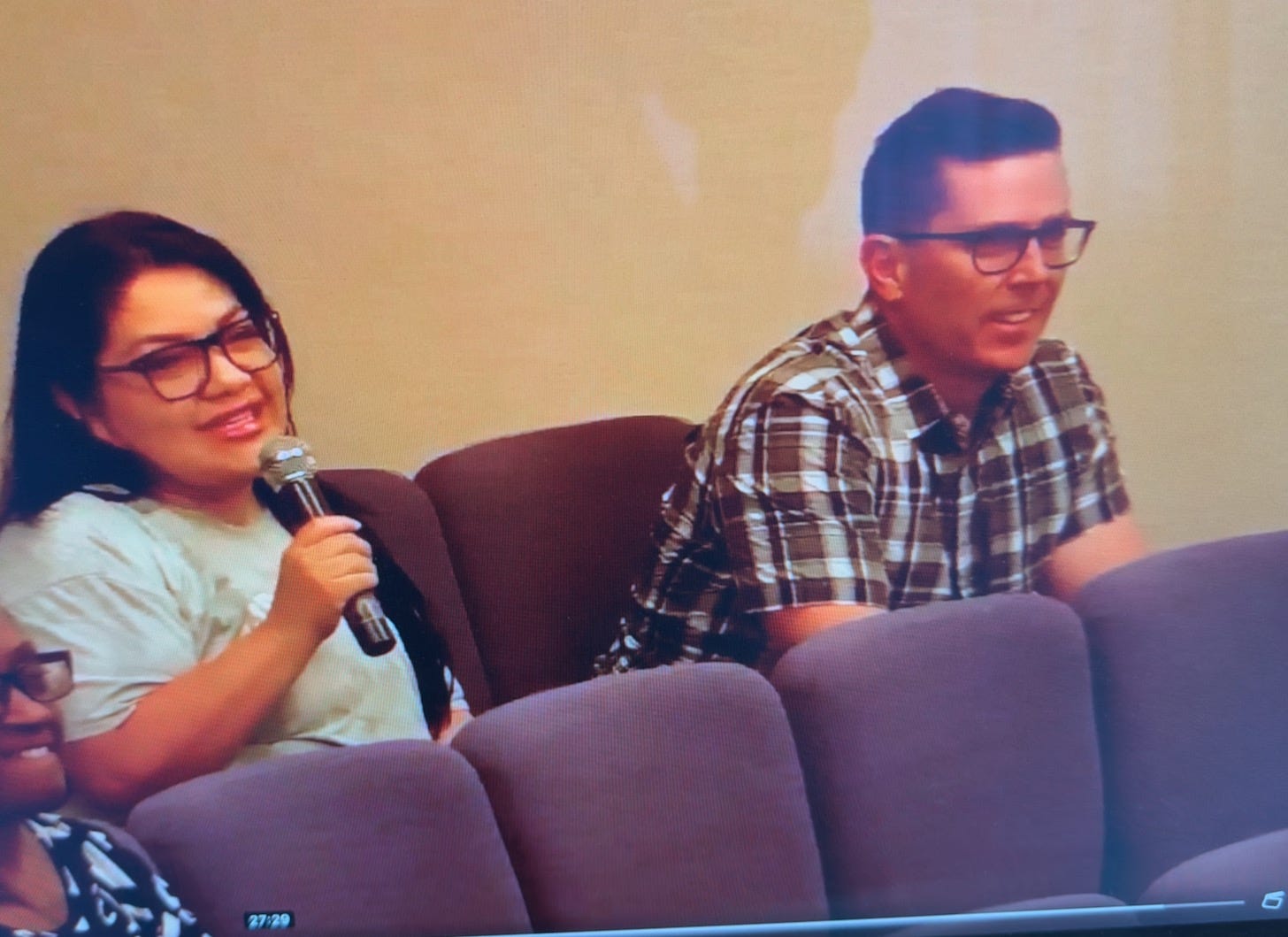
Less than two weeks after the Twentynine Palms City Council split 2-2-1 on whether to pursue a Community Resilience Center (CRC) grant in partnership with Sanctuary Church/Hope Center/Hope Project1 — which recently purchased the former Rite Aid building for $2.2 million — Councilmember April Ramirez published an extended statement on Facebook from her “Councilmember” account defending her handling of the process. We ran a transcription from screenshots of the statement and produced the pdf attached below.

As we pointed out in our recap of the July 28 meeting, the Council's discussion of the grant raised a bigger question: should general conventions — like Council approving which grants are pursued — be written into formal policy, so they can't be sidestepped? It also exposed a gap in City process: while the City has upgraded its vetting of nonprofits that apply for grant funds, it has no process for vetting potential City partners before they're brought to Council
Also, while the City now vets nonprofits applying for grant funds, it does not have a process for conducting a search for and evaluating potential nonprofit partners for government grants prior to being included in a staff report or presented at Council. Should Council institute a thorough and consistent process? Often information about nonprofits is verified through their federal 990 Income tax returns. Churches, however, are exempt from filing 990s. If a church and/or nonprofit funded by a church is vying to be a City partner for a government grant, should it be required to submit audited financial statements in lieu of 990s?
Is social media the best place to discuss the process issues that were apparent with this grant? Should Council do a public meeting discussing what took place?
Resident Lynette Ramirez (who is not related to Councilmember Ramirez) has argued for a Council code of conduct and consequences for ethical transgressions and breaches of decorum, such as those alleged to be present in Councilmember Ramirez's past social media postings and comments at Council meetings.
Again, I’m asking this Council to put a code of conduct and ethics with actual consequences in place. As long as one does not exist, every time this Council reminds citizens to conduct themselves professionally, remember this: you’re telling the public that the rules only apply to us, but not you.
The statement that Councilmember Ramirez posted on Facebook addressed accusations of process violations, her relationship with the Sanctuary Church, a disputed “$10 million to a church” claim, and a separate allegation that she retaliated against a resident. We examined several of these claims against the public record, including statements made on the dais by Mayor Daniel Mintz, our own prior reporting, and public real estate and municipal code records.
To be clear, our analysis examines the claims by Councilmember Ramirez in her Facebook statements and the process issues raised by her handling of the Community Resilience Center grant and the lack of vetting and transparency in her selection of a partner for the grant. With regard to the grant process itself, the Sanctuary Church / Hope Center appears to have been a bystander, and our primary focus is not on the church or its members and leadership.
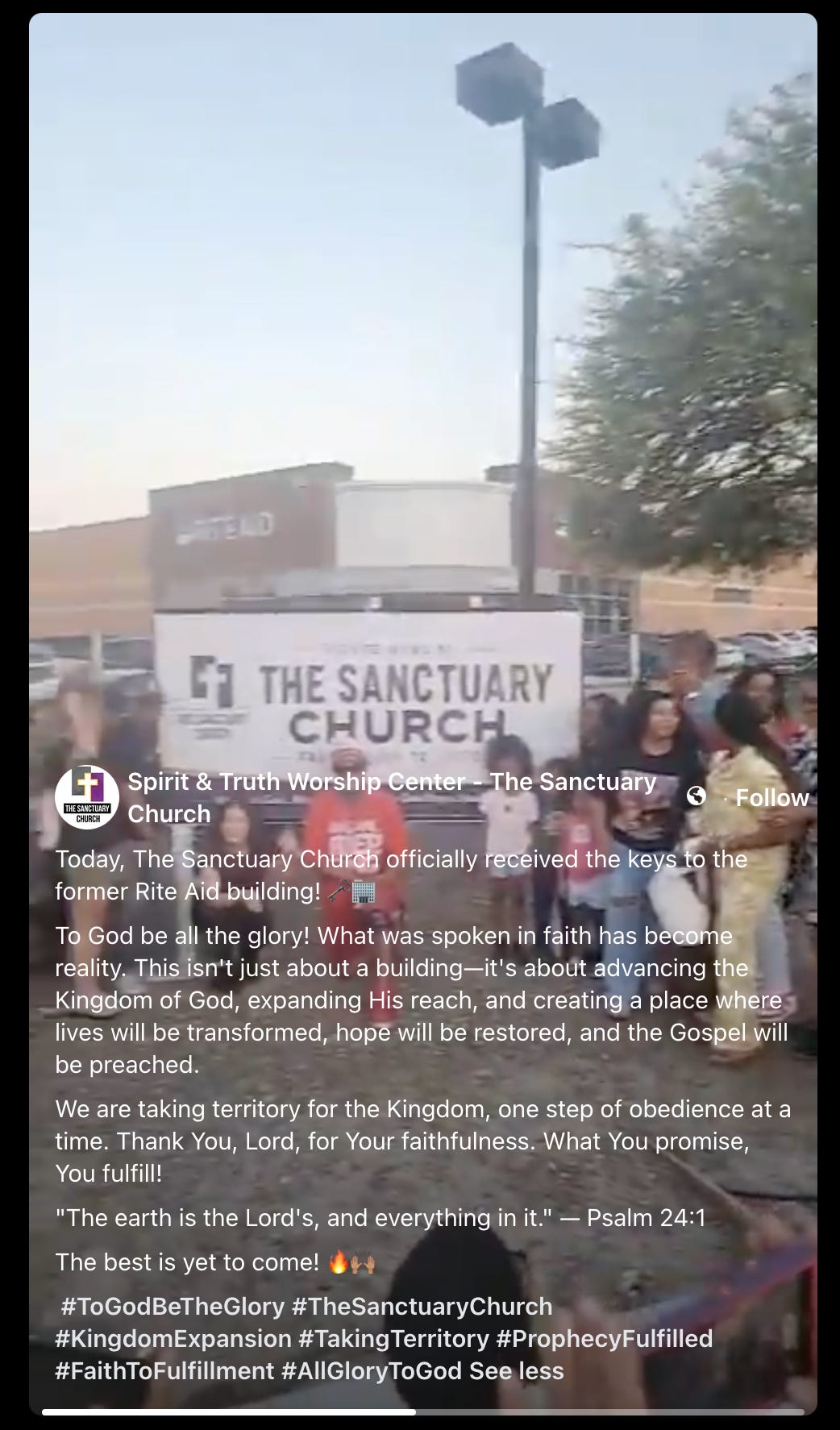
Several commenters on Facebook also pointed out issues in Councilmember Ramirez’s statement, with some raising First Amendment Establishment Clause concerns about the City potentially investing public grant funds in a building purchased to function as a church. A reel of an escrow closing celebration on July 6 or 7th makes no mention of a potential city partnership or community resilience center and is captioned:
…This isn’t just a building—it’s about advancing the Kingdom of God, expanding His reach, and creating a place where lives will be transformed, hope will be restored and the Gospel will be preached.
Councilmember Ramirez has not been shy about her own beliefs, posting the following on Facebook from her personal account: (Note: part of the text is a personal attack against a fellow Councilmember, and we’ve edited those sections out):
I AM BEING PERSECUTED FOR MY FAITH. (A CONSTITUTIONAL RIGHT) Remember this in November…
As an 🇺🇸 AMERICAN, it’s my First Amendment Right to go the church of my choice and praise whatever GOD I see fit. I will always praise God with every breath in my lungs, I will scream it from the mountain tops, and give ALLLLLLLL the glory to my Lord and Savior Jesus Christ…
She mentions a “PRA request” she claims was targeting a friend….
…This friendship is also centered around our Christian beliefs and love for God. We often go on walks and spend time in prayer. We do lots of fellowship, talk about the bible and do outreach ministry in our private time 🙏✝️.
All I know is this is not a weekly attack about difference in leadership styles. This is a weekly attack on my CONSTITUTIONAL RIGHT: Freedom of Religion, trying to control me via COERCION, and trying to hurt people who choose to practice Christianity in 29 PALMS.
I’m not the only Councilmember under attack for my faith, but I WILL BE the most vocal about it.
NO. WEAPON. FORMED. AGAINST. ME. SHALL. PROSOPER. (sic)
The post was accompanied by an image of a tattoo consisting of a slingshot and a reference to Psalm 144:1. The text of that Psalm, in which David looks back at a life of warfare is:
Blessed be the Lord, my rock, who trains my hands for war, and my fingers for battle.
Of course, everyone is free to practice their religious and spiritual beliefs in their personal lives and should a request for proposals (RFP) be issued, the Sanctuary Church/Hope Center can be evaluated as a prospective City partner alongside other places of worship and nonprofits in a competitive process. However, our analysis of Ramirez’s response to criticism of her position on the Community Center is taking place at a moment when the Church appears to be making a move to amass power on Council by running candidates in the upcoming City Council election. Or as one of the hashtags in the celebration reel reads: #TakingTerritory.
Our Analysis
“Nothing Was Approved That Evening”
Councilmember Ramirez’s Facebook statement opens by noting that the July 28 agenda item was “a recommendation, not an approval,” that no grant was awarded and no contract executed. This undersells her own role in the process.
The staff report inside that same agenda packet credits Ramirez with bringing the resilience center grant opportunity to then-City Manager Stone James and the City’s grant-writing team, California Consulting. And at the meeting, it was Ramirez who made the motion to pursue the grant. When Councilmember Steven Bilderain expressed confusion about what “moving forward” would actually mean, Ramirez clarified she meant continuing the work already underway:
[We’re going to] continue the months of work that Stone James put into this... We told him go within your purchasing agreement. Go and do the things, and then we go and do the things, and we have all of these organizations and community leaders coming out to do it.
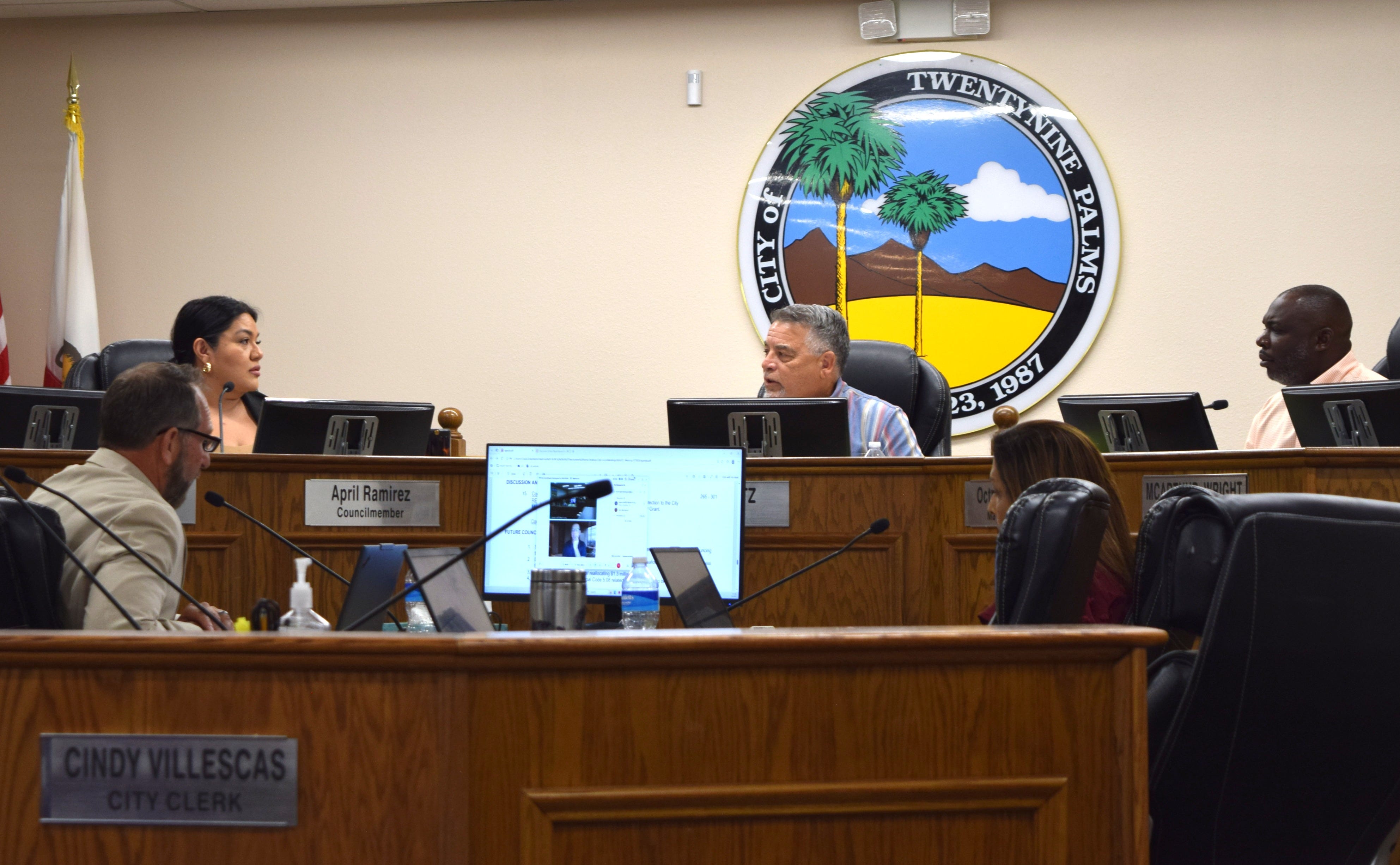
Bilderain then seconded her motion. When the vote was cast with Ramirez and Bilderain in favor, Mayor Mintz and Mayor Pro Tem Scott opposed and Councilmember McArthur Wright abstained, City Clerk Cindy Villescas clarified why it didn't carry: "You have to have three in order for it to carry." The motion had failed 2-2-1.
So while it's true that nothing was formally approved that night, it’s not because the item was just an “idea” as claimed by Ramirez, it’s because her own motion to proceed on the project she initiated didn't get the votes it needed. The motion’s failure doesn't erase the process issues that led two Councilmembers to vote no and a third to abstain.
“The ONLY Certified Shelter Partner”
Ramirez's central justification for choosing Sanctuary Church rests on a claim of exclusivity. In her own words:
The Hope Center2 was the ONLY organization whose volunteers completed ALL the required certifications…To my knowledge, it is currently the ONLY American Red Cross-certified shelter partner in the Morongo Basin capable of LEGALLY serving in that role.
That claim doesn’t hold up. A source with direct knowledge of Red Cross shelter operations told the Desert Trumpet:
The statement that partnering with a single local nonprofit is the only way to bring Red Cross emergency services into the community is simply not how the Red Cross operates.…I’ve never seen a policy requiring one specific nonprofit to serve as the gateway for Red Cross disaster services in a community.
The same source noted that shelter-training courses are open to the public, and completing one doesn’t qualify someone to independently staff a shelter during an actual disaster.
The Red Cross’s own published materials bear this out. Sheltering runs on individual Shelter/Facility Use Agreements signed with specific facility owners such as schools, churches, community centers, with each agreement applying only when the Red Cross itself requests the space and manages the operation. The Archdiocese of Los Angeles's own emergency-response policy describes this arrangement: a location "may permit the nonexclusive use of its premises by the Red Cross" — explicit language confirming there's no exclusive designation involved.
Multiple denominations, including the LDS Church and the Los Angeles Archdiocese, maintain standing templates for exactly this.3 The term “certified shelter partner” appears nowhere in Red Cross materials.
We’re in the midst of our summer subscription drive! Help the Desert Trumpet reach 1600 subscribers by subscribing today!
In support of her own claim, Ramirez posted excerpts from the American Red Cross Sheltering Handbook and a summary describing Red Cross shelter operations as governed by “an internal organizational operating policy and standard.” The excerpts she posted, which covered how shelter managers handle in-kind donations, procure supplies, and request additional staff, describe general internal Red Cross procedures for operating a shelter. None of it establishes an exclusivity requirement, a regional certification limit, or any rule that only one local nonprofit may serve as a Red Cross partner in a given area.
If anything, the material undercuts her claim further: it describes local governments or host facilities, including churches, partnering with the Red Cross under formal agreements where the Red Cross itself supplies trained supervision — a description of how a facility hosts Red Cross operations, not evidence of a single certified regional gatekeeper.
The sole sign-up contact
The training that likely produced Sanctuary Church’s certified volunteers adds one more detail complicating Ramirez’s account. On August 14, 2025, the Red Cross of San Bernardino County announced a free, public Shelter Fundamentals training in Twentynine Palms for August 16 — an entry-level course open to any community member, framed as volunteer recruitment, with sign-ups directed to Ramirez’s own City email address.4 That Sanctuary Church’s volunteers were “the ONLY organization whose volunteers completed ALL the required certifications” describes who attended a public class Ramirez was personally routing signups for, not any Red Cross rule limiting who could attend.
“Not $10 Million to a Church”
Ramirez called it a "myth" that the City was "giving $10 million to a church," noting the grant funds would go to the City, not directly to Sanctuary Church. That's technically true, the City would cut the checks. But it sidesteps the substance of the concern: that the church's own newly purchased building was the intended site, with a long-term use agreement yet to be written and a two mortgages to be paid.
Real estate records confirm the purchase price at $2.2 million, financed through two concurrent mortgages totaling $1,570,000, recorded the same day as the sale.
Renovation dollars spent making part of the Rite Aid building usable as a "community resilience center" would necessarily add value to a structure owned by the Sanctuary Church and not by City. Public grant dollars used to improve a privately held, heavily leveraged asset raises questions about wise investment that are more pressing than whether the checks are written by the City or the church.
“Council Members Were Briefed”
This is where Ramirez’s account runs most directly into the public record. She wrote:
Each Council member has regular one-on-one meetings with the City Manager. My understanding is that Council members were briefed5 regarding this project before it appeared on the agenda.
Mayor Mintz’s own words at the July 28 meeting say otherwise. Asked about the City’s grant-writing consultant’s involvement, Mintz said:
What are you talking about? I never implemented this…I never knew we were specifically trying to get a grant for the Hope Project for this resilience center.
And on where the authority to pursue grants actually sits, Mayor Mintz said:
That’s our job is to direct staff as far as what grants we want to pursue. Now, if you use monies to find out what grants were available, is one thing. But the City Manager cannot say we’re going to get this grant, especially [when] this is going to cost $50,000.
We have also confirmed that Mayor Pro Tem Octavious Scott first learned of the grant and choice of partner when the agenda was released on July 23.
This timeline matters. The California Strategic Growth Council's grant guidelines were released at the end of April 2026. Yet, Ramirez didn't bring the item to a Council agenda until mid-July, after the church closed escrow on the Rite Aid building on July 6.
Had Council been informed of the grant and given the opportunity to vote on pursuing it in early May, there would have been time to issue an RFP and evaluate the Sanctuary Church alongside other qualified partners. The Council could then have approved one or more partners in time to meet planning grant deadline of September 4, the grant that sets the City up for a successful implementation grant in the next round. Instead, the staff report recommended the more complicated implementation grant with a September 25 deadline that would supply the church with renovation funds on a shorter timeline if granted.
Disclosure: I serve as a former chair of the Public Arts Advisory Committee and, in that role, brought a grant proposal to Council through the proper process — including Council approval of both the funding request and the final application.
“This Is Actually a Common Practice”
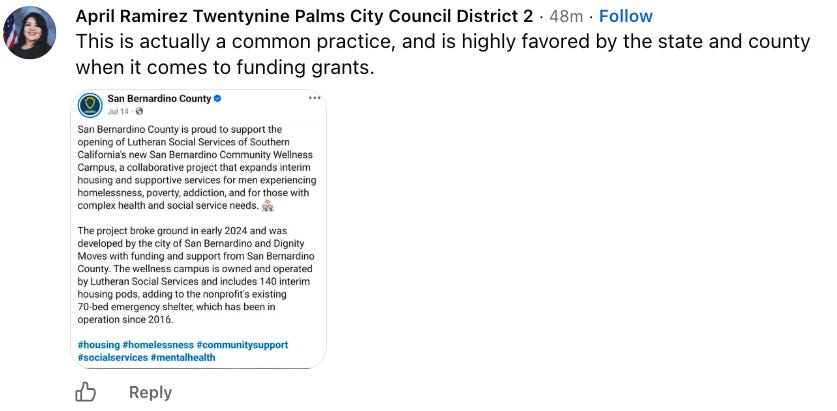
After the meeting, Ramirez separately posted a San Bernardino County announcement about Lutheran Social Services’ new wellness campus, captioning it: “This is actually a common practice, and is highly favored by the state and county when it comes to funding grants.”
No one disputes that nonprofit partnerships in general are common, or that the City’s own grant guidelines encourage them — Ramirez made that point herself in Council. The issue was never partnership in principle. It’s that she moved forward without Council approval to write the grant, and without Council approval of the specific partner she chose, which also happened to be a church she attends.
Additionally, the comparison to the Sanctuary Church’s Hope Center project doesn’t hold. The Lutheran Social Services project involved an established nonprofit operating a 70-bed shelter since 2016, developed through a formal city-county partnership. Sanctuary Church, by contrast, reports under $50,000 in annual revenue on its Hope Center/Hope Project IRS filings and has murky, still-unresolved nonprofit status for that arm. While the Community Learning and Equipping Project (CLEP), the Hope Center’s fiscal sponsor, has been in existence since 2017/2018, its primary function for several years was as a Christian counseling center, while the Hope Center’s website indicates that project was founded in 2023.
"A Local Preference Policy"
Among Ramirez’s defenses against claims that she violated Council process was a repeated reference to a 2016 city ordinance. Ramirez cited the ordinance twice.
Ordinance No. 270, Signed by Mayor Daniel Mintz and adopted by the City Council on February 9, 2016, provides a local preference policy in certain purchasing situations. While that ordinance is not itself a grant policy, it reflects the City’s policy on contractual agreements for services rendered and partnerships. (Grant writers included)
The ordinance’s actual text doesn’t support that read:
“Notwithstanding any other section herein, and unless State law sets a lowest bidder requirement, fitness and quality being equal, the City Manager or the City Council shall have the authority to grant local preference when awarding any contract for the purchase of supplies, materials, equipment or services.”
It is, in short, a rule for breaking ties in competitive purchasing contracts. It says nothing about grant-partner selection, nonprofit vetting, or faith-based organizations. A review of the full Twentynine Palms Code of Ordinances turned up no provision anywhere governing how the City selects a nonprofit partner for a grant, and no RFP requirement specific to grant partnerships.
Ramirez cited the ordinance a second time, defending the City’s grant-writing contract specifically:
The City’s adopted purchasing ordinance, Ordinance No. 270, addresses procurement of professional services. The staff report estimated grant-writing services between $15,000 and $18,000, which falls within that discussion.
The only relevant codified check we found is City Manager contracting authority, which tops out at $25,000 before Council approval is required, a threshold the $15,000–$18,000 grant-writing estimate does fall under. But that threshold only governs routine purchasing contracts and City Manager signing authority. It says nothing about whether pursuing the grant opportunity or selecting Sanctuary Church as the partner required Council approval. Those are questions the ordinance simply doesn't address.
“Because I attend church”
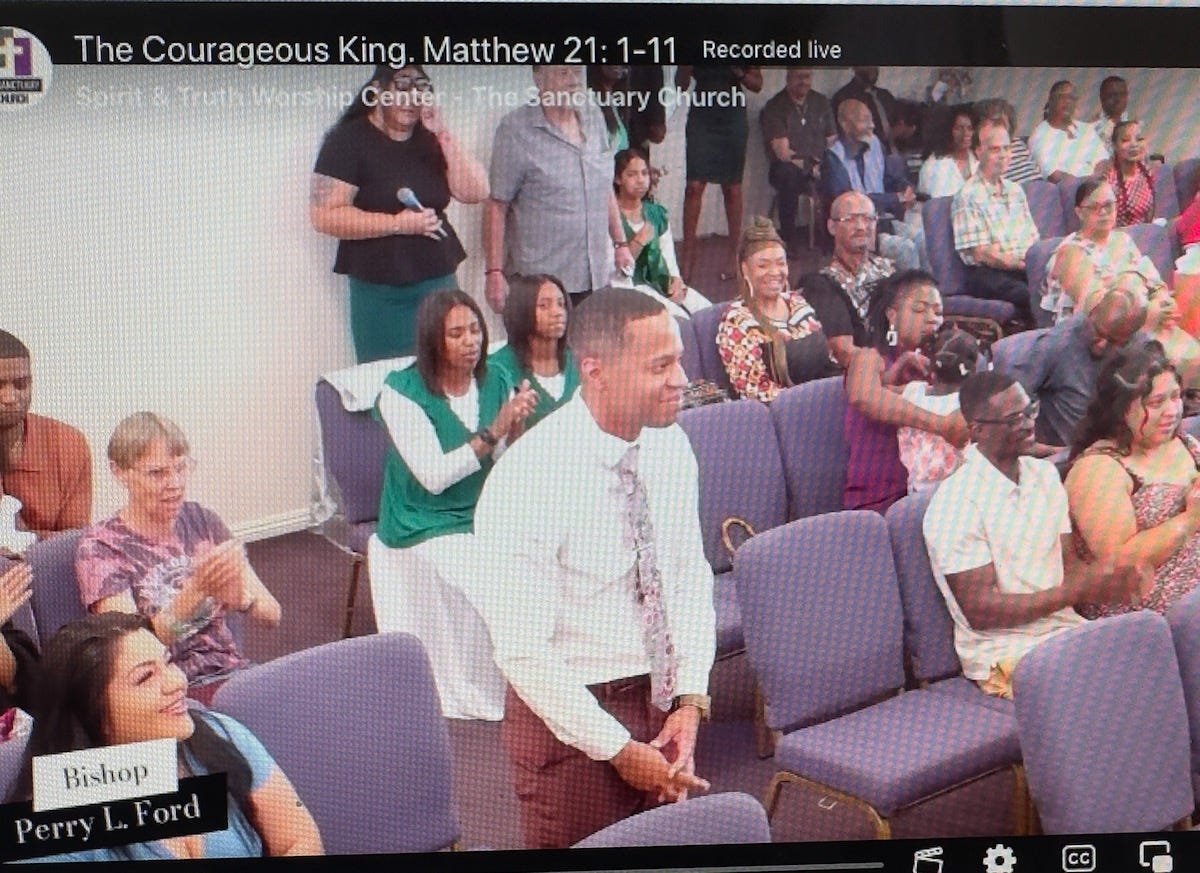
Ramirez’s statement also addresses concerns about conflict of interest:
Another allegation has been that I should have recused myself because I attend church. Before the meeting and a few months prior, I sought legal advice from the City Attorney. I was advised that attending a church does not, by itself, create a disqualifying conflict of interest because I am not employed by the church, I do not serve on its board or leadership, I receive no compensation, and I receive no financial benefit.
Even taken at face value, that defense may hold up under the narrowest reading of the law. The Political Reform Act's disqualification rules turn on five specific categories of financial interest — business entities, real property, income, gifts, and personal finances — and mere church membership or attendance, without compensation or a leadership role, doesn't clearly fall into any of them. On that narrow question, Ramirez's defense tracks the FPPC's own framework reasonably well.
But disqualification and disclosure are different questions. As the California Court of Appeal put it in Hamilton v. Town of Los Gatos (1989) 213 Cal.App.3d 1050, 1058, the broader purpose behind the Act's conflict rules is "not just actual improprieties which the law seeks to forestall but also the appearance of possible improprieties."
A Councilmember who regularly attends a church and participates in its events, including its recent Color Run, and then advocates for and votes to steer a multimillion-dollar grant toward that same church, raises exactly that kind of appearance concern, whether or not it rises to a technical disqualifying interest. At a minimum, that relationship called for upfront disclosure to Council and the public before the vote, not just a private conversation with the City Attorney beforehand. Ramirez’s statement doesn’t engage with that broader transparency standard at all — it only rules out the narrowest legal definition.
“Thoughtful conversation”

In an exchange in the comments section of the Facebook post, former City employee Scott Clinkscales, who administered the “City’s Contributions to Non-Profits” grants, offered relevant context that Ramirez’s statement doesn’t mention. Sanctuary Church/CLEP/Hope Center applied for and received funding through that standard grant process in 2025/2026, but did not apply for 2026/2027; they were simply notified of the new application window as a past applicant. Clinkscales also noted the organization has received other City support over the years including utility assistance and an expansion of free non-profit rental days for an anniversary event at the Community Center from one to three. Not mentioned by Clinkscales was $10,000 allocated to CLEP in February 2025 to make up for a shortfall in funding for their Feed the Need program.
That history matters because it undercuts any suggestion that the City has excluded or shut out Sanctuary Church/Hope Center from ordinary public support. They’ve had, and used, a normal application pathway as well as advocacy to Council for funding. The criticism of the Community Resilience Center grant was never that Sanctuary Church shouldn’t receive any City support; it’s that this specific, much larger grant partnership was selected without the process that governs those decisions.
Rather than address that financial and procedural record, Ramirez’s public response reframed the criticism as an attack on “an organization comprised of 98% Black Americans, Hispanics, and Pacific Islanders” that “deserves thoughtful conversation.” No one raised the congregation’s racial composition. The concerns raised throughout this process — by this reporter, by Clinkscales, and by Mayor Mintz on the dais — have consistently been about disclosure, Council authorization, and financial vetting, not about who the church’s members are.
“I did not demand”
Ramirez’s statement also addressed a claim that she tried to get a resident fired following a confrontation after the March 23, 2026, Council meeting, in which the E-Group Solar Project was voted down. Her account:
After the March 24 (sic) Council meeting, as I was leaving an individual blocked my path, screamed at me, cursed at me, threatened me, and called me names. I left that meeting shaken and crying (many staff members witnessed this). I later realized that individual worked with my child through a youth program.... I contacted the program director and requested that my child not be left alone with that individual. I did not demand anyone be fired.
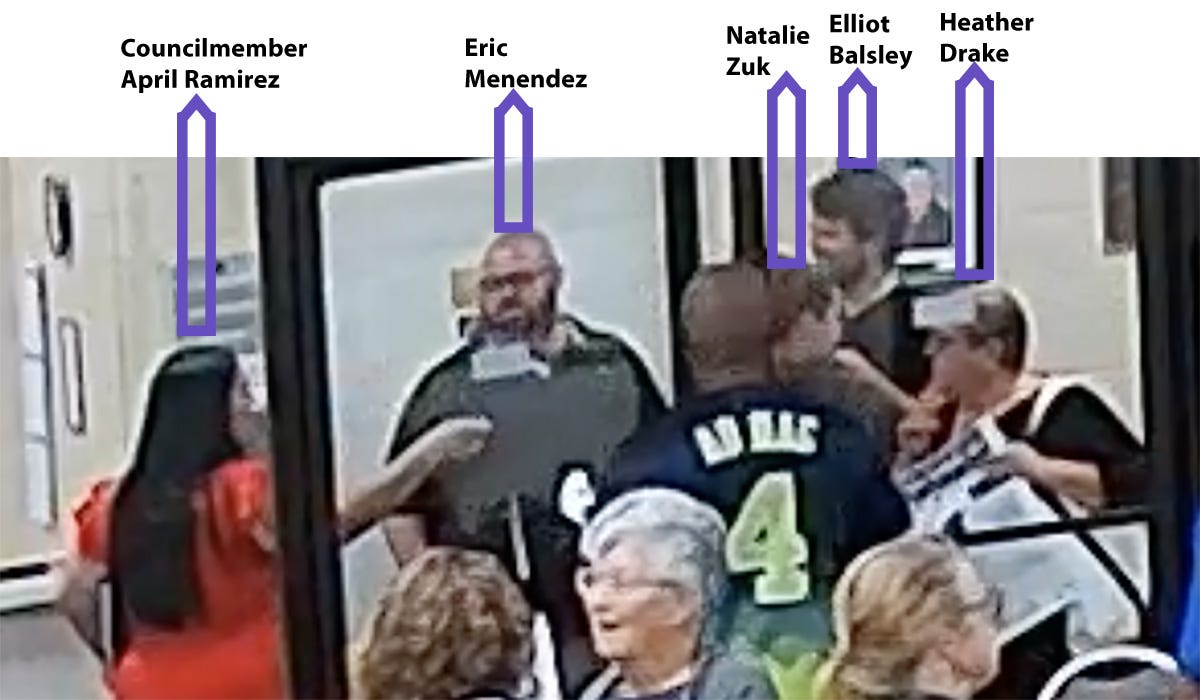
Ramirez is referring to a conversation with Heather Drake, a Twentynine Palms resident active in the anti-Flock movement who had commented against approving the solar farm. The Desert Trumpet has spoken with Drake and two witnesses to the conversation, Elliot Balsley and Desert Trumpet writer Natalie Zuk, as well as reviewed video of the incident recorded by the Council Chambers security camera and obtained by Public Information Request. While the exchange appeared to be heated, the video and witness accounts do not confirm Ramirez’s version. The video is below, we have muted the sound as the conversation in the hallway is not audible but the conversations in Chambers are.
Security footage recorded on March 23, 2026, from Council Chambers at City Hall
Drake, in a long black dress, can be seen holding the Council Chambers door open as Ramirez (in red) exits. At no point does it appear that Drake “blocks” Ramirez. Ramirez then interacts with Eric Menendez and Balsley. The topic of the conversation was a remark made by Ramirez from the dais referring to one of the solar opponents:
I have a really hard time weighing that when those same people talking about integrity can find themselves on Megan’s Law website.
Per participant and witness accounts, Balsley, Menendez and Ramirez were debating the ethics of labeling solar opponents as being “on Megan’s Law website.” Zuk enters the hallway after Drake interjects, calling Ramirez “MAGA.” No one recalls Drake cursing at or threatening Ramirez or calling her names. Zuk, however, described Ramirez as shaken by the interaction.
On the morning of March 24, Ramirez sent an “urgent” email to the director of the youth program, the employer of resident Heather Drake, requesting a meeting. The email itself, obtained through a Public Information Request, contained no stated subject or explanation beyond the urgent request to meet. When reached by the Desert Trumpet, for a published account in April 2026, program leadership confirmed that they were contacted by the Councilmember about Drake, but since they were unable to discuss an employee, the conversation shifted to other business.
The Desert Trumpet reached out to City Manager Kevin Cole, Mayor Daniel Mintz, and Mayor Pro Tem Octavious Scott for comment on the claims addressed in this story. We will update this piece if a response is received.
This article was produced with AI assistance, consistent with the approach described in our AI Policy.
Hi, new subscribers! Desert Trumpet understands you might not be interested in all of our coverage. That’s why it’s divided into separate newsletters allowing you to opt out of reporting that’s not important to you. For instance, you may want our Education news but not City Hall 29.
Here’s how to opt out: go to your Substack settings, scroll down to “subscriptions,” and select “Edit” for the Desert Trumpet. Simply uncheck the box next to the newsletters you don’t want to receive in your email inbox. You’ll still be able to access all coverage online if you change your mind.
Become a paid subscriber!
Not a paid subscriber yet? Did you know that paid subscribers receive discounts on our DT Social events and invites to DT Front Porch, intimate discussions featuring local officials and notable residents?
Upgrade to a $50+ paid subscription for a 10% discount.
Upgrade to $100+ for a 25% discount.
Sustaining subscribers at the $250+ level and above receive complimentary tickets
Leave your thoughts in the comments below. Please note that we do not allow anonymous comments. Please be sure your first and last name is on your profile prior to commenting. Anonymous comments will be deleted.
This coverage is free - please share!
We refer to these collectively as “Sanctuary Church” throughout this piece for clarity. The Hope Center and Hope Project have been used interchangeably by both the City and Sanctuary Church/CLEP to describe the same operation, and CLEP’s own board is composed largely of Sanctuary Church leadership. At the July 28 Council meeting, Mae Ford, wife of Sanctuary Church Bishop Perry Ford, told Council directly that the Hope Project has never generated independent revenue: “The Sanctuary Church pays all of their bills through the free will giving of the members... nothing that happens through the Hope Project is charged back to the people, so there is no revenue that comes into that project.” Given that the church funds the operation directly and church leadership sits atop its organizational structure, we treat references to the Hope Center, Hope Project, and CLEP as references to Sanctuary Church itself.
Compounding the issue: the “Hope Center” and “Hope Project” names don’t hold up well under scrutiny of California DOJ and IRS records. The only place either name appears in DOJ’s Charitable Trust Registry is as a “DBA” on a now-expired registration (RCT PL0000166, a “Charitable Fundraising Platform” filing that lapsed December 31, 2025). CLEP’s one currently active DOJ registration — a separate “Charity Registration,” RCT CT0298486, current through May 2026 — lists no DBA at all. On the IRS side, CLEP’s 990-N e-Postcard filing lists “The Hope Project 29 Palms, Inc” only in the website-URL field, not as a registered organization name. In other words, “Hope Center” and “Hope Project” exist as informal or lapsed labels, not as the identity under which the organization is currently, formally registered anywhere. The Hope Center’s own website separately claimed to be “a nonprofit organization recognized by the state of California,” language corrected only after the July 28 meeting.
In her Facebook post, Ramirez fails to note which City Manager might have briefed Councilmembers - Stone James whose final day was May 15 or Kevin Cole, the current City Manager.