
Possible School Closures Dominate May 5, 2026, MUSD Board Meeting as Community Pushes Back
“What may appear as a simple line item in a budget," said one parent, "is in reality a place with a true heart and soul.”

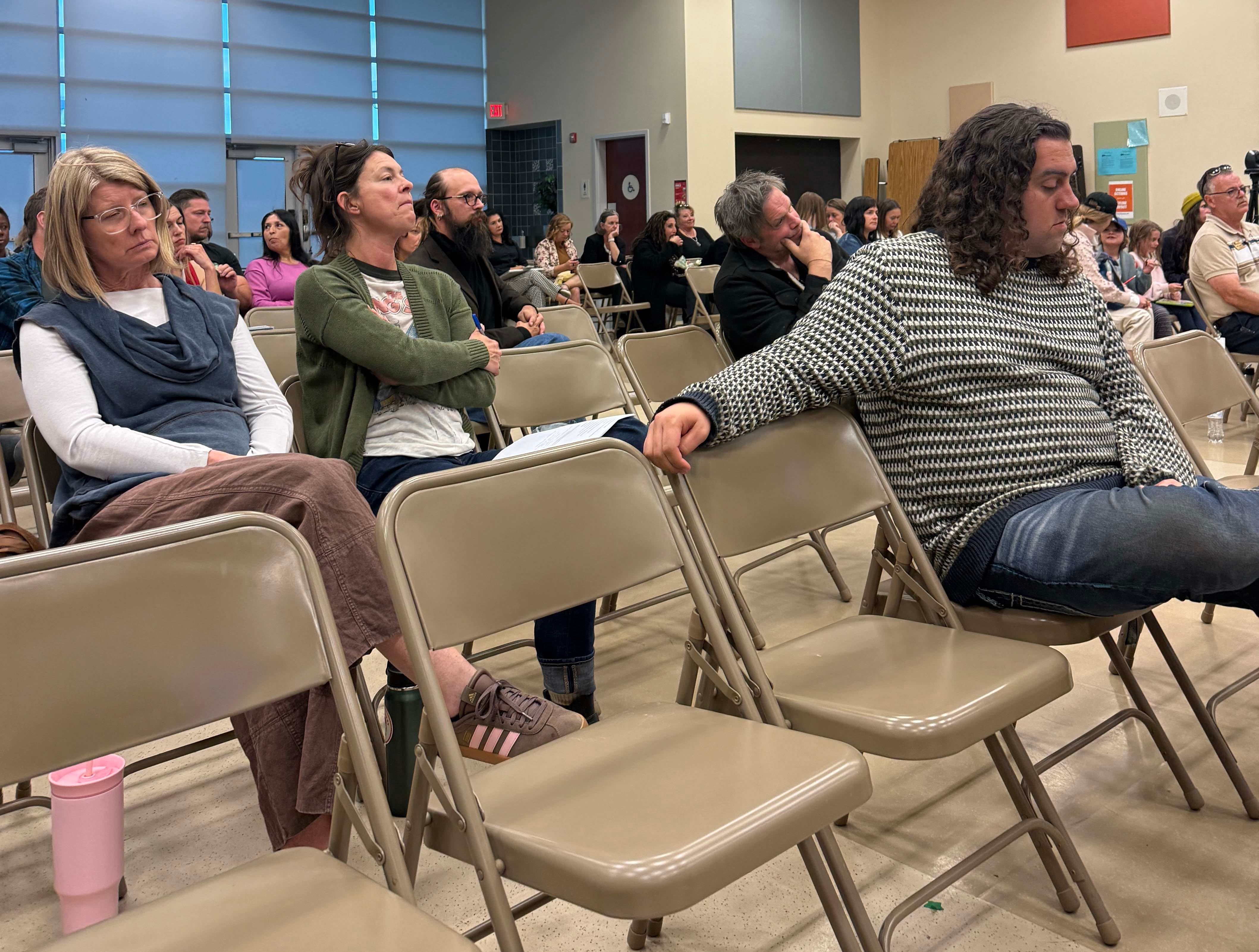
Dozens of parents, teachers, and community members packed the Morongo Unified School District Board of Education meeting on Tuesday, May 5. Many spoke passionately during public comment, urging MUSD administrators and the Board of Education to slow the school closure process and consider other ways to fix the district’s budget problems. The meeting ran over an hour and covered staff honors, student updates, and routine business. Although none of the Board members spoke about enrollment, the question of which schools might close clearly weighed on every audience member attendee in the room.
The agenda and video recording of the meeting are linked here.
The Closure Question
For months, MUSD has been working with a hired consulting firm, SchoolWorks, Inc., to develop a plan for stabilizing the district’s budget. The district faces declining enrollment, meaning fewer students, and therefore less state funding, while costs keep rising. A volunteer citizen Enrollment Committee1 has been meeting regularly to review options and make recommendations to the board. Those recommendations are expected by the June 9 board meeting.
Falling enrollment is an issue throughout the state of California, not just in the Morongo Basin. The primary causes are more declining birth rates and reduced immigration than families switching to private schools or homeschooling, according to a recent article in EdSource. The tension between fiscal reality and community impact, especially in small, rural towns where a local school is central to community identity—as parents at Tuesday’s meeting testified—is playing out from the Morongo Basin to Mendocino County.
Many community members say the process is being rushed, however, and that school closures are being pushed forward before other solutions have been seriously considered. Several speakers pointed to SchoolWorks’ report,2 which identifies opportunities for more than $4.2 million in annual savings from better purchasing practices, $2.9 million in potential new revenue, and $2.9 million in one-time grant opportunities. That’s more than $10 million in possible savings without closing a single school.
“Closures is not the whole stabilization plan,” said Vadim Altschuler, a Twentynine Palms parent who has spoken at multiple board meetings and who wrote an editorial last month for the Desert Trumpet. He cited the final slide of the consultants’ report directly:
The district is not in crisis. It says MUSD is at an inflection point—that the work ahead is deliberate structural adjustment, not emergency response. So if this is not an emergency, do not use emergency tactics.
Others challenged a figure the district has repeated often: that closing each school saves $500,000 per year. “That number gets repeated and repeated, but it has never been shown—no line-by-line, itemized breakdown,” said one speaker. “If that number is real, it would be easy to show. And if it can’t be shown, it shouldn’t be used.”
Landers Elementary in the Crosshairs
Landers Elementary was the school most discussed Tuesday night by parents in public comment. A letter from the superintendent’s office had named a scenario involving closing Landers and moving its students to Yucca Valley. Multiple speakers came to the school’s defense. About 93% of Landers students are considered socioeconomically disadvantaged; approximately 48% are Hispanic; and around 17% receive special education services.

The Desert Trumpet runs out of operating funds on July 1, help us provide the coverage you depend on and also experience a unique concert at Spirit Wind. Purchase tickets for our May 14 fundraiser today.
Altschuler was direct:
Landers cannot be treated as a quiet option just because fewer working parents can make it to the evening meetings. Closing a remote rural school serving an underserved population would not be responsible fiscal management—it would be administrative convenience dressed up as fiscal necessity.
Gillian Thorpe, a parent of a kindergartner at Landers, described the school as one of the few community anchors in the area—alongside the post office and local lodge. “What may appear as a simple line item in a budget is, in reality, a place with a true heart and soul,” she said. Thorpe also warned that families pushed out of Landers might turn to homeschooling or leave the district entirely—putting even more pressure on neighboring schools.
Palm Vista Parents Speak Out
Palm Vista Elementary drew passionate defenders as well. Teacher Stacy Smith, who has taught there for five years, accused the district of sending its most difficult students—and unwanted staff—to Palm Vista without adequate support, then pointing to the school’s struggles as a rationale reason to close it. “You set up Palm Vista to be the dumping ground,” she told the board. She also called out the high salaries of district administrators, saying:
Our district is top heavy. Why are there no cuts up in your level? What I wrote first was, we feel ignored, and what I decided was that’s not true. You’re ignoring us. We feel dismissed. Nope, you’re dismissing us. We feel discounted. Nope, you’re discounting us. And by your actions, you are proving what is most important to you is your paycheck and your bonus. When you talked about the burden of teacher salaries, what about the burden of your salaries?3
Parent Tina Femke spoke about her son, who has a behavioral diagnosis and had a hard time at his previous school. At Palm Vista, she said, teachers learned his strengths, worked with the family on weekends, and helped turn things around. “He now has goals for the future,” she said, her voice breaking. “Please don’t close his school. You’re not just closing a building—you’re taking away a place where kids feel safe, seen, and supported.”
Calls for Transparency
Several speakers questioned the process itself. Community member Ruben Rodriguez, who had previously argued for delaying closures until after November elections, said he changed his mind after attending the April 29 Enrollment Committee meeting. His concern: that whoever controls which options end up on the list effectively controls the outcome.
One speaker called for disciplinary action against two district consultants, saying,
During the meeting, it became evident that members did not have enough time to review the budget stabilization plan or presentation by SchoolWorks…. Towards the end of the meeting, [the consultant] from SchoolWorks was pressuring the committee to come to a consensus on closures, while withholding all the other cost-saving options that MUSD could pursue.
The Board did not respond to those claims, or any others, during the meeting.
Awards and Regular Business
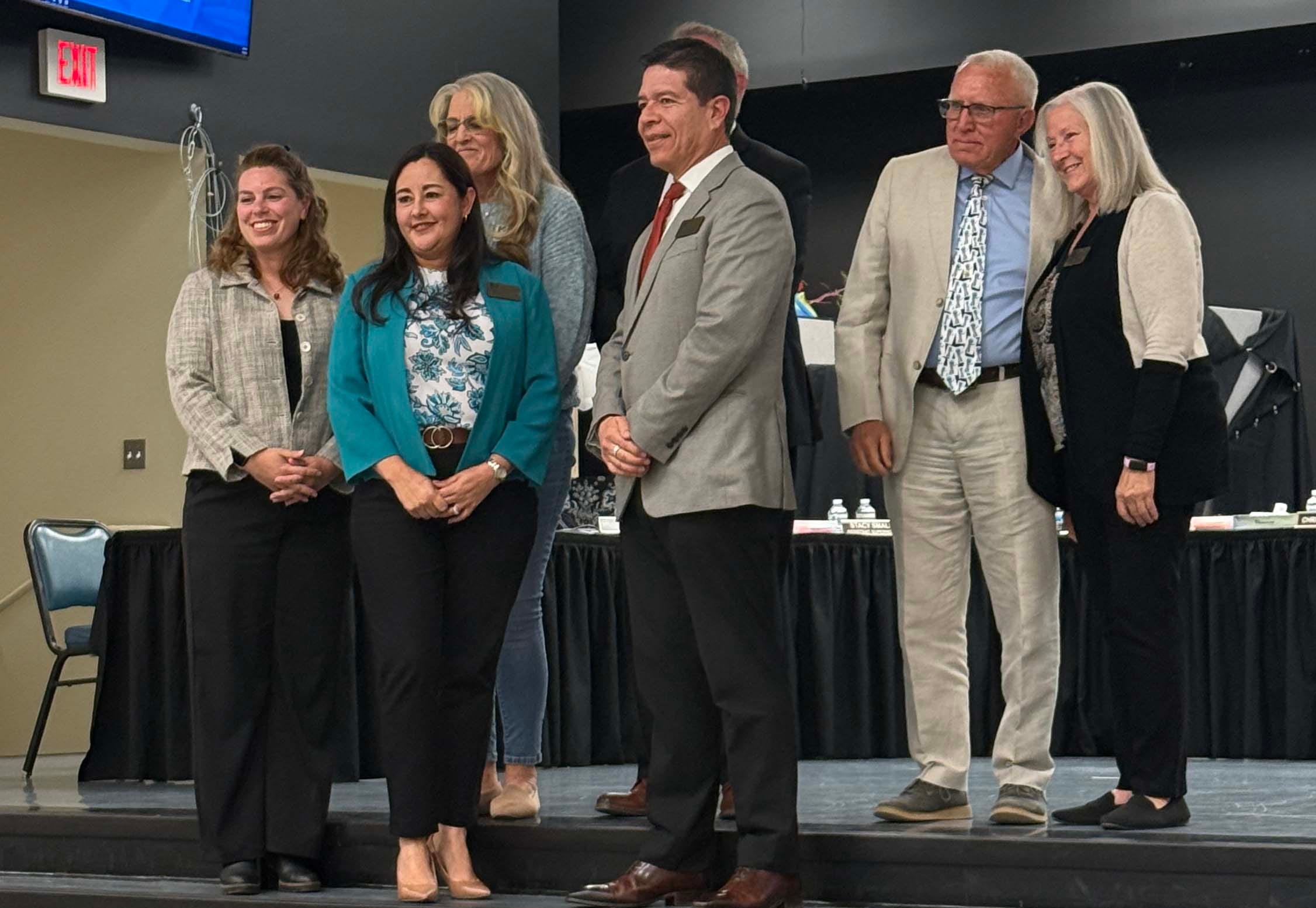
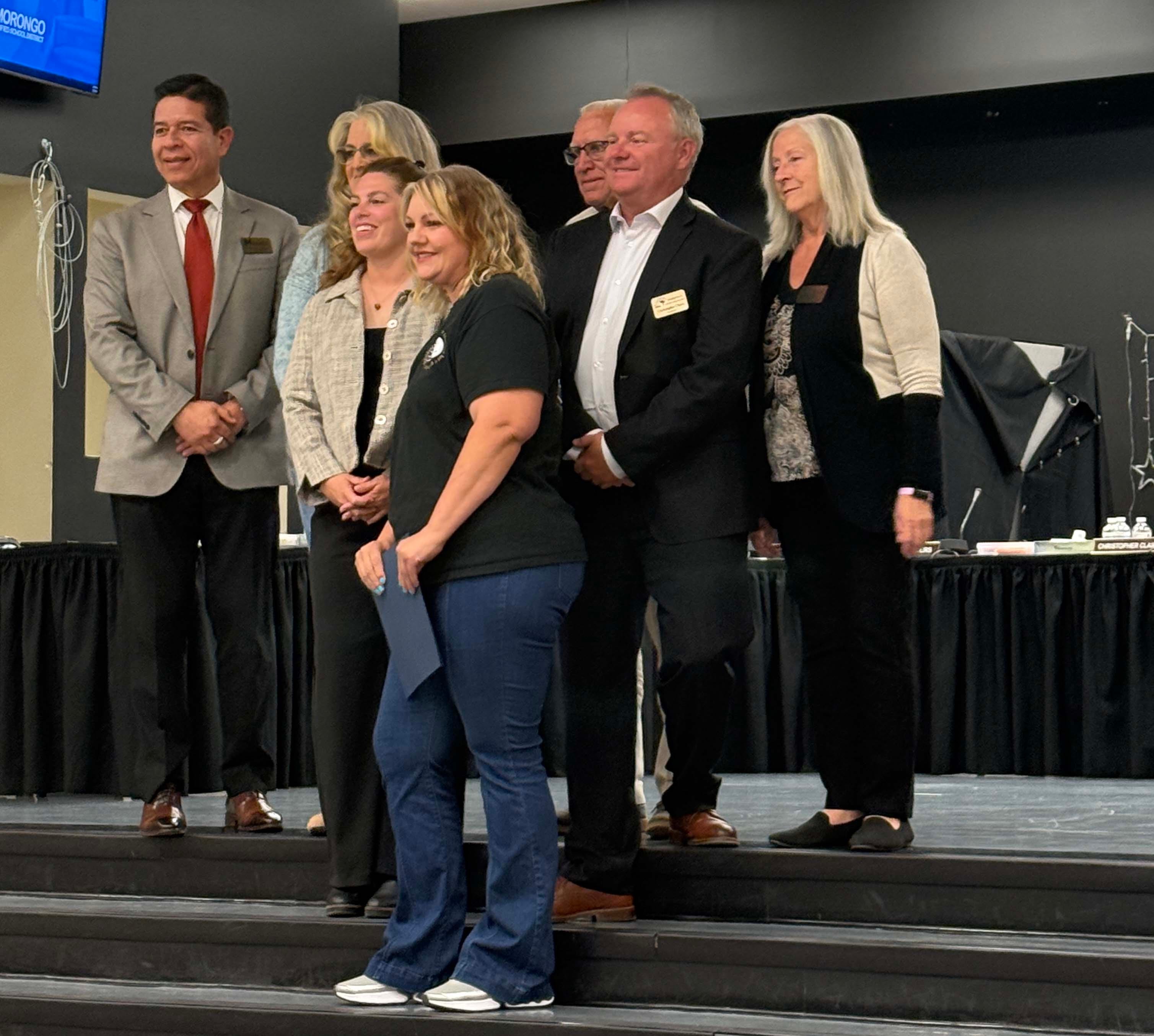
The Board recognized two district leaders: Assistant Superintendent Dr. Gracie Gutierrez Harris, named Central Office Administrator of the Year by California Association of Latino Superintendents and Administrators Region 6, and Superintendent Patricio Vargas, who received the Superintendent of the Year award from the same group. Student representatives from Twentynine Palms High School, Twentynine Palms Palms Junior High, and Lucerne Valley Middle School shared updates on AP exams, sports seasons, and upcoming events. The board unanimously passed resolutions honoring teachers and classified employees. The district’s bargaining team also reported that contract talks with the teachers’ union are going well, with a settlement expected before the school year ends.
What Comes Next
The Enrollment Committee is expected to present its recommendations at the June 9 board meeting. Multiple speakers on Tuesday asked the board to confirm that date is not a hard deadline—and that the community will have a real role in whatever decision is made. Whether the board will pump the brakes or push forward with closure scenarios remains an open question. One thing is clear: the community intends to keep showing up until it gets an answer.
The next MUSD Board of Education meeting is scheduled for June 9, 2026, at 6 pm.
According to an article in a February 19, 2026 issue of the Desert Trail, the committee consists Morongo Basin residents Jennifer Cusack (Chair), Karla Buchanan (Vice Chair), Krystal Conrad, Nicole Hitch, Jeff Brady, Daniel Ramon Inguez, Wayne Hamilton, Amanda Mayes, and Sara Smith.
These salaries can be found in documents listed here.
Hi, new subscribers! Desert Trumpet understands you might not be interested in all of our coverage. That’s why it’s divided into separate newsletters allowing you to opt out of reporting that’s not important to you. For instance, you may want our Education news but not City Hall 29.
Here’s how to opt out: go to your Substack settings, scroll down to “subscriptions,” and select “Edit” for the Desert Trumpet. Simply uncheck the box next to the newsletters you don’t want to receive in your email inbox. You’ll still be able to access all coverage online if you change your mind.
Did you know that paid subscribers receive discounts to DT Social events?
Not a paid subscriber yet?
Upgrade to a $50+ paid subscription for a 10% discount.
Upgrade to $100+ for a 25% discount.
Sustaining subscribers at the $250+ level and above receive complementary tickets
Leave your thoughts in the comments below. Please note that we do not allow anonymous comments. Please be sure your first and last name is on your profile prior to commenting. Anonymous comments will be deleted.
This coverage is free - please share!