
RECAP: Twentynine Palms City Council, February 24, 2026
Budget Approvals, Infrastructure Magic, and Continued Public Pushback on Surveillance


Last Tuesday, the Twentynine Palms City Council held a ninety-minute meeting in which they approved budget transfers for three financial fund categories and discussed placement of a youth tile project in Freedom Plaza. They again heard from citizens on Flock camera concerns and the proposed E-Group PS solar facility near Harmony Acres.
The City’s agenda packet is here; our agenda preview of the meeting is here; video footage of the meeting is here.
AWARDS, PRESENTATIONS, APPOINTMENTS AND PROCLAMATIONS
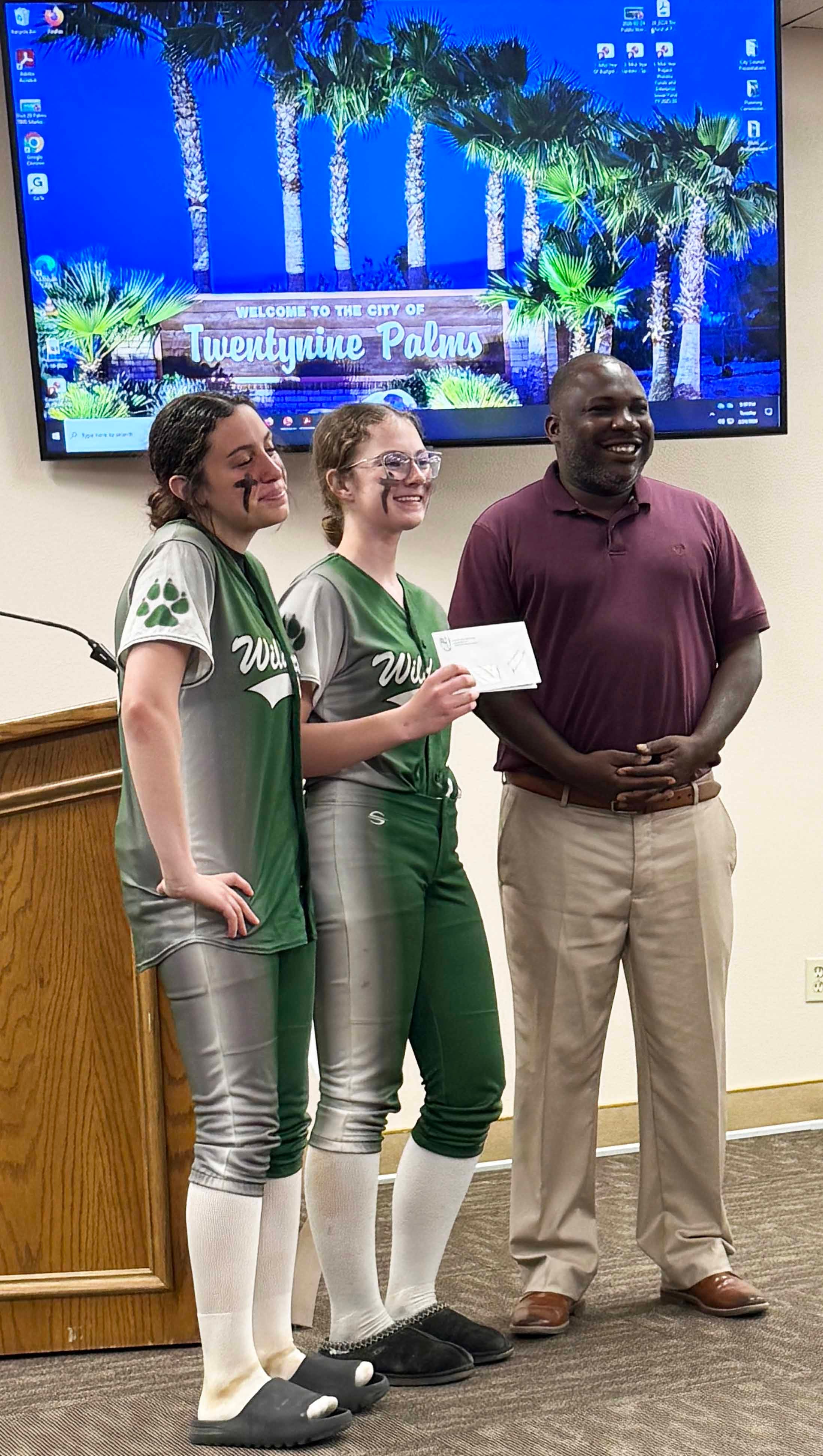
Public Works Department Update
Craig Stacey of the Twentynine Palms Public Works Department updated the Council on its current projects. He gave an overview of his department’s work on the 150 miles of paved and 20 miles of unpaved roads the City maintains as well as the 14 major municipal buildings and numerous smaller facilities scattered throughout the city.
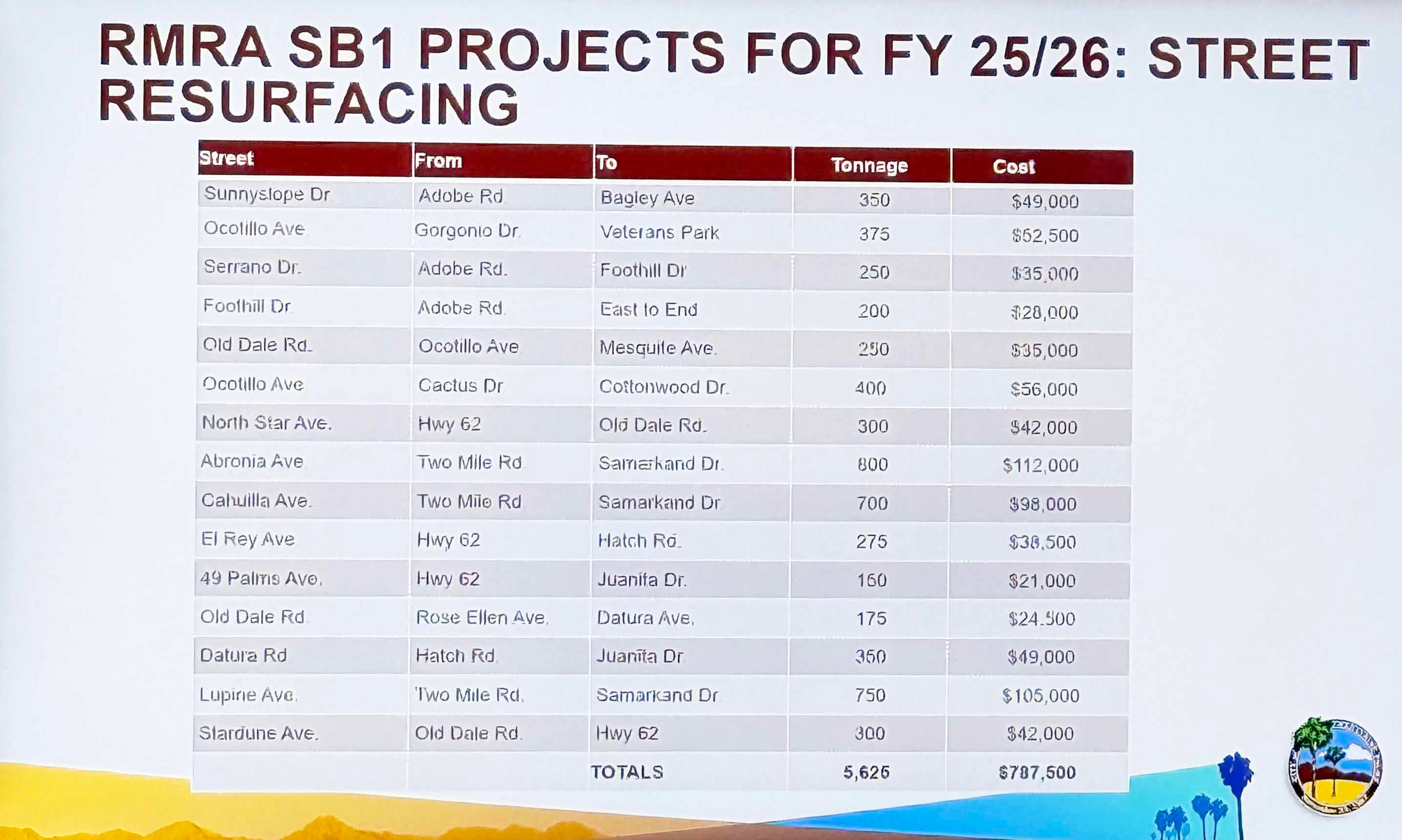
Stacey said “paving season” is currently in its second week. The city uses various funding sources, including $787,500 in SB 1 (Road Repair and Accountability Act) funding. Stacey said,
this is what makes the magic happen….When people leave for work and it looks like a bomb went off, storm destroyed all the roads, dirt everywhere, the shoulders are washed out, they go to work and they come back home from work and it’s all put back so it does have kind of a magical feeling.


By performing much of this work “in-house”—meaning using city staff and equipment rather than hiring outside contractors—Public Works is able to stretch its budget further. Stacey noted that this approach allows the city to get more work done for the taxpayers’ dollar.
Meetings Attended
Councilmembers reported meeting with constituents with concerns such as homelessness, economic growth, and children’s safety, as well as attending the mayor’s prayer breakfast and a fundraiser for the animal shelter. Councilmember Ramirez noted attending the San Bernardino County Office of Homeless Services East Desert Regional Steering Committee meeting, saying:
as a direct result of our involvement and partnership with the county, we’ve also secured $95,000 in grant funding….These funds are available to Twentynine Palms residents. I have the one-page application and it is specifically for people who are currently homeless or are at risk of becoming homeless. That being said, these funds are now available. They’ve been released, and I can help with first and last month’s rent down payment assistance and the turnaround time.
She amplified the grant announcement on social media the following day, which seemed to turn grants offered through Inland Housing Solutions in Loma Linda into an effort that was the result solely of her efforts, framing it as a campaign pitch.
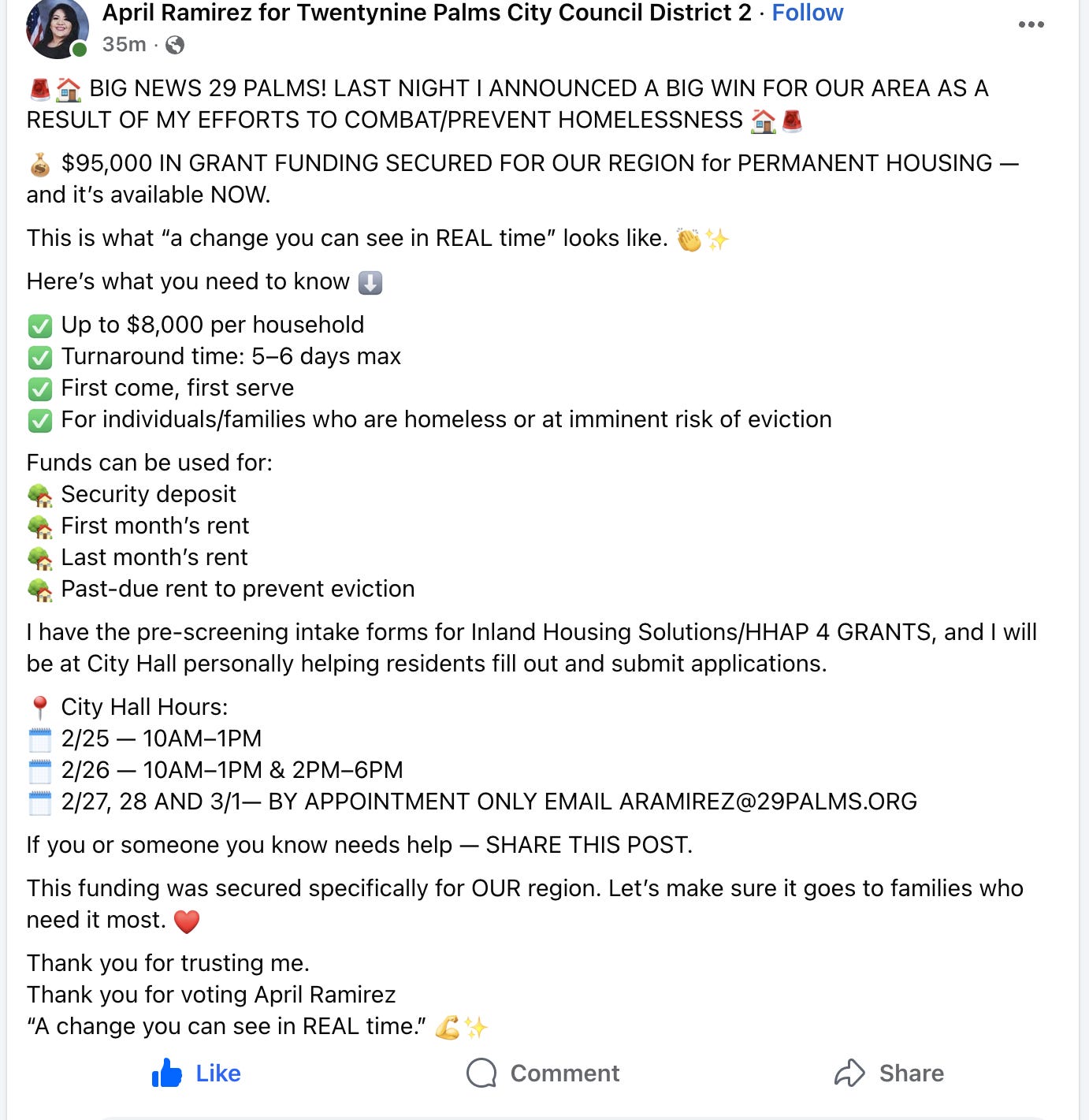
The Desert Trumpet has reported extensively on Homeless Housing, Assistance and Prevention Program (HHAP) grants, which are administered by the San Bernardino County East Desert Regional Steering Committee, consisting of eight members. Participating are representatives from Yucca Valley, Supervisor Dawn Rowe’s office, Molding Hearts, the Morongo Basin Conservation Association, Reach Out Morongo Basin and Rescue + Reisdence, in addition to Councilmember Ramirez and City Manager Stone James. In the past the grants have been available through other organizations such as Reach Out Morongo Basin —see “RECAP: SBCO East Desert Regional Committee on Homelessness, October 16, 2025” and “Recap: Twentynine Palms City Council, May 13, 2025.”
CONSENT CALENDAR
The Consent Calendar consisted only of the minutes for the February 10 meeting and the adoption of a resolution that changes the length of time before City records are destroyed or deleted. It was passed unanimously without discussion.
In public comment on City records, Heather Drake asked asked where she could find the text of the resolution referenced in the Staff report.
DISCUSSION AND POTENTIAL ACTION ITEMS
Twentynine Palms Mid-Year Budget Report
Finance Director Abigail Hernandez-Conde presented a summary to the City Council regarding the city’s performance through the midpoint of the 2025-2026 fiscal year.
General Fund Mid-Year Budget Update
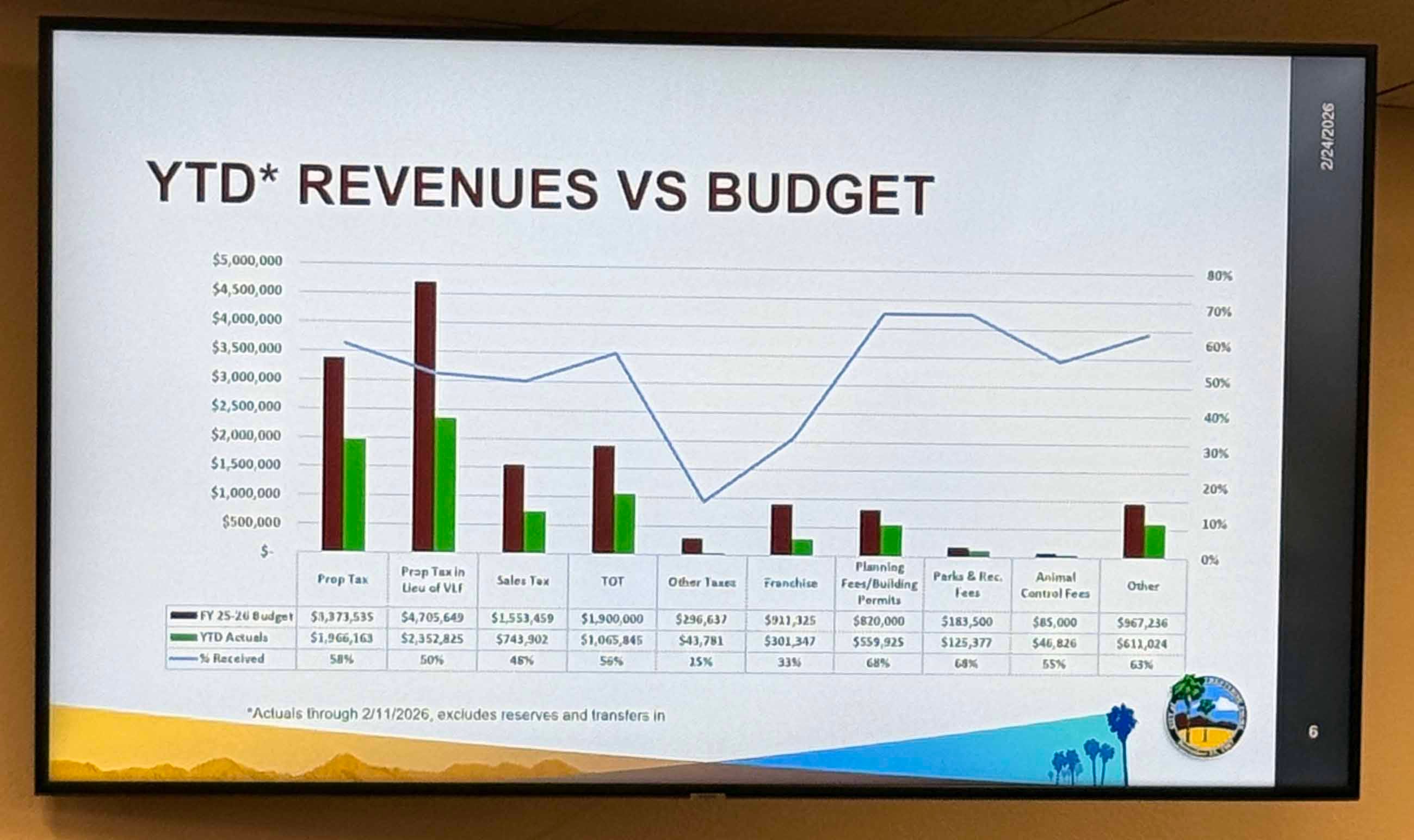
The city’s General Fund, which pays for everyday services like police and parks, remains in a healthy postion, Hernandez-Conde reported. As of December 31, 2025, the city held $19.8 million in total cash and investment balances. To make this money grow, the City Treasurer invested $10 million in a local agency fund (LAIF), which earned a 4.2% interest rate. Another $25.2 million is held in certificates of deposit (CDs), and $1.3 million is in U.S. Treasury bills.
In terms of income, the city has collected $7.8 million, or 52% of its expected revenue for the year. Property taxes and vehicle fees are performing well, but sales tax revenue is expected to stay flat due to high interest rates and national economic uncertainty. On the spending side, the city has used $8 million (54% of the budget). Law enforcement is the largest expense, accounting for 43% of the city’s total operating costs. Because of necessary adjustments, the city’s projected surplus was reduced by $137,000.
Capital Projects and Special Revenue Funds
Capital projects are long-term investments in city infrastructure. The city is currently managing several major efforts, including the Split Rock construction, the Sullivan bike path, and renovations to the Senior Center. To ensure these projects stay on schedule, the City Council approved moving $183,300 from the General Fund into these accounts. Additionally, the city continues to receive “COPS” program funds, which are restricted specifically for public safety and citizen-option programs.
Project Phoenix and Enterprise Sewer Fund
Because of his wife’s business in the downtown area, Mayor Daniel Mintz recused himself from this discussion. Project Phoenix is a major downtown development initiative, Hernandez-Conde explained. A key part of this project involves the package treatment plant that manages wastewater for some of the downtown area. To support this, the council approved a transfer of $80,000 from the General Fund to the Sewer Fund. This money is specifically designated for utility connections and infrastructure costs required to make the treatment plant fully operation.
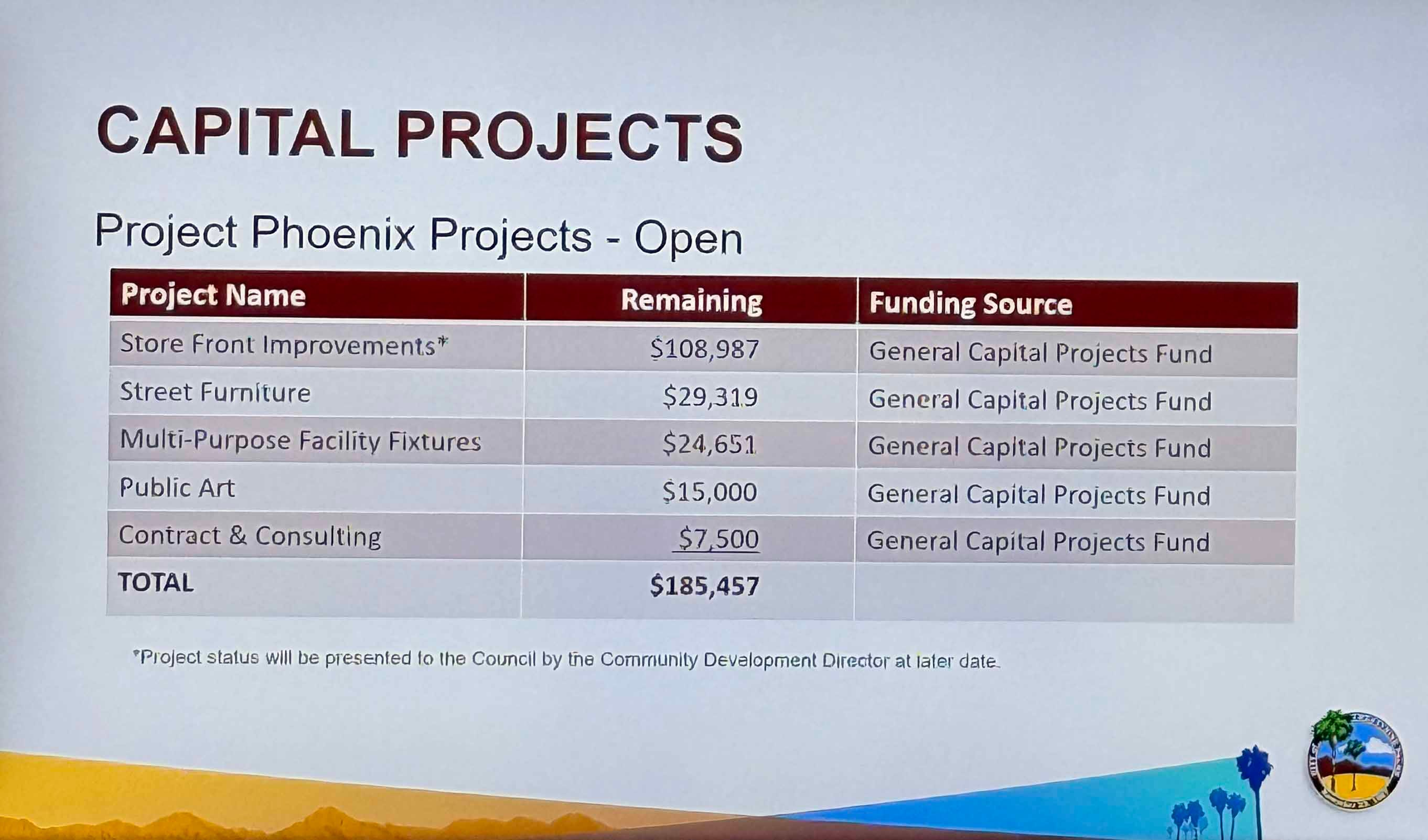
All three budget transfer requests were approved by City Council with very few questions.
Freedom Plaza Youth Mural Project
Rhonda Coleman, Director of Groundwork Arts, outlined an upcoming collaborative project with Twentynine Palms Parks & Recreation Department to create a student-made tile mural for Freedom Plaza. Funding comes from California Arts Council including a $18,500 grant to Parks & Recreation and $21,500 to Groundwork Arts. An additional $15,000 left over from an allocation for public art at Freedom Plaza was awarded with approval from the Public Arts Advisory Committee. (Because of his connection to Freedom Plaza, Mayor Mintz again recused himself from the conversation.)
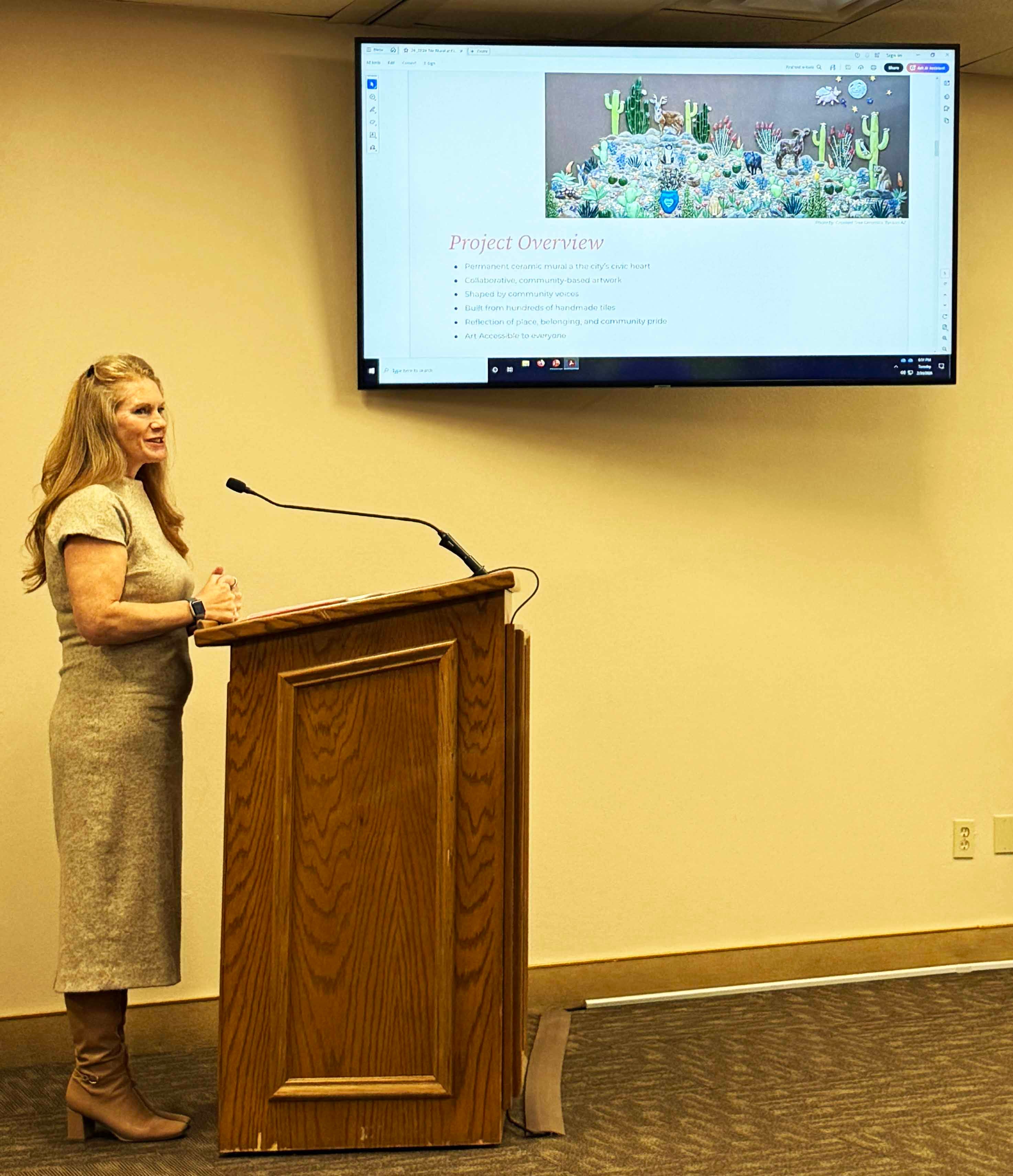
Coleman presented the timeline, saying turnaround time would be quick:
March: Community engagement and surveys. Digital and paper surveys will be distributed to residents to collect ideas on themes, local imagery, and preferred color palettes.
April: Design concept presentation. Groundwork Arts will work directly with all MUSD schools. They will collect feedback from more than 3,000 students, as well as teachers and staff, to ensure the youth perspective is the heart of the design.
April–July: Community members and students will participate in hands-on workshops. Here, they will help create the actual individual ceramic tiles that will make up the larger mosaic.
June–September: Mural assembly.
October: Final installation. Coleman assured Councilmembers that her team would seek the best price point for quality of work for the mural’s placement.
Councilmembers expressed strong support for the project, and a key point was the project’s funding strategy. Council members were impressed that Groundwork Arts didn’t just ask for more money; instead, they secured significant outside grants to supplement the city’s $15,000 contribution.
Some initial concerns were raised about the durability and “professional look” of a youth-led project. Coleman reassured the council that with her 35 years of experience and a professional staff of artists and designers, the result would be a high-quality, permanent landmark that fits the city’s identity as an oasis of murals.
There was much discussion of the tile mural’s location, including the back of the stage at Freedom Plaza, the front of the stage, and the side of the Joshua Tree National Park Visitor Center. Paul Razo, Chair of the Public Arts Advisory Committee, was enthusiastic in his support.
Council voted unanimously to support the project.
PUBLIC COMMENT


For the third consecutive Council meeting, public comment focused on Flock cameras. Heather Drake argued that the Flock surveillance cameras are a violation of privacy and a “corrupt waste of money” that turns the community into a “police state”. Drawing on her 15 years of experience in information technology, she warned that the centralized database treats citizens like “data points” and will ultimately hurt local tourism and the arts scene. Drake was also concerned about the scheduled destruction of documents included in the Consent Calendar.
Victor Lewis echoed Drake’s points and noted that while they did not have new arguments to add to the discussion, they felt it was important to formally record their disagreement with the project.
The fact that you once again have a full house, or nearly full house, of people begging you to reconsider this should be enough to make you question your decisions. Thus far, it's our job to tell you when you could be doing better. I hope you've realized by now that we will keep telling you and keep showing up until this issue is addressed properly. Please show us that you value our voices and feedback.
These concerns were also echoed by Jeff Johnson, “Heather,” Gretchen Grunt, and Pauline Pisano, who said:
The tracking of people's location constitutes a significant invasion of privacy which can reveal many things about our lives, such as what friends they visit, what doctors we visit, what spiritual places of worship we visit, and our society is a core principle that government does not invade people's privacy and collect information.
It's okay to change your mind.
Booker Harper argued that the “Flock” camera system constitutes a Fourth Amendment violation by allowing law enforcement to track movement patterns without a warrant. He expressed deep concern over the lack of transparency regarding which agencies have access to this data, noting that even the San Bernardino County Sheriff’s Department could not confirm if the FBI has access. Harper cited legal precedents and examples of other California cities such as Santa Cruz and Los Alto Hills that terminated their contracts after discovering police were using the searchable databases for personal reasons like stalking.
Demanding the City terminate its contract with Flock Safety, Elliot Balsley cited "Big Brother" surveillance risks and a petition signed by more than 570 residents.
You had a few weeks to read and digest the numerous news articles. All written on the subject, and you all remain silent. So at this point, I have to assume you don't care about these risks and you like living under Big Brother surveillance.
Balsley went on to say:
The Flock company provides audit logs for accountability, showing how many searches are being run by each officer, and these include timestamps and reasons, and these are public records, so I've read them, and they show some interesting trends. One thing that stands out in San Bernardino County, five officers of the San Bernardino Sheriff are running searches 24 hours a day. Now I know these sheriffs are probably dedicated public servants, but I don't believe any of them are working 24 hours a day. So who is running these searches, surveilling people? Does that seem strange to any of you? The most likely explanation is that they've shared their password with someone else, maybe another officer, maybe an ice agent, or maybe it was stolen by a hacker.
John Talley-Jones discussed a letter from the California Department of Housing and Community Development regarding potential violations of the Housing Crisis Act (SB 330). He stated that improper rezoning for the Ofland Resort may have illegally reduced residential capacity and said the letter demanded the city comply with state law by March 20.
On behalf of the 29 Palms Ministerial Association, LeeAnne Clark thanked the mayor, city council, and community for attending the recent Mayor’s Prayer Breakfast. She highlighted several upcoming events, including an emergency preparedness meeting on March 19, a Good Friday service on April 3, and an Easter sunrise service at Freedom Plaza on April 5. She invited the public to the National Day of Prayer on May 7.
City Manager’s Report
Dr. H. Stone James highlighted several infrastructure improvements and community milestones for Twentynine Palms. A major focus is on local parks, specifically a $98,000 ADA parking lot improvement at the south entrance of Lucky Park scheduled for completion in March. The city is also seeking additional federal grants to upgrade the park’s courtyard and playground equipment.
Power stability is another priority, as Southern California Edison plans to replace 70 electric poles and install a second 33 kilowatt power line starting in late 2026. This project will take six to eight months and may cause one-lane traffic delays on Highway 62. He did not mention whether these upgrades would again inconvenience downtown businesses, as they did last summer. Additionally, Edison is upgrading circuit breakers and using coded lines to prevent proactive power shutoffs in the downtown area.
He also reported that the War Hawks football team now practices at the junior high, improving access for families who previously could not enter the military base. He said two major 75th-anniversary celebrations are approaching for the Mojave Trails National Monument and the Marine Corps Base.
Prompted by concerns expressed by Heather Drake, Dr. James said that a recent closed session of the council focused exclusively on site security.
NOTE: Desert Trumpet staff members Cindy Bernard, Kat Talley-Jones, and Heidi Heard live in the Indian Cove neighborhood, adjacent to the Ofland development project, and are on the organizing committees of Indian Cove Neighbors and Say No to Ofland. Read our policy for covering Ofland here.

Help us get to to $9,000 — we’re just $15 away!! Upgrade your subscription from free to paid today for just $50 per year or $5 per month.
Want to make a one time donation or are you able to give more than $100? Donate via Paypal!
Leave your thoughts in the comments below. Please note that we do not allow anonymous comments. Please be sure your first and last name is on your profile prior to commenting. Anonymous comments will be deleted.
Thanks for reading! This post is public, so feel free to share it.