

In a two-hour and 45-minute marathon that ended with a continuance to their March 3 meeting, the Twentynine Palms Planning Commission lobbed questions at representatives of the E-Group Solar Project and considered in-person public comment from 21 residents and letters from five more. In Part 1 of our report we covered a contentious exchange on the Community Benefit Package, the challenges of Code Compliance, and the tight timeline the project is on if its to receive needed federal tax credits. Here we will cover Environmental and Scenic Impacts, whether the project meets the AB 205 threshold and Public Comment.
Four of five Commissioners were in attendance, with Commissioner Leslie Paahana out with an excused absence. In addition to usual staff attendees Community Development Director Keith Gardner, Planning Assistant Shelley Green and Assistant Planner Diane Olsen, Assistant City Attorney Jennifer Farrell and Terra Nova Representative Nicole Criste were also present.
For reference:
Environmental and Scenic Impacts
Inadequate documentation of scenic impacts and the impossibility of mitigation
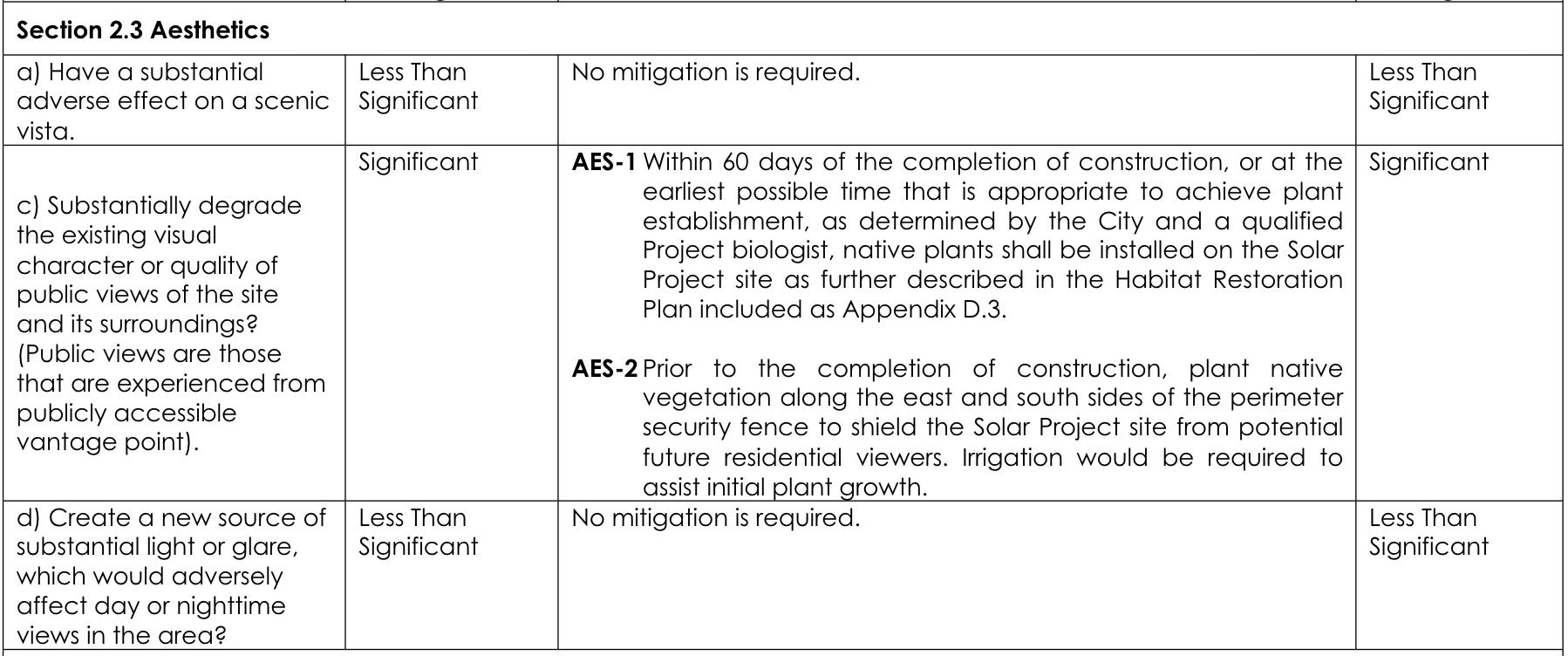
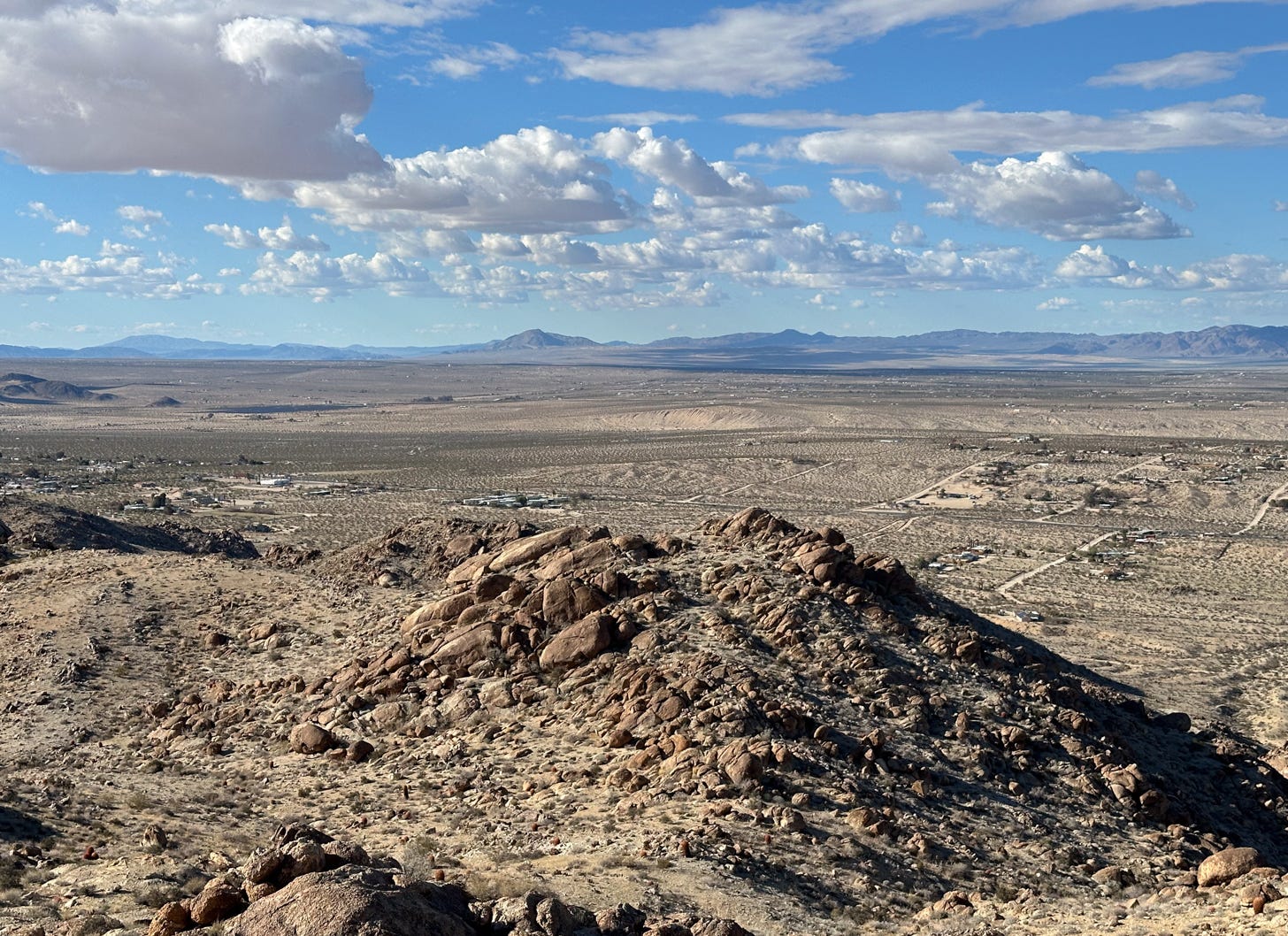
Within the California Environmental Quality Act (CEQA) there are two different assessments of visual impact: scenic vistas and public views. Both of these have somewhat fluid definitions contingent on local plans and policies, but generally a scenic vista is an elevated view encompassing a large area while a public view is what is visible from a public right of way such as streets, sidewalks, trails and parks. Twentynine Palms’ topography and proximity to Joshua Tree National Park complicate these definitions somewhat since many scenic vistas here are also public views and visible from “elevated” points such as Highway 62 (a public highway) and the 49 Palms Oasis Trail, which is within a public park (Joshua Tree National Park).
Yet, despite this, in the CEQA analysis, the impact on scenic vistas was rated as “less than significant” while the impact on public views is “significant” to the degree that it cannot be mitigated. The challenge with these definitions was evident, with E-Group Attorney Robert Smith concluding:
So things like concerns about tourism, which you think about the great scenic vistas you have in the City, that was concluded to be not a significant impact.
Chair Jessica Cure then asked “so for the tourism, how is that determined?” and CEQA Consultant and Terra Nova Representative Nicole Criste replied:
Tourism and economic issues are not CEQA issues. They were removed from CEQA several years ago. The Park [referring to Joshua Tree National Park], however, is a public view, and additional visual simulations from points in the Park would be appropriate under this analysis.
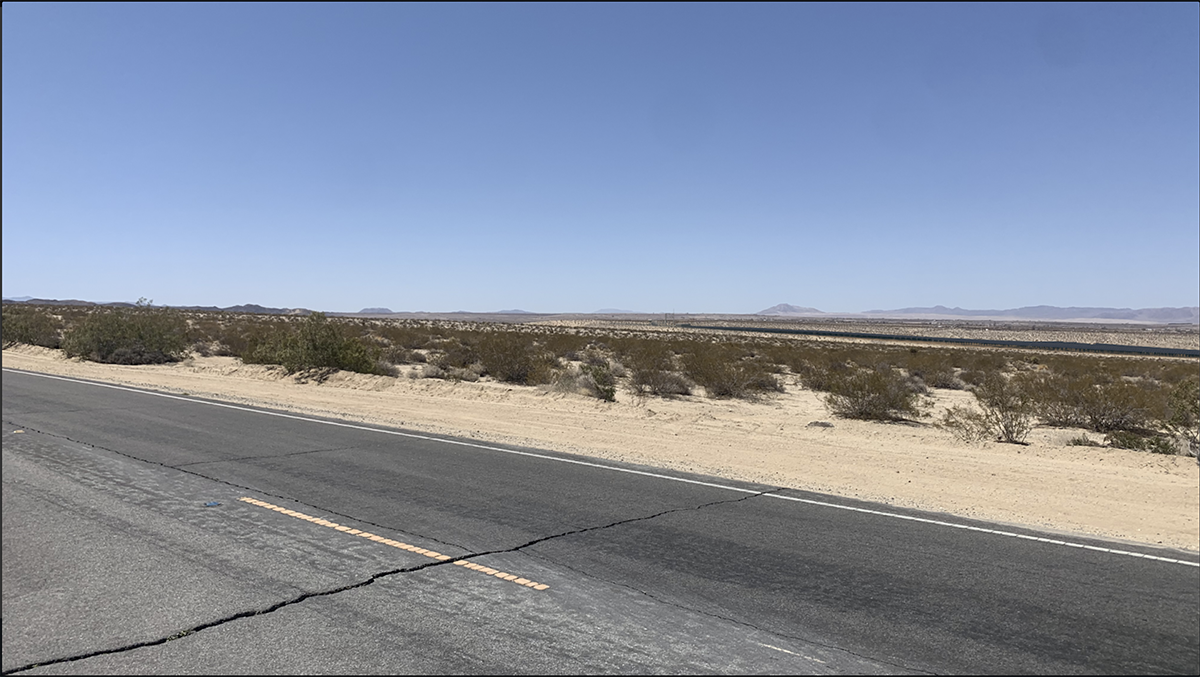
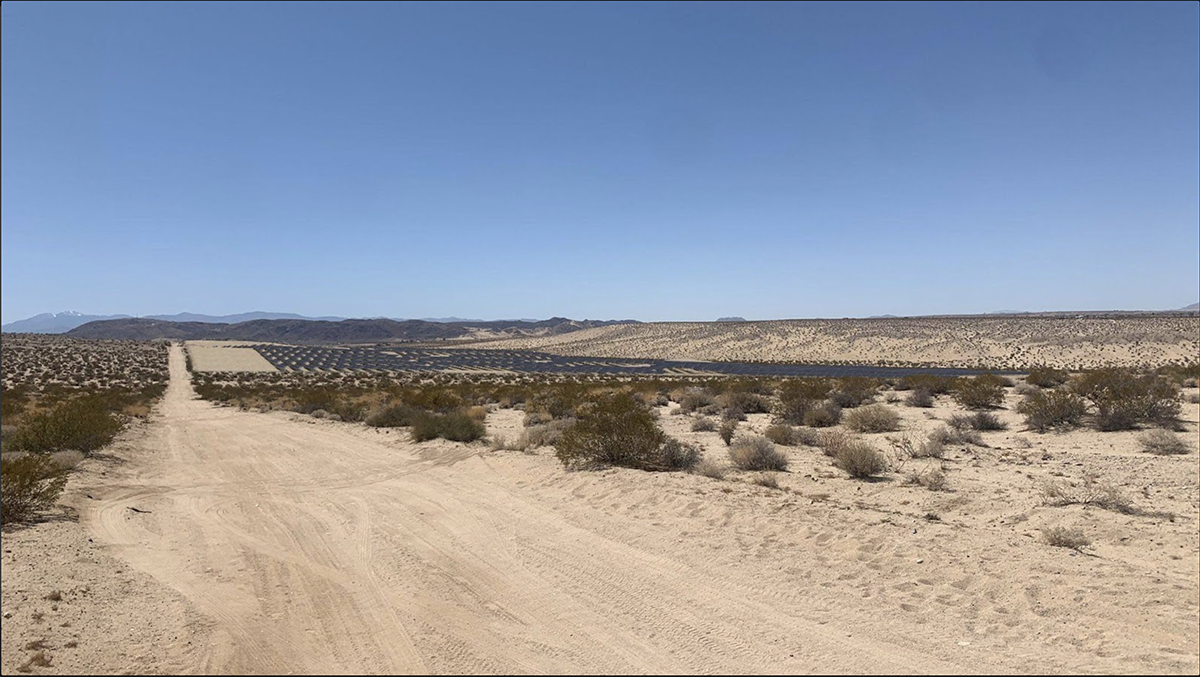
E-Group presented several renderings in an attempt to prove minimal visual impact, yet none were from an elevation higher than Two Mile Road—nothing from Highway 62, the neighborhoods south of 62 or from inside Joshua Tree National Park. The 49 Palms Oasis Trail is directly across the highway from the project, for instance.
When questioned by Chair Cure about renderings from higher elevations, Smith conceded they had not been produced. Smith appeared to be pointing out that pre-existing solar fields appear as insignificant “block dots” making these renderings unnecessary. Cure wasn’t buying it:
And the other solar farms in the area that you can see from the views… I mean [for] me personally, from homes on the hill and from hiking in the park, I consider to be much larger than a black dot…that these other solar fields that already exist with this visual impact — is that something that is was considered or documented in the report?
Criste conceded that while cumulative impact was considered, there was not a comparative analysis of the two existing solar fields versus the E-Group Solar Project.
Cure then requested renderings from other locations and Smith agreed to provide them.
Also discussed was the impossibility of adequate mitigation for visual impacts, with Smith stating:
Unfortunately, given the topography the site, we’ve evaluated a number of different possible ways that we can try to screen it. We have not found one that would work, but certainly we’re open to suggestions.
Criste expanded on that:
The only potential mitigation would be fencing. And as you can see in the visual simulation Keith has up, it would not be effective. You could theoretically plant huge trees, unlikely to be successful, and therefore not feasible in this environment. The aesthetics analysis under CEQA is associated with public viewsheds, and so the locations that were selected for the visual simulations are from public viewsheds. There is no…[mitigation] other than revegetation by reseeding with native plants, [which] will soften around the panels. There is no feasible mitigation, and that’s why the impact is significant.
Dust Mitigation and Health Risks
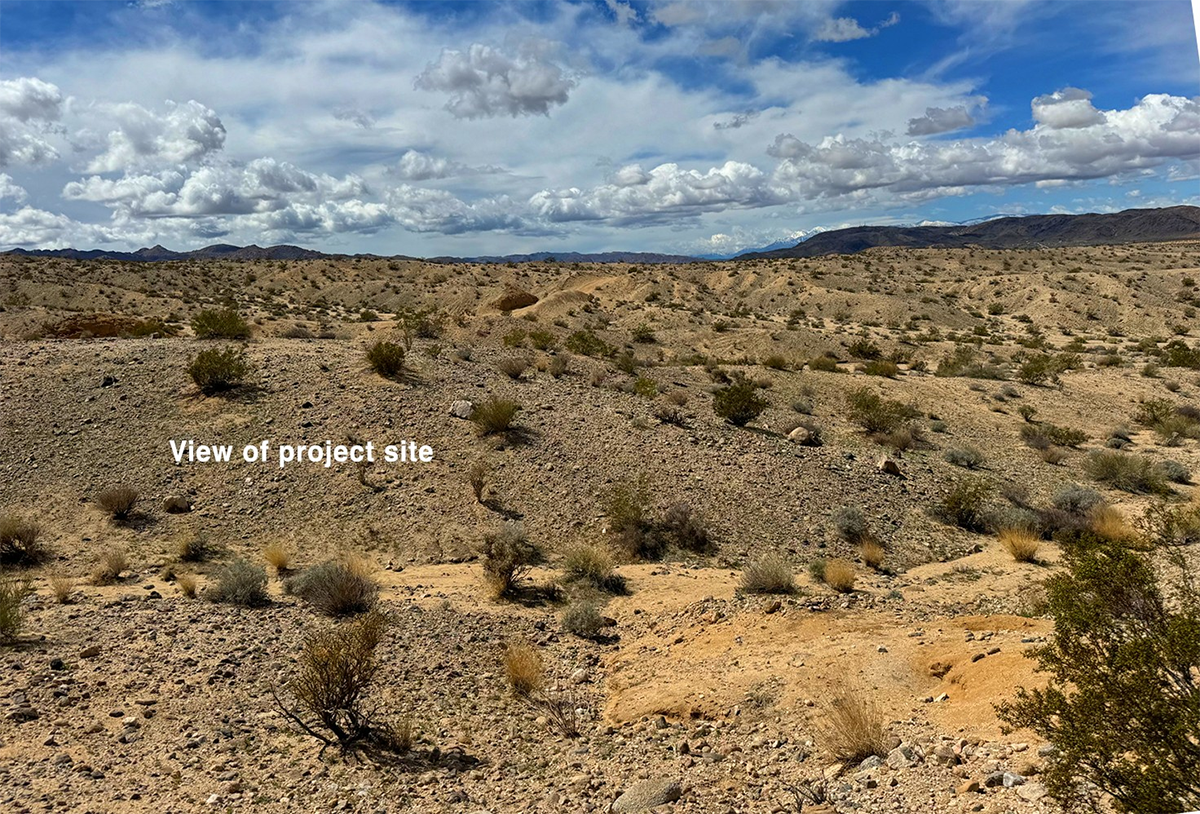
The removal of existing vegetation and reseeding were also discussed with regard to the massive grading required for the project, which would remove approximately 262,000 cubic yards of crust developed over millennia that holds the desert together.
As Smith concedes, that is a significant amount of grading:
We’re not running away from that fact that it’s a conclusion in the EIR. We’re trying to minimize grading to the maximum extent feasible by, for example, leaving the tributaries or the streams that are go through the site untouched. But there are some significant reasons why that amount of grading was needed. You know, basically we’ve tried to minimize it to the extent possible.


Many of the public comments referred to grading, dust, valley fever and the difficulty of replacing slow-growing desert vegetation:
Pat Flanagan:
I will take issue with the fact that they’re doing massive grading, and then they say they will do habitat revegetation. I have been following these projects now since 2014 with the first solar project went in, and I’ve been breathing the dust from that project, which is in Joshua Tree. Since that time, they’re not going to be able to revegetate the desert—vegetation doesn’t happen that easily. And I would just bet you go to any solar project that said they would re-bed (i.e., restructure the soil bed), and you will not see it to have happened. So that doesn’t work.
Two speakers, Gina Kohn and Ted Meyer, spoke to valley fever, which is on the rise across California.1 Gina Kohn spoke to Twentynine Palms’ founding as a place of healing and described the impact valley fever had on a family member:
Valley fever is not theoretical. It is not rare, and it is not harmless. A family member of mine who is my age, a Rancho Mirage resident who lived a quarter of a mile from the 618 acre luxury Disney Resort [when it was under construction], was diagnosed with valley fever one year ago, resulting in multiple life-threatening ICU stays, antifungal, IV drips, multiple strokes, a feeding tube, tracheotomy and the loss of their ability to walk, speak or work. Their future is still uncertain.
In addition to grading, Peter Lang was concerned about long-term accountability on a project that will “reshape our landscape permanently”:
The applicant’s capacity and accountability are unclear. E-Group is a small foreign firm with no verified track record of completing projects in the US. the city must determine whether this is a special purpose vehicle and whether it has the financial and operational capacity to carry long-term responsibility.
Smith acknowledged the concerns:
…there are a number of different conditions that the city will require for us to comply to try to reduce or mitigate dust concerns. That includes watering the site three times daily during active construction, ceasing construction activities when winds are greater than 20 miles per hour….
In terms of long-term mitigation, Smith appeared to be unaware of the challenges of slow-growing native desert vegetation:
There’s already an inventory of desert plants on the site. Those are going to be preserved and replanted in an appropriate mitigation site. That’s a condition of approval and mitigation measure in the EIR. But also on site again, there will be habitat restoration, planting native plants. So within a couple of years, that root structure will build again, and we’ll have at least the number of the same coverage of plants, or similar coverage of plants on site as you would have today to reduce those long term dust impacts.
As Kurt Keppler pointed out:
Those creosotes that they’re talking about relocating — that’s not something you just dig up and move to another place. Those take hundreds of years, sometimes, to grow, and the root systems are very expansive. It’s not just a matter of just shifting them around.
And this was confirmed by a representative from Dudek Environmental, one of the consulting firms hired by E-Group that was present at the meeting. When asked by Commissioner Max Walker “If the vegetation doesn’t take and nothing decides it wants to grow in that section of the dug up desert, what’s option number two?” The representative replied:
Well, the revegetation plan, just for clarification, we do have a restoration report that specifies the details of that, but the revegetation would not be removing creosote bushes as an example. As we know, as somebody had stated, those have a deep root system. They’re hard to relocate or translocate, so this would be simply hydro seeding to provide that barrier and under cover. It’s easy to grow. There will be shade underneath the panels. The panels will be lifted. So the hydro seeding of native annuals and native grasses would provide that that cover. So that is more of what the revegetation plan is intending.
The representative did not address Walker’s question “option number two.” Chair Cure also pressed for more information,:
Okay, 20 miles per hour [referring to the wind speed at which mitigation kicks in] then there’s no construction. But that doesn’t actually change the fact that there’s dust blowing if there’s been grading done. So I just, I’m trying to get a little bit deeper level of if there’s additional dust control measures in those factors, as well as like long-term factors after construction is completed.
Criste replied:
The AQMD permitting requires that watering continue during wind so because it’s windy, the other measures don’t stop. There are also provisions for inactivity that watering may not be sufficient and chemical stabilization needs to occur — that’s the green patches you’ve seen on long-term construction sites. They also have to implement track-out devices that that put gravel on the ground so that the trucks don’t track the dirt and wash off their tires when they leave the site.
Which again didn’t address long-term mitigation during the operational phases of the project.
What about endangered species such as the desert tortoise?
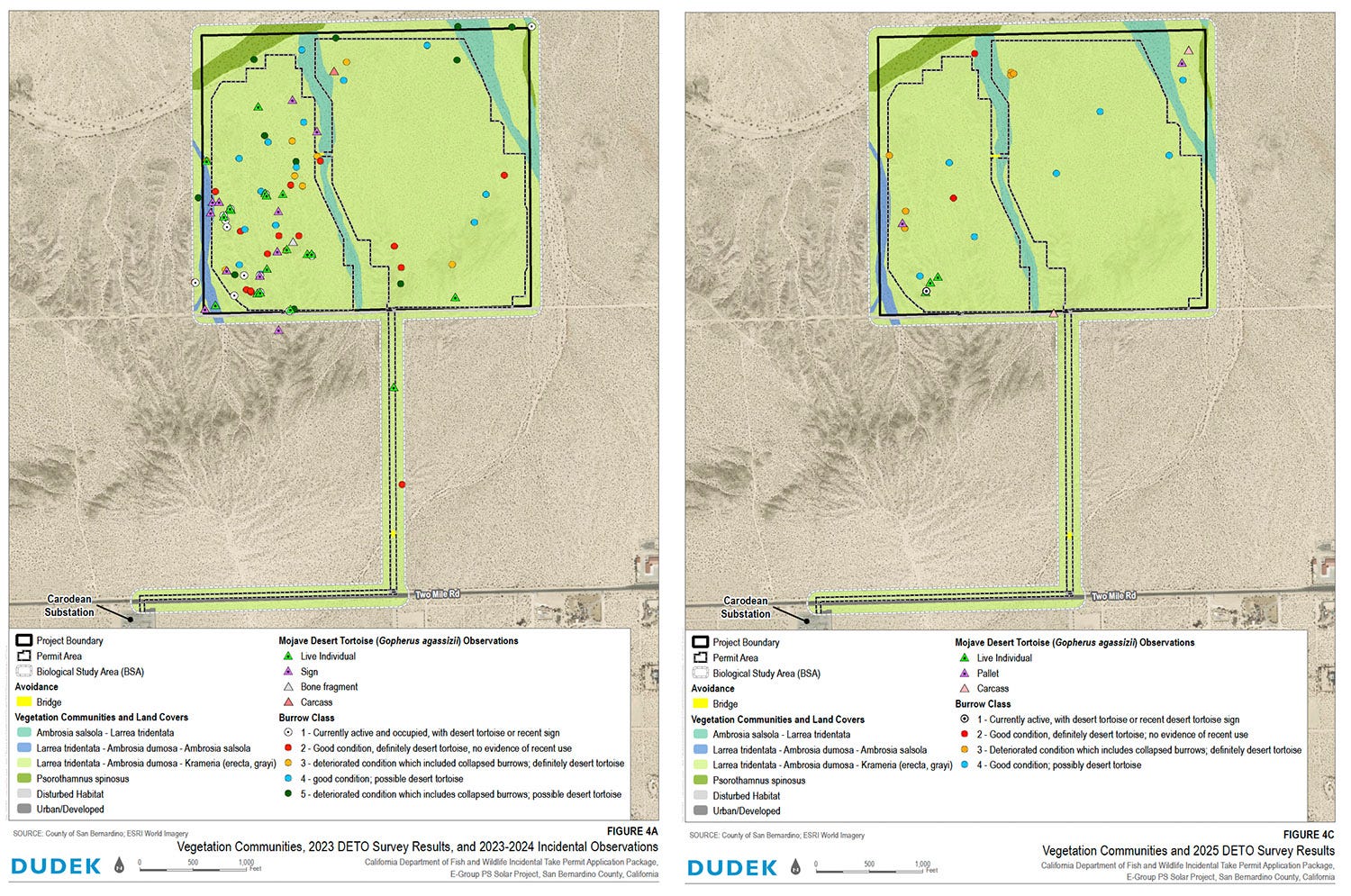
Our discussion of wildlife on the parcel will focus on the endangered desert tortoise as documentation has been presented at prior meetings verifying their presence on-site. While Smith indicated that they identified two desert tortoises on the parcels in the most recent survey, prior surveys as well as documentation provided in public comment by resident such as Mary Kay Sherry have indicated a larger number:
I can tell you for a fact, that I don’t know when they were walking that area, there are more than two desert tortoise in that area. I traveled it daily for over 15 years, and I’ve seen multiple tortoises. I had pictures here at the last meeting, from baby ones to larger ones. They’re there.
Smith indicated E-Group’s intention to abide by California Department of Fish and Wildlife (CDFW) rules for relocating tortoises; however, recent studies have indicated that species fertility drops with relocation:2
So we’ve already been in coordination with both the California Department of Fish and Wildlife and US Fish and Wildlife, which both require that we get an incidental take permit…And so what that means is that, first, there’s specific requirements for relocating those desert tortoises, but also that we have mitigation. We identify mitigation site, and we do that a certain mitigation ratio. And so that’s a minimum of one to one, but the final ratio that will be approved will be approved by CDFW…So we’re currently actually working actively with California wildlife to identify a site.


Does the project meet the AB 205 threshold? And what about a Power Purchase Agreement?
There has been considerable debate about whether the project meets the threshold of 50 megawatts, which is required for state intervention. (See our discussion of AB 205 for further details on that bill.) Here we’re going to look at the debate on the threshold, which focuses on whether the California Energy Commission bases its determination on AC or DC power generation.
The confusion arises from the text of the law, which reads, “Existing law vests the Energy Commission with the exclusive jurisdiction to certify the construction of a stationary or floating electrical generating facility using a source of thermal energy with a generating capacity of 50 megawatts or more” without specifying AC or DC power. However, as pointed out in public comment by Elliot Balsley, AC is the industry standard:
The question is, “Which number is used by the CDC for their measurement?” And every power generation project is always measured in alternating current, because that’s what connects to the grid. That’s what they pay for. That’s what you pay for your house. That’s what the utilities pay for. It’s always AC that applies to solar, wind, gas, and every other type of generation facility. This is how every other developer talks about their power. They talk about AC power. The Darden Fresno facility, which was the one approved by AB 205, is consistently described as 1,100 megawatts. That’s what it says on the headline in the news. That’s what is on their application. That is the AC power. That facility produces about 1,600 megawatts of DC power. But that number is irrelevant. AC power is the only thing that that matters, and that’s what we should be talking about. They keep bringing up this 51 megawatt number, but no other solar developer measures things that way.
Smith countered that the project could be configured to hit the threshold, but they are trying to mitigate noise impacts:
Some of the public comments noted that it actually is less if you calculate those inverters. That’s correct — Inverters don’t generate energy. They actually convert energy from DC to AC wattage, and so that the inverters aren’t what is considered by the CEC when considering qualifications — it’s actually the solar panels themselves. In fact, E-Group proposed to have less inverters, out of respect for the community, to reduce the noise impact associated with those inverters.


Vice Chair Alex Garcia was particularly interested in the lack of a Power Purchase Agreement (PPA) — a long-term contract (typically 10–20+ years) where a developer designs, installs, owns, and maintains a solar system on an industrial site, selling the generated electricity to a company like Southern California Edison for distribution.
Smith confirmed that they’d have to market the energy via a PPA but that,
It’s unusual to have a PPA before any entitlements have been issued for a project, especially with a city that has a moratorium. We’ve certainly reached out to a number of potential purchasers, but they’re saying, until you go through the city process, we’re not really willing to engage in substantive conversations, because you still have to go through your entitlement process. CEQA approval and certification is also a critical part of that.


What happens if the project fails? What’s the deaccessioning process?
Several public commenters raised concerns about the project’s compliance with the city’s development codes—especially the City’s moratorium on large-scale solar projects—and the potential for long-term environmental damage. Once the project closes down, Cure asked, “what would be the percentage of it being returned to its original state?” The answer appeared to be none of it as Smith replied that the parcels would be returned to an undeveloped state, that is, they still would be graded and scraped but without the installed panels.
Cure was also concerned about how changes in the viability of the project would affect the benefits package:
If it’s no longer a 30-year project, because of some reason, change of technology, something changes. Then what are the guarantees that exist, that the benefits would continue to the city? If this project was no longer viable, if it’s obsolete?
Gardner replied, “there is some provisions in there for the cease of operations, and there are certain costs associated with that as well. And I’d have to find that information for you.” And Smith added, “Please do.”
Help us get to to $9,000 — we’re just $15 away!! Upgrade your subscription from free to paid today for just $50 per year or $5 per month.
Want to make a one time donation or are you able to give more than $100? Donate via Paypal!
Leave your thoughts in the comments below. Please note that we do not allow anonymous comments. Please be sure your first and last name is on your profile prior to commenting. Anonymous comments will be deleted.
Thanks for reading! This post is public, so feel free to share it.
Valley Fever cases climbing statewide, UCLA Health, May 23, 2025
Smithsonian Study shows relocated desert tortoises reproduce at lower rate, Smithsonian Insider, May 24, 2017.
I didn’t realize that this project involves our beloved “Sugarbowl”, an eroding paleosol full of flowers when the time is right, and a striking visual landmark representing 29 Palms.
There are drainages which would involve ephemeral streams throughout this project area.
And the dust blowing from the one and only giant sand dune in town would be disastrous.
What an idiotic location!
June 4th, 1970 !! Four dead in Ohio !! REMEMBER KENT STATE ! the shame. happening again !
ICE..........how can this happen in America ??