
RECAP: Twentynine Palms Planning Commission January 20, 2026
Commission tells Development Director on zoning consolidation, “Put your plan together and then come back and let’s see what it is.”

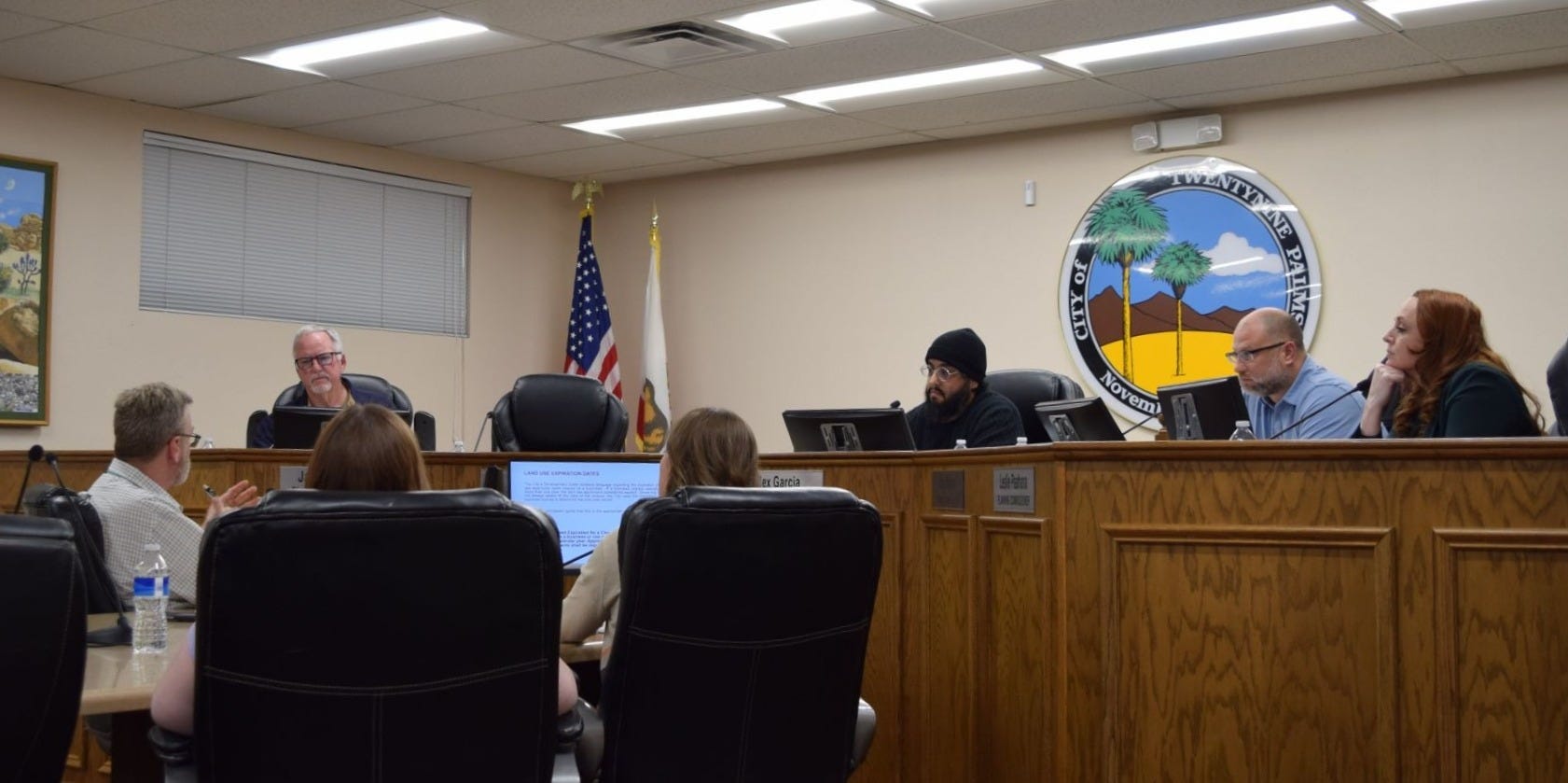
Tuesday’s meeting was an expeditious forty minutes in which Planning Commissioners held two study sessions and heard comments from residents on Development Code inconsistencies and a proposed solar farm project. Four of five Commissioners were in attendance. This was Vice Chair Alex Garcia’s first time conducting the meeting with Chair Jessica Cure having an excused absence.
The evening marked the first meeting of 2026 and, aside from the Consent Calendar with last meeting’s minutes, there were no action items to be voted on. The last meeting Commissioners voted on anything other than routine Consent Calendar items was over three months ago at their October 21 meeting where they unanimously approved a 30-unit eco resort slated for Amboy Road.
Since then, only study sessions have been conducted, which have typically involved language consolidation of the City’s Development Code. Study sessions are not streamed or recorded by the City, making the official record of these sessions limited to meeting minutes only, which are taken by Commission Planning Assistant Shelley Green.
Commission agendas are made by City Staff in coordination with Community Development Director Keith Gardner.1
Coverage of the meeting agenda is available here.
PUBLIC COMMENTS


First to speak was resident Alex Barron who addressed the Commission on inconsistencies in the Development Code regarding allowed uses on residential lots.
Barron, who owns two adjacent parcels on Kern Boulevard, which is zoned for Rural Living-5, would like to place a shipping container on one of those parcels. The adjacent parcel has a primary residence, while the parcel he is seeking to place a shipping container is currently undeveloped.
According to Barron, current Development Code language does not allow for accessory structures like shipping containers on undeveloped rural lots if there is no primary use structure on the property, such as a home or other residential dwelling. The alternative for Barron would be to merge the two adjacent parcels, which would cost around $5,000 for a survey inspection, or to build a primary use structure on the undeveloped property, another costly expense.
Bottom line up front, I am seeking to discover the official mechanism by which I can propose an adjustment or change to the municipal code, specifically regarding allowable land uses and primary requirements for rural living districts.
Barron cited allowable land uses for his zoning, which range from permitted mobile home parks, communications facilities, a produce stand, and cemeteries, but not accessory use structures:
Again, I can have a cemetery permitted on my vacant lot, but I cannot have a shipping container placed on my vacant lot. That, to me, is pretty unreasonable.
It is unclear if the Development Code allows for a zoning variance permit or some other form of acceptable use policy to bypass code in this instance. In November, the Community Development Director approved a 4,000 foot 8-unit parking garage on a partially developed residential lot on South Adobe Road that also lacks a primary use structure.
Part-time resident Suzanne Lyons addressed the Commission on a proposed solar farm development in the Harmony Acres neighborhood, stating she is opposed to the project on scientific grounds:
I will also say I’m completely an advocate of solar power. This is not about solar power. I love solar power. I wrote a book on climate change for teachers—I love it. The problem is that all solar farms are not alike. There are really, really important ones that are carefully vetted and operated with expertise, and then there are others that do more harm than good, and I’m afraid that what we’re looking at is a project that’s going to lead us down the road that we would really regret.
Lyons cited the project’s magnified size when compared to other solar farms in the area. Solar farms north of town, easily visible from Highway 62, are 9 and 12 megawatts. The proposed E-Group solar project exceeds this by over four times at 50 megawatts.
Lyons, who distributed a fact-sheet to Commissioners after the meeting, also noted that if approved, Twentynine Palms would be one of the only cities in California with an industrial scale solar plant in city limits. This is despite a City ordinance that bans commercial solar plants.2
Peter Lang, Lyons’ husband, noted that they own property yards away from the proposed project. He cited visual aesthetics and environmental concerns, such as impact to desert tortoise habitat and dust generated by the project being blown downwind to residential areas.
Lang encouraged the Commission to walk the proposed site themselves and questioned numbers published in the Draft Environmental Impact Report (DEIR), which can be found on the California Environmental Quality Act (CEQA) website.
I also have a question about how E-Group has characterized this project as being eligible for AB 205 approval. 50 megawatts of power to the grid is required—go to page 338 of the DEIR to see that each inverter is rated at 225 kilowatts, and the number of inverters is around 170—total capacity equals 170 inverters times 225 kilowatts equals 38.25 megawatts of AC power to the grid. So the DEIR is inconsistent. It refers to 50 megawatts, but this does not add up based on the equipment they say they are using. Can E-Group confirm that AB205 would apply? From what I can tell, it would not. And this gives me the sense that the state can’t force this project, which is kind of the rhetoric that we’ve been hearing. Thank you.
Summing up public comment was Carlos Blandon, who spoke on visual impact of the solar project, using abundant corrugated metal fencing throughout residential areas as comparison, encouraging Commissioners to avoid glare effects.
Desert Trumpet coverage on the proposed solar farm is available here.
COMMISSION COMMENTS AND REPORTS OF MEETINGS ATTENDED
Commissioners had no meetings to report; Commissioner Leslie Paahana wished everyone a happy new year while Vice Chair Garcia announced he was assisting a mother and daughter with a local donation drive for the unhoused, encouraging anyone with food, clothes, or hygiene packets to reach out to him.
CONSENT CALENDAR
The only consent calendar item was approval of the December 16 meeting minutes, approved 4-0-1.
COMMUNITY DEVELOPMENT DIRECTOR UPDATES
Community Development Director Gardner announced that the second reading of the City’s new policy on ancillary entertainment permits will come before the City Council at their upcoming January meeting, and that the City anticipates it will start accepting entertainment permit applications starting March 1.
City staff will compose a list of approved spaces for this activity, and share that list with the Public Arts Advisory Committee (PAAC) and the Tourism Business Improvement District (TBID). The concept of City-issued entertainment permits was first introduced by the Development Director in September 2024.
Gardner also displayed a calendar of potential Commission meeting dates for the 2026 year, clarifying if any dates conflicted with planned travel for Commission members. Although traditionally incorporated cities hold two meetings per month, the City of Twentynine Palms website does not mandate both meetings, stating “Planning Commission meetings may be held on the first or third Tuesday of each month at 5:00 p.m. in the Council Chambers at City Hall.”3
In the 2025 calendar year, the City formally cancelled twelve Planning Commission meetings (Meeting cancellation dates are listed on the City website under Meeting Documents.)

Going into the 2026 elections, Desert Trumpet has sustained a potential 50% cut in funding. Help us provide the coverage you’ve come to expect by becoming a paid subscriber or upgrading your paid subscription today!
STUDY SESSION
Land Use Expiration Dates
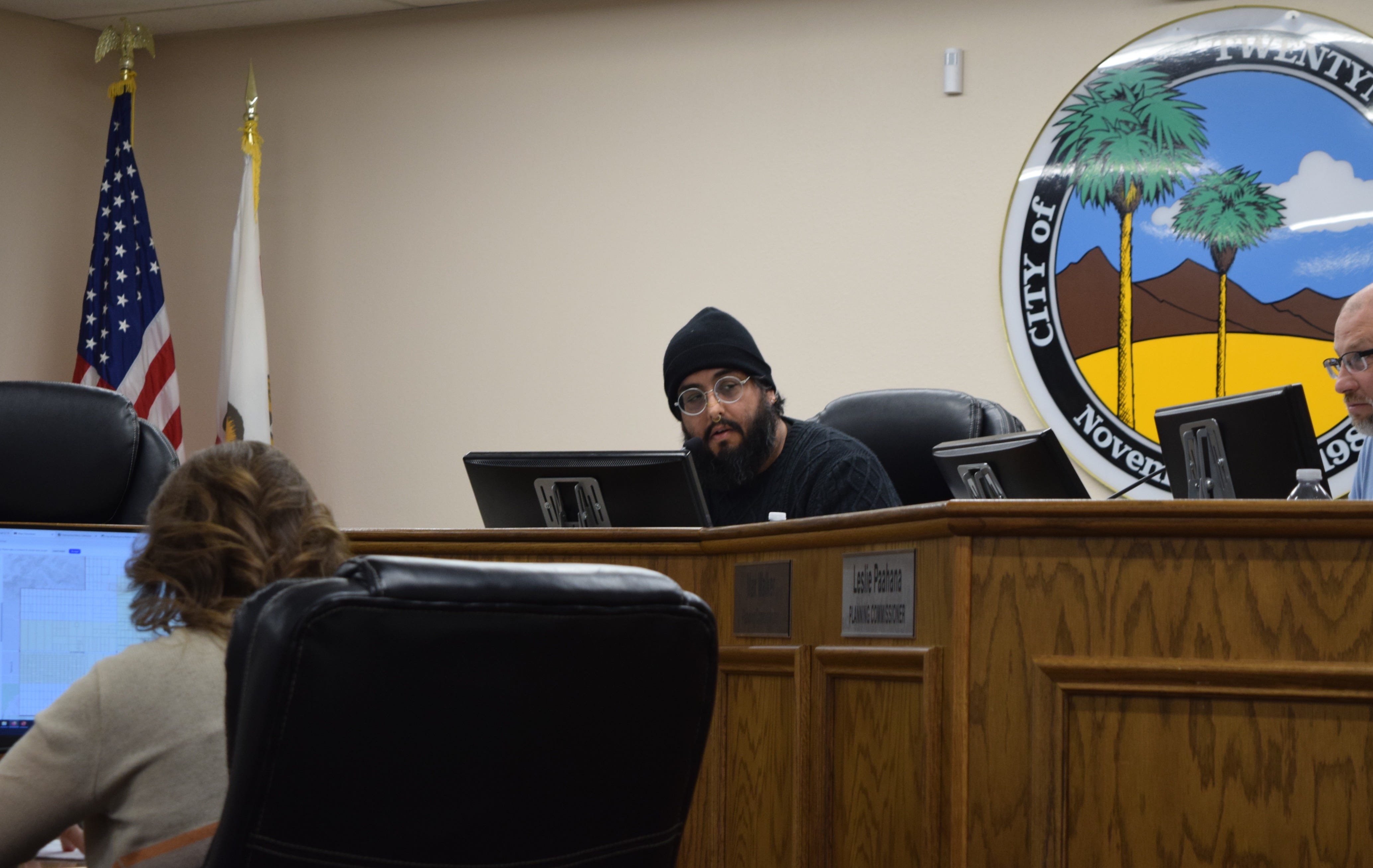
Director Gardner kicked off this study session topic by outlining a fairly common issue City Staff encounters:
We have a provision in our Development Code that contains language regarding the expiration of land use approvals upon closure of a business. [A] business ceases operation for more than one year, then the land use approval is considered expired. So this is particularly relevant for a lot of our vacant buildings, and we actually have some vacant tenant spaces in shopping centers that this is will also be relevant to.
Often, the City has no indication that a business has shut down until its business permit expires. Gardner is using the one-year expiration date of that business permit to enforce approved land use policy, calling the one-year expiration date “standard across the board for various jurisdictions.”
Commissioner Jim Krushat inquired if business license policy requires businesses to inform the City when they shut down. It does not.
“And after that year, they have to go through entirety of inspection of everything, correct?” inquired Vice Chair Garcia. Gardner affirmed:
Yeah. So if it was a restaurant, then we’ve got to re-establish the restaurant as a land use. The kitchen may have to be upgraded because of current building code standards, etc.
No further land use permits are required if a restaurant moves into another restaurant space if it is within less than one year of that business permit expiration.
Gardner says the City is very seldom informed when a business is closing. Krushat provided a potential alternative:
Unless we changed the Development Code to read that businesses that close down have a requirement to inform the City, and then you can start from that date— but if they don’t inform the city, then it goes by when the business license expires— would be one option. I’m okay with the way it is now because it’s very set.
Garcia was also in favor of the current interpretation using the business permit expiration date:
I think I agree with that, because if nobody’s going to inform you when doors are being closed then you have to start somewhere.
Speaking from the public on the study session item was Carlos Blandon who advocated for the land use onus to be placed on landlords rather than tenants:
You should start pushing a lot of responsibility back to the landowners on what they’re going to be allowing.
Consolidation of Zoning Districts
In anticipation of the City’s General Plan update, the Commission’s seemingly eternal saga of language simplification study sessions continued with this second topic— consolidation of zoning districts, particularly those designated as Rural Living 2.5 (RL 2.5) and Single Family Residential-Estate (RS-E), which are both zoned for 2.5 acres.
Gardner stated:
We’ve got two residential zones with one acre minimums, we’ve got two residential zones with two and a half acre minimums, we’ve got two higher density residential zones with eight acre minimums and two higher density residential zones with 20 acres plus volumes per acre.
Regarding RL-2.5 and RS-E, which have the same minimum lot size of 2.5 acres, Gardner and City Staff believe there is room for “consolidation and simplification.”
However, despite both zones being near each other geographically and adjacent in acreage minimums, vast differences exist between the two zoning types in terms of their allowed land uses and the intensity of permit requirements.
Allowed uses for Rural Living and Single Family Residential-Estate Land Use Districts are listed in the Development Code under Table 19.08.030-1, which outlines permitting restrictions for residential care facilities, day cares, campgrounds, cemeteries, mobile home parks, non-commercial solar fields, hospitals, race tracks, stadiums, horse stables, and more.
RS-E is less restrictive than rural living, for example, only requiring an Administrative Use Permit (AUP) at no cost to build a child daycare or residential care facility, while RL-2.5 requires a more costly $5,000 Conditional Use Permit (CUP.)
Gardner pulled up an interactive zoning map, which had similar color coding for residential and rural zoning that made concrete geographic comparisons difficult for the Development Director to project at the meeting:
There is a slight change in color and I can see it barely on this screen, but the Commission asked where these were. So this is where they are.
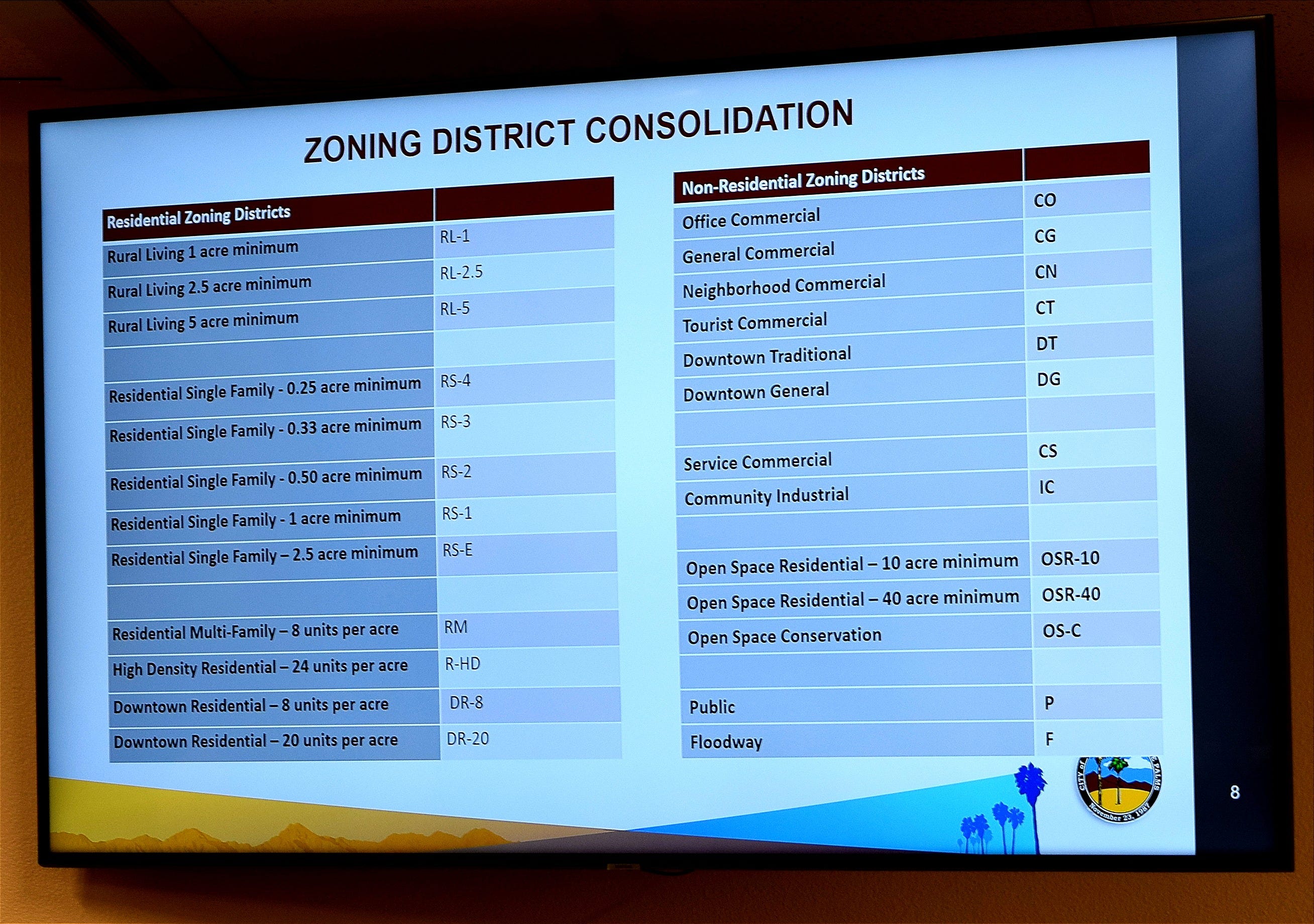
In Commissioner discussion, issues with the display map were repeatedly expressed. Walker told Gardner:
I’d like to see the allowable uses and something I can read.
Gardner said the allowable uses in the two zoning types are “pretty much exactly the same.” However, Commissioner Paahana raised differences between the two zoning types, speaking on Residential Estate zoning:
It doesn’t allow race tracks, horse stable boarding, sports oriented recreation facilities requiring remote locations. You can’t do transient lodging there, bed and breakfasts, campgrounds.
Walker chimed, “I think in some of them, consolidating is probably going to be a good thing, but in others, maybe not as much.”
Krushat, who said he was in favor of consolidation but that the Director’s plan was a little premature, summed up Commissioner discussion:
I would almost recommend, put your plan together and then come back and let’s see what it is.


Speaking from the public was property owner George Mulopulos:
The main reason that this has been proposed I think is because they have the same density, right? They have 2.5 acres per residence. And I think the multi-family was the same— it’s because the density is the same. But there may be other differences I don’t know about that they’re different between RS-E and RL 2.5. For example, it may be that you could have a campground on an RL 2.5 but not on an RS-E, which is both the same density.
So my question would be, if these are consolidated, what would the rules be? Would they take the place of the RS-E 2.5 or would they take the rules of the RL- 2.5. They’re different rules I think. Maybe a lot of things are the same. The setbacks are a little different. I mean, there’s very small differences, but there are bigger things, like what you’re allowed to do with the land. So I would just, you know, caution everyone to make sure we understand what’s being given up, because there could be a loss of some ability you have with one designation than the other, even though they’re both 2.5 zoning.
Alex Barron spoke in favor of land owner freedoms and advocated for a less restrictive policy adoption:
I take issue with the word “simplify.” Who are you simplifying for— you or the people? Then please at least try to err on the side of making it more permissive and less restrictive for those who own the land and want to do something with the land.
The next Planning Commission meeting is scheduled to take place February 3rd, 2026 at 5 pm.
Thanks to our new paid subscribers, we are at $8500 in subscriptions, just $1500 short of our $10,000 goal. Upgrade your subscription from free to paid today for just $50 per year or $5 per month.
Are you able to give more than $100? Donate via Paypal!
Leave your thoughts in the comments below. Please note that we do not allow anonymous comments. Please be sure your first and last name is on your profile prior to commenting. Anonymous comments will be deleted.
Feel free to share this article!
According to numbers published on Transparent California, Gardner earned upward of $152,350 in salary and $21,078 in benefits plus pension, for a total pay of $174,641.63 in 2023. Numbers for 2024 and 2025 have not yet been published by Transparent California.
Currently, the City’s Development Code does not allow for commercial solar farms (19.18.030 Allowed Uses and Permit Requirements). It banned utility-scale solar facilities in 2012, shortly after the Highlander 1 Solar Field became operational.
Hmmmm! Perhaps I'm mistaken, correct me if I'm wrong. But aren't some of the folks who spoke against the solar farm, using some of the same objections as the people opposed to Ofland, the folks who were in favor of Ofland? Guess it's different when it's in your own backyard.