
Return of the Rabbit Virus? Updated for 2026
Good News / Bad News about Dead Rabbits in the Morongo Basin

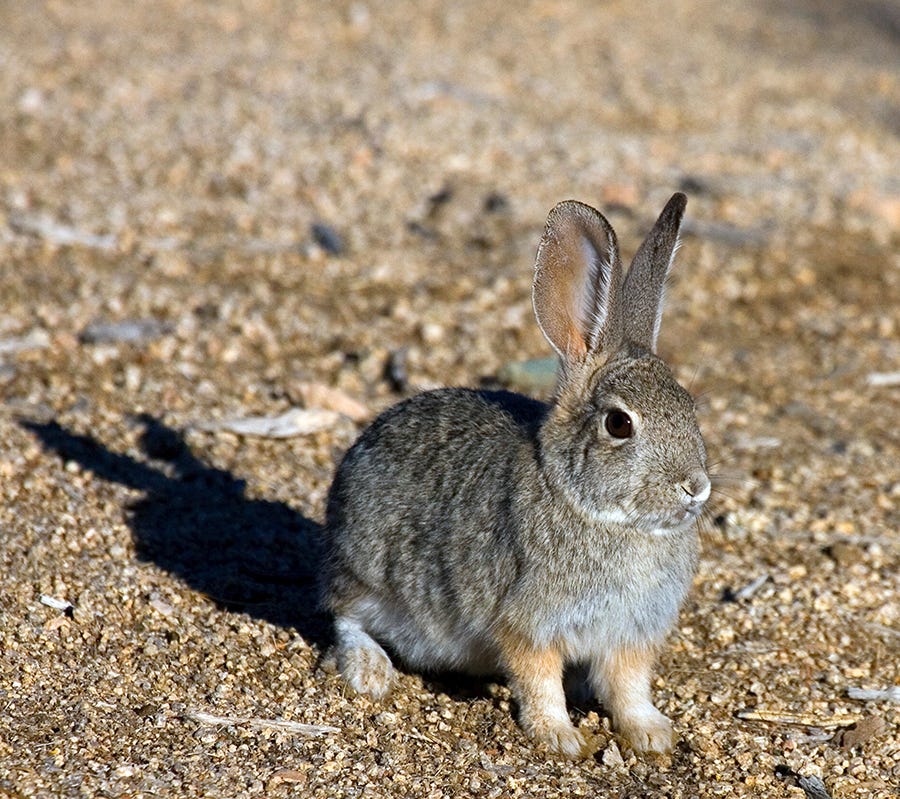
Update – May 2026: The situation in the Morongo Basin looks much the same as it did in 2024. After another wet year, rabbits had a strong breeding season; however, some of the young rabbits born this spring did not inherit immunity to rabbit hemorrhagic virus (RHDV2) from their mothers, and some have since died from the disease. Residents should continue to report dead rabbits to California Department of Fish and Wildlife (CDFW) and follow safe handling guidelines. The CDFW is not seeing a large uptick in reports—yet.
July 3, 2024
Residents of the Morongo Basin, including Twentynine Palms, have reported finding dead cottontails and jackrabbits these last few weeks, bringing back disturbing memories of the rabbit hemorrhagic virus (RHDV2)1 that burned through the rabbit population in 2020.2
The Desert Trumpet reached out to the California Department of Fish and Wildlife (CDFW) and received information from Senior Veterinarian Dr. Deanna Clifford about the RHDV2 cases that are currently being reported from Yucca Valley, Joshua Tree, and the Indian Cove area.
Which Animals Are Affected?
RHDV2 kills up to 100% of the rabbits that catch it, which includes desert cottontails, black-tailed jackrabbits, and domestic rabbits. There is no treatment for it, but there is a two-dose vaccine for your pet bunny—which is available from vets in the low desert who treat exotic animals; El Paseo Animal Hospital in Palm Desert carries the vaccine, for example.
It appears to be specific to rabbits and does not transmit to humans, pet dogs and cats, or other wild mammals. Nonetheless, wear gloves if you have to handle a dead rabbit and wash your hands well afterward.
How Does the Virus Spread?
The RHDV2 virus is seasonal, Dr. Clifford said. Kits have immunity from their mothers, but lose it after they stop nursing—one reason we are seeing some dead rabbits now. There is immunity in the wild cottontail and jackrabbit population, and it is hoped that rabbits won’t experience the mass die-offs of 2020.
It is likely, Dr. Clifford said,
“that the virus has remained present in the population at a low level, then periodic outbreaks occur when a lot of susceptible rabbits are present on the landscape. This could be from a good reproductive year with a lot of young animals present and from normal population turnover due to average lifespans of individual rabbits (2-5 years roughly). We have seen a seasonal increase in dead rabbit reports and RHDV2 cases in spring-early summer each year, which corresponds to the time that rabbits are most abundant with a lot of young animals present.”
The belief is that the rabbit community will develop strong immunity over time. A CDFW Biologist Supervisor also said, “The working hypotheses for what’s behind a resurgence include two recent wet years producing crops of naive young rabbits and hares, or variation in the RHDV2 virus leading to evasion of prior immunity, or of course, some combination thereof.”
The virus spreads:
from direct contact between rabbits, carcasses, water sources, flies, fleas, and mosquitos
predators can spread it through their feces.
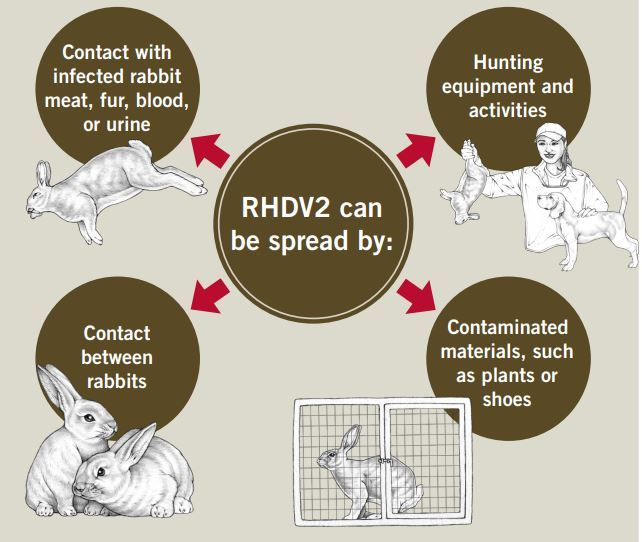
The virus is very difficult to eradicate and freezing weather won’t kill it. Infected rabbits may look disoriented or have difficulty moving and die quickly.
What Do I Do If I Find a Dead Rabbit?
Take a photo and do an online mortality report for CA Fish and Wildlife (CDFW). If your internet access is spotty, you can also call (916) 358-2790 to reach CDFW’s Wildlife Health Lab to make a report.
From CDFW: Reporting parties are advised to remove carcasses to slow the spread to healthy rabbits; we recommend double-bagging carcasses, spraying the outer bag with 10% household bleach solution, and disposing of in regular trash, or by burying it more than three-feet deep. If samples are sought in your area, a representative of the CDFW Wildlife Health Lab may contact you to seek your assistance in preserving a sample by freezing or refrigerating.
We also recommend carefully cleaning water dishes with bleach regularly or removing them up entirely, because they can spread the disease.
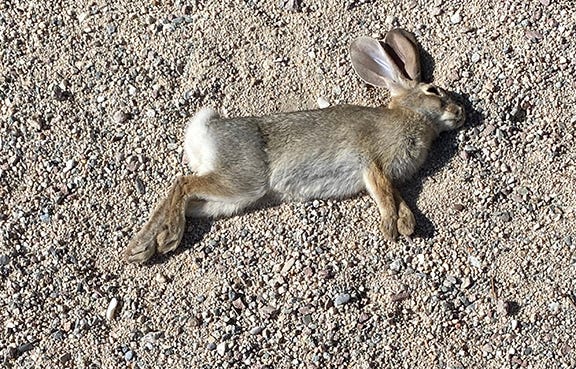
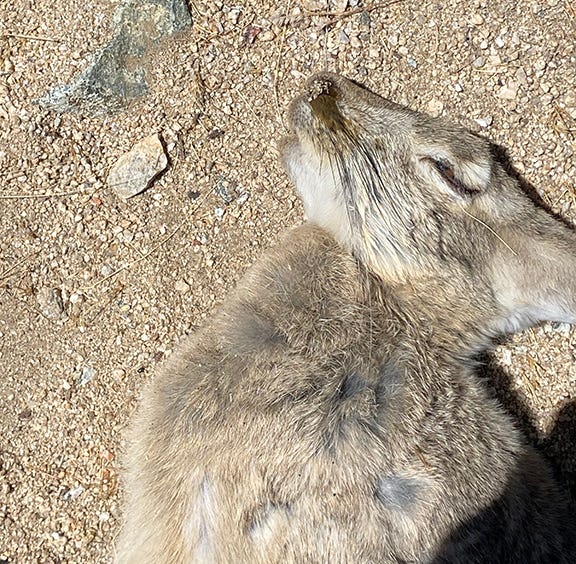
Rabbits die quickly from the RHDV2 virus. You may see blood around the mouth, nose, or rectum. (Photos by Kat Talley-Jones)
Dr. Clifford said that the CDFW has been receiving reports of dead rabbits from Yucca Valley and Joshua Tree. “Having members of the public continue to submit reports on what they are seeing is valuable for trying to understand more about what potential impact the disease may have in a local area, and how long recurrent outbreaks appear to be causing mortalities.”
We will update information about the RHDV2 virus if we receive more information and are grateful for information we received from CDFW. Let’s hope that our local cottontails and jackrabbits quickly weather this outbreak.
Thanks to you, Desert Trumpet met our winter $10,000 paid subscription goal!!!
Not a paid subscriber yet? Did you know that paid subscribers receive discounts on our DT Social events and invites to DT Front Porch, intimate discussions featuring local officials and notable residents?
Upgrade to a $50+ paid subscription for a 10% discount.
Upgrade to $100+ for a 25% discount.
Sustaining subscribers at the $250+ level and above receive complementary tickets
Leave your thoughts in the comments below. Please note that we do not allow anonymous comments. Please be sure your first and last name is on your profile prior to commenting. Anonymous comments will be deleted.
This coverage is free - please share!
1 RHDV1 spread from China in 1984, and it was contained by about 2001. The RHDV2 mutation arose in 2010 in France and has since troubled rabbit populations worldwide. For a fascinating look at the virus, see Susan Orlean’s 2020 “The Rabbit Outbreak” in the New Yorker. (The article is behind a paywall; here is a PDF.)