

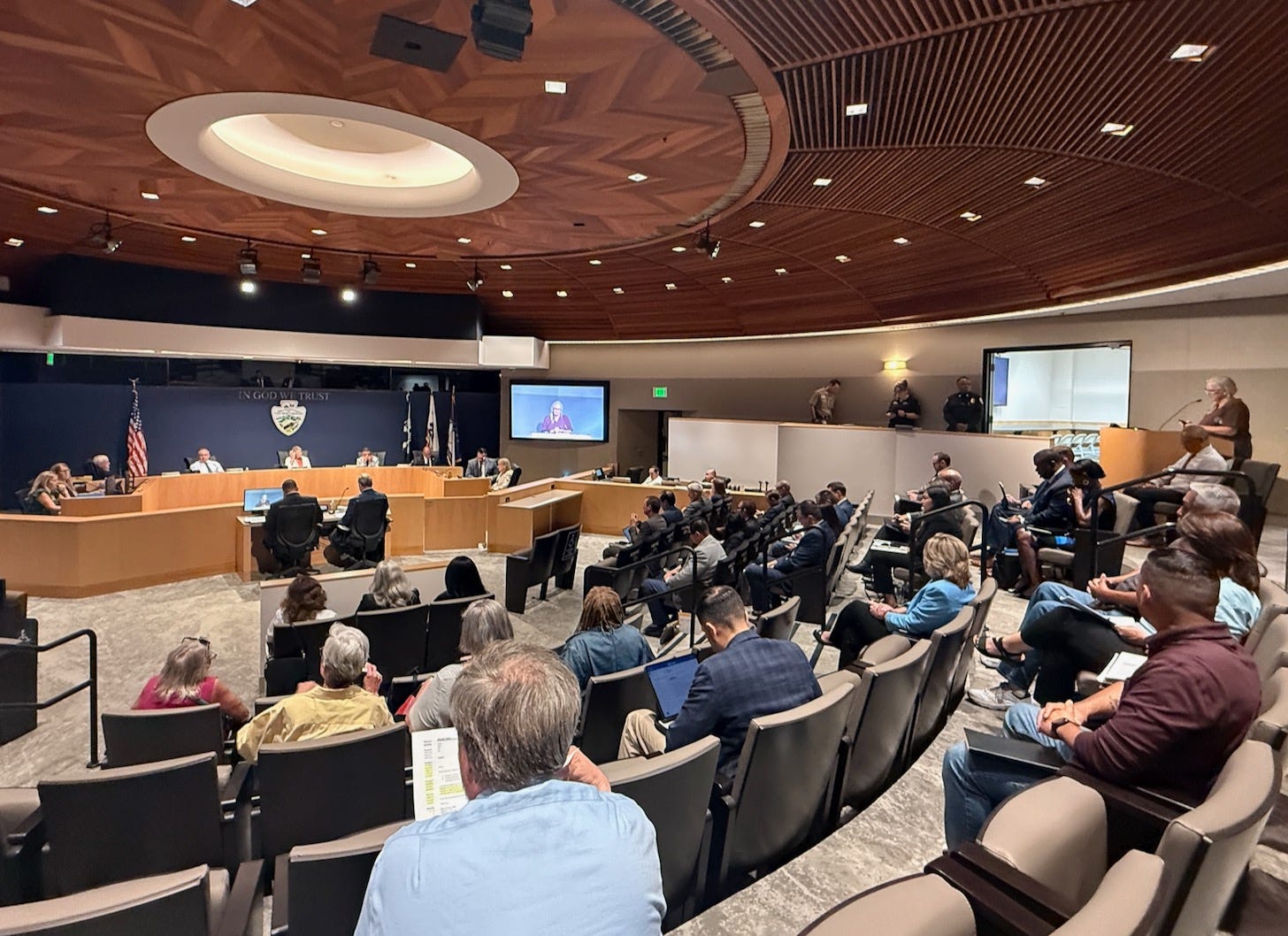
The San Bernardino County Board of Supervisors did NOT adopt the controversial surface mining ordinance rewrite on August 18 that waives County permits for mines with federal approval on federal land. After more than two hours of testimony, with nearly every speaker urging denial or delay of the ordinance, the Board voted to continue the hearing to October 20, sending staff back to do the public outreach residents say never happened.
At issue: the question of whether the County has ANY permitting authority on federal land, and new language stating a County permit "shall not be required" for mining on federal land that has federal authorization. Critics, which include Twentynine Palms and Wonder Valley residents, Earthworks, and the National Parks Conservation Association, warn it could let projects like the proposed Music Valley Mine with stakes in the City of Twentynine Palms and near Joshua Tree's east entrance sidestep County permitting and CEQA review.
Since there was little new information presented at the August 18 meeting, for a fresh perspective, we’re going to relay the meeting entirely through quotes from the discussion and public comment. But first a recap of the core objections to the ordinance to date:
Waiving County permits on federal land surrenders local control over mines to federal agencies.
Removing the County permit eliminates the trigger for CEQA environmental review and its public hearings.
The County publishes required legal notice only in the San Bernardino Sun, rather than in communities’ local papers of record — so affected residents across the County are unlikely to see it.
Projects like the proposed Music Valley Mine near Joshua Tree National Park could advance without close local scrutiny of water use, dust, and traffic.
A four-group conservation coalition (Center for Biological Diversity, Earthworks, Sierra Club, and the National Parks Conservation Association) asked the County to rewrite the “permit not required” language so it clearly waives only the County’s zoning permit, not the reclamation plan or the financial guarantee. The County declined, arguing the permit and reclamation plan are already separate under the ordinance, and that the “may accept” language on federal studies preserves its discretion to conduct its own review case by case.
The coalition also claims that a Public Records Act request turned up no records of mining-exploration projects the County had informally exempted from permits under the 1992 state-federal MOU — the same MOU the new ordinance now codifies. The coalition is arguing the County has been informally letting mining-exploration projects skip permits under this MOU for years, off the books, with no paper trail. The claim is the coalition's; we have not independently verified it.
The coalition's third request targets a technical cross-reference they say lets the County exempt mines from the Surface Mining and Reclamation Act (SMARA) more broadly than state law allows, by failing to count a project's total footprint and instead breaking it into smaller pieces. Center for Biological Diversity attorney Lisa Belenki cited a specific case: the County exempted the Gold Discovery Group mine from SMARA compliance by breaking a 15-acre project into individual pieces of less than one acre each. Belenki called that the wrong reading of the statute and asked the County to apply the exemption only when a project's total disturbed area is under one acre.
Relevant links:
Selected Discussion and Public Comment Voices
Note: quotes have been edited for clarity, brevity and to avoid repetition. We have footnoted claims made by the speakers as needed.
Dan Walsh, Chief Engineering Geologist: Historical background and, later, defends the ordinance revision
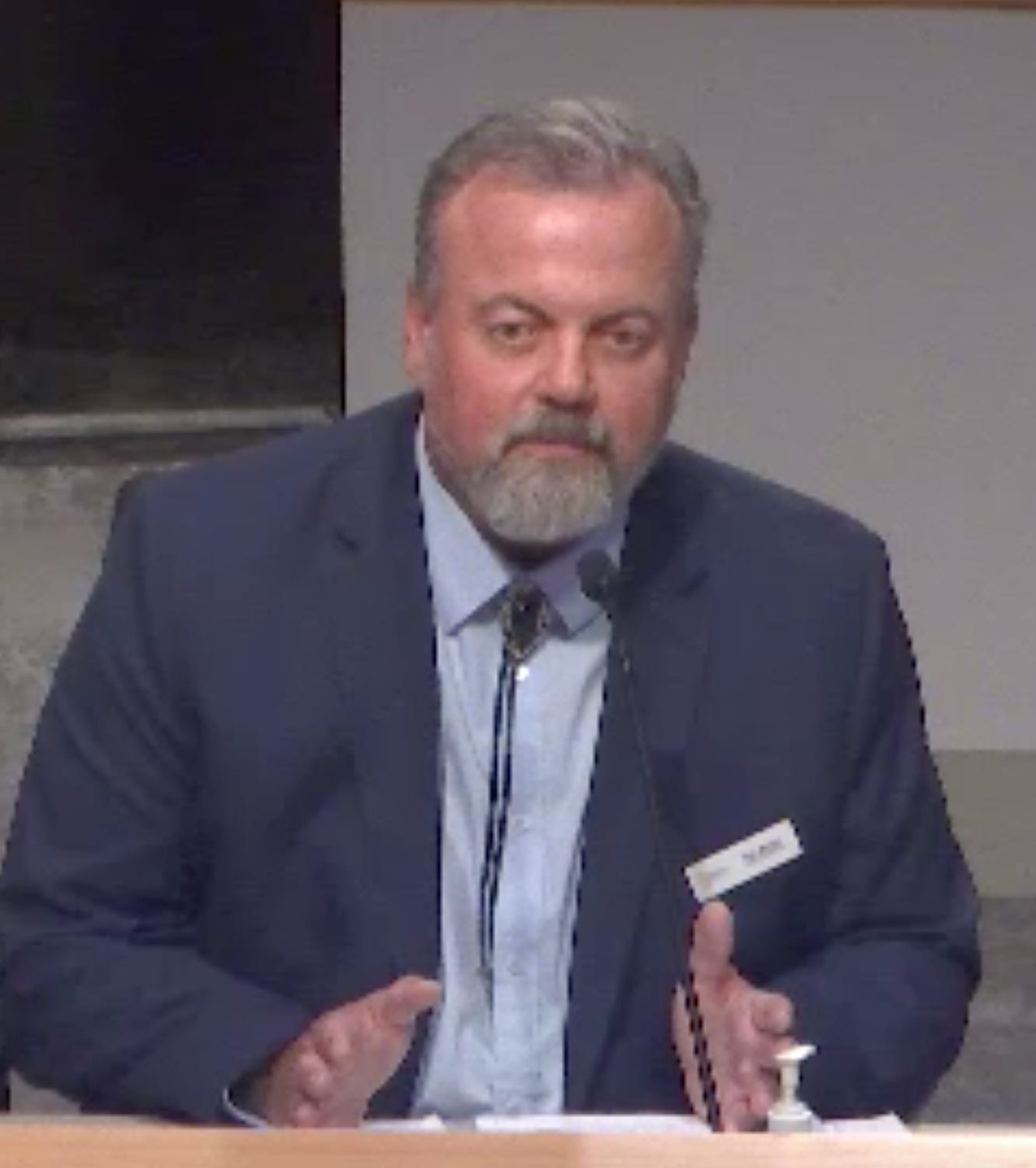
…It might help if I go through just a brief history of federal regulation as far as mining goes on federal [land]…The first date is 1872. Before that date, mining was illegal on federal property.
After 1872, the General Mining Act went into effect. It was enacted by Congress, and at that point, it was pretty much a free for all. And we're seeing the vestiges of those disturbances still in our County…in the Mojave Preserve, and out in the desert, pretty much everywhere in the mountains. And that was for a little over 100 years.
And then in 1976, Congress enacted the Federal Land Policy and Management Act, which actually was the beginning of requiring permits and reclamation standards for federal lands. That was right around the same time that the California Surface Mining and Reclamation Act (SMARA) came out, and just after California Environmental Quality Act (CEQA).1 So we have all these new regulations coming into effect, and National Environmental Policy Act (NEPA)…There's a lot of duplicity [sic] in the reviews and the industry, the public are going, "Hey, let's get our act together here, guys."
So in 1992, California got together with the federal agencies…and the MOU was signed by — on the California, on the state side it was signed by the State Mining and Geology Board and the Department of Conservation; on the federal side it was signed by the Department of Interior, namely the Bureau of Land Management and the U.S. Forest Service. So we have a state agreement with those agencies on the federal side.
So as far as the County authority is concerned, we're given our authority to regulate surface mines by SMARA….so the state gives us that authority. The MOU has clarified the jurisdictional responsibilities [state and federal] to help us work through this— so we are working together.
So that allows us to take the project as a whole, when a BLM [office] gets an application for a plan of operation, which is their permit, they have the applicant contact the County and say “we want to start a mine on federal properties.” We say great. We're going to have to bring in an application for a reclamation plan, and then we contact [the BLM field office] and we start that conversation. Sometimes we even make an MOU for that specific project if it's big enough, if there's enough moving parts, just so there's more clarification on authority.
…So once the plan of operation application's in and the reclamation plan application's in, we work with BLM…the ordinance says we may take studies and documents that are submitted for the plan of operation [by the company]. If you read the MOU, the actual language is we may take those if they meet or exceed the standard of CEQA.
Jared Naimark, Earthworks (Western Mining Senior Manager): The revised ordinance language is unclear

I'm commenting today to respectfully request that you deny the proposed mining ordinance update until reasonable revisions are made to clarify the language. As we wrote in our comment letter, we continue to have serious concerns that the section regarding applicability on federal lands is problematic and will lead to confusion for applicants, agencies, and the public.
In response to our comments, staff suggests that the ordinance distinguishes between a permit for land use entitlement and reclamation plan approval, but this is not at all clear from plain understanding of the text, because permit can mean any approval by a lead agency. This could be interpreted by applicants to mean federal approval is all that they need to move forward. It would be extremely easy to fix this language for clarity for all stakeholders.
This section is also problematic because it relies on an outdated MOU between California and the federal government. That suggests that this simply allows the County flexibility to avoid duplicating work on environmental review. But because NEPA and CEQA are so different — due to recent changes made to NEPA — it means that federal documents are highly unlikely to fulfill CEQA requirements, and the public will have no way to understand the basis on which the County made that decision.
So again, we urge the [need] for more clarity for all stakeholders. I would also like to add, for the record, that this section on applicability2 is neither included in the State Mining and Geology Board's model language for its mining ordinance update, nor in the language adopted by the two counties that have already updated their ordinance.3 It's not necessary and it's not part of the standard updates that other counties have adopted. Without revision, this draft risks allowing bad actors to avoid sensible environmental regulations that responsible operators completely comply with.
Nicholas Graver, Twentynine Palms, professional biologist: Mining projects are never only on federal land
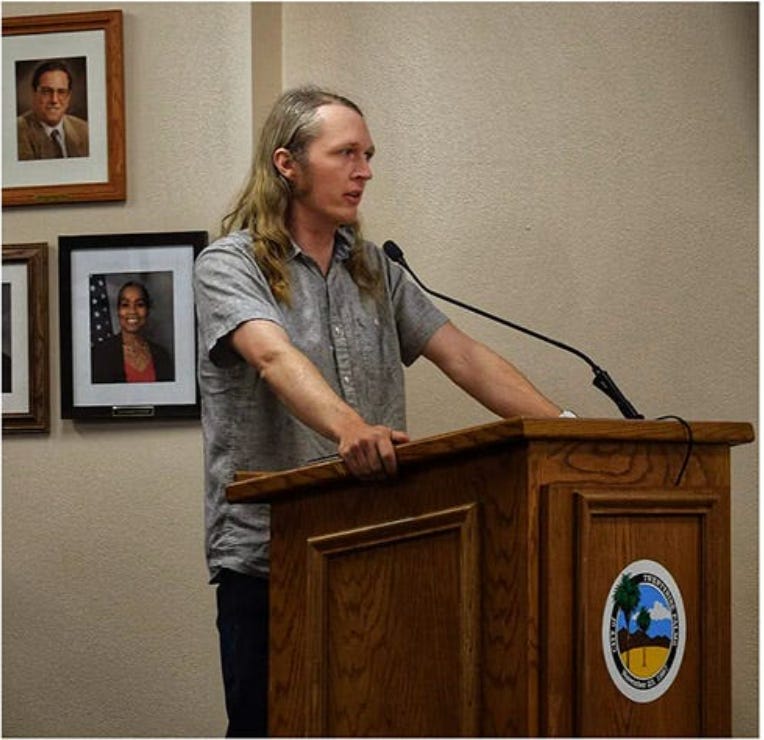
I’m speaking to wholeheartedly oppose the adoption of this ordinance. County and Planning Commission staff acknowledged at the planning meeting that this was our first opportunity to comment after years of them supposedly working on this regulation, I guess in secret. The County staff scoffed at the idea of further public comment because, in their view, the community has nothing of value to contribute because of our lack of expertise…
Allow me to present myself as an alternative. I’m a professional biologist with 10 years of experience living and working in San Bernardino County. I’ve worked on NEPA and CEQA projects, and I worked and consulted on state and federal [endangered] species protections. I worked on mine reclamation, particularly for the species in our County that matter most to us, like the desert tortoise and the Joshua tree.
The staff characterized this as a joint environmental review conducted under NEPA and CEQA, covered by the County. That’s not a fair characterization of what’s written in the regulations… I just wanted to call attention to the idea that when you institute a blanket regulation that a certain type of activity does not require a permit from the County, you’re ceding all control to the offenders themselves to decide whether their activity applies or doesn’t apply to the way that regulation is written..
And more fundamentally, there is no such thing as a mining project that takes place only on federal land in our County…This is because those mining materials must be loaded onto trucks that pass through our residential communities, because the dust and emissions from those mines will be breathed by our children, because I live close enough to the proposed Music Valley mine that I know I will hear the sounds of mining from my house. We are a community — all of our communities across San Bernardino County need the ability to have input on these regulations.
Margaret Oostendorp, Wonder Valley: Dr. Luckie and health
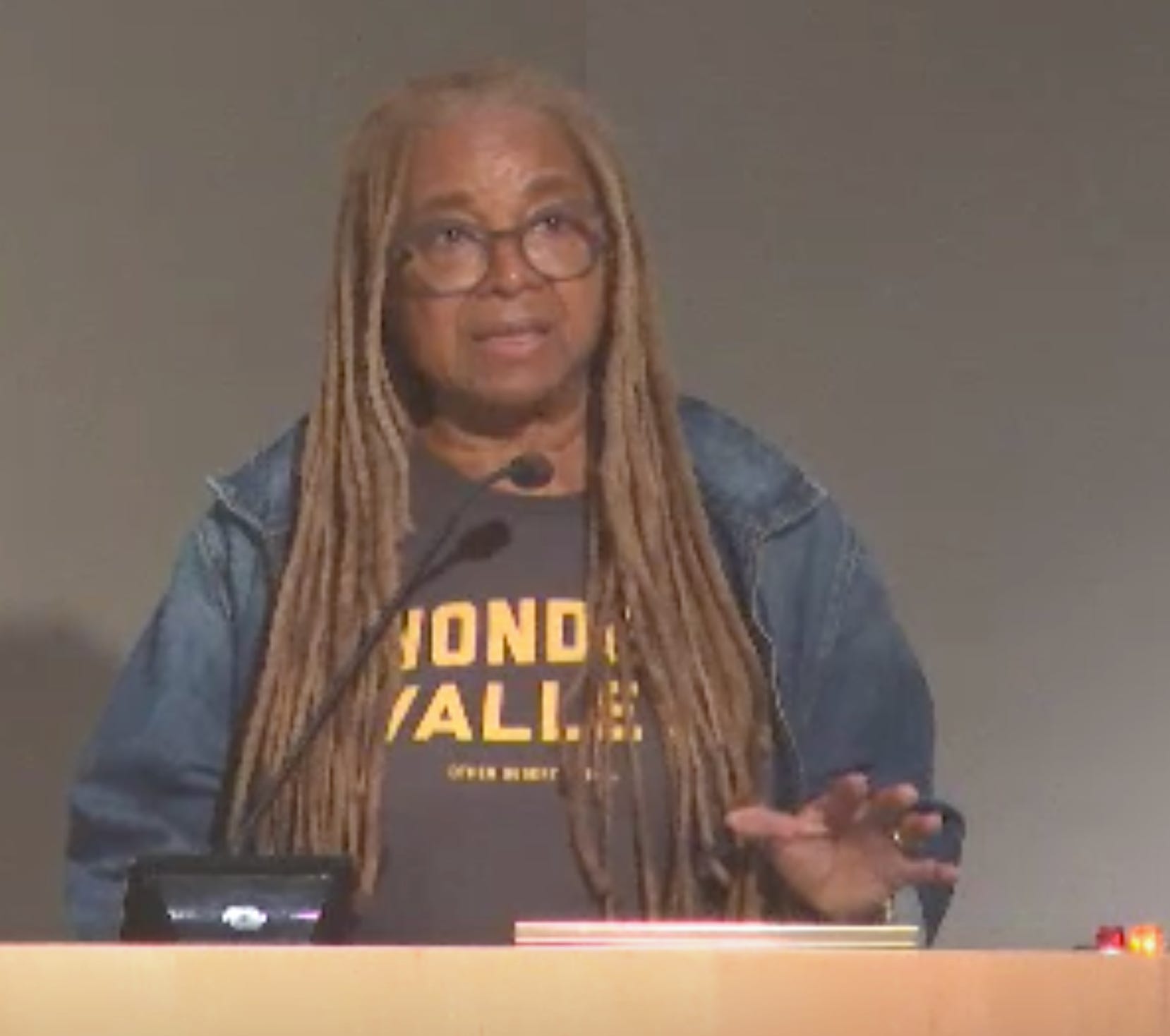
I’m speaking as a human being who lives in Wonder Valley, who moved to this community because of health issues, because of issues with my lungs... Our community has had a long history, going back to Dr. Luckie and the work that he did with veterans from World War I coming to the area for our health. We know that the County has put on record about its obligation to the health and well-being of your constituents, like myself. To pass and approve this ordinance will basically give over and go against what you have put in writing as what you’re concerned about with the health of the community.
Chris Carraher, Wonder Valley: Three questions
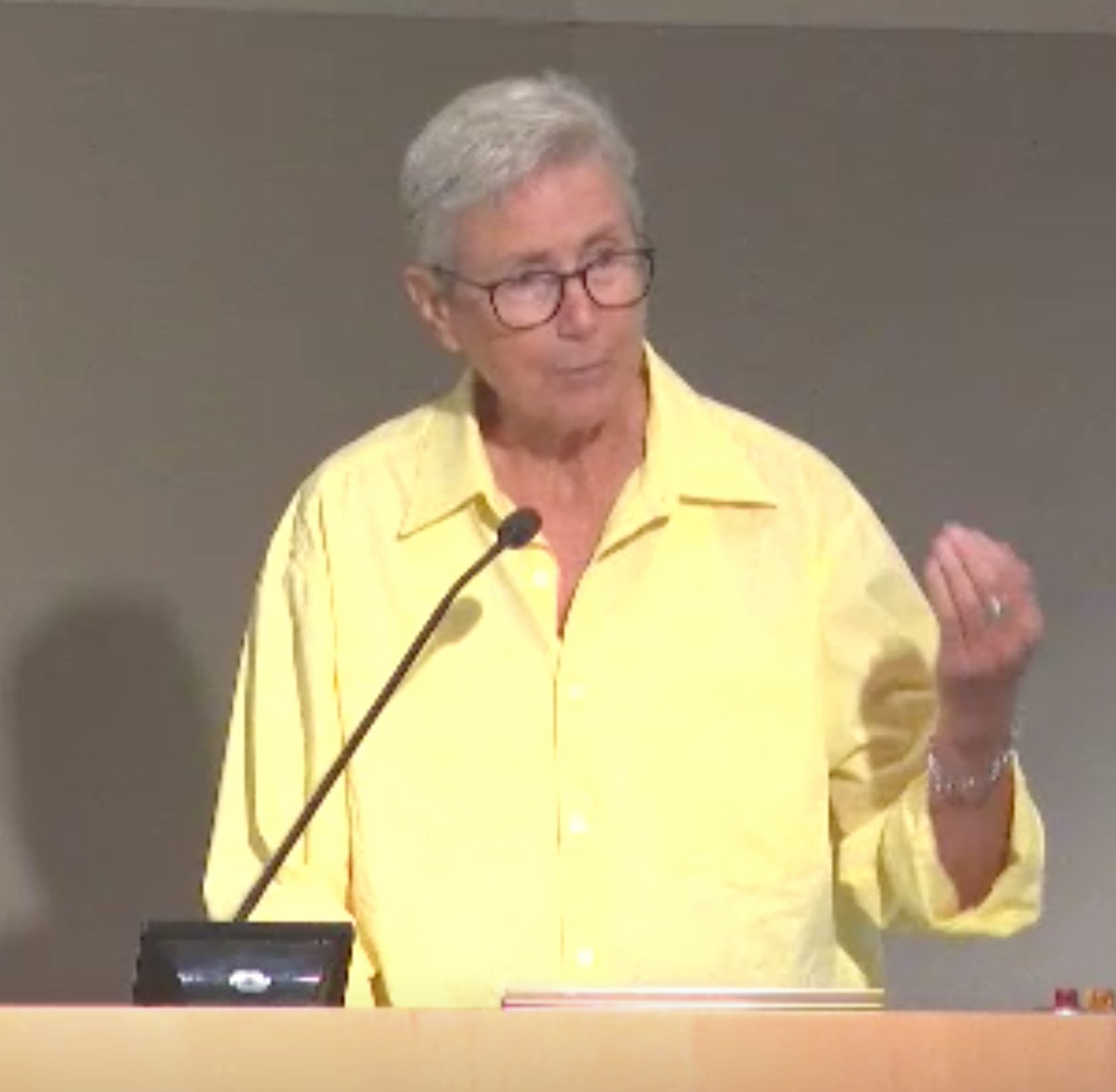
Folks who live in Wonder Valley are almost all within potential walking distance of mining claims, and most of us depend on wells, as there is no piped water in Wonder Valley. Ground disturbance and mine tailings leaching chemicals can potentially make our properties uninhabitable.
Clearly, the proper permitting and oversight of mining operations is of vital importance to us, and local desert communities need to be fully informed and able to participate in that process . That did not happen in this case…as we've learned of this, tried to understand a few basic questions and been having a hard time getting a straight answer. Therefore, I ask that before you vote on this item, you provide straightforward answers… so that the good people of Wonder Valley can understand them, to the following questions:
One, if this ordinance passes, will any mining operation or portion of any operation that currently goes through County permitting, CEQA review, public notice, public hearings, or County-imposed conditions no longer go through those processes because of the new federal land provision. Yes or no?
Number two, specifically, is there any County or public oversight that exists under the current ordinance that would no longer exist or would be diminished under the proposed ordinance. Yes or no?
Number three: if the answer to question number two is "no," please explain to our residents why the new "permit shall not be required" language is being added. The current ordinance does not specifically state that a County permit shall not be required for federally authorized mining. If the County truly has never had permitting authority in these circumstances, why is this new exemption necessary?
I urge you to deny the adoption of the measure before you.
Vadim Altschuler, Twentynine Palms: Long-term effects
…Music Valley is not imaginary. Dateline Resources reports more than 21,000 acres of claims in this rare-earth project area. EPA says that rare earth processing can involve uranium and thorium and can produce radioactive TENORM waste4. EPA also says particulate pollution can aggravate asthma, reduce lung function, and harm children, who are among the most vulnerable.
I’ll add — I’m from Russia, and I know what it looks like when laws are twisted to accommodate oligarchs, extraction, and administrative convenience. Ordinary people are told it is procedure, but this is America.
Pauline Pisano, Flamingo Heights: Crisis of democracy
…My occupations led me to visit Flint, Michigan, during their water crisis... The folks I spoke to in Flint, Michigan, never framed the crisis as a water crisis. They said it was a crisis of democracy. I think everyone in this room should heed the people of Flint: to repeal and rewrite Chapter 88.03 to give up the County permitting authority feels undemocratic, because it is.
Krystian Lahage, Joshua Tree: Public Policy Officer, Mojave Desert Land Trust: Reenforce CEQA review
…Before my comments, I wanted to acknowledge two things, and the first is that we recognize that the County has the right and need to update these ordinances, and I also want to recognize that we recently met with Dan Walsh and had some of this clarified for us as well…And I heard Dan say it again today that projects at the federal level that are not subjected to review that is as strong as CEQA, would have CEQA [review].
We just want to make sure that it's [mining] done responsibly and sustainably. And we feel that it would be stronger, both in terms of understanding for the community, to have that strong language guaranteeing the CEQA review…

Exchange between Dan Walsh and District 4 Supervisor Curt Hagman


Walsh: ...if we don't update our ordinance, the State Mining and Geology Board (SMGB) will continue to put pressure on us if we just refuse, and they will have the opportunity — they'll have the authority to take the mining regulation over. They'll be able to take our lead agency authority away from us and become the lead [agency].
Hagman: …Several of us have served at different levels of government. Generally, the higher level of government doesn’t necessarily need a lower level government to do something. So the federal government, on their lands, will want to give a permit for mining, and we refuse — they can bypass this. Clarify when you say that.
Walsh: Yeah, that’s part of the supremacy clause.5
Hagman: Okay. Same thing on the state level — state supersedes the County, and it's a higher level of policy. So what the state of California does is made an agreement with the federal government on their lands: this is going to be the process of what we're going to do, which combines generally NEPA and CEQA in those applications. But they're given it to us to be that lead agency. So if we do not have an up-to-date ordinance, then we lose that participation potentially at all at a local level. So I think that's the bigger question for me: how do we get to the point where we're still at least at the table? We may not like all the things at the table, but at least we're participating in that.
…
Hagman: So the other states, the federal government says we’re giving you this permission to go do it, and they don’t have much say in it at all.
Walsh: There’s only a few states in the union that allow for local lead agency regulation of mines. [Referring to SMARA designating the County or City as “lead agency” as opposed to the State]6
...
Hagman: So in updating this ordinance, do we lose any control that we had in the old ordinance to the new ordinance?
Walsh: No, it’s based on the same 1992 agreement between the state and the federal government on federal lands. What is updated are better processes for enforcement, more information needed for applications for reclamation plans — in 2017 the state surrendered its right to be lead agency for vested rights determinations, turned that back to just the local agencies, so that’s one area that we’ve had to develop because the state bowed out of it.
Exchange between Dan Walsh and Chair Dawn Rowe (District 3)


Rowe: Well, here’s a more simplistic question I think from the community. If we don’t adopt this today, does Music Valley Mine, if it were to move forward, have less control at the County level or more control at the County level?
Walsh: It has the same as we've had all along... Now remember, there's three parts. There's three parts of a mining operation approval. There's the permit, there's the reclamation plan, and there's the financial assurances. Okay, so we have control of reclamation plan and financial assurances, but we have authority to review the whole project in its entirety... We review the whole. That means offsite haul roads, means going through town, whatever the truck traffic is, emissions, and all that. That's all part of CEQA, and these studies have to answer all those questions that CEQA asks. Otherwise, they don't get a reclamation plan, which means their permit is worthless.
Jesse Armendarez, District 2: We totally dropped the ball
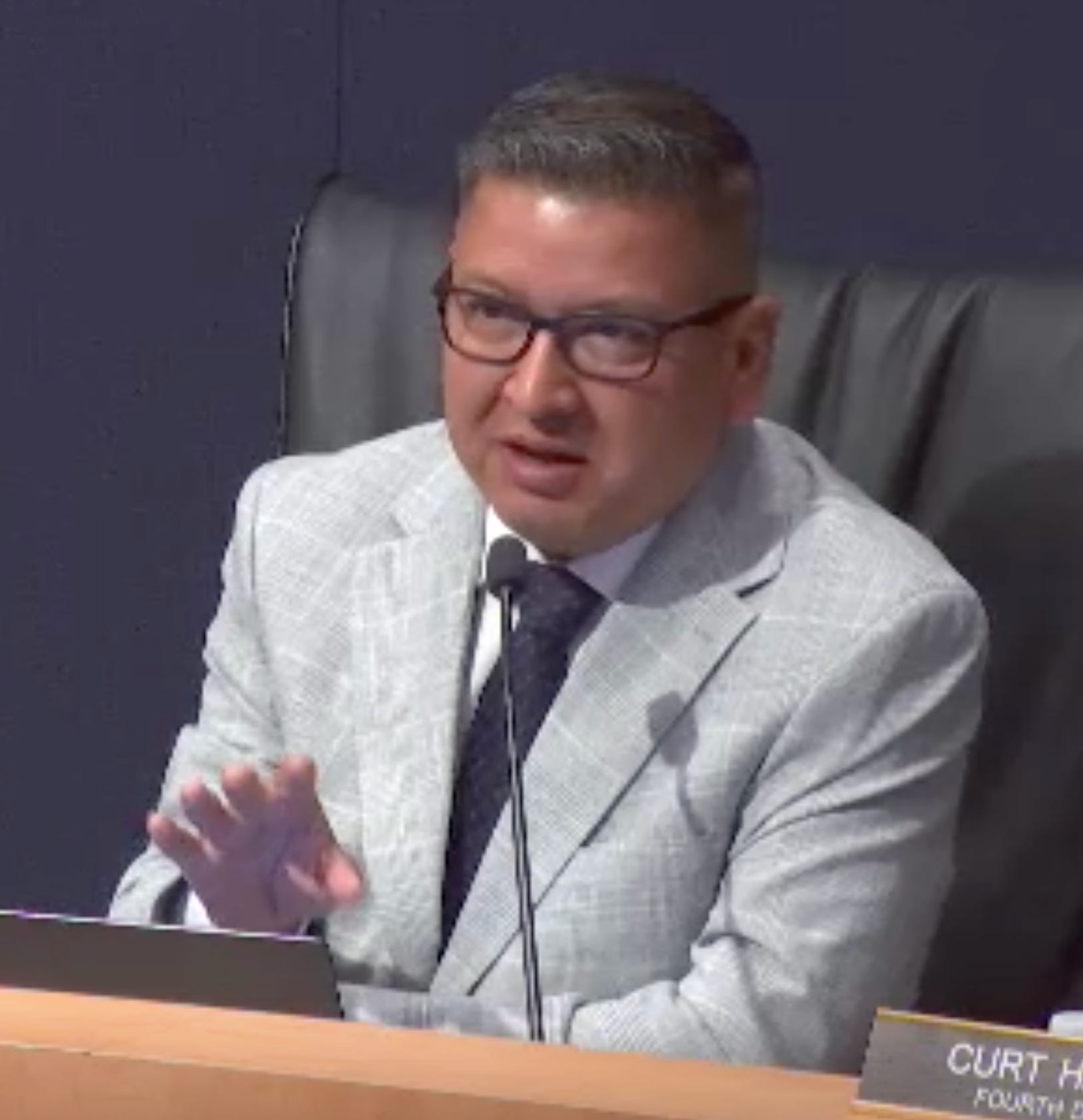
We have to do this change, is my understanding of this, but what I have to say is this has been terribly communicated to the public... I think we totally dropped the ball on that... I think no matter how we vote today, we're going to have people not happy because we really failed in the outreach... We need to really have real, true dialog with the stakeholders that are out here who obviously have a concern.
Paul Cook, District 1: The real desert
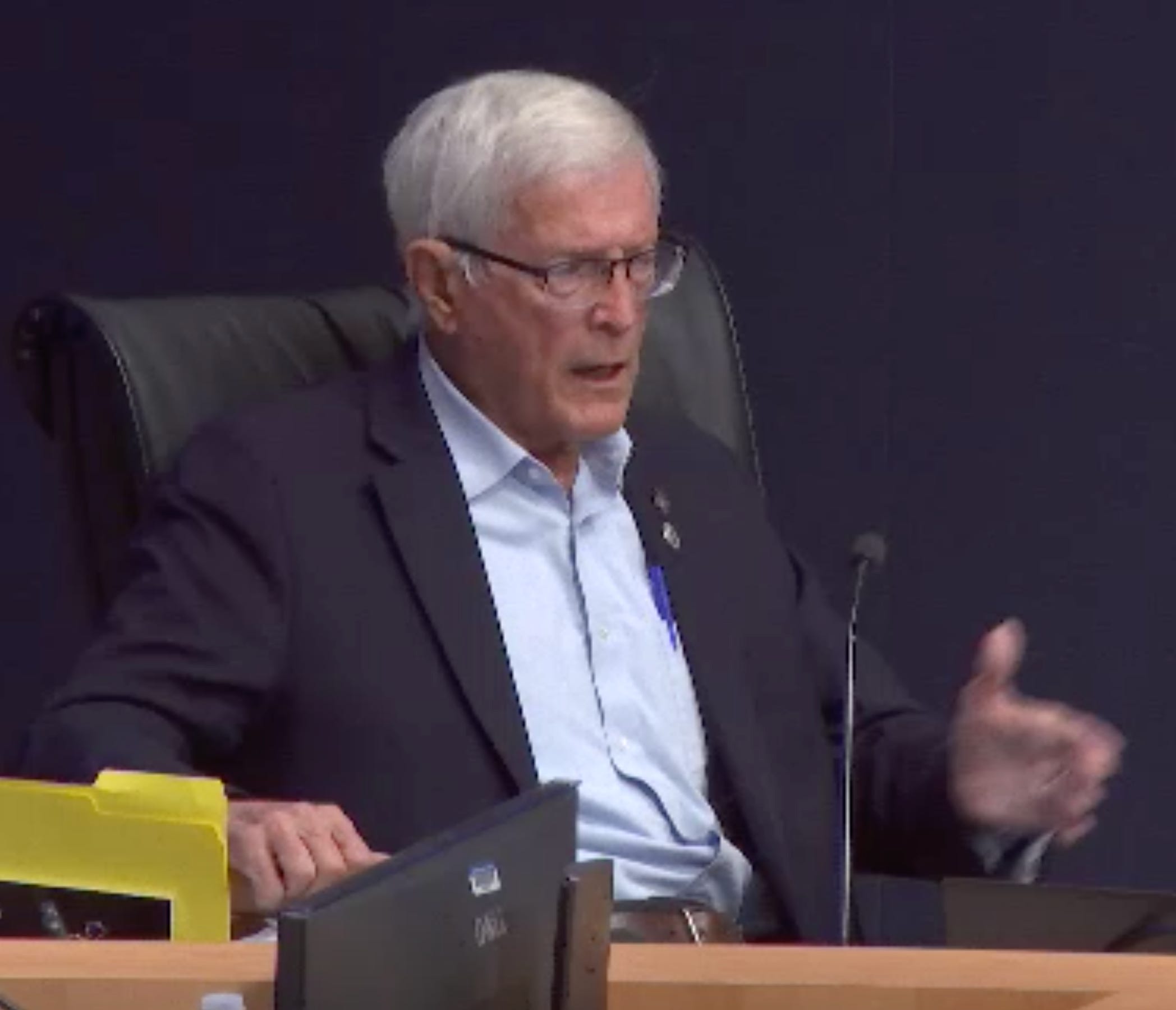
Yeah, I don't think you're going to understand the problem, this board here, until we pack up our gear and we go out there in the middle of the day at 12 noon... The desert is very unforgiving... It's brutal, particularly in the summer... I probably swore more than I ever did when I was out there, because it's so damn hot and very unforgiving.
Now I'm sympathetic, but I also... want to make sure that we don't change what they have there as a training area, a live-fire training area7... I want it to be maintained as one of the few training areas that the armed forces of the United States has — live-fire training areas, you can't do that anywhere else because you don't have that much. It is a huge, huge area, and so... right now I'm not prepared to vote for this, and I think we need more conversations. And if you guys got the guts, let's go out on a high day, high note, and bring your beer or what have you, and we'll go out there and we'll see what the real desert is like.
Dawn Rowe, District 3, Board Chair: Recommending a FAQ
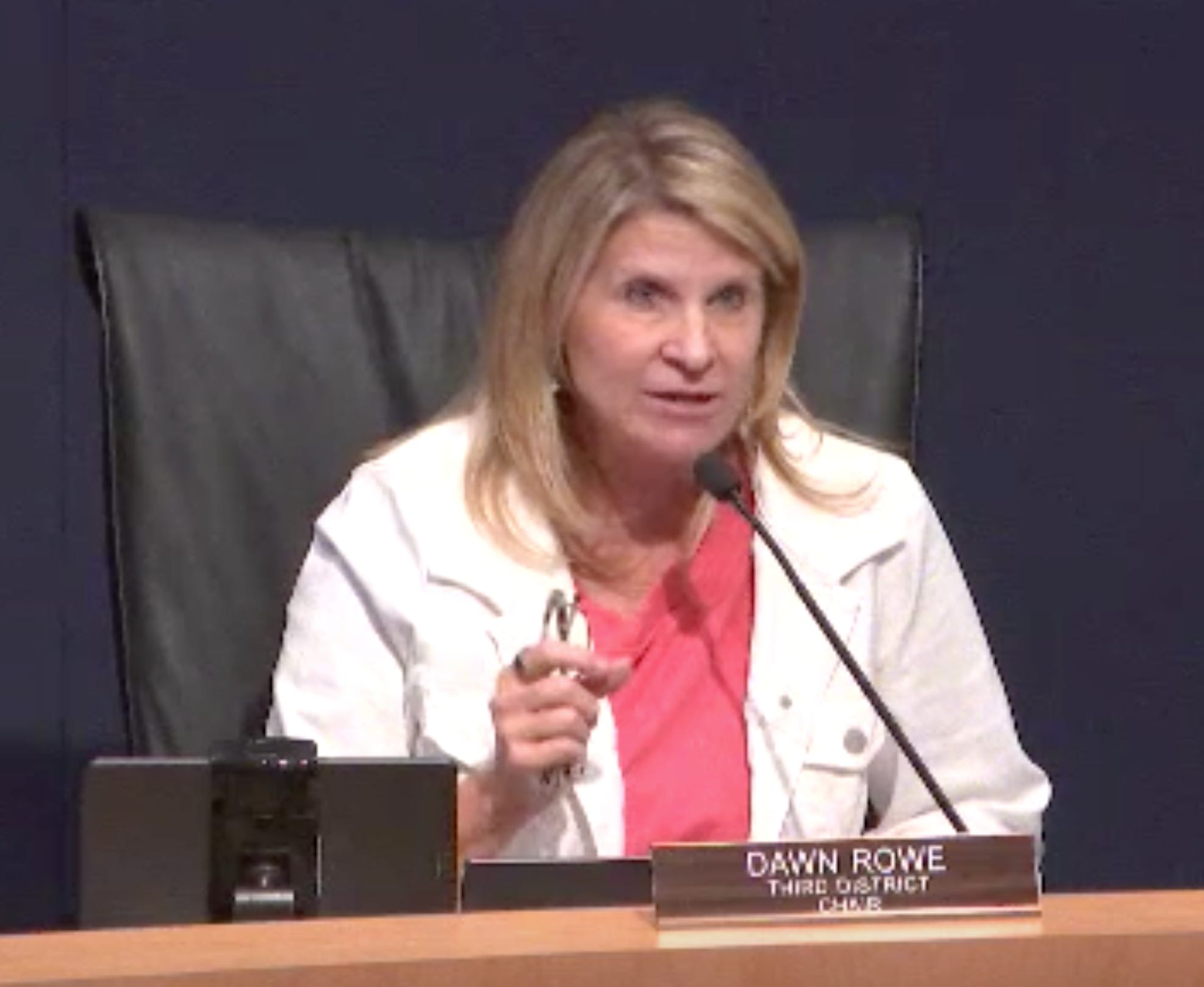
There's a lady seating behind you [refers to Chris Carraher]. She was very well spoken and kind in a yellow shirt, and she had three questions for us. I don't necessarily think that I got them answered today... What I would suggest that we do is I'm going to close the public hearing, which will close the public comment... and to address the questions that we've heard here today, that I thought were very reasonable, and put them together and come back to a board meeting... If there is misinformation, to correct it, and that is the minimum that we need to do for our residents that have taken the time to provide thoughtful input, and then also for you to make the changes that are possible to make based on the public input today….
Every public comment that came in came to my email... we can put it into a format of frequently asked questions so that we can either dispel misinformation, clarify misinformation, or at least answer some of the questions that we've heard here today.
In Conclusion
What comes through in these voices is a Board that heard the room, even if it couldn't fully answer it. Rowe named Carraher's questions directly and committed to compiling every public comment into an FAQ. Armendarez and Cook both said, on the record, that the County outreach had failed and that they weren't ready to vote. Staff's position — that the ordinance changes nothing about who holds authority, only how it's organized — is one the Board pressed hard on rather than simply accepted, and the continuance to October 20 is the result: more time for that FAQ, for clarifying language, and for the County to close the gap between what it says the ordinance does and what residents believe it does.
Depending on how substantial any changes turn out to be, County Counsel noted the item may need to return to the Planning Commission first, and staff may still need the State Mining and Geology Board's sign-off before final adoption, so October 20 may not be the last stop.
Whether the gap closes by then, or whether "permissive" language proves different enough from required language to satisfy the concerns raised from the first comment to the last, is what the next hearing will decide.
The next regular meeting of the San Bernardino County Board of Supervisors is scheduled for September 1.
Part 2 of our recap of the Board of Supervisor meetings on August 4 and 18 will be published Monday (tentative).
Desert Trumpet Editor in Chief and writer CIndy Bernard serves on the organizing committee of Indian Cove Neighbors, co-litigants with the Center for Biological Diversity in a separate matter.
This preview was produced with AI assistance, consistent with our AI Policy.
We’re in the midst of our summer subscription drive! We’re just 25 subscribers away from hitting 1600 — help the Desert Trumpet reach our summer goal by subscribing today!
Leave your thoughts in the comments below. Please note that we do not allow anonymous comments. Please be sure your first and last name is on your profile prior to commenting. Anonymous comments will be deleted.
This coverage is free - please share!
SMARA was enacted in 1975 and CEQA in 1970 — five years before SMARA, not "just after" it as Walsh states. The 1992 MOU itself came 17 years after both. The substance of his account (signatories, workflow) checks out against the MOU document; this is a timeline compression in a live quote.
"This section on applicability" refers to new County subsection 88.03.040(b), the "Federal Lands" provision discussed throughout this piece — the language stating the County "may accept" federal environmental documents as functionally equivalent to its own, and that a County permit "shall not be required" for mining with federal authorization.
Neymark's claim that the federal-lands language is absent from SMGB's model ordinance is confirmed. It does not appear in the Board's 2024 Mining Ordinance Guidance Document. His claim that it's also absent from the two counties that have already updated their ordinances (likely Mendocino and Shasta, per SMGB board minutes) is plausible but not independently verified against those counties' adopted text.
TENORM (technologically enhanced naturally occurring radioactive material) is an EPA term for waste created when processing concentrates naturally occurring radioactive elements. EPA states that rare earth minerals are typically processed from ores that naturally contain uranium and thorium, and that separating and removing those elements during processing produces TENORM waste, consistent with Altschuler's claim.
The supremacy clause (Article VI, Clause 2 of the U.S. Constitution) establishes that federal law generally takes precedence over conflicting state or local law. Walsh's point is that if the County doesn't retain a role through the 1992 MOU and SMARA framework, the federal government could authorize mining on its own land regardless of County objection.
Of the 19 states where federal mining claims can be located, California is the only one where County or city government holds primary permitting and reclamation authority ("lead agency"). In the other 18, that role belongs to a state agency (e.g., Nevada's Bureau of Mining Regulation and Reclamation, Colorado's Division of Reclamation, Mining and Safety, Arizona's State Mine Inspector). Local governments in some states retain separate zoning or land-use permitting on top of the state process, but not the reclamation-permit authority itself. This confirms Walsh's point that few states put mining lead-agency status at the local level. California appears to be the only one of the major western mining states to do so.
Cook's comments refer to the Marine Corps Air Ground Combat Center at Twentynine Palms, the Marine Corps' largest live-fire training facility (roughly 932–1,102 square miles), located north and west of the city. The Music Valley project site sits roughly eight miles southeast of Twentynine Palms, in a different direction from the base's documented footprint. We found nothing establishing the mine site is within the base boundary; Cook's remarks describe the broader desert region rather than the specific parcel.