
San Bernardino County Planning Commission Recommends Giving Up Local Permitting Over Mines on Federal Land
Residents from Wrightwood to Wonder Valley joined public comment; none spoke in favor

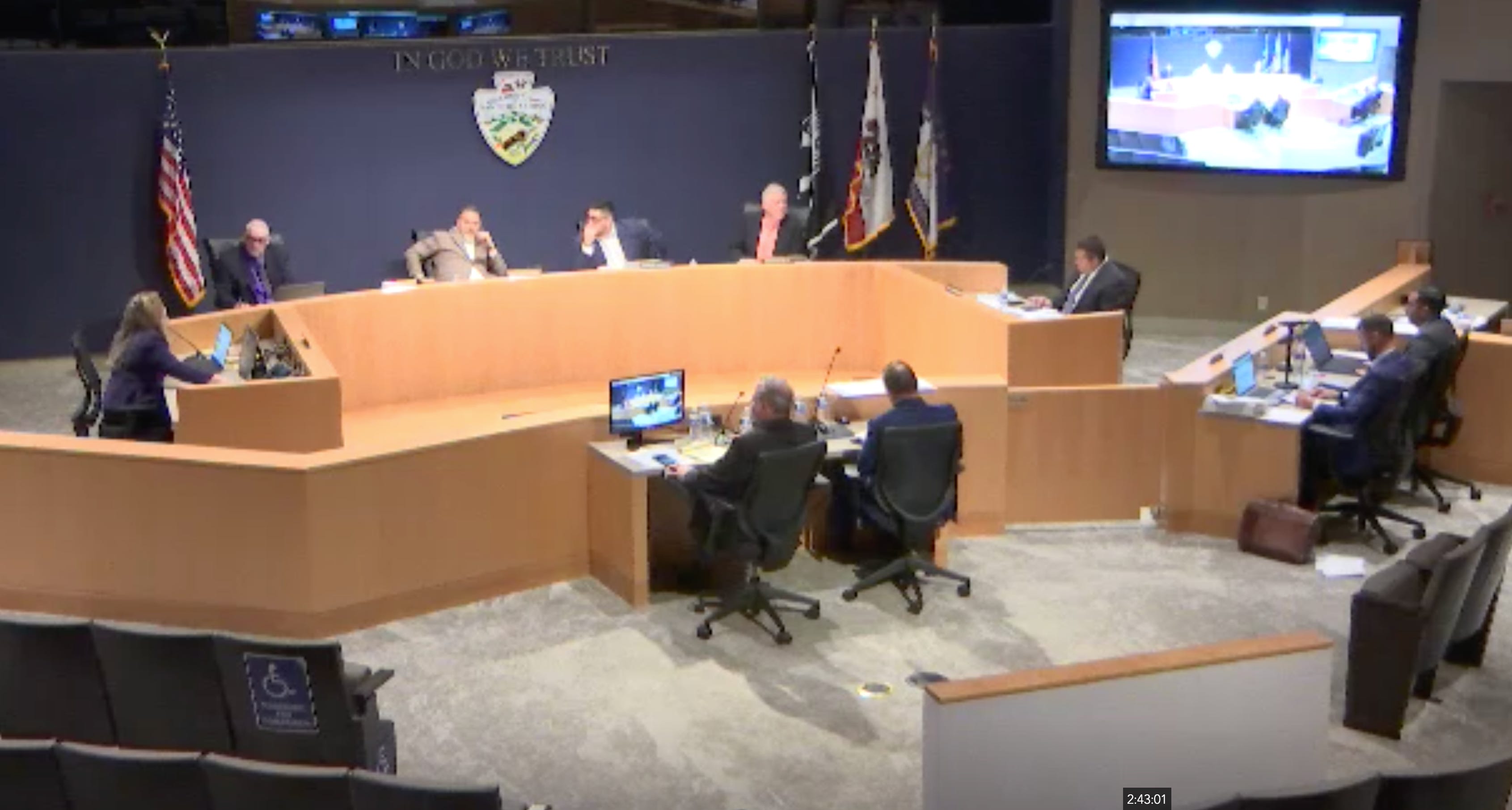
On July 9, the San Bernardino County Planning Commission voted to recommend that the Board of Supervisors adopt a full repeal and reenactment of Chapter 88.03 of the Development Code, the county’s local rules for surface mining and land reclamation1 (Project No. PMISC-2026-00029). The recommendation passed on a voice vote with no audible opposition, following roughly two hours of public comment. In attendance were Commissioners Matthew Slowik (2nd district) and Jonathan Weldy (1st district), Chair Michael Stoffel (3rd district) and Vice Chair Kareem Gongora (5th district). The absence of Commissioner Suket Dayal (4th district) was not noted by the Chair.
By our count of the transcript, 32 people spoke, and every one either opposed the ordinance or asked the Commission to delay it. None spoke in support. Nineteen participated remotely from the Joshua Tree Community Center; thirteen spoke in the chambers in San Bernardino. Staff also reported more than 100 written comments submitted for the item.
While the two groups of speakers were united in their opposition to the loss of local review, they were focused on two different projects. About a third of the remote contingent expressed concern over the proposed Music Valley rare-earth mine near Joshua Tree National Park. The in-chamber speakers, most from the mountain community of Wrightwood, came to oppose the proposed Lone Pine Canyon Road Quarry near the Cajon Pass; nine named that project directly.
The July 9 vote sends a rewrite of the County’s surface mining ordinance to the Board of Supervisors, tentatively on August 18. We cover the meeting’s opening and Item 3, the mining ordinance; we’ve set aside Item 2, an unrelated warehouse and parcel-map project in San Bernardino that does not affect the Morongo Basin.
Relevant links:
What the ordinance does, and how staff framed it
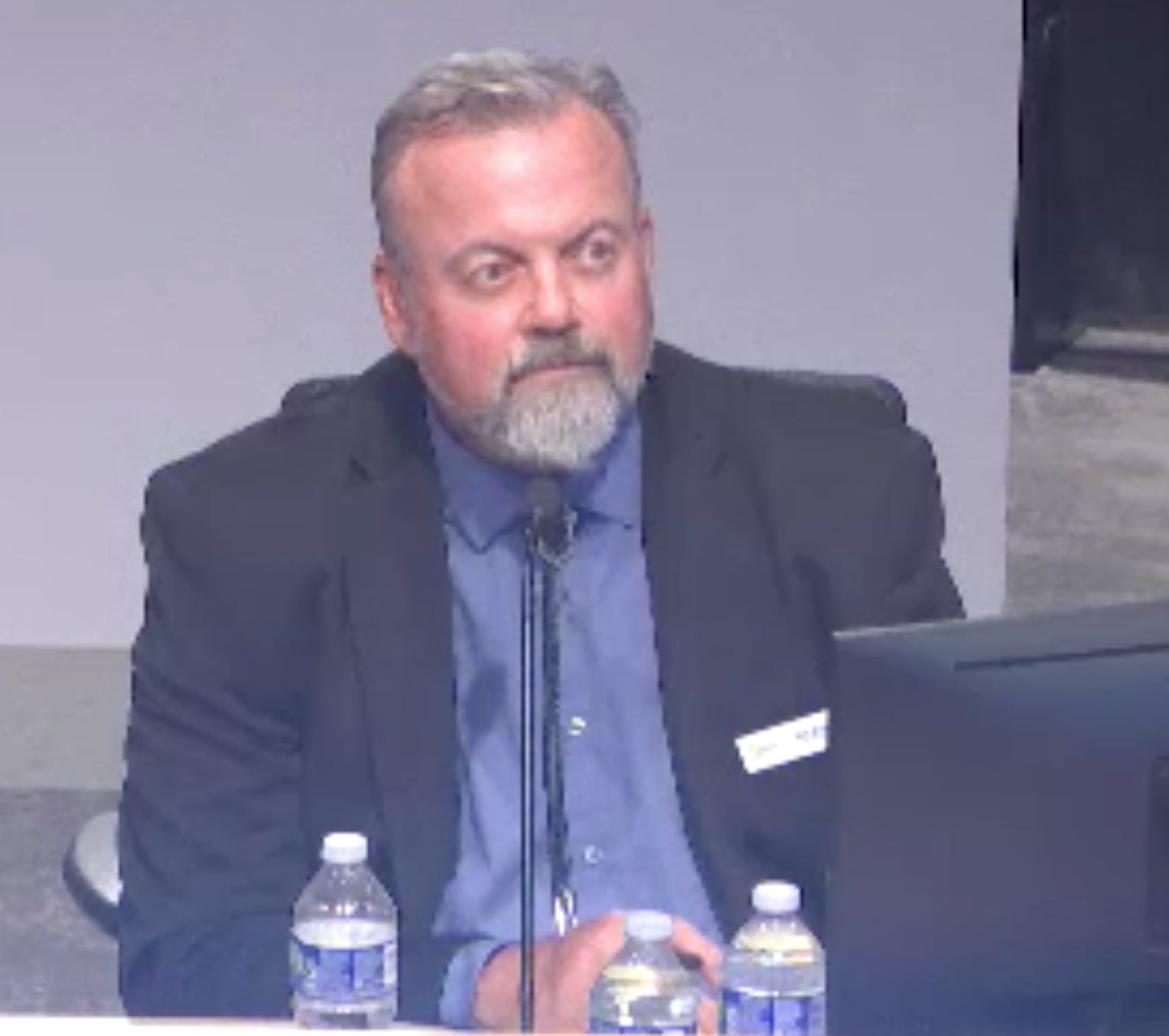
Dan Walsh, the County’s Chief Engineering Geologist, presented the item:
This ordinance represents a comprehensive modernization of Chapter 88.03. It expands procedures, strengthens enforcement, and aligns the County’s regulations with current state requirements.
He told commissioners the ordinance was “adopted in 1999 and certified by the State Mining Geology Board on November 10, 1999” and “has not been significantly revised since.” The written staff report instead states the chapter was “last substantively amended in 2007.”2
Staff is asking the County to treat the ordinance as exempt from environmental review:
The proposed amendment was determined by the County to be exempt under CEQA pursuant to Section 15061(b)(3)... because the ordinance is limited to an administrative update of an existing surface mining and land reclamation ordinance, and will not directly or indirectly authorize activity that may have a significant effect on the environment.
A Wrightwood resident who identified himself as an attorney, speaking during public comment, challenged that reasoning, noting the "common sense" exemption applies only where the County can show "with certainty" that there is "no possibility" of a significant environmental effect, a standard, he argued, staff never addressed.
We’re kicking off our summer subscription drive! Help the Desert Trumpet reach 1600 subscribers by spreading the word!
The provision that drew the objections
The change residents focused on is a new “Federal Lands” subsection, 88.03.040(b). Its operative sentence reads:
A Permit shall not be required for those portions of surface mining operations that require and obtain a federally approved plan of operation, or other federal authorization, to conduct surface mining operation.
Speaker Catherine Powell, a Wonder Valley resident, read that language aloud, noted it “has not been stated very clearly in the presentation,” and translated it:
If a mining company gets a green light from the BLM or another federal agency, it no longer needs a County permit for work on that federal land. This gives area residents much less recourse to challenge mining operations that directly affect them.
Under questioning from Commissioner Matthew Slowik, Walsh maintained the ordinance does not shift authority, because “the County has never had jurisdiction for permitting on public lands.” Per Walsh, federal agencies permit mining on federal land, the County requires a reclamation plan, and the update, he said, only makes those existing boundaries “more clear.” Slowik concluded he did not “see [the proposal] changing anything relative to jurisdiction, review authorities, decision making.”
Two different environmental-review laws are in play. Mining on private or County land triggers the California Environmental Quality Act (CEQA), the state's review process; mining on federal land falls under the National Environmental Policy Act (NEPA), its federal counterpart. Which one applies — and how much public say comes with it — turns on whether a County permit is required.


Asked directly whether federal-land mining would proceed with no environmental review, Walsh said review would still occur “whether it be federally or locally,” but added a caveat:
in the past, NEPA and CEQA have been kind of in lockstep together. That’s changed recently. Obviously, with the new administration, they are kind of depleting federal staffs and their ability to review all the environmental impacts under NEPA.
Several speakers argued that is precisely the problem. Pat Wallis, a Yucca Valley resident, former city planning commissioner, and 2026 candidate for the 23rd District congressional seat, told the Commission:
Staff calls this an administrative update. It isn’t... The County permit is what triggers CEQA. It’s what gives residents notice, a hearing, enforceable conditions... NEPA has been hollowed out... This determination will not survive judicial review... it’s going to result in predictable litigation.
The national backdrop
The County’s move doesn’t sit in isolation. It comes as the Trump administration has acted aggressively to expand mining on public land: a March 2025 executive order invoked emergency powers to increase domestic mineral production, directed the Interior Department to prioritize mining over other uses on federal land holding critical mineral deposits, and told agencies to fast-track and streamline the federal environmental review, the very NEPA process the County’s ordinance would lean on for mines on federal land. That push is the engine behind the rare-earth rush now reaching the desert, from Dateline Resources’ mining explorations in Music Valley to Colosseum gold mine near the Mojave National Preserve.3
That thinning of federal review is exactly what Walsh flagged during the hearing. And it is the crux of what residents pressed: the County proposes to defer to a federal process at the very moment that process is being pared back by design.
The choice also comes from a County with a documented streak of friction with the state. In 2022, San Bernardino County voters narrowly approved Measure EE, directing officials to study seceding from California over its share of state resources, a study the county later shelved.
Voices from Joshua Tree
Nineteen residents addressed the Commission remotely from the Joshua Tree Community Center, most objecting to the loss of local oversight over mining on public lands, with at least six pointing specifically to the proposed Music Valley rare-earth mine.
Chance Wilcox, California Desert Associate Director for the National Parks Conservation Association, urged denial:
This common sense exemption seeks to remove the County and therefore the people from that review and keeps us in the dark. As we speak, foreign mining companies are seeking to begin large-scale surface mining in and around our federal public lands... The people were not included in the process of this analysis, and it seems as though there was only one stakeholder meeting that was only attended by mining companies and operators, the very entities who benefit from this action.
Pat Flanagan, a Desert Heights resident speaking on behalf of the Morongo Basin Conservation Association (MBCA), challenged the premise that the federal process is an adequate substitute for county review:
Both NEPA and CEQA, enacted in 1970, mandate that agencies open their environmental evaluations to the public... [but] the BLM has recently introduced multiple sweeping regulatory updates that will drastically limit the public’s ability to participate in land management decisions.
She cited a 2026 BLM grazing-rule rewrite affecting 155 million acres and a 2026 oil-and-gas leasing proposal, both of which, she said, cut public comment periods and narrow who may weigh in.
David Fick, a 40-year Joshua Tree resident and MBCA board member, was blunter:
What you’re considering is surrendering control to the federal government, and this is called a backroom deal... Do not trust the BLM on this.
Fick recounted a 20-year fight against the Eagle Mountain “mega dump,” which he attributed to “vast amounts of BLM corruption.”


Nicholas Graver, a Twentynine Palms resident and biologist, rejected the “administrative update” framing outright:
The proposed changes are not merely administrative; they’re an abdication of responsibility from the County and the state, instead opting to trust the federal government’s environmental review process.
Graver said he lives on the only road in and out of Music Valley, where “that same mining corporation, Dateline Resources, proposes to build a massive new mining operation”:
My house shakes when a medium-sized truck drives through down Baseline Road, and now we’re talking about a major mining operation that would have to use those same roads.
Galen Boone, a Yucca Valley resident, pointed to the shared transportation corridor — a reminder that even a mine sited on federal or out-of-county land would route its trucks through San Bernardino County communities:
We also do not want parades of mining trucks clogging Highway 62, our only highway and lifeline that connects our communities from Morongo to Wonder Valley.
Boone cited the scale of the Music Valley claims — “almost 1000 claims over almost 20,000 acres of mostly BLM land, some within 100 feet of our national park” — figures consistent with reporting on the Dateline Resources project.
In the chambers: Wrightwood and the Lone Pine Canyon Road Quarry
The thirteen in-chamber speakers came largely from Wrightwood with concerns over the proposed Lone Pine Canyon Road Quarry, a roughly 285-acre project about four miles from town, along the San Andreas Fault in the Cajon Pass. (Despite the name, it has nothing to do with the town of Lone Pine in the Eastern Sierra.) They raised concerns about blasting near the fault, dust and air quality, heavy-truck traffic on their only evacuation route, and a recurring worry about the ordinance itself: that it lets County staff decide whether a change to a mine’s reclamation plan is “substantial” — triggering public notice — or “non-substantial,” approved without a hearing. Several asked the Commission to continue the item and to consult local tribes, noting the industry had a seat at the drafting table and residents did not.
Who was consulted
Repeatedly, speakers said the County drafted the ordinance with the mining industry and no one else. Walsh confirmed the collaborators on the record and defended the choice:
during this time we have been [in] collaboration with [CalCIMA]4, we have been [in] collaboration with also SMGB5... we called on the experts... these are the attorneys that actually litigated the case law behind the SMARA6 sections. So why pore over a legal document that we’re probably not going to understand when we just talked to the guy that was in the courtroom that day, the guy that actually litigated the case.
He added that “all the comments received by SMGB were incorporated into the document.” Staff did not identify any residents, tribes, or conservation groups as participants in drafting. Commissioner Weldy acknowledged the concern:
[Industry] are the experts. But there also is the inference there: we’re working in our own self-interest, and so you need to have the public sort of output and input along with that... to level the playing field so that it’s a fair hearing.
Where Music Valley sits — and whose jurisdiction it is
One question ran beneath much of the testimony and never got a clean answer: where is the Music Valley project, and who would review it?
County staff told the Commission the project is “not within San Bernardino County... located within Riverside County, six to eight miles southeast of 29 Palms,” on BLM land and that “the county has no jurisdiction on that.”
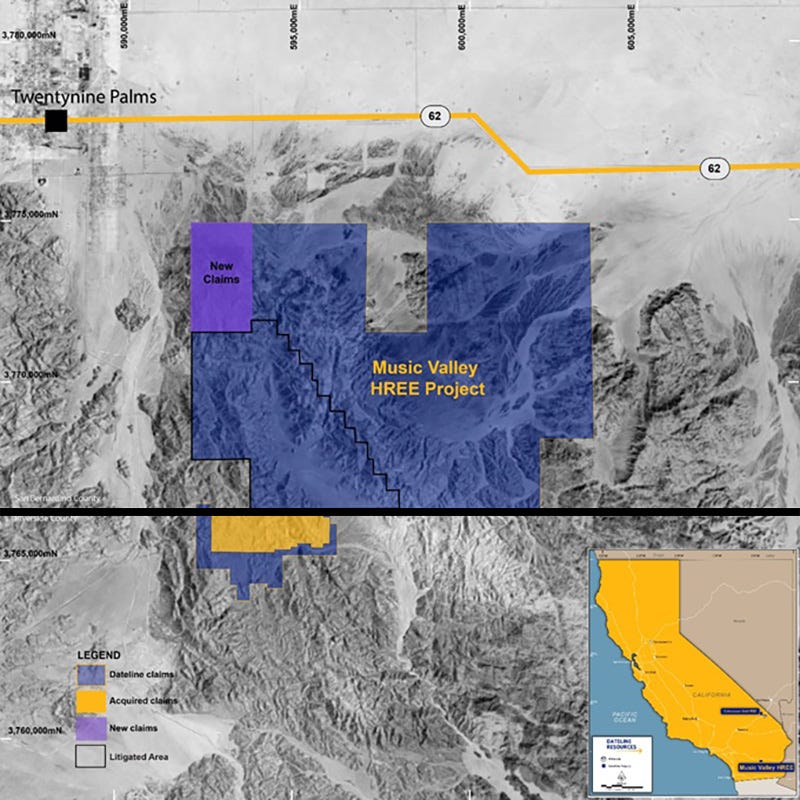
The company’s own account differs. In its June 22, 2026 press release, Dateline Resources describes the Music Valley project as located “in Riverside and San Bernardino Counties,” with its newest claims — 66 claims covering about 1,300 acres — in the “northwest of the project area... approximately six kilometres southeast of the town of Twentynine Palms.”
That distance is measured from the town center, not the city boundary. Twentynine Palms is a large incorporated city whose limits extend well to the southeast, and a point six kilometers from the center can still fall inside them. An overlay of the city’s own boundary, from the City of Twentynine Palms’ public GIS, and Dateline’s claims appears to place the newly staked claims within the city limits, which lie entirely in San Bernardino County.
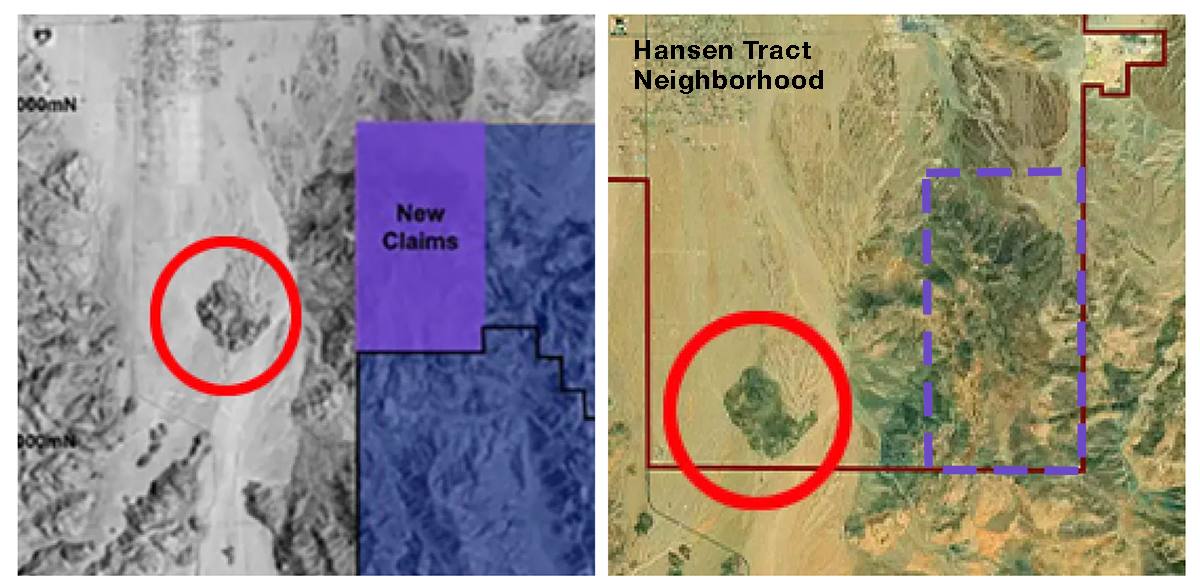
If that placement holds, the problem isn't staff's claim that the County lacks jurisdiction — that may well be correct. It's that the reason would be the opposite of the one staff gave: not that the project sits in Riverside County, but that it sits inside the City of Twentynine Palms, in San Bernardino County. This would give the City of Twentynine Palms, a government entity that staff never mentioned, a direct stake, and raises the question of which agency would review it.
The Desert Trumpet has asked San Bernardino County, the City of Twentynine Palms, and the Bureau of Land Management to clarify exactly where the claims fall and which agency would review the project. We will report their responses.
Notice in the largest county in the country
The County’s legal notice of the July 9 hearing ran once — on June 29, in the San Bernardino Sun. Walsh described the Sun in his presentation as a paper that “reaches a countywide audience.”
San Bernardino County is the largest county by area in the contiguous United States, roughly 20,000 square miles — larger than New Jersey, Connecticut, Delaware, and Rhode Island combined. The Sun is based in the city of San Bernardino, on the valley side of the county; the desert and mountain communities that turned out to object sit 50 to 100 miles away. As Joshua Tree speaker David Fick put it, the commissioners are “all about 90 to 100 miles away from what this Music Valley mining project is.”
Those communities have their own newspapers of record — in the Morongo Basin, the Hi-Desert Star (Morongo Valley, Yucca Valley, Joshua Tree, Landers, Pioneertown) and the Desert Trail (Twentynine Palms, Wonder Valley, Desert Heights). Near the quarry, the Mountaineer-Progress (Wrightwood, Phelan, Piñon Hills) is the paper of record. The County placed notice in none of them.
The result was visible in the testimony: residents reported learning of the hearing anywhere from 18 hours to about two months out, many only from neighbors or from the Desert Trumpet. Nothing in state law barred the County from also noticing the affected communities in their own papers of record. It published the single legal minimum instead.
The vote, and what comes next
Commissioner Kareem Gongora, the vice chair, said he had come in unconvinced:
initially, I was not in support of this, but just hearing that dynamic gives me more comfort because I want stronger protections.
He seconded the motion. Slowik moved approval of staff’s recommendation with a single corrected code reference — a cross-reference staff conceded was wrong, changing “8308” to “8608,” the kind of drafting error Wallis had flagged from the podium. Chair Michael Stoffel called the voice vote: “All in favor? Aye. Any opposed?... Motion passes.”
Asked why the rewrite was moving forward now — a question Weldy raised directly, framing residents’ suspicion that it was timed to smooth pending projects — Walsh said the timing was coincidental, the work having begun in early 2023. Staff said the recommendation is tentatively headed to the Board of Supervisors on August 18, would require a second reading, and would not take effect until roughly mid-September to early October, after which it returns to the State Mining and Geology Board for certification. Staff also noted the Lone Pine Canyon Road Quarry is tentatively set for Planning Commission review on August 6, before the ordinance would take effect.
This recap was produced in collaboration with our AI, Anthropic's Claude, working with human direction and review from the meeting's Otter.ai transcript, the County staff report and the additional research sources listed below. Please read our AI policy for further information.
Become a paid subscriber!
Subscribing to the Desert Trumpet will always be free. That said, did you know that paid subscribers receive discounts on our DT Social events and invites to DT Front Porch, intimate discussions featuring local officials and notable residents?
Upgrade to a $50+ paid subscription for a 10% discount.
Upgrade to $100+ for a 25% discount.
Sustaining subscribers at the $250+ level and above receive complimentary tickets
Share your thoughts in the comments below. Please note that we do not allow anonymous comments. Please be sure your first and last name is on your profile prior to commenting. Anonymous comments will be deleted.
Share this post—it’s free!
Reclamation is the cleanup a mine operator is required to perform once mining ends including regrading the land, controlling erosion, replanting, and removing equipment so the site is left safe and reusable. Under state law, every mine must have a county-approved reclamation plan and must post financial assurance to guarantee that work gets done.
The county’s own materials give two different dates. In his July 9 presentation, Chief Engineering Geologist Dan Walsh stated that Chapter 88.03 was “adopted in 1999 and certified by the State Mining and Geology Board on November 10, 1999,” and “has not been significantly revised since.” The written staff report, however, states that the chapter was “last substantively amended in 2007 and certified by the SMGB.” Desert Trumpet was unable to reconcile the two dates from the public record.
Dateline Resources is an Australian mining company based in Sydney. It's a mineral exploration and development company with a portfolio spanning gold and critical/rare earth minerals in California, including its flagship Colosseum gold project alongside Colosseum Rare Earths, the Music Valley Heavy Rare Earth Project, and Argos Strontium.
CalCIMA is the California Construction and Industrial Materials Association, the trade group representing aggregate, industrial mineral, ready mixed concrete, and asphalt producers.
SMARA is the the Surface Mining and Reclamation Act of 1975 which “provides a comprehensive surface mining and reclamation policy with the regulation of surface mining operations to assure that adverse environmental impacts are minimized and mined lands are reclaimed to a usable condition.”
Comprehensive list of references:
Music Valley / Dateline Resources
Dateline Resources, "Dateline Expands Music Valley HREE Project," June 22, 2026 (source of the "Riverside and San Bernardino Counties" language, the "~6 km southeast" detail, and the claim map) — https://www.accessnewswire.com/newsroom/en/metals-and-mining/dateline-expands-music-valley-hree-project-1180056
Los Angeles Times, “Next to Joshua Tree National Park, a mining company is staking its claim for rare earth minerals,” March 30, 2026 (via AOL) — https://www.aol.com/news/next-joshua-tree-national-park-100000658.html
Lone Pine Canyon Road Quarry
Lone Pine Canyon Road Quarry, CEQAnet record — https://ceqanet.lci.ca.gov/2026030881
ABC7, “Wrightwood residents express concern over proposed rock quarry on San Andreas Fault” — https://abc7.com/post/wrightwood-residents-express-concern-proposed-rock-quarry-san-andreas-fault/19357382/
Geography, boundaries & maps
City of Twentynine Palms public GIS (boundary layer) —
(claim footprint: Dateline June 22 release, above)
National & state context
White House, “Fact Sheet: President Donald J. Trump Takes Immediate Action to Increase American Mineral Production,” March 2025 — https://www.whitehouse.gov/fact-sheets/2025/03/fact-sheet-president-donald-j-trump-takes-immediate-action-to-increase-american-mineral-production/
ABC7, “Measure EE: San Bernardino County… secession from California” (2022) — https://abc7.com/measure-ee-san-bernardino-county-election-november-2022-secession-california/12414229/
ABC7, “San Bernardino County secession ‘unnecessary’ and ‘unlikely,’ new study shows” — https://abc7.com/post/san-bernardino-county-secession-california-unnecessary-new-study-shows/15210595/
Notice & county size
San Bernardino County (largest county by area, contiguous U.S.) — https://en.wikipedia.org/wiki/San_Bernardino_County,_California
Hi-Desert Star — https://adowl.hidesertstar.com/site/about/article_4fce5eaa-007f-5ada-9b18-b64e2563dcff.html
Desert Trail — https://www.hidesertstar.com/deserttrail/
Mountaineer-Progress (Wrightwood; confirm the URL resolves) —