
Sanctuary Church proposal for Community Resilience partnership denied by City Council
We dive into the questions raised — Part 2 of our recap of the July 28, 2026, City Council Meeting

This is Part 2 of our City Council meeting recap.
Part 1 is available here.
The 301-page agenda packet is here.
The video for the 2 hour and 48 minute meeting is here.
The night’s most contentious item was a request from City Manager Kevin Cole for Council direction on whether to pursue a Community Resilience Center implementation grant from the California Strategic Growth Council (CSGC).
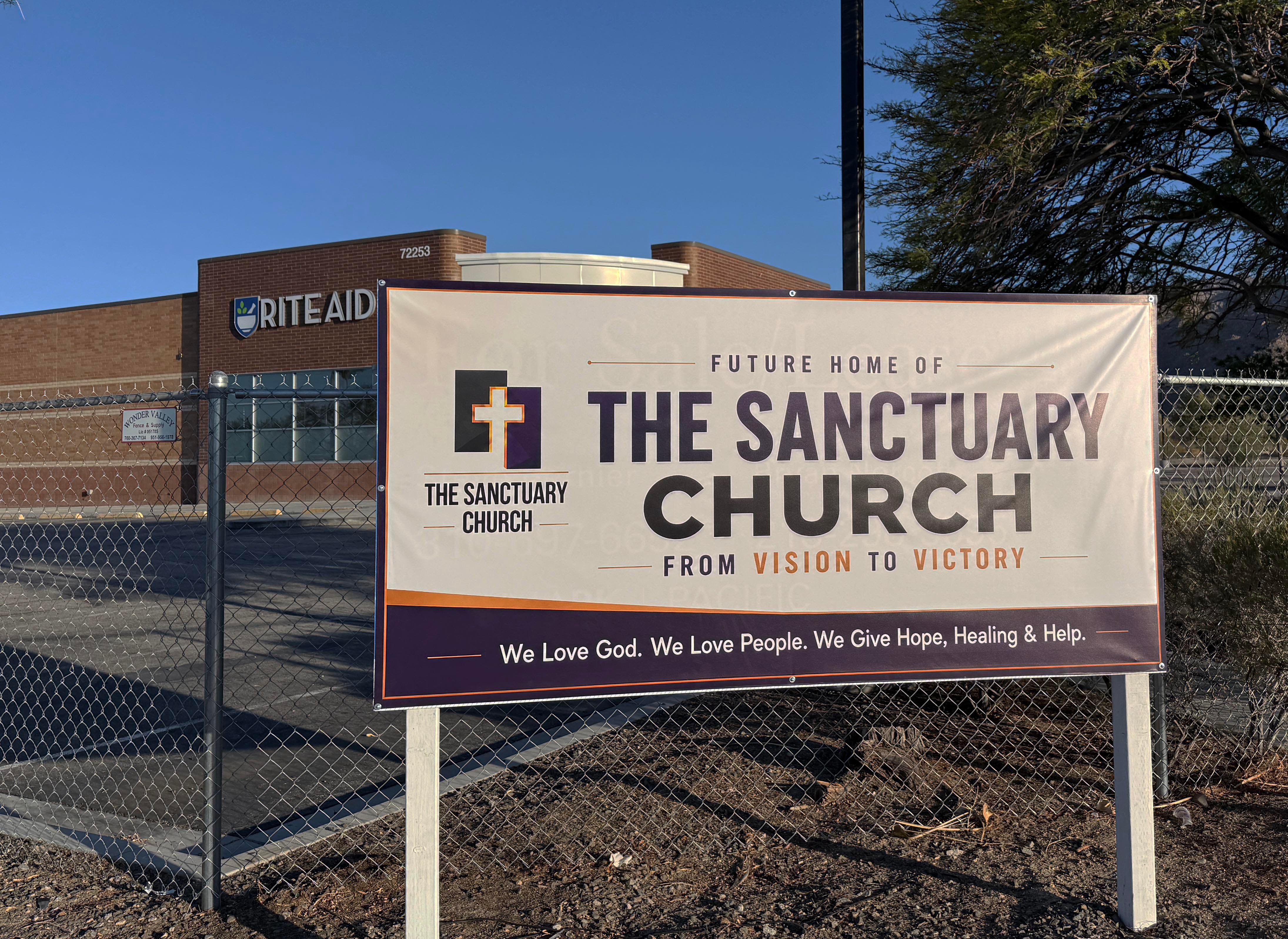
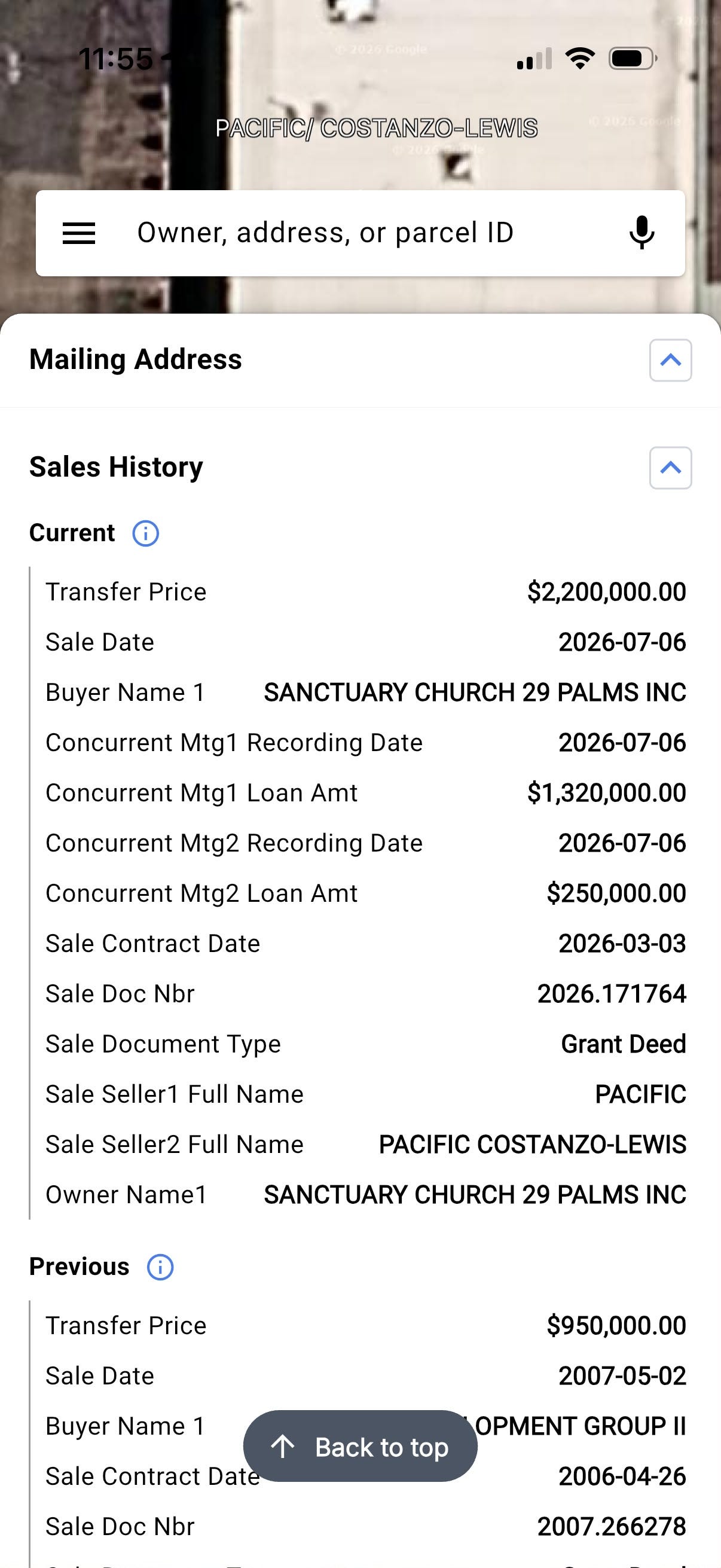
Through this grant, the City would partner with the Hope Project, a nonprofit wing of the Sanctuary Church, which has recently paid $2.2 million for the former Rite Aid building at 72253 29 Palms Hwy.1
The implementation grant guidelines were released April 29, 2026, three months prior to the proposal being presented to the City Council at this meeting. The application deadline is September 25. What seems clear from the staff report included in the agenda packet and from the meeting itself is that the development of the grant and the choice of the Hope Project as the grant partner appear to have been withheld from the Council.
The staff report credits Councilmember April Ramirez with bringing the resilience center grant opportunity to then-City Manager Stone James and the City’s grant-writing team, California Consulting. This interchange at the meeting lays out how decision was made to partner with the Hope Project and the grant developed without knowledge of most of the Councilmembers:
Councilmember Ramirez: …maybe this staff report doesn’t accurately reflect that this contract [for grantwriting] was already executed, and within the past year you [speaking to the grantwriter] have been working with Stone. I came in towards the end once I went to the grant writing….
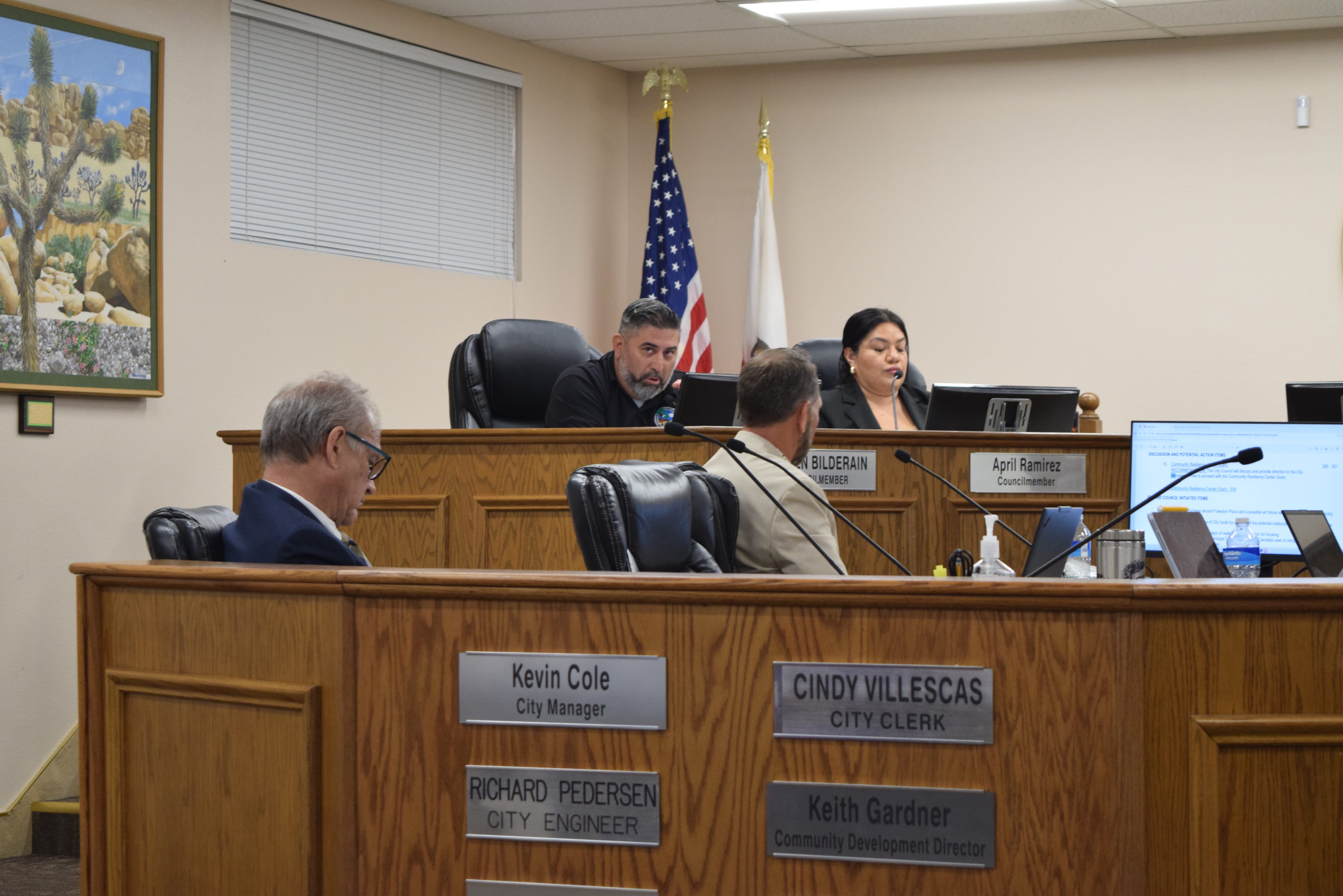
Mayor Daniel Mintz: What are you talking about? I never implemented this.City Manager Kevin Cole: The contract with California Consulting is an “as needed.” If we find a grant opportunity…
Mayor Mintz: Stone told him to start working on this?
Councilmember Ramirez: Our agreement [with California Consulting] went into effect March of 2025. We are in a contract. Yes, Stone identified a grant for new sidewalks because it’s within his signing purchase. 2
Ramirez goes on to describe small infrastructure improvement grants the City was considering.
Mayor Mintz interrupted:
I never knew we were we were specifically trying to get a grant for the Hope Project for this resilience center.
This discussion raises several questions, including
What is the signing authority of a City Manager?
Did ex-City Manager Stone James continue to work with Councilmember Ramirez on the grant after his employment ended around May 15?
When was new City Manager Kevin Cole made aware of the grant?
What is the responsibility of a Councilmember when it comes to informing the rest of City Council about grant opportunities?
At what point in the grant development process should Council approve moving forward with an opportunity?
How are City partners for grants selected? What’s the vetting process?
We’ll do our best to untangle a complex and sometimes contentious discussion.
Resilience Center Background
This is not the first time the Council has weighed a resilience center partnership with this network of organizations.
In 2024, Women of Color Global 29 brought a climate resilience center proposal to Council alongside a federal EPA grant program, with Councilmember Octavious Scott a co-sponsor of that effort.
When Women of Color Global 29 later withdrew, in August 2024, then-City Manager Stone James selected the Community Learning & Equipping Project (CLEP), a nonprofit tied to the Sanctuary Church, as the new partner without a formal request for proposals (RFP) or council approval. (CLEP has been rebranded as the Hope Project, also sometimes and very confusingly known as the Hope Center. And again, the Desert Trumpet has not been able to confirm the Hope Project’s nonprofit status.)
Council voted to approve that CLEP partnership in November 2024, just ahead of the federal deadline. Although the EPA program subsequently lost funding due to Trump administration cuts, the resilience center concept has persisted. This Community Resilience Center grant sponsored by the California Strategic Growth Council revived this discussion at the state level.
We’re kicking off our summer subscription drive! Help the Desert Trumpet reach 1600 subscribers by clicking the button below and receiving the Desert Trumpet in your inbox!
Council Discussion
There are two CSGC grants in question. The first is a planning grant. This grant is due on September 4, 2026 and helps communities plan to build a resilience center. It covers community meetings, site studies, and building partnerships. The award amount is $100,000 to $500,000.
The second grant is an implementation grant that pays for building or renovating an existing structure to serve as a resilience center. Applications for this grant are due September 25, 2026, and the award amount is $1,000,000–$10,000,000.
Per application guidelines, the program prioritizes investments in communities most burdened by environmental, socioeconomic, and health inequities, including low-income areas, Tribes, rural communities, and unincorporated regions.
California Consulting, who currently contracts with the City for as-needed grant writing services, estimates that the grant writing assistance would cost between $15,000 and $18,000. Dan Rodriguez and David Marquez of California Consulting were on standby remotely to field questions from Council.
City Manager Cole laid out the stakes. The CSGC implementation grant itself requires no local match and would fund $1 million to $10 million for construction or renovation of a resilience center that could double as an emergency shelter, heating and cooling center, and hub for year-round community programming. Pursuing the grant would entail upfront costs, not just in the form of consultant fees but city staff time and attorney time as well. City Manager Cole said:
Additional application-related costs, costs including city staff time and legal services, are difficult to estimate, but could total as much as another $30,000, including the development of a long-term use agreement and legal fees.
Council was confronted with a potential $50,000 bill with zero guarantee that any money would be awarded. What makes this grant potentially competitive, however, is that it is directed at rural, economically disadvantaged communities like Twentynine Palms.
Confusion over which grant, and which entity, the City would be applying with.
Much of the early discussion untangled whether the CSGC program was one grant or two and which of the two grants the City would apply for. California Consulting’s Dan Rodriguez muddied the water by saying, “it's one grant that the city is applying for" and then further confused the issue by saying, "No, it's contingent on which grant we're applying for. So whether we're applying for the planning and or the implementation. So it's one or the other."
Mr. Rodriguez added that the planning grant is meant to get a project “construction ready,” funding the pre-construction work (community outreach, CEQA/environmental review, site and design work) needed to advance a project’s design toward completion before seeking construction dollars via the implementation grant or funding from another source.
It became clear that Councilmember Ramirez and ex-City Manager Stone James had unilaterally decided that the City should apply for the implementation grant and had not mentioned the planning grant to the City, which California Consulting did not seem to be aware of. Ramirez and James had also approached the Hope Project/Sanctuary Church as its nonprofit partner that would run the resilience center while the City retained the grant funds, paying the Hope Project a fee yet to be determined.
Mayor Mintz pressed on which nonprofit entity would actually be the city’s partner, after confusion over whether “Hope Center,” “Hope Project,” and “CLEP” were the same or different organizations.3
Hope Project Staff Addresses Council
Addressing Council from the public were Community Outreach Director Shanese Risper, Disaster Preparedness Director Lashara Maea, Bishop Mae Ford of the Sanctuary Church, and Cindy Bernard who has written extensively on nonprofits, CLEP and the First Amendment church and state issues for the Desert Trumpet.


Mae Ford, who’s husband Perry Ford is the Bishop of the Sanctuary Church and is listed as the Principal Officer of CLEP, addressed Council:
I just wanted to make a clarification that CLEP is the Hope Project, not the Hope Center. [The] name was changed just because Community Equipping and Learning Project was too much to speak out on a normal basis. So CLEP has been changed to the Hope Project, which is why you see it. Right now we’re waiting for the IRS to send us the final paperwork on that. That’s why you see [CLEP] doing business as the Hope Project.

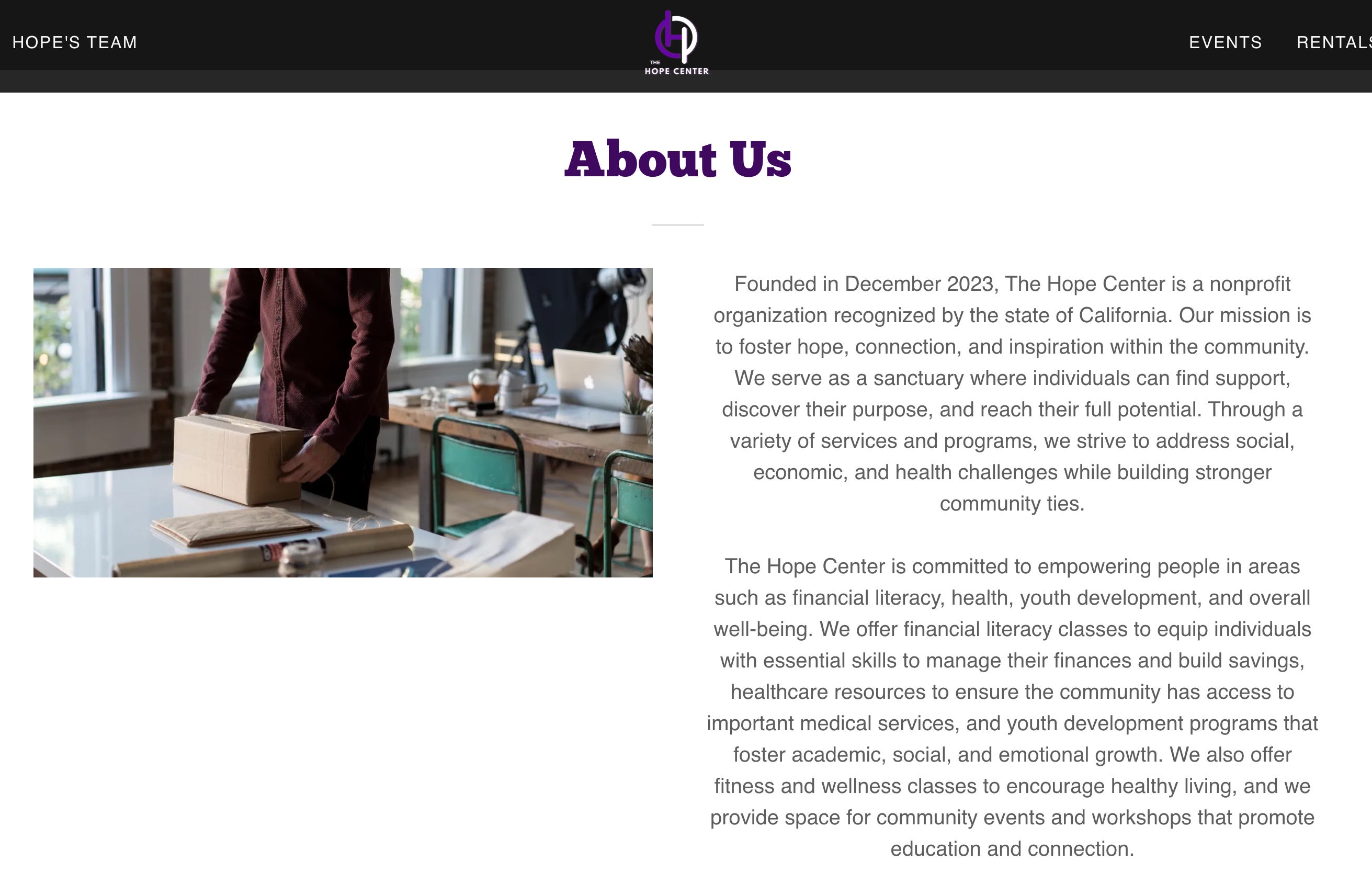
CLEP’s board is largely comprised of Sanctuary Church leadership. The church’s website previously included a page describing CLEP counseling services, now rebranded as Voices of Hope Christian Counseling Services. An incomplete CLEP website also exists as well as separate Legacy University 29 Palms with Church branding. To date, the Hope Center has had its own separate website and identity — and although it has operated with CLEP as its fiscal sponsor, enabling it to receive funds from the City. Until recently the website incorrectly stated that the organization is “a nonprofit organization recognized by the state of California.”
Since Tuesday’s Council meeting, the website has been updated to read “The Hope Center is a community hub operated by The Hope Project 29, Inc., nonprofit organization recognized by the state of California” (sic) reflecting the in-progress name change for CLEP claimed by Mae Ford.
Cindy Bernard took issue with the organization’s financial capacity to operate a hefty grant award in excess of $1 million if the organization has received under $50,000 in annual revenue per their 990N IRS postcard filing. Bernard stated:
This entity, the Hope Center, and its fiscal sponsor, CLEP, an arm of the Sanctuary Church – per CLEP’s IRS filings, do not have the financial capacity or transparency to be a City partner on a project of this scale, as indicated by CLEP’s filings of 990N postcards for organizations with less than $50,000 per year in revenue. This is a million dollar project. They show less than $50,000 in revenue every single year, per their IRS filings. I have provided proof of this via an email to the city manager, the mayor, and the mayor pro tem, and given this lack of documented capacity, would the grant even be competitive?
In response to Bernard’s comments, Ms. Ford clarified:
The Hope Project, in its three years of existence, even before that– CLEP has never made a dime. The Sanctuary Church pays all of their bills through the free will giving of the members. So that’s why you see the less than $50,000 made — because nothing that happens through the Hope Project is charged back to the people, so there is no revenue that comes into that project.4
Hope Project’s Community Outreach Director Shanese Risper and Disaster Preparedness Director Lashara Maea told Council that the organization has served as the Morongo Basin's primary Red Cross-affiliated shelter provider since June 2025,5 has trained 41 shelter volunteers, operates a weekly food distribution serving more than 1,300 people each month, and recently secured a national partnership with disaster-relief nonprofit ToolBank. Maea said:
We would love for the city of 29 Palms to partner with us... it’s not if, but when a natural disaster is going to happen.
City Manager Cole acknowledged the wider philosophical discussion at play:
Obviously some issues have been raised. The separation of church and state is certain. I mean, it’s a little fuzzy to me whether [it’s] the Hope Project is going to be the partner or whether it’s the Sanctuary Church. Certainly the signs that are down there on the building right now suggest the Sanctuary Church is going to go into that location, and I don’t know what the plan is as far as renovating it to accommodate a resiliency center or a church, so that would be worked out in a long-term use agreement.
Councilmember Ramirez responded:
….I don't understand the difference between church and state and the signs and the buildings. What was discussed at that meeting, where you, myself, and their leadership team and California Consulting was there, was that there would be a long-term use agreement.
Council Splits on Vote
Ramirez explained her involvement began when she and Dr. Stone James were the only ones to attend Red Cross trainings, which James had organized in response to the City's fertility clinic bomber, recurring flooding, and the lack of an emergency shelter. She noted that partnering with a local community liaison was the only legal path to bringing Red Cross emergency services to the City, and she and Dr. James were the only ones who had shown up to pursue it:6
Then we went a little bit further into what other building structure is there in this city that could house more than 40 people at one time. What other organization has come forward and said ‘We don’t want anything, we just need you to help us so that we can help the community?” Because the last grant [the Women of Color Global 29 EPA grant], even though we were named as a co-applicant, showed millions of dollars for salaries. That’s not what they’re asking for.
Specific salary terms for the Women of Color Global 29 2024 EPA grant proposal have not been verified by the Desert Trumpet.
Speaking on the grant review process, Ramirez added:
They [California Strategic Growth Council] want to see the County and the Red Cross and the nonprofits and the churches and the tribes and the cities all working together for an emergency disaster preparedness program. We don’t have one, so open up an RFP.7 Who else can bring 40 certified American Red Cross people?8
Mayor Mintz objected that Freedom Plaza, which is a City-owned facility, could serve as a shelter:
Well, we do have a place to put them now. We have Freedom Plaza. We can fit 100 people in that building. Just to be clear. I guess what I want to ask the consultant then, as far as doing the program, obviously there’s some questions about who’s applying. Now, if they said that CLEP is going from CLEP to Hope Center, but Sanctuary is the one with the 501(c)(3) — how can they apply then? Who’s going to apply?
Everything on here says Hope Center. So if they were to start this off with Hope Center and they research and they’re not the 501(c)(3), what would that do to the grant? Would that even get off the ground?
Consultant David Marquez acknowledged a lot of administrative footwork would need to be completed before the grant application can be submitted.
Mayor Pro Tem Scott noted he’s attended and volunteered at Sanctuary Church and Hope Project events, and that he appreciates their community work. His main concern, he said, is timing:
I know how difficult achieving grants can be, and the reason why I brought up Women of Color [Global] — when they first brought their resilience center proposal, they had actually gotten pro bono work from a grant writer, and they had worked on that grant for six months before they had brought it to the City, so they were almost pretty much shovel-ready.
After Councilmember Ramirez suggests moving forward in her motion, Councilmember Steven Bilderain expressed confusion about what moving forward would mean. Ramirez responded:
Ramirez: [We’re going to] continue the months of work that Stone James put into this. You got to think about this. We told him go within your purchasing agreement. Go and do the things, and then we go and do the things, and we have all of these organizations and community leaders coming out to do it. We’re wasting the time of California Consulting, and then now it came back to us, even though it was something that was worked on then and I just feel like every single project that we’ve that we’ve brought up, or that Stone brought up, or any grant that we’ve pursued hasn’t been able to move forward for one reason or another. Either city staff says no, or the council says no, and I mean now we just have this grant writing money sitting there.
Mintz: That’s our job is to direct staff as far as what grants we want to pursue. Now, if you use monies to find out what grants were available, is one thing. But the City Manager cannot say we’re going to get this grant, especially what this is going to cost $50,000.
After a brief discussion, Councilmember Steven Bilderain seconded the motion, citing his firsthand experience as mayor during both floods and the Palm Springs fertility clinic bombing. Despite reservations about the September 25 application timeline and the cost, he said he was willing to bet on the community and the Hope Project’s ability to deliver.
I know it sucks. Believe me, I’m very frugal, but I believe in the Hope Center and that staff. If we can get the grant and get everything done, I know we’ll be successful. I have to bet on our community members and everything they’ve done… It’s going to happen, and I believe they’re going to pray too. So they got the church on their side too, and a lot of people don’t like what’s going on because they’re focusing on individuals and not the project. Look what the project and what this thing can do for the community, and not people behind it you don’t like.
Mintz, the longest-standing member on Council, commended the work Hope Center does with fiscal responsibility in mind:
You guys are doing a great job. I was up there for your opening of the Hope Center. You guys are doing great. You’re feeding lots of people. I go by your church down there. There’s cars lined up constantly, so this is by no means my saying that you, if this was to happen, you wouldn’t do a good job. I’m just making sure that whatever we do, it’s done the right way. Because if we go through all of this, spend $50,000, and then [it] just doesn’t happen, then the city is out $50,000. That’s basically the bottom line here.
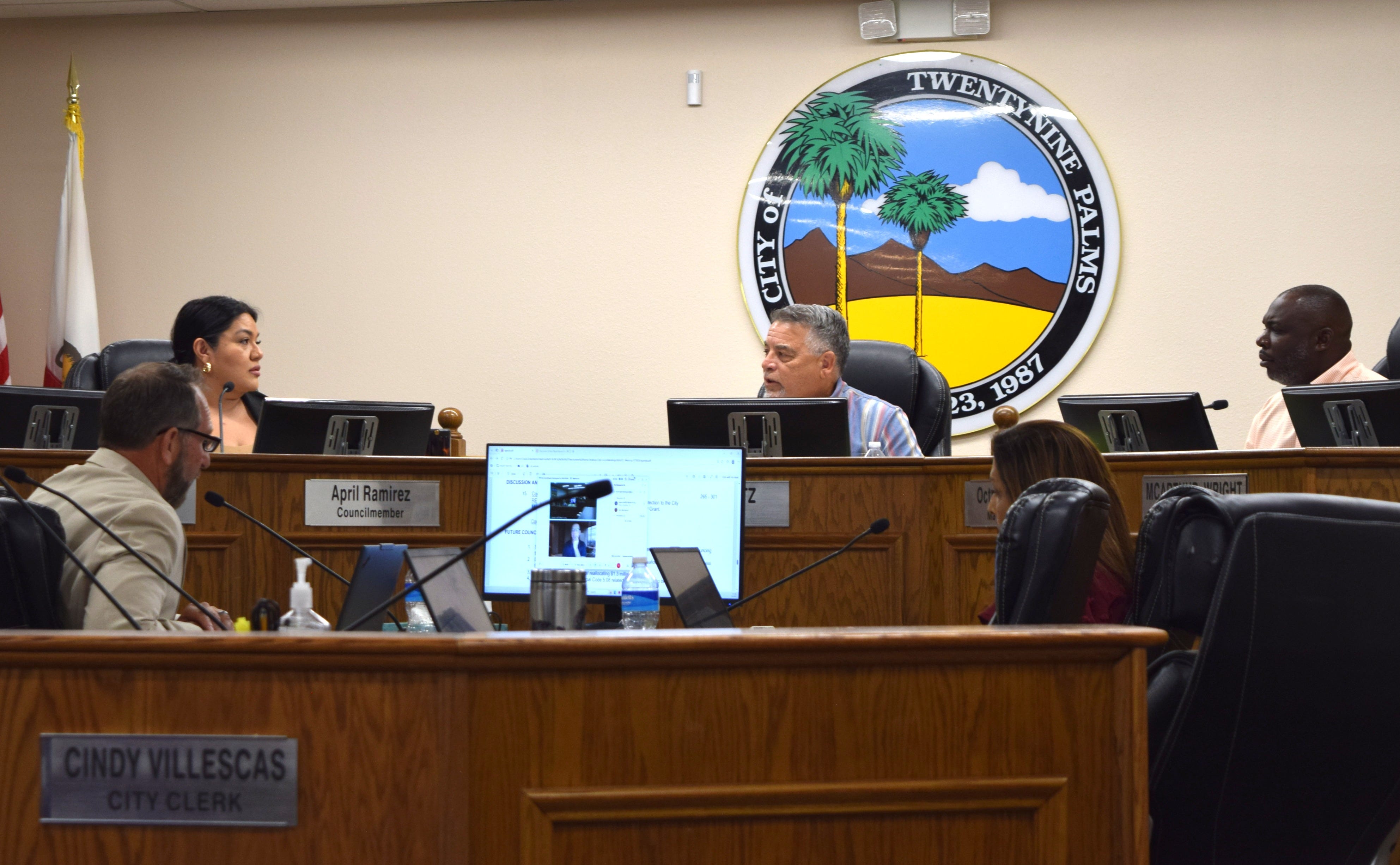
When the vote was called, Councilmember McArthur Wright, who serves as President of the 29 Palms Ministerial Association, of which Sanctuary Church is a member, abstained. Ramirez and Bilderain voted in favor, while Mayor Mintz and Mayor Pro Tem Scott were opposed.
“You have to have three in order for it to carry,” acknowledged City Clerk and Council Secretary Cindy Villescas. The motion for the City to move forward with the grant application failed on a 2-2-1 vote.
What lessons will City Council and the City Manager take away from this discussion? Will new policies be created or existing policies tightened to prevent the apparent overreach evidenced in this agenda item? Will a code of conduct be needed to prevent Councilmembers from pursuing grants and City partners outside of Council approval and oversight? Stay tuned.
GENERAL PUBLIC COMMENT


Addressing Council during open public comment were Beth Sheffield, Ricky Johnson, Warhawks Coach Bruce Spencer, Cindy Bernard, Scott Curry, and Mark Van Horn.
Bruce Spencer, Coach of the Warhawks football team, said the league has expanded outside the Marine base, making the program open to everyone, saying the season is running now until November.
Van Horn struck the meeting’s final cord:
I care about this community, and it really pains me. I think it’s great that everyone has all the churches and everything, but when I see another business failing, when I see Rite Aid going down to be turned into a church, I think, man, who’s going to be paying the taxes around here?
Van Horn illustrated how the shuttered Rite-Aid has universal implications within the Twentynine Palms microcosm, encouraging the City to stand up for itself:
The only place where you can get ice cream for $1 instead of paying $10 over at Cold Stone, the only place where you have a drive-in pharmacy, the only place where you can buy hair dye for a woman because Stater Brothers now only carries men’s hair dye, which I think is ridiculous. I try to get people from LA, my friends, to come visit, and they don’t want to come here because — well, we don’t even have a Denny’s anymore… And now we hear about this open-pit mine that they want to build up there…
The August 11 City Council meeting is cancelled. The next Twentynine Palms City Council meeting will take place August 25, 2026 at 6 pm.
Desert Trumpet Editor Cindy Bernard, writer Natalie Zuk, and Associate Editor Kat Talley-Jones contributed to the research and writing of this article.
Hi, new subscribers! The Desert Trumpet understands you might not be interested in all of our coverage. That’s why it’s divided into separate newsletters allowing you to opt out of reporting that’s not important to you. For instance, you may want our County news but not City Hall 29.
Here’s how to opt out: go to your Substack settings, scroll down to “subscriptions,” and select “Edit” for the Desert Trumpet. Simply uncheck the box next to the newsletters you don’t want to receive in your email inbox. You’ll still be able to access all coverage online or read them later if you change your mind.
Become a paid subscriber!
Subscribing to the Desert Trumpet will always be free. That said, did you know that paid subscribers receive discounts on our DT Social events and invites to DT Front Porch, intimate discussions featuring local officials and notable residents?
Upgrade to a $50+ paid subscription for a 10% discount.
Upgrade to $100+ for a 25% discount.
Sustaining subscribers at the $250+ level and above receive complimentary tickets
Share your thoughts in the comments below. Please note that we do not allow anonymous comments. Please be sure your first and last name is on your profile prior to commenting. Anonymous comments will be deleted.
Share this post—it’s free!
Up to now, the church has operated with the Community Equipping and Learning Center (CLEP) as its fiscal sponsor. The Desert Trumpet has been unable to verify the nonprofit status of the Hope Center or if the name of the entity has been formally changed from CLEP to the Hope Center.
Councilmember Ramirez is referring to the City Manager’s signing authority. Under the City’s municipal code (Chapter 3.24, governing procedures under the state Uniform Construction Cost Accounting Act), informal purchases and contracts up to $25,000 can generally be handled administratively, with anything above that requiring City Council approval. Per a City webpage search, Council has approved payments to California Consulting in the past (2019 and 2017, respectively). However, meeting document searches yield no results for a March 2025 contract approved by the City Clerk or City Manager.
The names “Hope Center” and “Hope Project” have been used interchangeably by both the City and Sanctuary Church / CLEP.
Here, when referring to “less than $50,000 made,” Ford appears to confuse “revenue” with “profit“ or in nonprofit language, “excess revenue.” Revenue is the total amount of “unearned revenue” such as donations, grants etc and “earned revenue” such as merchandise sales, that an organization bring in. If no funds are being run through the nonprofit and all expenses and revenue, including donations, are being handled by the Church, what is the function of the nonprofit?
The Red Cross identifies facilities that meet its shelter standards and can be opened during an emergency as a normal part of its shelter network. There are multiple identified shelter locations throughout the Morongo Basin. Per an anonymous source, there is not a unique designation or special certification that makes one organization the exclusive Red Cross shelter provider for the area.
Per an anonymous source, “the statement that partnering with a single local nonprofit is the only way to bring Red Cross emergency services into the community is simply not how the Red Cross operates. The Red Cross routinely opens and operates shelters with its own volunteers and also works with local governments, schools, faith-based organizations, and established disaster partners through shelter agreements and local emergency management and VOAD networks. In all my experience with the Red Cross, I’ve never seen a policy requiring one specific nonprofit to serve as the gateway for Red Cross disaster services in a community.”
There is no evidence that Ramirez and James issued an RFP on behalf of the City.
Per an anonymous source, shelter training courses are open to the public, and anyone can take them. Completing the training does not make someone a Red Cross volunteer or qualify them to staff a Red Cross shelter on their own. During an actual disaster, shelter workers generally need to be affiliated with a responding organization, complete any required background screening and onboarding, and be assigned through the incident’s operational structure.