
Terms of Engagement: What Is Sex Positivity?
Jojo discusses communication, inclusivity, stigmas, and shame


Last month I introduced myself and this column, “Terms of Engagement.” As I mentioned, my goal here is to talk about sex positivity and write openly about communication, pleasure, healthy boundaries, and consent, always expressed with compassion and clarity.
What is sex positivity? Put simply, it’s liberation. It’s creating a mindset of looking at people and situations with new perspectives. It’s learning healthy sex habits. It’s understanding that lack of sex doesn’t mean safe sexual habits.
Sex positivity consists of three primary points:
open honest communication: consent, desires, fantasies, preferences, and boundaries are practiced and understood;
inclusivity: promoting acceptance and awareness of different sexual orientations and relationship dynamics and respecting each experience’s uniqueness with a learning mindset;
challenging stigma and shame: open dialogue about subjects that may be “taboo,” education about alternative lifestyles, empowerment as opposed to shame or negative cultural values, sexual health awareness and appropriate contraceptives.
Of course, some concepts fall into more than one category—for instance, communication on contraceptives is crucial, but the use of appropriate contraceptives is also an inclusivity issue.
Communication
Consent is asking and giving permission freely, knowingly, and enthusiastically. It is always given with a clear conscious mind and is specific. It is also reversible at any moment. Consent can presented in three ways: verbal, non-verbal and sometimes even written.1 Consent includes discussing fantasies, preferences, thoughts, fears, insecurities, and experiences that may not be typical.
Consent is also the clear defining of boundaries for what is and is not permissible in sexual encounters and relationships. While sex positivity means the acceptance of all relationship styles and acts or lack thereof, this makes hard conversations about boundaries and learning how to express them with consent even more crucial.
Communication also includes open dialogue with partner/s about topics that may be embarrassing or just difficult to voice such as testing for sexually transmitted infections, whether a partner has a common STI2 such as chlamydia, herpes, genital warts, or HIV and the use of appropriate contraceptives for preventing disease or unwanted pregnancy.
Inclusivity
To be sex positive we have to accept that the wide variety of differing relationship dynamics is impossible to list here and includes everything from brief sexual encounters to on-going casual sexual relationships; from platonic relationships to monogamous or open long-term sexual relationships; as well as relationships built around fetishes. There are sexual encounters taking place in person, by phone, online, on a couch, on a kitchen table, in a bedroom, in your local park and in national parks.
Inclusivity is also understanding that safe sex means that different sexual acts require specific prophylactics such as thicker condoms and silicone-based lube for anal sex or dental dams for oral sex.
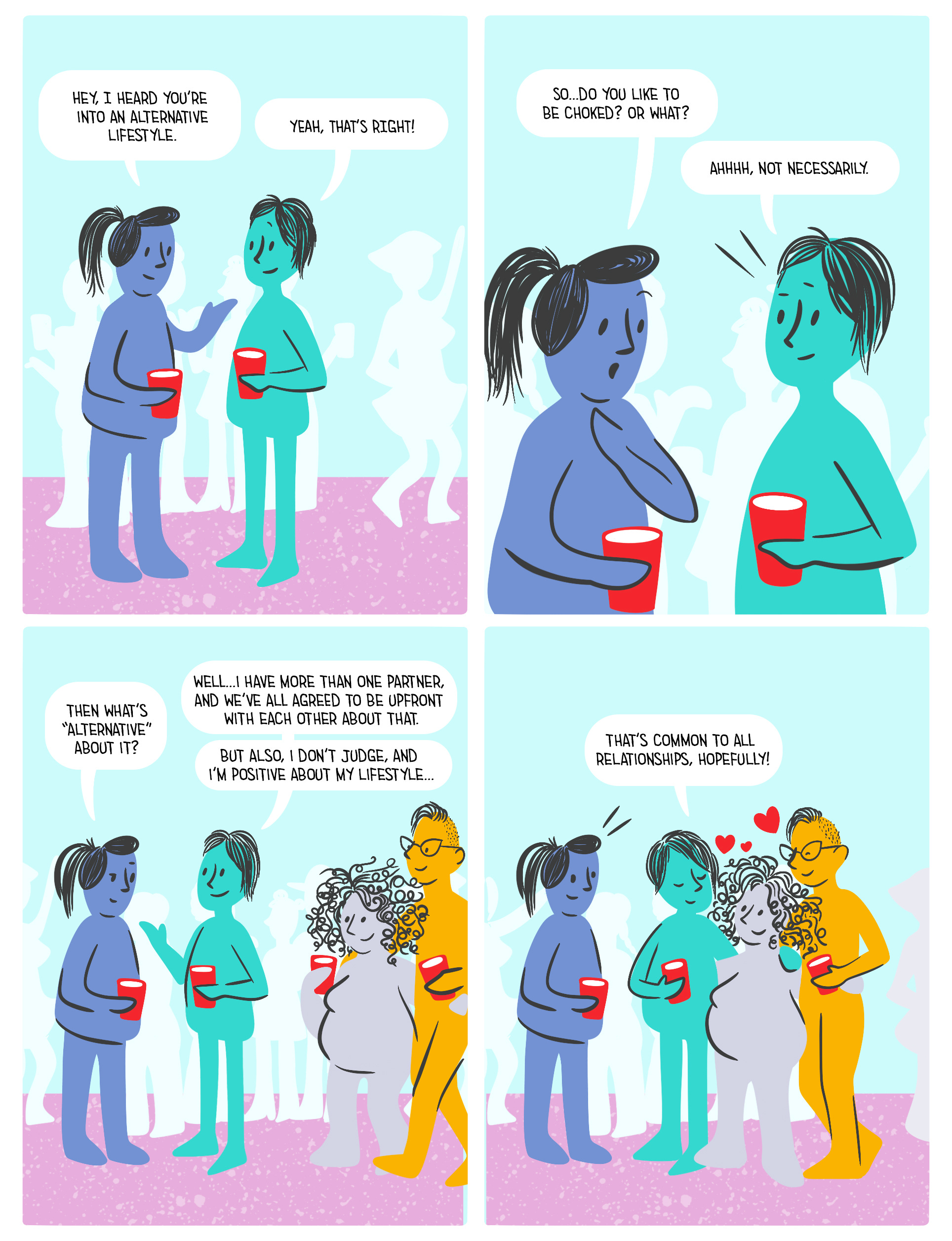
Being sex positive also means breaking the silence of common misconceptions on alternative lifestyles: Polyamory, Open Relationships, Monogamy, Asexuality, Pet Play, Age Regression, and more. It is also accepting that there is no moral hierarchy; no one relationship dynamic is better or worse than the other.
It can be scary or different at first, but there are communities and worlds that exist and have existed for decades that many people are curious about but are lacking information, while at the same times members of those communities often do not feel seen or heard.
Challenging stigma and shame
Sex positivity is defining and challenging social norms with positive and trauma-informed language. When speaking of ourselves or others it is important to speak with intention — acknowledging that language alone can be offensive/or upsetting in a way that many people don’t understand. Trauma-informed language is a way of speaking that includes every individual’s experience and acknowledges that some words, phrases, or situations can be triggering (a reaction to a situation that results in an emotional response).
Challenging stigma is the learning of new experiences and opportunities that normally are dismissed or commonly misperceived. When challenging stigma, we begin to challenge shame. Shame exists when we allow our biases and our repressed ideas to surface. The antidotes for shame is curiosity and vulnerability. When we ask questions and embrace differences we start to defeat shame.
It is also removing contemporary stigmas around alternative lifestyles, appropriate contraception, and common STIs.
Changing perspectives
The point of being sex positive is to change your perspective and learn about new terms, topics, or unconventional relationships with grace and understanding. It is to understand that all bodies are unique and complex. Therefore, actions that work for one person may not for another and to ostracize someone for their preferences is an antiquated way of thinking.
With this new mindset we can look at changing bodies not as being inadequate or celibate but as new bodies, and, as sexual beings, lean into the discomfort of looking inward. Even casual sexual partners who don’t have relationships defined as ”traditional” still have “traditional” fears and communication challenges.
All we have to do is take our insecurities, our shame, and our fears of inadequacy and face them with confidence and crush them with the strongest weapon: vulnerability. We take the ugly truths we believe about ourselves and douse them with these three things: honest communication, respect for self and others, and acceptance. We ask uncomfortable or silly questions, learn every day, and accept everyone at their core.
Have a question for JoJo? Leave us a voice mail with your first name at the Desert Trumpet phone line 760-362-6099, and we’ll pass it along for a future column. Voice mails will be converted to text, and the identity of callers will be kept confidential. Readers can also email questions to editor@deserttrumpet.org.
Desert Trumpet understands this content may not be for all readers. Here’s how to opt out: go to your Substack settings, scroll down to “subscriptions,” and click on or hit “Edit” for the Desert Trumpet. Simply uncheck the box next to Terms of Engagement if you don’t want to receive it in your inbox.
Leave your thoughts in the comments below. Please note that we do not allow anonymous comments. Please be sure your first and last name is on your profile prior to commenting. Anonymous comments will be deleted.
Feel free to share this article!

Thanks to our new paid subscribers we are $400 closer to our $10,000 goal! Upgrade your subscription from free to paid today for just $50 per year or $5 per month.
We are facing a potential $30,000 loss in funding for 2026. If you are able, would you care to donate more than $100? Our Paypal account is up and running!
The details of consent are the subject of a future column.
While it is a common practice to use STD/STI’s interchangeably, it is to be acknowledged that using STD’s may no longer be accurate as most are infections (not diseases) that can be managed with preventative or prescribed medications.
We in the Sixties and Seventies liberation movements worked for these values wayyyyyy back then. What happened between then and now???
I am really not interested in this subject. Please remove me from any more emails from Jojo Blake. Thank you.
This is not against the author, just not interested in the subject.