
It’s June and destination nuptials are back in town, but behind the scenes locals know that making it in the Mojave is no garter toss. Survival requires a creative hustle and boy-howdy do parasitic plants have some ingenious strategies for getting by.
With no roots to draw water and little-to-nothing in the photosynthesis1 department, you’d think that life as any kind of plant would be one big fail. But by tapping directly into the vascular systems of neighboring plants using haustoria, or root-like structures that penetrate tissue, parasitic plants are able to usurp resources generated by others. Uninvited, these smooth operators merge with hosts and proceed to work the buffet line. Before unmasking their identities and signature moves, let’s delve into what they share in common.
To Be Green or Not to Be Green
First of all, “parasite” is an unfair term that evokes an unwelcome microscopic thing in your gut biome or the ex-roommate who bilked you. Rather, parasitic plants exude the otherworldliness of anime demons, with exotic hues that result from their lack of chloroplasts, the photosynthesizing cells that contain green chlorophyll pigments normally associated with plant appearance. Take away chloroplasts and you lose the green.2 No green, no photosynthesis.
There are two broad categories of parasitic plants. Holoparasites are wholly reliant on other plants and make an entire career out of dependence. They’re characterized by completely atypical colors.
Then there are hemiparasites with some ability to photosynthesize but still needing a host to survive—think gig worker with a trust fund. They’re often pallid or “green if you look hard enough."
The Players
Desert Mistletoe (Phoradendron californicum), a hemiparasite
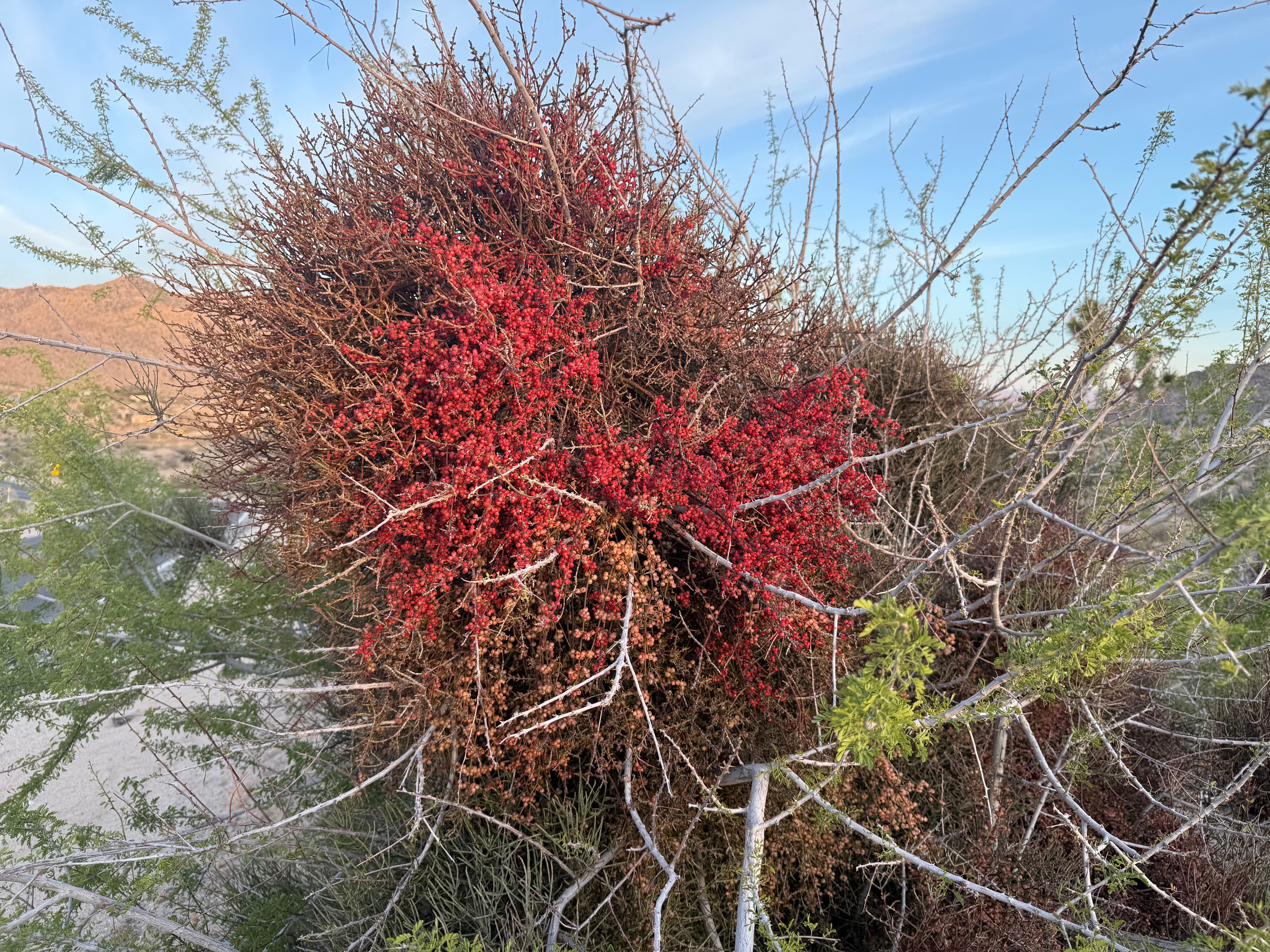
We all know this one as desert mistletoe or erroneously as witch’s broom. Mistletoe is a parasite while witch’s broom is actually a cluster of abnormal stubby plant growth that takes on a similar starburst form, hence the confusion.
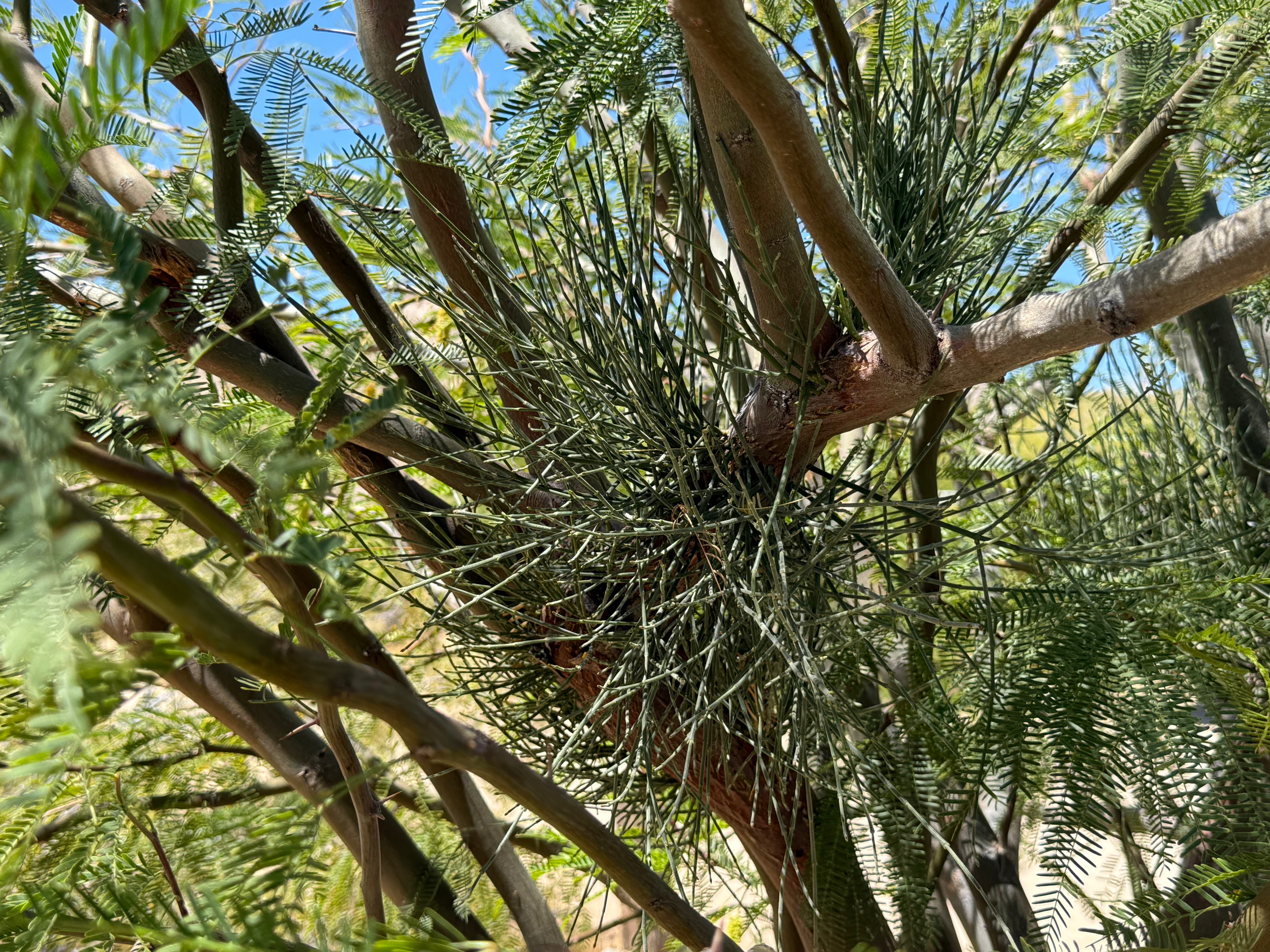
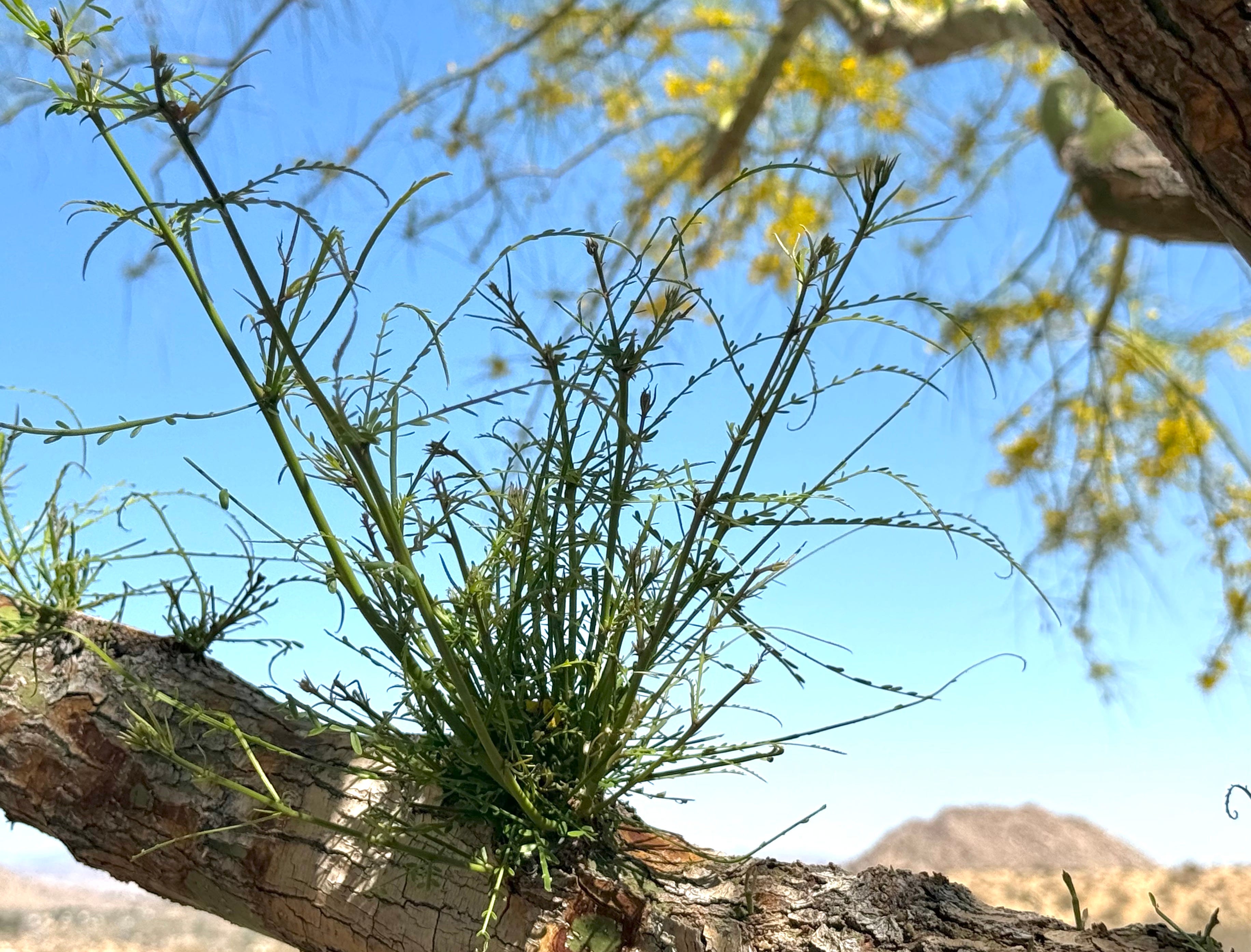
Finding wild success on our ubiquitous catclaw acacia (Sennegalia greggii), mistletoe migrates to other trees of the pea family such as palo verde and mesquite. Occasionally it takes stabs at the odd creosote without gaining much traction. Veins of haustoria travel unseen beneath the bark layer looking for a new spots to emerge, making it challenging to manage in garden settings.3
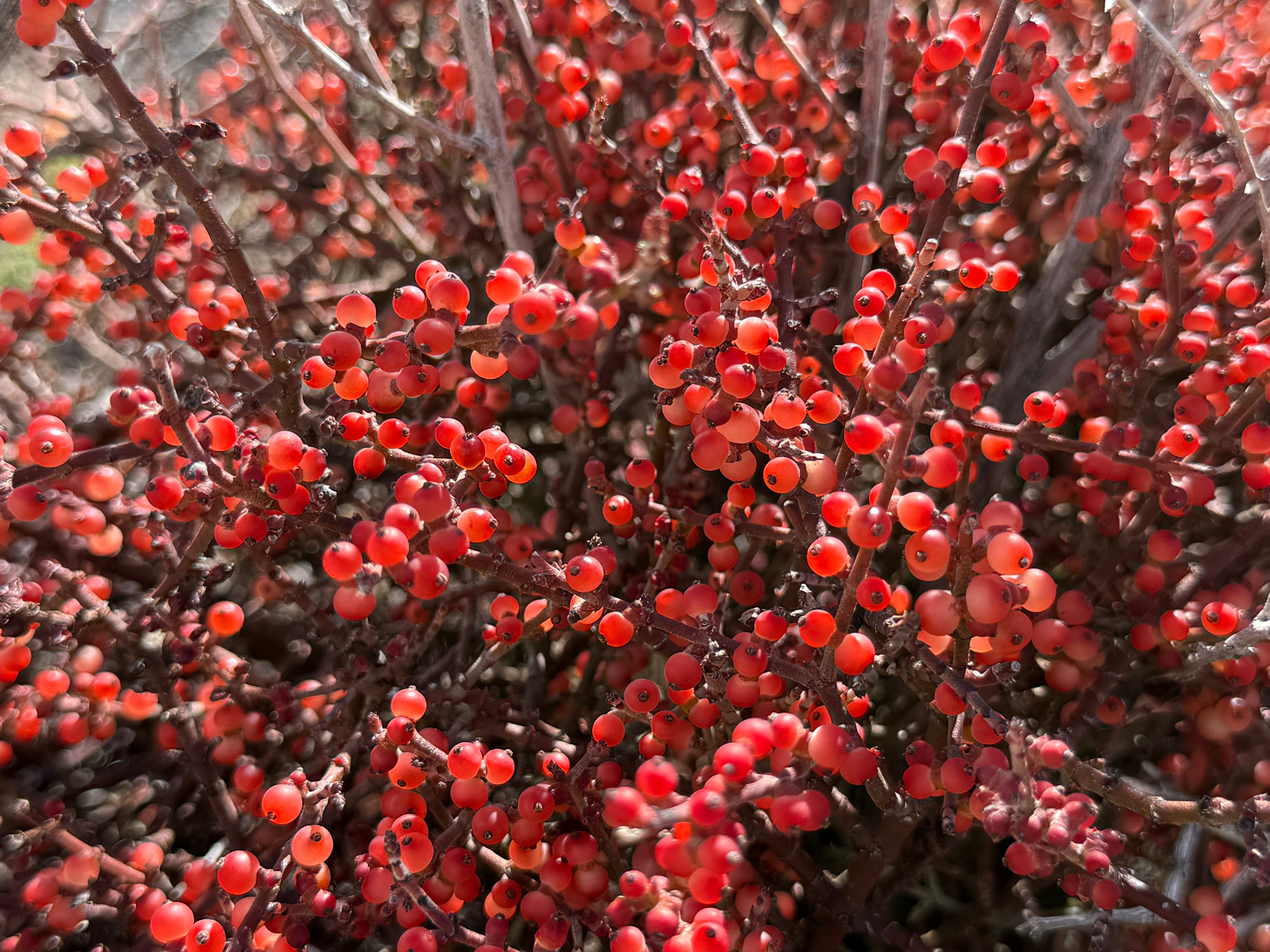
How does it spread so vigorously? One of the coolest looking dispersers in the avian world, the Goth Cardinal Phainopepla, gobbles up the fruits. Gorge they must, because the berries have low nutritional value and race through their digestive tracts. Next stop, a nearby tree to pass the meal in the form of sticky seed-laden residue that must be heartily rubbed onto a branch to come free of the bird’s vent. However you feel about this plant, give it credit for engineering ways to firmly secure copious seed onto new hosts.
Small-toothed Dodder (Cuscuta denticulata), a holoparasite
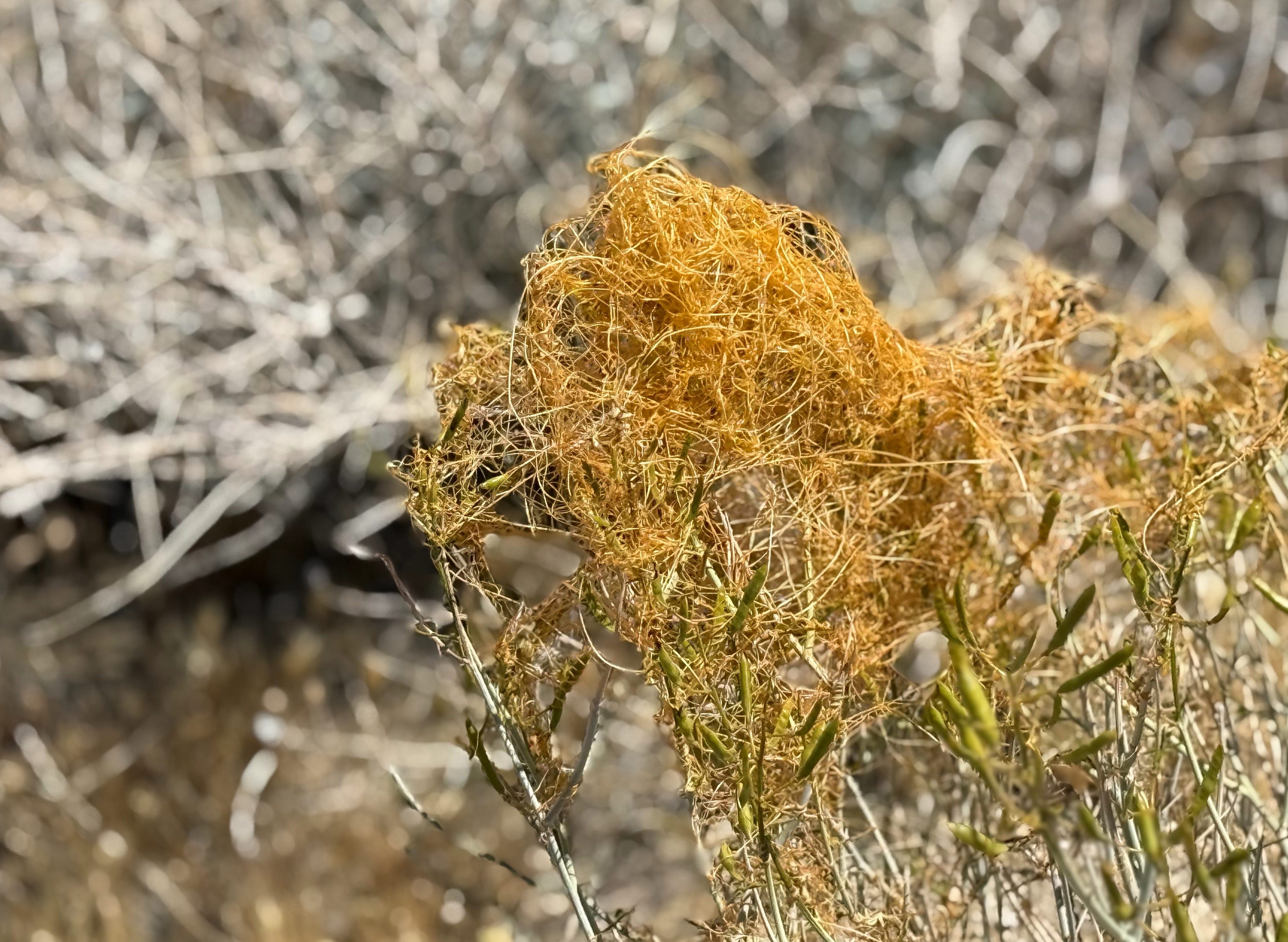
Whereas mistletoe germinates aloft on branches, dodder seedlings emerge from soil and immediately start “sniffing” out chemical cues in search of a victim and groping the air maniacally to latch on. Once that happens, its temporary root-ish appendage withers away. If no host is found, the seedling dies in the five or so days that it takes to deplete the nutrients that came prepacked in the seed. This time lapse is worth a watch, even if only for the menacing B movie soundtrack and the Aussie narrator who you’ll want to have record your phone message to spam callers.
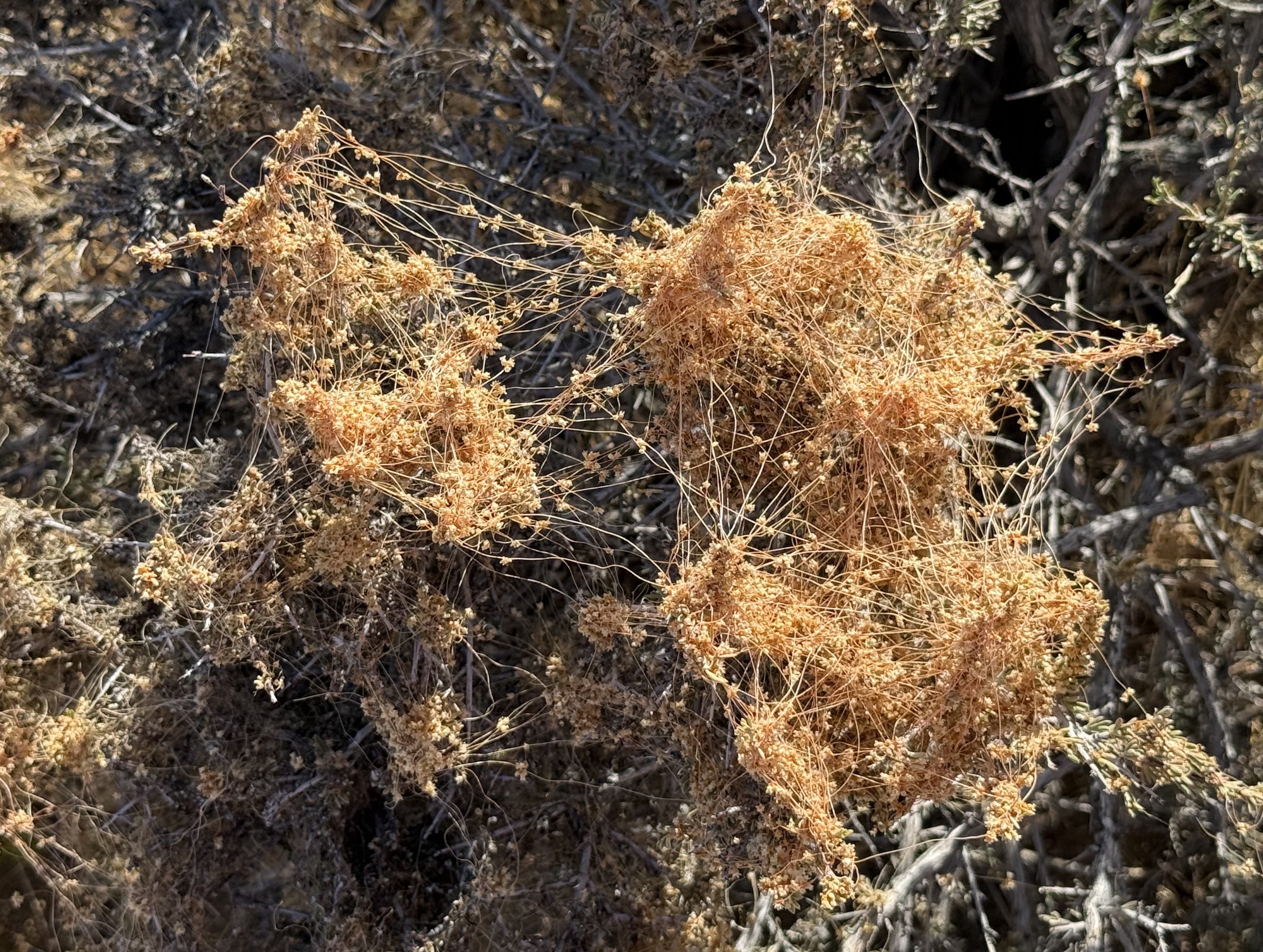
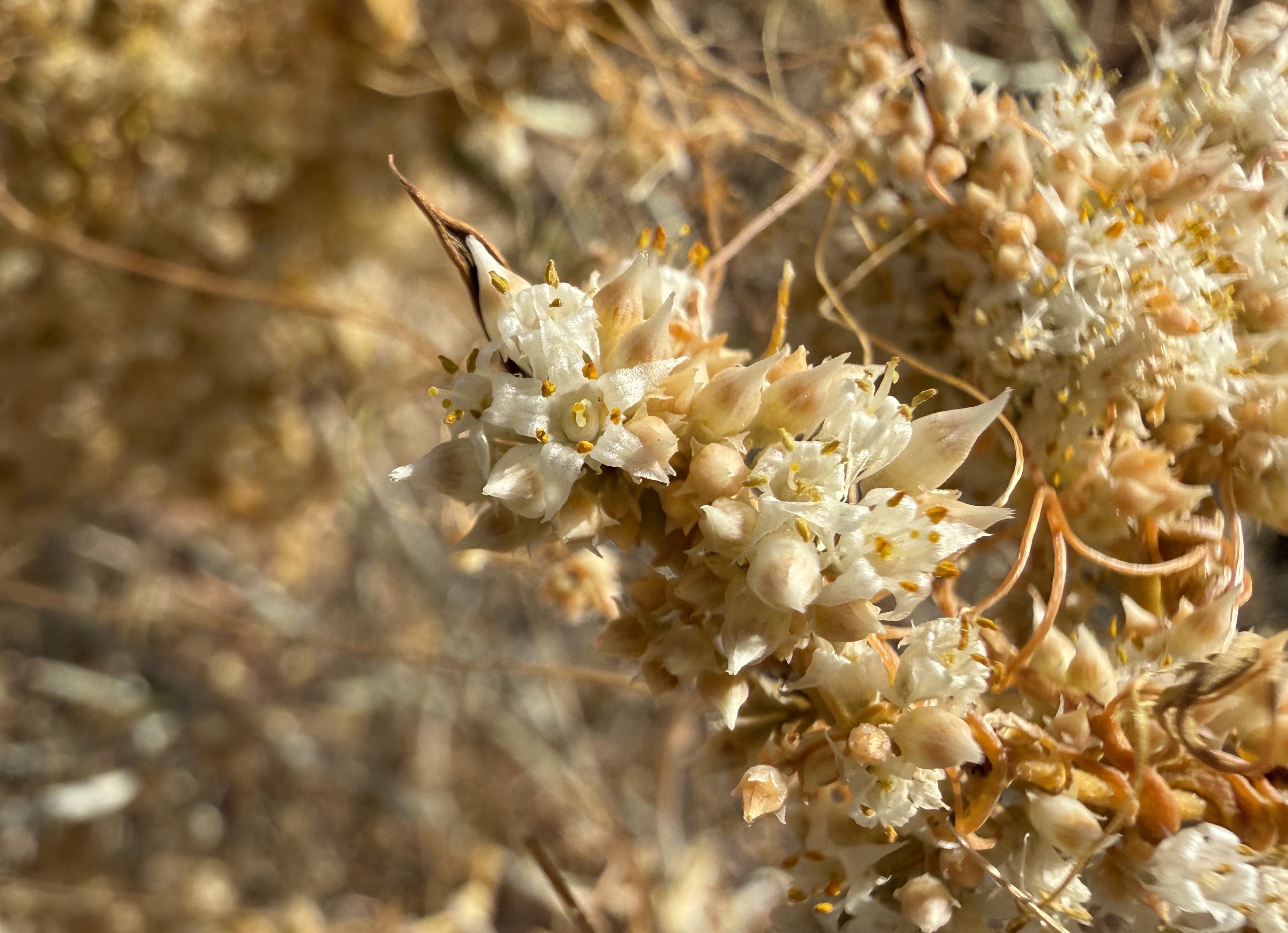
The quest to dominate extends further. By confiscating flowering signals when hosts ramp up to bloom, dodders make sure to bear fruit ahead of the decline or death of the host.4
Pretty Little Parasites
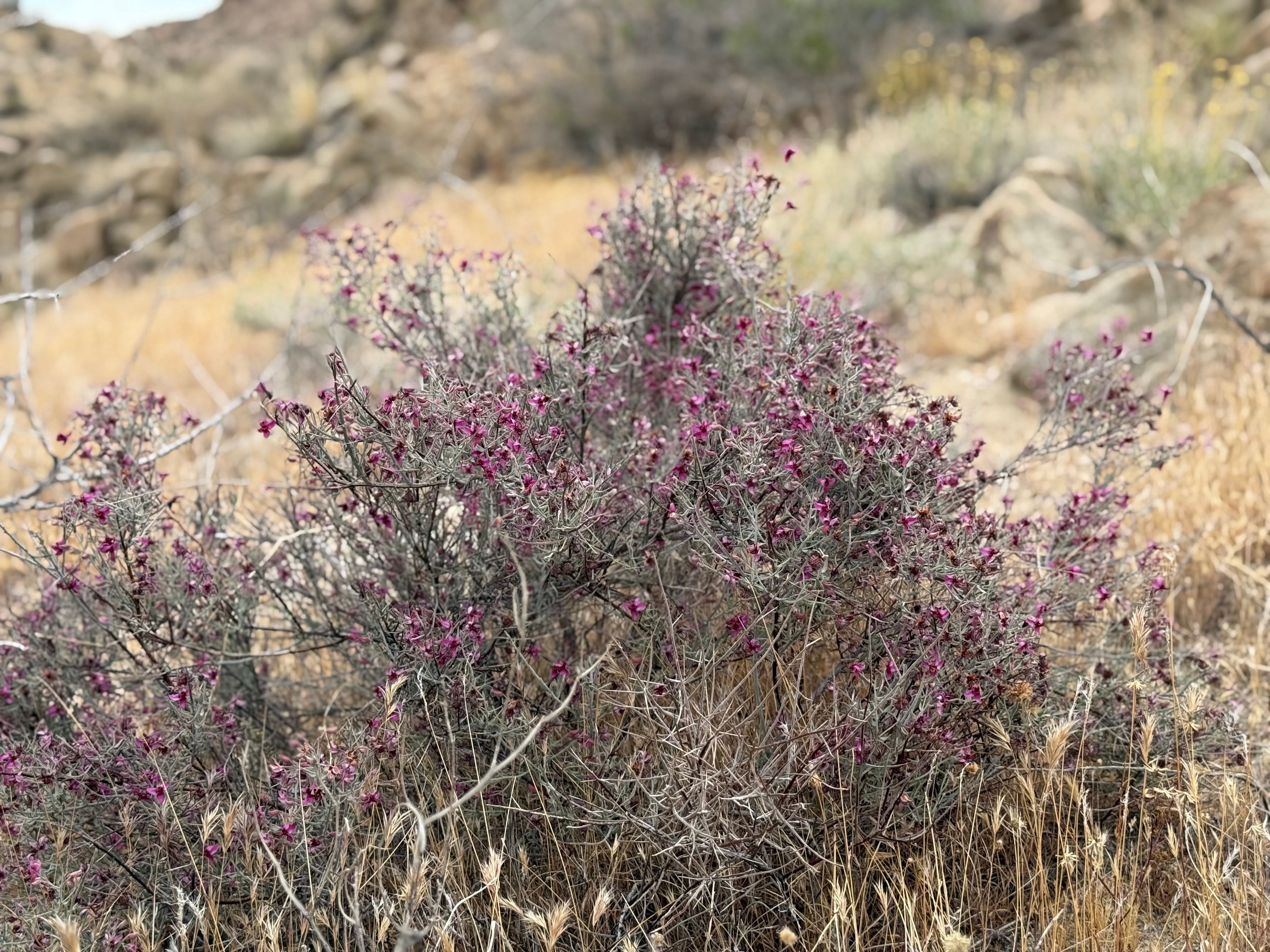
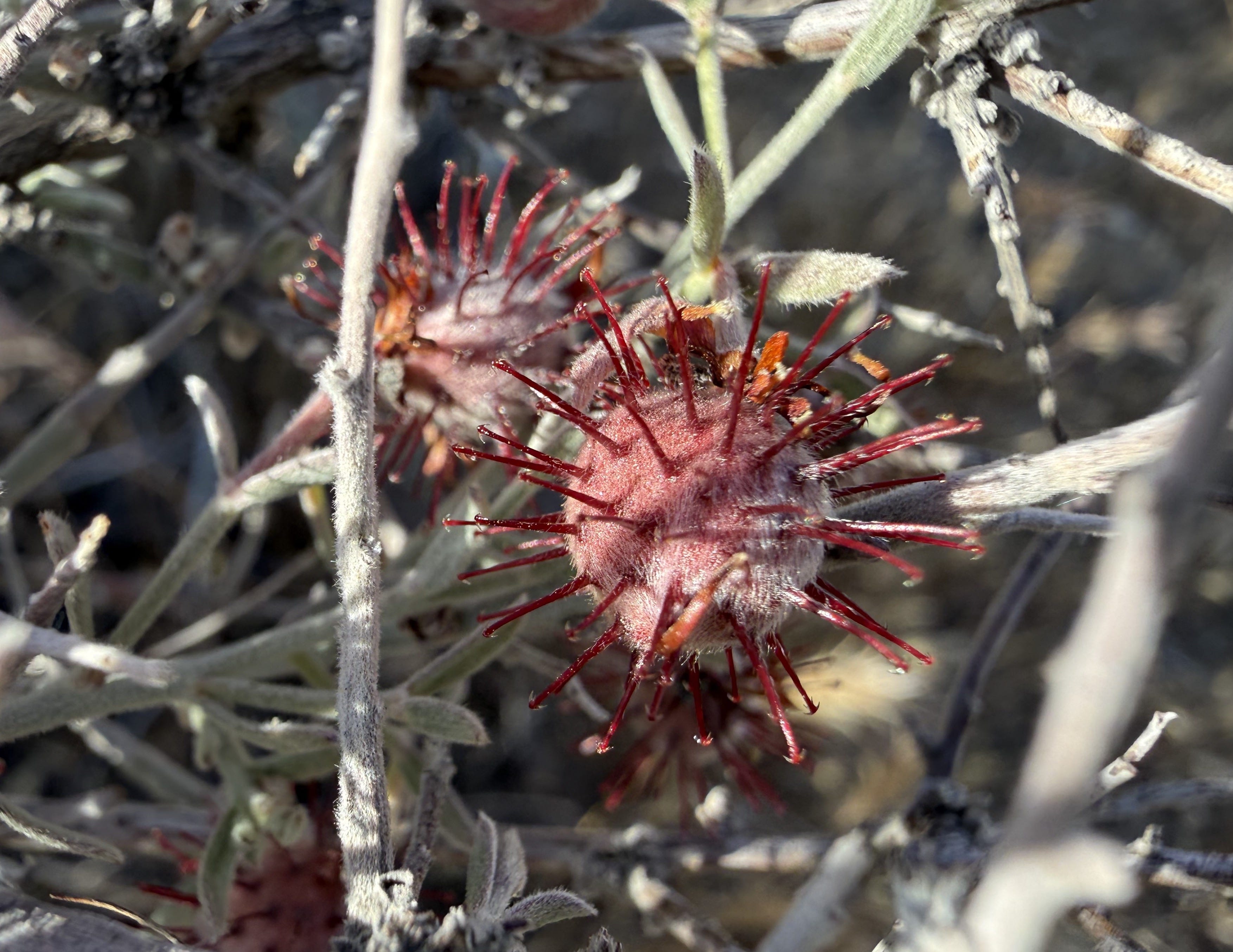
White Rhatany (Krameria bicolor)
From a distance, shrubby Krameria bicolor appears as bluish puffs of magician’s smoke, settling across the desert floor. Maintaining polite distances from their creosote hosts, K. bicolor taps into creosote roots but leaves them no worse for the wear.
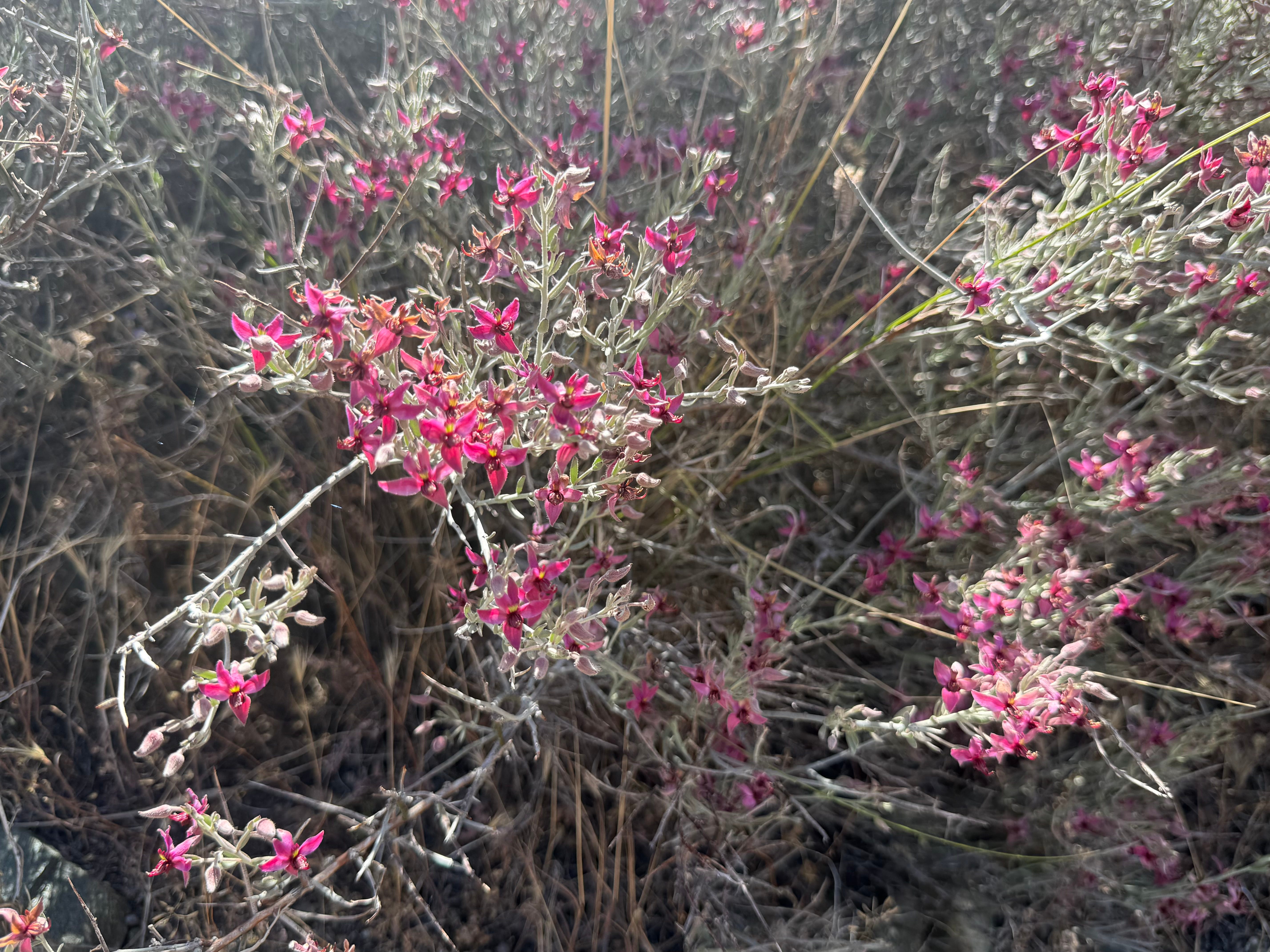
Profuse nectarless flowers are filled with raspberry scented oil collected by native Centris bees, with their absorbent hairs and squeegee-like legs for harvesting. The oil is then used to line nests and roll into balls with pollens and nectars to feed larvae. Eventually, the intense magenta blooms transform into Sputnik seed capsules waiting to attach to passing animals for dispersement.
Scarlet Paintbrush (Castilleja miniata)
Crowd pleaser Indian Paintbrush only comes around after heavy rain seasons when resources are abundant. Its favorite local hosts are native grasses desert needlegrass (Stipa Speciosa) and big galleta grass (Hilaria rigida), but it also taps into roots of buckwheats, desert mallow, lupines, sagebrush, and others. Keep that in mind if trying to sow seeds on your property.5
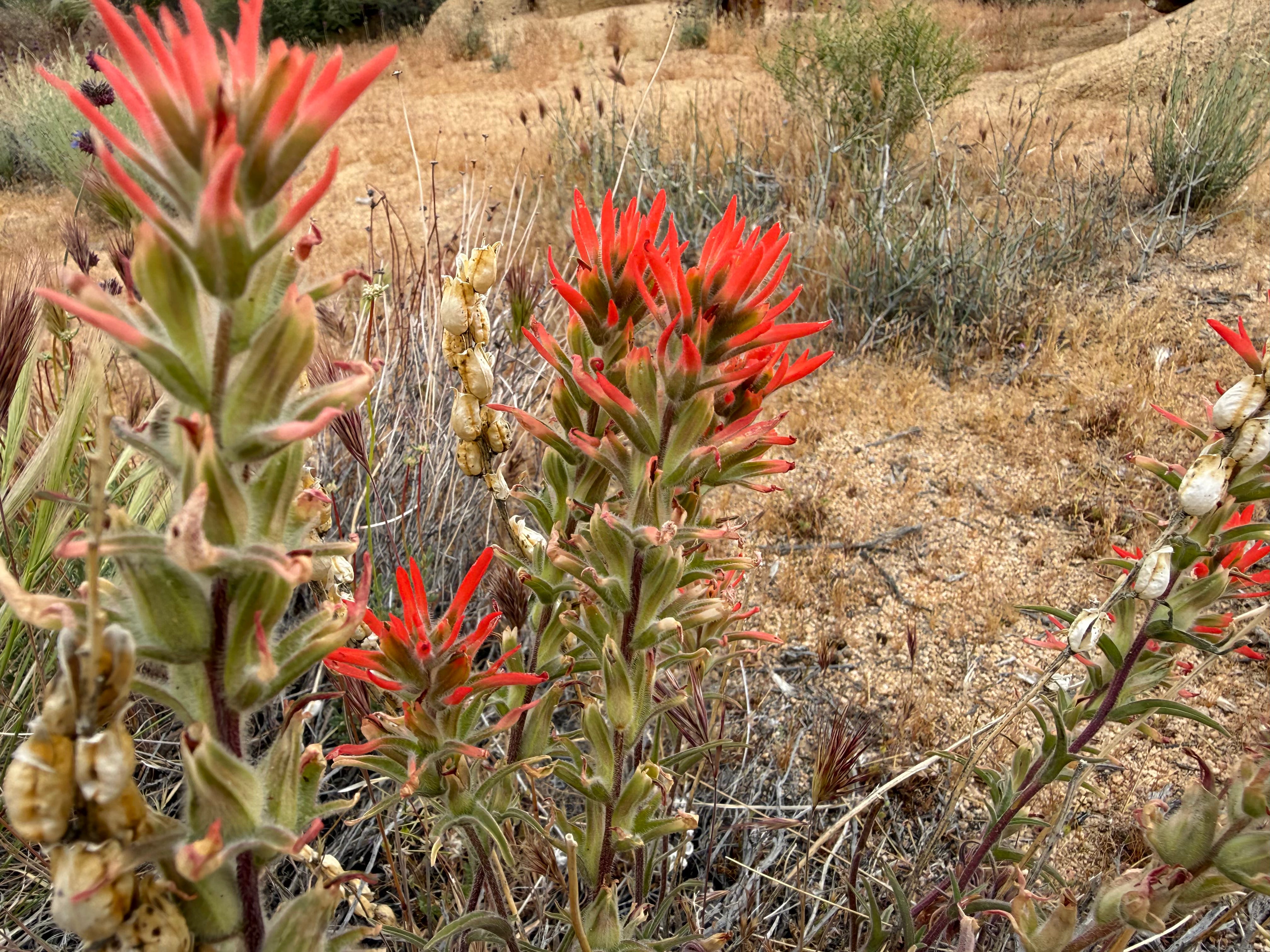
Just looking at the deep tubular form of the bracts, which, by the way, aren’t petals, you can tell that this plant screams out for hummingbird pollination. Think long beaks and the bright scarlet-orange that hummer optics are super sensitive to. Knowing that this is a parasitic plant and seeing the green-tinged foliage, no field guides are needed to peg it as a hemiparasite.
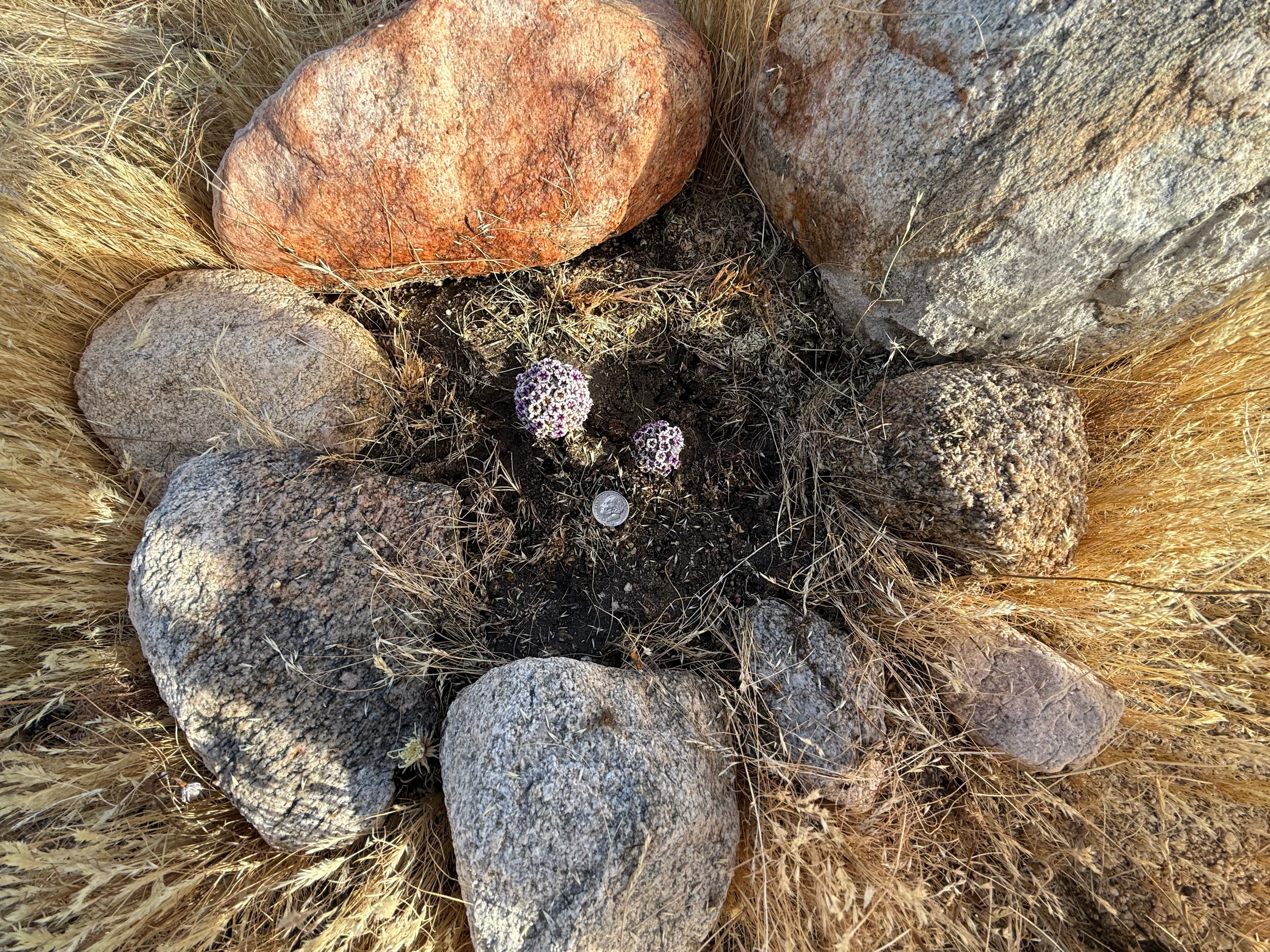
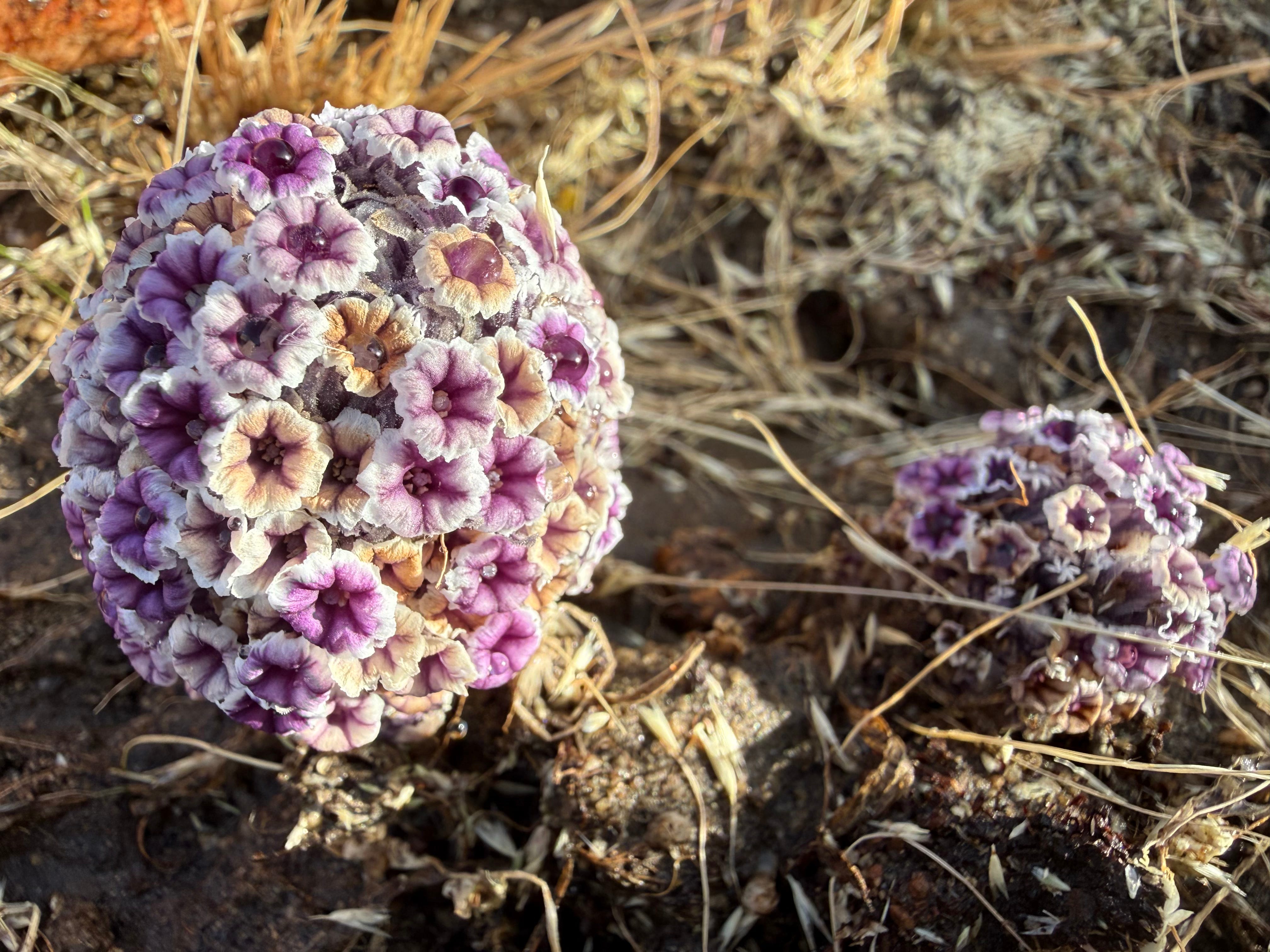
Scaly-stemmed Sand Plant (Pholisma arenarium)
Let’s end on a zinger, the ephemeral scaly-stemmed sand plant. Small and hard to spot, it’s also a considered at high risk from habitat loss and OHV sand compaction. Multiple attempts to list6 this plant speak to its rarity. Like white rhatany and Indian paintbrush, its haustoria penetrates roots, making all three root parasites.
Incredibly, seeds must find their way underground helped by shifting sands, ant burrows, or rodents, and germination only occurs if a suitable host is sensed. A “pilot root” (more stem than root) emerges followed by haustoria, traveling several feet down and out to plug in and start resource transfer.
Sandy soil aids this exploration and protects from rot during multi-year underground dormancies. In these especially fast draining, low nutrient conditions, only the very toughest plants thrive, so it’s no surprise that P. arenarium bedfellows with hardy burrobush, ragweed, and California croton. As one example of reciprocation between parasites and their hosts, there’s evidence that during extreme drought, water from stored resources is returned by Pholisma.
Truth Be Told
When humans extract resources, we downright deplete. But after a mistletoe empties out a catclaw acacia, what remains is a fortress where the rabbits, quail, and lizards who fuel the food chain can brood in safety. Parasites like dodder support pollinators and warn hosts of threats through interplant signal transduction. Connected by networks of haustoria, defenses are shared among associates. And who knows, its death grip might strengthen host species by removing unresistant individuals from the gene pool or curb imbalances from overabundance.
Nature does stuff like that. It’s a misdirect to describe some native plants as malevolent and others as benign when each plays multiple roles in our rich desert ecosystem. As with the dodder, the transmission lines are finely intertwined, and every thread we pull reveals fascinating side hustles. Invited or not, crashers are welcome at the wedding table of Observation and Science, where thinking deeply is free.
Hi, new subscribers! Desert Trumpet understands you might not be interested in all of our coverage. That’s why it’s divided into separate newsletters allowing you to opt out of reporting that’s not important to you. For instance, you may want our Education news but not City Hall 29.
Here’s how to opt out: go to your Substack settings, scroll down to “subscriptions,” and select “Edit” for the Desert Trumpet. Simply uncheck the box next to the newsletters you don’t want to receive in your email inbox. You’ll still be able to access all coverage online if you change your mind.
Thanks to you, Desert Trumpet met our $10,000 paid subscription goal!!!
Not a paid subscriber yet? Did you know that paid subscribers receive discounts on our DT Social events and invites to DT Front Porch, intimate discussions featuring local officials and notable residents?
Upgrade to a $50+ paid subscription for a 10% discount.
Upgrade to $100+ for a 25% discount.
Sustaining subscribers at the $250+ level and above receive complementary tickets
Leave your thoughts in the comments below. Please note that we do not allow anonymous comments. Please be sure your first and last name is on your profile prior to commenting. Anonymous comments will be deleted.
This coverage is free - please share!
Photosynthesis is the process by which plants combine sunlight, carbon, and water to make their own food.
Many non-parasitic desert plants are gray in appearance, yet are completely photosynthetic. The deceptive coloration comes from coverings of dense white hairs or waxy coatings that serve to reduce water evaporation from leaves and protect from excessive sunlight. These are common desert adaptations readily exhibited by the agaves, encelias, and desert mallow. When desert plants appear true green, the leaves are usually small and profuse as in creosote, acting to self-shade and avoid broad sun-facing surfaces prone to evaporation.
Since the mistletoe parasite is already living within the host’s vascular system, removing the visible growth won’t end the problem. Gardener’s solution: depending on the size of the expression, pruning back at least 18” from the outbursts does offer a chance at reducing the host’s burden, enabling the two plants to coexist without the host succumbing, and ongoing maintenance required.
Blooming sometimes signals that the plant is nearing the end of its life. In other cases, the plant directs its resources to the blooms at the cost of other systems.
Incredibly difficult to grow in pots, even though seeds may germinate and grow for a while. Those who do try, sow seeds into the pot of a companion host plant. In spite of its popularity, the unavailability of this plant in nursery cultivation reflects the difficulty of producing viable plants.
A listed plant species is any taxon formally designated as endangered, threatened, or rare by federal or state agencies under legal statutes like the U.S. Fish & Wildlife Service Listing and Classification framework. These plants receive strict legal protections against harm or unauthorized removal.
This is a great article. For us desert dwellers these plants are a big part of our landscape. Miriam Seger’s collection of these wonderful simultaneously positive and negative symbionts (in energy flow terms) really captures the foundations of our living desert’s biota and community structure. Well done!
Wonderfully written. Thanks, Miriam.