
When Commerce Meets Culture: Art Fairs in the Desert
A special Sad Trombone features a conversation between Cindy Bernard and Bernard Leibov with 90 Miles From Needles Host Chris Clarke

Editor’s note: In this special edition of Sad Trombone, we’re featuring a transcription of the May 9 Episode of the 90 Miles from Needles podcast, hosted by Chris Clarke, produced in collaboration with the Desert Trumpet:
We are going to take a second look at an art fair that we recently covered in a previous episode. After that episode aired, I heard from some folks I trust that we left some things out, so we revisited the topic, and I was expecting to spend a fair amount of this interview talking about problems with the episode, but instead our guests briefly addressed those, and we went on to talk about arts and desert communities in the broader sense, with less reference to the episode, but more to what’s actually going on in the art world and how that reflects what people are trying to do to educate folks about what the deserts need from us — Chris Clarke
The episode, titled S5E15: When Commerce Meets Culture: Art Fairs in the Desert is available for listening on the 90 Miles From Needles website.
Chris Clarke: A couple of episodes ago we had a discussion about the High Desert Art Fair, especially with regard to an article that appeared in the LA Times that provoked some bad feeling among some members in the Morongo Basin community. There was discussion about that. So we talked about that, put the episode to bed, published it, and then I heard from someone whose judgment I trust a great deal that there was a bunch we left out in that episode. So we are revisiting that topic to perhaps add a little bit of nuance to it.
I am joined by Cindy Bernard, who is the friend who reached out. She’s an artist and activist with a conceptually oriented art practice across a variety of media. She’s exhibited internationally and her work is in the collections of the Museum of Contemporary Art, Los Angeles, LA County Museum of Art, the Whitney Museum, the Museum of Modern Art, and the Pompidou, among others.
Her grants and fellowships include Creative Capital, Anonymous Was a Woman, California Community Foundation, the John Simon Guggenheim Memorial Foundation, and the Pollock-Krasner Foundation. She was a National Endowment for the Arts fellow at MacDowell Colony, and her work will be included in Staging California in Early Hollywood at the UCI Langston OCMA this summer. In addition to teaching studio art at colleges and universities across Southern California, she was the founder of SASSAS, where she produced more than 150 concerts and other events in the greater Los Angeles area. She is co-founder and editor in chief of the Desert Trumpet, an invaluable online local news publication covering 29 Palms and the broader Morongo Basin.
We are also joined by Bernard Leibov, who is the founder and director of Boxo Projects, which is a residency and programming initiative based in Joshua Tree. Also co-founder and co-curator of the Joshua Treenial. Before moving to California in 2011, Bernard was deputy director of Judd Foundation in New York and Marfa. He also operated a non-traditional gallery space in New York City which featured artists from regions beyond urban centers, and manages an art gallery for Joshua Tree National Park and is the director of the David McKenzie Estate. He’s also co-founder of Joshua Tree Arts Professionals, an informal association of arts professionals who support artists and the arts in the local community. Bernard has previously served on the board at the Joshua Tree Chamber of Commerce and the organizing committee for the Morongo Basin Strategic Plan for the Arts.
Clearly a couple of dreadnought people to talk to. What did I get wrong in that episode?
Cindy Bernard: Well, I think the word nuance is really the way to approach it. I just felt that the desert needs all sorts of people in order to be the economic place that it is. It’s an environmental place, but it’s also an economic place. It’s been an economic place since the Chemehuevi were using the Oasis of Mara as a trading center. So it’s been going on here for a very long time. And I felt that the episode didn’t fairly acknowledge that.
And you know, yeah, the LA Times article on the High Desert Art Fair—maybe there were a couple of things in there that were questionable, but the Art Fair itself was not the same as the article, and it [the episode] kind of collapsed the two together in a way that I felt was not completely fair. So I thought that maybe it would be useful to get together with Bernard, who participated in the High Desert Art Fair, and have a discussion that added some of that nuance to some of the valid criticisms that were in the prior episode.
Chris Clarke: That sounds very reasonable. Bernard, did you have a particular sense of how our episode may not have really reflected what was actually going on?
Bernard Leibov: Yeah, well, I think there were a number of things in the episode. One of the things that struck me was that there was a confounding of a whole set of issues, some of them related to the Art Fair and most of them not, in a way that kind of just picked up and ran. I think what was important in the Art Fair itself to understand firstly is that they’ve been building that for a number of years. Yes, they got a professional PR agency involved this year and probably got quite a little overboard with that, in a sense. And there were some misstatements. But the reality of the Art Fair was that it’s been in development for a number of years, and the organizers have been particularly generous to local organizations and careful with working with the local art community in the way that they put the fair together and program it.
We have a community here that to some degree is reeling from changes that have been happening over the last 15 years in the Joshua Tree area.
— Chris Clarke
Bernard Leibov: Almost fully half the fair was free or subsidized spaces for local organizations. My space [in the Pioneertown Motel] was provided to me absolutely free. And then I was treated in every way like a paying client in all the niceties that came with participation there. And I felt incredibly welcome and highlighted. And many other local organizations were treated in the same way. There was also a room devoted solely to fundraising for local nonprofits where artists donated their work.
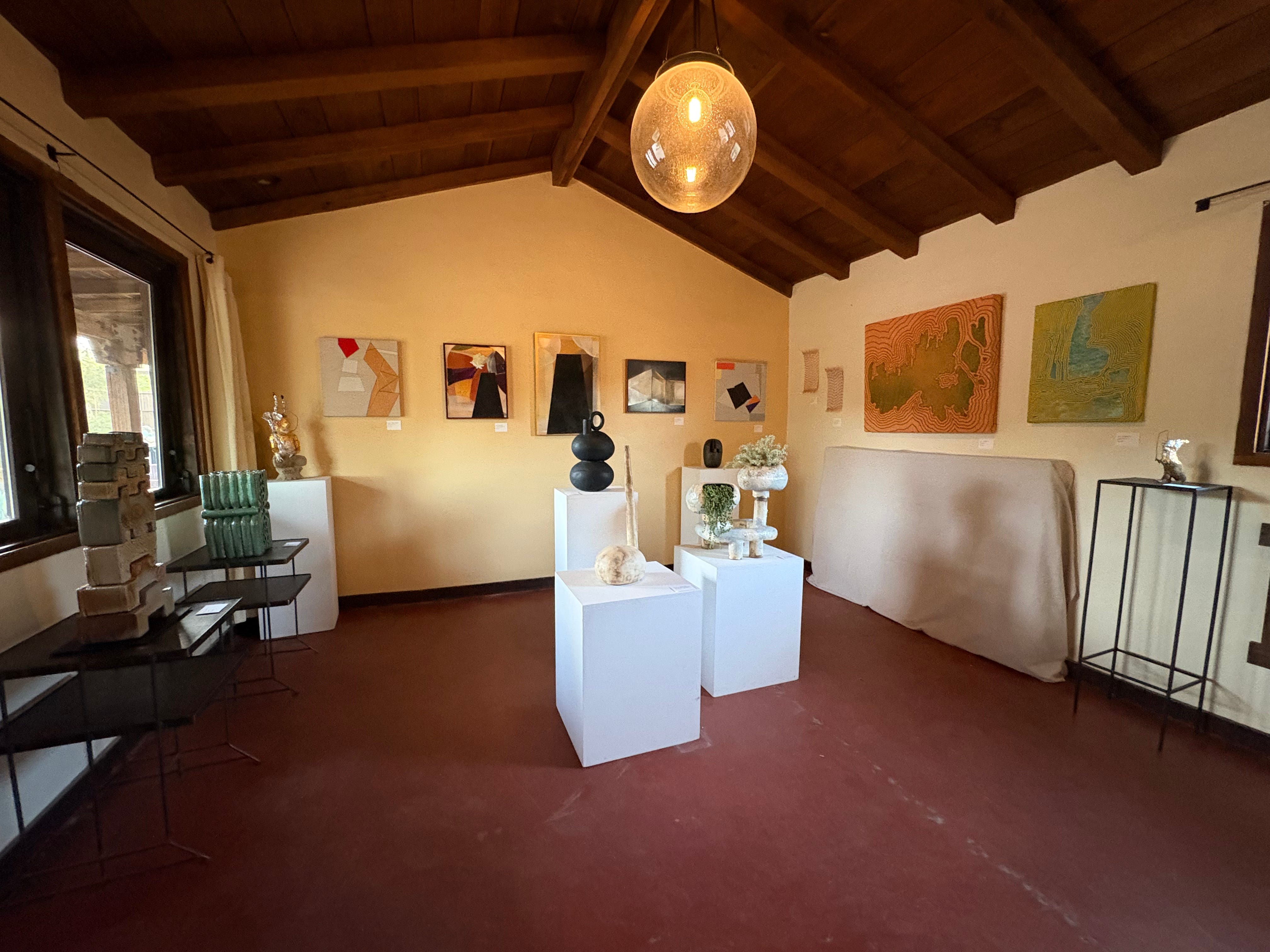
Bernard Leibov: So I think there was a lot of balance that was brought to the fair this year and a lot of fairness and then some very interesting programming. There were talks and musical performances of the sorts we don’t usually see, that addressed the kind of cultural and commercial aspects of being an artist or a collector in the desert. These are valuable discussions to have. The art scene here really is lacking professional platforms for exhibition—at Boxo we try to fill that somewhat with the Joshua Treenial and highlight local artists in a professional curated exhibition.
But what’s certainly missing is commercial platforms. There are one or two programmatic galleries, and they do a great job, but most haven’t been able to survive: it’s the economic reality. And this was a wonderful opportunity.
Chris Clarke: And you were quoted in the LA Times article with a couple of things that…I think the concern about affordability was something we mentioned in that episode. But there was also something that you said which has spurred some thought in me, which was that commerce is not always a bad word for people in the arts. I’m paraphrasing here. You know, the idea of the starving artist is sort of a romantic fiction. Not that artists don’t starve, but it’s not an aspirational goal.
Bernard Leibov: Exactly.
Chris Clarke: And clearly if somebody is going to be working on a large sculpture or a painting that takes an incredibly long time to execute in the way the artist wants, it would be nice if they sold it for something that—amortizing the income per hour spent making the piece—turned out to be somewhere around minimum wage or better.
Visual art is generally… it exists in objects. And so there's actually a physical thing to attach the resentment to.
— Cindy Bernard
Cindy Bernard: Artists’ labor deserves to be compensated. For working artists, it’s a part of our daily income. It’s not a luxury. And that’s a challenge.
Now, the long history of art fairs is complicated. There’s a quote from [artist] John Baldessari that is very telling about the nature of artists going to art fairs. Something along the lines of: if you accidentally walk into your parents having sex, it’s traumatizing. It’s something you know they do, but you don’t need to see it. And artists going to art fairs and experiencing that kind of commerce in a firsthand way, it’s very similar. You know that that kind of hard sell exists, but you don’t necessarily need to see it.
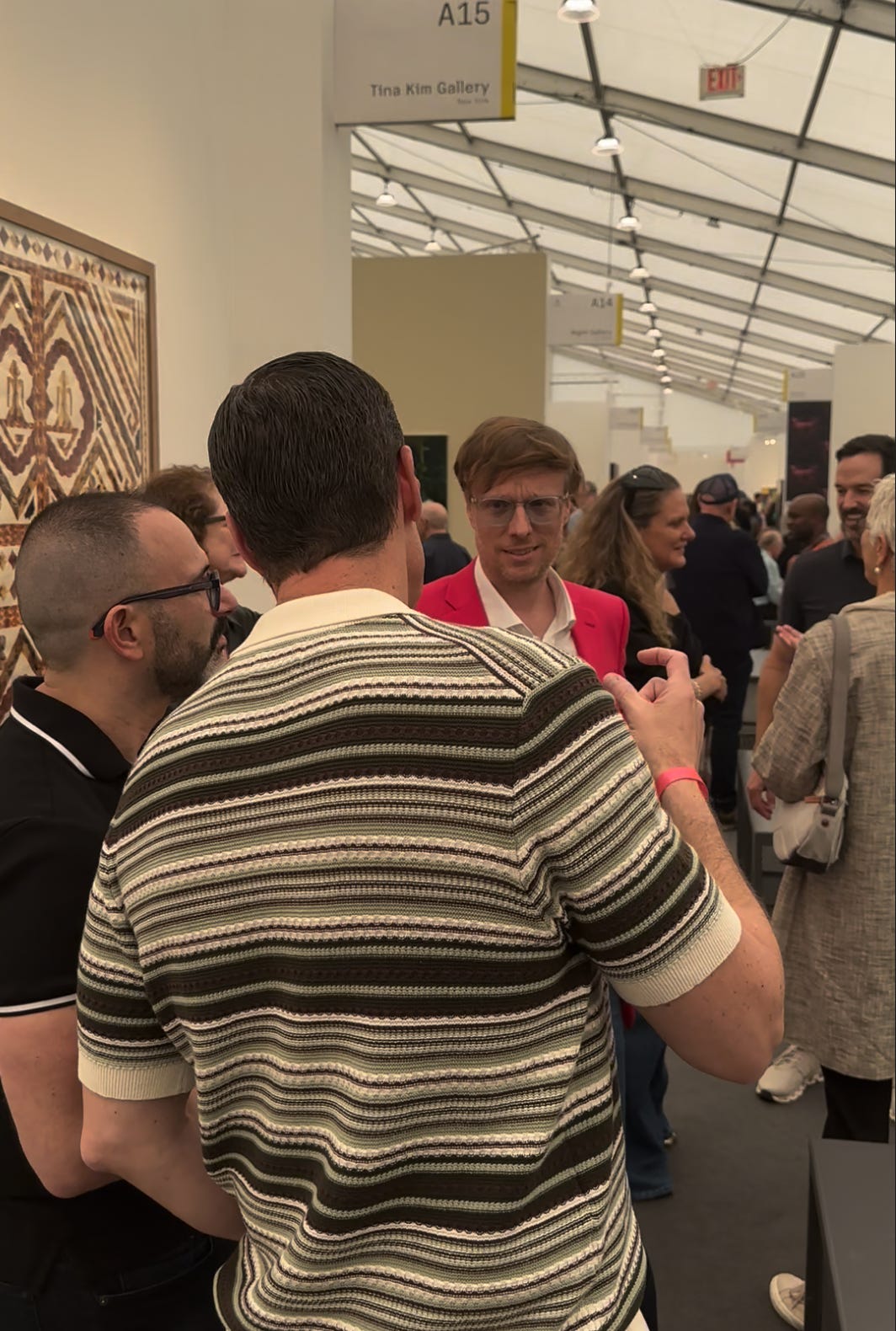
Cindy Bernard: But the nature of art fairs has really changed. You know, I mean, you have the big international fairs like Frieze and Basel, and those have been going on for some time. This other kind of fair that the High Desert Art Fair participates in—which is an alternative fair that started happening in motels—I think the Chateau Marmont in LA had an alternate fair for a while. There was the Farmer’s Daughter Motel in LA and it [an art fair] was at the Gramercy in New York—kind of funkier alternatives to the big box art fairs.
And the High Desert Art Fair is very much in that line. It was also a great hang, I have to say! It was really fun. And sometimes the other thing that’s positive that comes out of that kind of mixture of commerce and artists and curators being all in the same place is you get to introduce them to each other when they might not know each other previously. And that was definitely happening at that fair. So there are many positive outcomes from something that is commercially oriented and is a commercial enterprise like that.
That whole displacement and affordability question is something we really should constantly be bringing back to the county… The county really hasn't [acted], and then is collecting TOT money that is not coming back to the community.
— Bernard Leibov
Cindy Bernard: And I think the other thing that was happening a bit in the podcast is the collapsing together of something like the High Desert Art Fair with something like Desert X. So Desert X also participates in a lineage of events that are associated with contemporary art, and that is the international biennial. And these happen all over the world. They generally happen every two or three years—or in the case of something like Documenta, there’s a longer period of time between them. And these are international exhibitions of artists who are coming to them from many different places in the world and are brought together in one place.
And they are not necessarily commercial enterprises. So, for instance, Desert X is run by the Desert Biennial, which is a 501(c)(3) nonprofit. So it’s categorically different than the High Desert Art Fair, also in scale, and also I believe that Desert X is internationally funded, whereas I’m pretty sure the High Desert Art Fair is more or less locally funded. So they’re categorically different things. So I think that was another nuance that was important to point out—to understand what the difference is between something that’s an international biennial and something that’s a much more locally oriented art fair.
The lower desert is not in the lowest quartile of the Healthy Places Index. And parts of Twentynine Palms are in literally the 8th percentile… which maps economic and educational and social coherence within given communities in California.
— Cindy Bernard
Chris Clarke: Of course, the context in which this is taking place—or part of the context—is that we have a community here that to some degree is reeling from changes that have been happening over the last 15 years in the Joshua Tree area. And there is almost inevitably some resentment about those changes, which usually attaches to things like the burgeoning presence of short-term rentals, Airbnb kind of situations, or things that are almost beyond anybody’s control, like the Perseid meteor viewing apocalypse of a couple of years ago, where everybody in Los Angeles decided to come out to Joshua Tree to see meteors. I think when resentment is allowed to just go on and people are not feeling heard, it will attach to different things, often deservingly so.
But sometimes—and it’s certainly the case for me—sometimes that resentment gets attached to things that might have just been mildly annoying, like an article in the LA Times with a couple of tone-deaf statements that may or may not have actually been made verbatim by the principals of the High Desert Art Fair. And so it’s just interesting to me that that seemed to have been a lightning rod, which is why we did the episode.
One of the problematic statements in the Times article was “we want to make this a destination like Marfa or the Hamptons,” which I don’t usually think of Marfa and the Hamptons as going together, but Bernard, you have some experience working in Marfa. How different is that scene from what we have here? Or is it roughly the same?
Bernard Leibov: No, I mean, that’s exactly it. And I completely agree, and I think that’s a little bit what bothered me about the episode was this redirection of energy that I think we should be somehow organizing and directing to some of its proper targets. I’m sort of a little infamous around here in terms of saying that we couldn’t become Marfa because we’re unincorporated, and Marfa was very much created by a person, and it wasn’t the artist, Donald Judd, but it was a guy called Tim Crowley who came from Houston and built a lot of the assets there that catered to the art world and then brought the art world to Marfa, but very much in concert with the city of Marfa, working together, getting around all sorts of restrictions.
So we know that for better or for worse, we live largely in unincorporated areas here, and then the two big cities — or the town and the city. And that whole displacement and affordability question is something we really should constantly be bringing back to [San Bernardino] county. And that’s where the energy should be directed. Many other localities, including the City of Twentynine Palms and Yucca, have taken some action in the face of the vacation rentals, but the county really hasn’t and then is collecting TOT1 money that is not coming back to the community.
We need to constantly stay on that and take this anger that sparks up out of these episodes and bring it back into somewhere where possibly we could take action. And then, as I said, Marfa—you know, there was somebody with a very, very direct strategy there trying to turn it into something and working with the local authorities to do that. And I don’t see the potential for that here.
In Twentynine Palms… we have a Tourism Business Improvement District, which takes control of… 1.5% [of TOT]. And then that goes to fund… the development of arts events and other kinds of cultural events… and has sponsorships that go to support different, smaller events. — Cindy Bernard
It’s a really good model… There’s a strategy, there’s a local authority that cares, and that makes a big difference. But it’s a great model for how this could be done in a managed way in the county. — Bernard Leibov
Chris Clarke: The connection with the Hamptons seems a little bit more tenuous. You’ve been involved in the New York art scene. Is there anything you have to offer about what’s going on in the Hamptons? Is there much dialogue between the Hamptons and the city?
Bernard Leibov: I think that the Hamptons—many of the Hamptons galleries, and there is an art fair that happens out there as well—are satellites of New York City’s scene as well as have a direct tie there. And they’re very successful in capturing people that go out to their summer homes and things like that. But again, the mere economic wherewithal of those towns and the people who go there is so out of scale to what we’re dealing with here that this is not going to happen overnight. And again, working in concert with local authorities who will strategically welcome that kind of activity? We don’t have that here.
Another thing to say about San Bernardino Couny is that the county doesn’t have an office of culture or cultural figures and not a single dollar for culture. And so artists here are more pressed than ever to find commercial outlets for their work. And the Art Fair was a wonderful opportunity for that.
Cindy Bernard: In Twentynine Palms, I mean, it’s a little bit different because we have something that doesn’t exist in Yucca and it doesn’t exist in county, which is we have a Tourism Business Improvement District, which takes control of not all of the TOT, but 1.5%. And then that goes to fund—theoretically—the development of arts events and other kinds of cultural events in the city of Twentynine Palms and has sponsorships that go to support different, smaller events. And so in a way, we’re lucky here to at least have that. And that is probably the only government funding of the arts at this point that exists in the Morongo Basin.
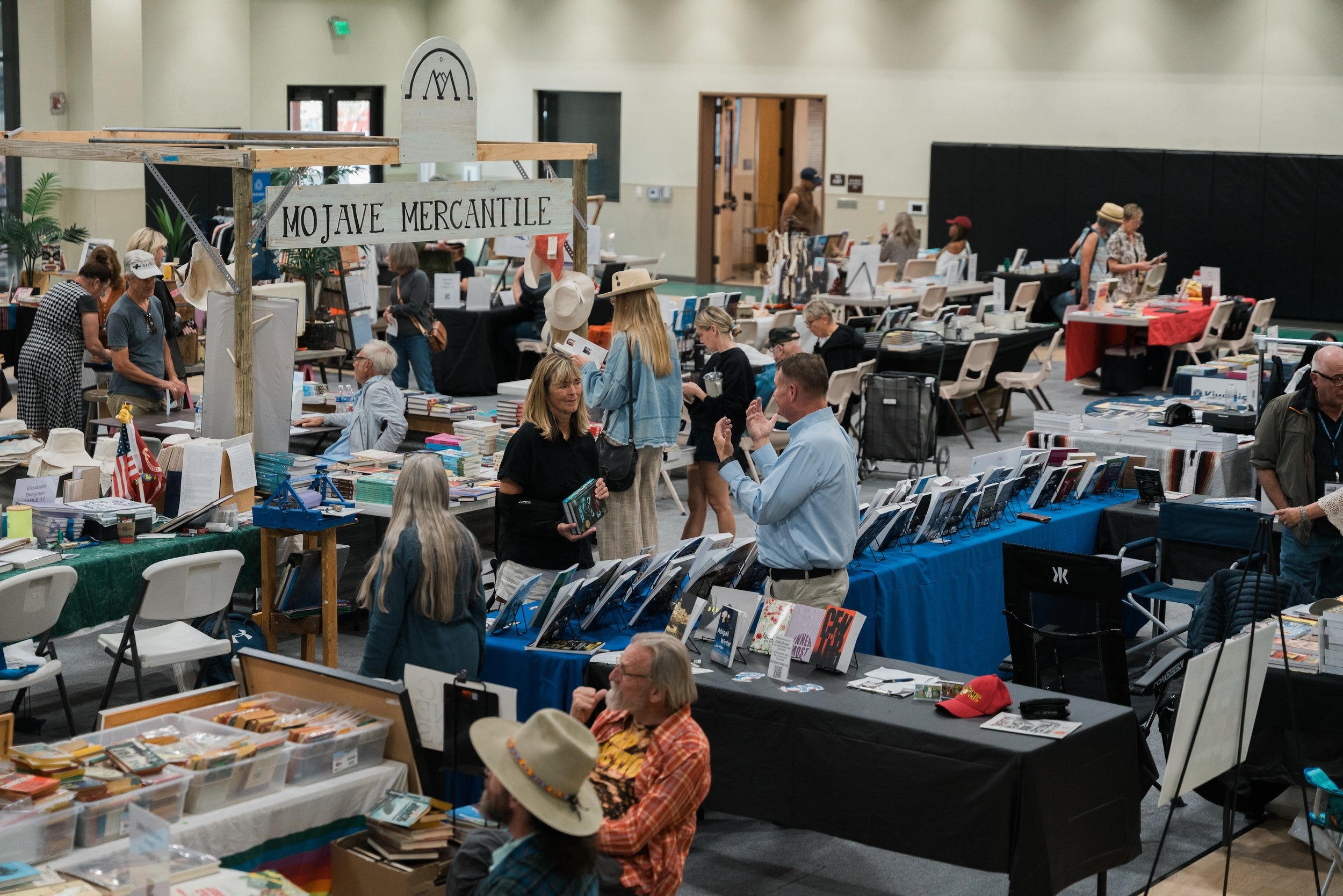
Bernard Leibov: And it’s a really good model. I don’t think anybody is complaining about what’s going on in Twentynine Palms. There’s a strategy, there’s a local authority that cares, and that makes a big difference. But it’s a great model for how this could be done in a managed way in [San Bernardino] county.
Cindy Bernard: Yeah, the model of the income—actually, some of the income being retained within the city itself, which I don’t think Yucca does [have a mechanism for funding the arts], and certainly the county definitely doesn’t do it. So, yeah, we’re a little fortunate to at least have that mechanism here. But yeah, speaking to one of the challenges—I agree with Bernard. I mean, one of the challenges with being an artist out here at the level I work at is there aren’t many places to exhibit the work.
One of the things that all the negativity often doesn’t really allow for is just a bit of compassion… Desert X did arrive originally as sort of an approach of the desert is a blank canvas. But they learned very quickly from that reaction.
Let’s just allow people some grace… We’re not original settlers of this land. We are all trespassing in a sense.
—Bernard Leibov
Cindy Bernard: This is a conversation that has to do with elitism and culture that sometimes comes up out here as well, and the tensions between the different kinds of artists that are out here and the different modes of working that are out here. And that’s real. It would be great to have a more expanded support system for all kinds of artists out in the Morongo Basin, and the High Desert Art Fair—that’s maybe the beginning of that to some degree. And we have High Desert Test Sites as a 501(c)(3) that’s going through some changes. And I think we’re going to see that become more community oriented. We have Boxo Projects and we have Compound YV and we…to make a list is kind of impossible, really.
Bernard Leibov: Material Lab.
Cindy Bernard: Yeah, Yucca Valley Material Lab, which is really crucial. And the art ecology out here is improving. And I think it’s important to note that it is also important. Culture is important. Our one movie theater is important.
Bernard Leibov: Two!
Cindy Bernard: We have two movie theaters! Two movie theaters are important. And we shouldn’t look down on those efforts because we need them.
Chris Clarke: I wonder sometimes why the visual arts seem to get a little bit more flak than writing. I mean, my writing has arguably contributed to the wave of tourism that we’re all afflicted with here—or able to take advantage of, or whatever your point of view is on that.
Cindy Bernard: It’s not a concrete form, except when it’s in a book or a magazine. And I think that visual art is generally—not always, but often—it exists in objects. And so there’s actually a physical thing to attach the resentment to. But I was going to say—building on what you just said—in the Lo-Fi Lit Festival that just happened, which used Highway 62 as a backbone—which I personally think is one of the great ways to work with the Morongo Basin because we have such a unique kind of physical infrastructure here that allows the use of this highway as a backbone for different kinds of things.
I mean, the Lo-Fi Lit Festival was also hugely successful and consisted of people, I think, at very different points in their careers getting up and reading and expressing that vulnerability at the mic, you know.
I think coming with that concrete object very often is a lot of capital, and it does often require more than $50 to buy an artwork. And I think there’s some resentment around that. It would be a lie to say there’s not a relationship between the world of contemporary art and large sums of money, but it’s not everybody, and it’s certainly not here very much.
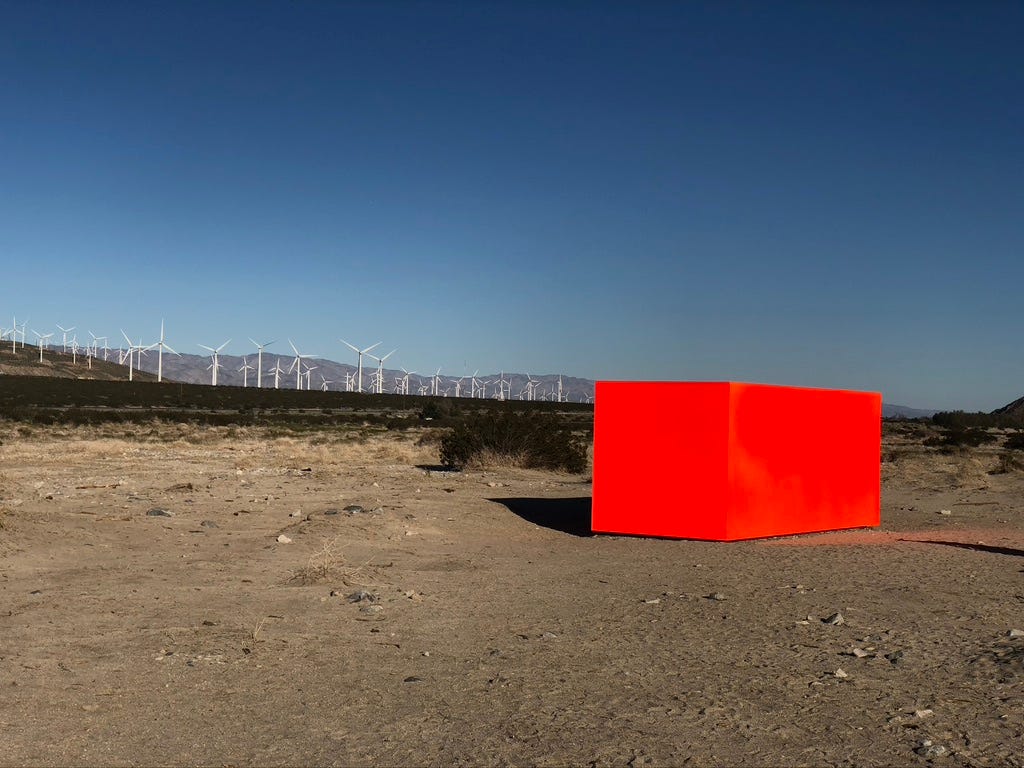
Cindy Bernard: I mean, I think that some of that capital does exist around Desert X, but that’s a whole—like I said before, it’s a whole other thing than what we’re talking about up here in the Morongo Basin. And certainly the lower desert is not in the lowest quartile of the [California] Healthy Places Index. And parts of Twentynine Palms are in literally the 8th percentile out of 100 points in the Healthy Places Index, which maps economic and educational and social coherence within given communities in California. We’re talking about art and culture existing in quite a different place when we talk about the Morongo Basin, as opposed to, say, the lower desert, where Desert X takes place.
Bernard Leibov: Something to be said about deserts as well. And I think one of the things that all the negativity often doesn’t really allow for is just a bit of compassion in terms of people spending time in the desert and learning. I’ve only been here 14 years, and I’m constantly learning—learning how to deal with the environment, deal with the social aspects here. Desert X did arrive originally as sort of an approach of the desert is a blank canvas. But they learned very quickly from that reaction and in the last edition actually referred to the “Reading the Landscape” guidelines, which were created between High Desert Test Sites, Joshua Treenial , Rebecca Lowry and the Mojave Desert Land Trust as guidelines for artists working on the land. They did refer to that. They are sharing that with their artists.
It takes time sometimes for people to settle down. The Art Fair has only been going here for four years. You learn from all these waves of reaction, you know, and adapt. The black houses [referred to in the prior episode] are being built by people who really just don’t understand. But they’ll learn and they’ll repaint or they’ll do something.
Chris Clarke: Black paint is easily correctable.
Bernard Leibov: Yes. Let’s just allow people some grace. Oh, another thing—really good for all of us to remember: we’re not original settlers of this land. We are all trespassing in a sense.
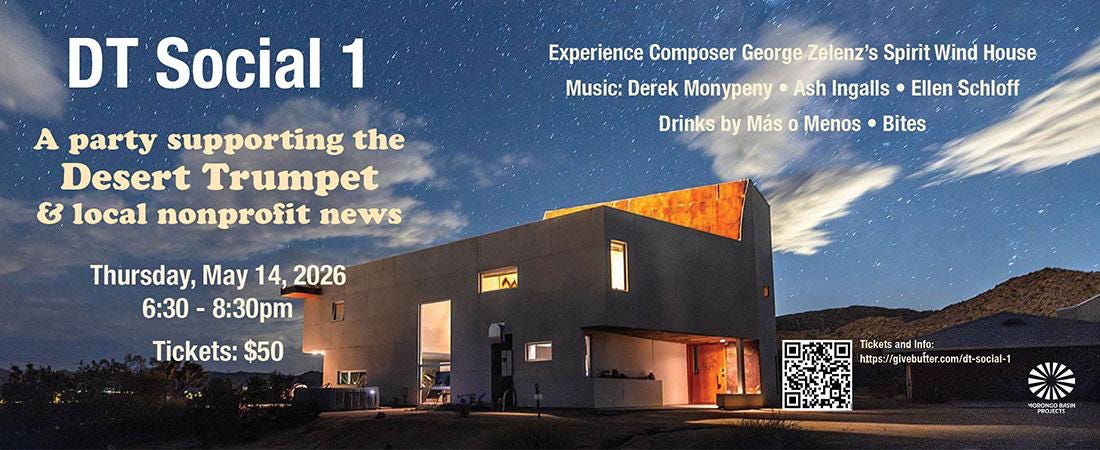
The Desert Trumpet runs out of operating funds on July 1, help us provide the coverage you depend on and also experience a unique concert at Spirit Wind. Purchase tickets for our May 14 fundraiser today.
Chris Clarke: Absolutely. I’ve been hearing a lot of people that I meet randomly complaining about black houses in the desert. And it seems to have just gotten to be—maybe not critical mass of awareness, but definitely people have been more sensitized. I mean, a paint color is about as superficial as you can get in architectural criticism. I mean, literally superficial. But just the idea of what that says—
Bernard Leibov: —it’s emblematic of a lack of understanding of context. It’s not just the black paint. It’s also a lot of these houses have huge windows facing west or east to get the views, not understanding about the solar gain. But I think people will learn over time. And there’s a dereliction of regulation. This has always been our dilemma out here—again, except for Twentynine Palms and Yucca. We like a sense of freedom and want local government but are lacking levels of being able to express political will — we’re just too small to make a difference. That’s something we have to live with and to fight when we can. And we do. And it’s an ongoing conversation.
Cindy Bernard: Well, I don’t think that the cities are paradises of planning. It’s true, at least you can go say something. The number of people complaining about dark sky violations in Twentynine Palms and the lack of enforcement is legion in this town.2 Not to mention recent builds that are entirely black here. So the Reset Hotel did so many things that were right, I’m not going to knock them for being primarily black painted, but certainly the city didn’t comment on the color, let’s just put it that way. I don’t know if we want people saying, your house can be black, your house can be white, your house can be pink or whatever? I don’t think we want that being dictated to us necessarily.
Bernard Leibov: Something the authorities could do a better job of is at least educating. So the guidelines—like the “Reading the Landscape” guidelines—whenever they were implemented at the Joshua Treenial, the Land Trust would come and meet with the artist and educate them about the environment, not tell them what they can or couldn’t do. People will very naturally understand not to do this and not to do that. So if there were an educational effort or some such, applying to painting a house black, we could at least say, that’s going to be a five-degree gain.
Chris Clarke: I get the sense that there are some folks—and I have occasionally been included in this number—that when we think of art in the desert landscape, people like Michael Heizer come to mind. I don’t really feel qualified to have an opinion on the validity of his work. But it is not environmentally benign.
Cindy Bernard: Oh, no, it’s not.
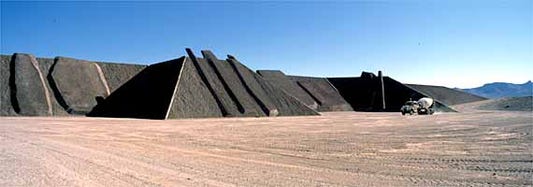
Chris Clarke: You know, I admire the vision of some of it. City is a spectacle for sure, but could have been maybe built on somebody’s old, retired alfalfa field or something like that. And I’m not saying that all art in the desert needs to necessarily be reflective of environmental sensibilities about desert situations, desert living, that kind of thing. People can move to the desert and write novels about people living in small apartments in Brooklyn if they want. It’s part of why we’re here. But it’s interesting to me just to see the degree to which spending time in the desert does affect artists and does kind of, I guess, soften some of the urban edges.
Bernard Leibov: I could pick up on the Michael Heizer thing just because I did work for the Donald Judd Foundation. Heizer is of a generation of kind of macho male artist who created work that dominates the land, but that has really gone through a lot of eco-feminist critique. I used to give a tour of the Noah Purifoy Foundation and there’s a wonderful piece there where you can go in—Aurora Borealis—and you can see broken mirror on the ground and the outside of that has these black sculptures. And there’s a piece called Land where he’s dug into the land.
And these were conversations with artists—Heizer and Smithson and other people like that — who were doing this kind of work out in the land. It’s a real educational tool for what not to do now and how not to do it. And I don’t think we really see that sort of approach, particularly here anymore. I had an artist come from Switzerland who wanted to do a rock sculpture with mirrors on it, and I educated him about the potential for bothering neighbors and fire.
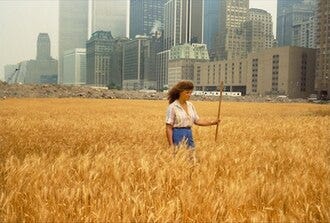
Cindy Bernard: There’s also, just to broaden that land art discussion a little bit—you had the Michael Heizers and other artists, not all male, who would dig into the landscape, but there’s also a realm of land art that did not do that or created more subtle alterations, like Richard Long, you know, basically just lining up rocks and then photographing that, or bringing mud from one location into the gallery and using it to make a drawing on a gallery wall. Or Agnes Denes—D-E-N-E-S. She planted this massive wheat field on a piece of property in Manhattan. So that’s a different kind of landscape alteration.
So I think there’s some of the guys that made these works—and I’ve experienced one of them in person, the Lightning Field. It’s completely worth it for that square mile. It’s an amazing experience to watch the light bounce off of those metal rods and causes perhaps a consciousness about light, environment and space that is useful, even though clearly that part of the New Mexico desert was pretty disturbed to put those poles in. So, yeah, there are tradeoffs as well.
Chris Clarke: There was a discussion at a symposium I was at a couple of months ago in Ajo, Arizona. It was the Trinational Sonoran Desert Symposium. And it’s a wonderful event. You learn so much about what all the different researchers are doing and what the activists are doing. And the border wall, as you might expect, looms very large in the minds of people that are working in the Sonoran Desert. There was a conversation, one workshop, and then some subsidiary conversation about what to do with the wall.
And the idea that really caught me and made me think that maybe it’s the best possible thing to do, given the destruction that’s already occurred to put that wall in, is to modify it enough so that it’s no longer a barrier to wildlife or people crossing through, and then declare it a memorial work of art—sort of like a combination of the death camps from World War II still being open to the public and preserved and Christo’s Running Fence along the border. And it just seemed to me like such an out-of-the-box approach to it. And possibly the most environmentally benign way of dealing with the wall being there is just to kind of leave it there. Don’t engage in another massive construction project, but just neutralize the wall, leave it there. Let it fall down of its own accord, because it’s a Trump construction, and it’ll probably fall down in the next eight years.
Cindy Bernard: It’s a marker of its moment in time. To completely get rid of it would be just as destructive. But it’s also an erasure of a marker in history that has some significance.
Bernard Leibov: And artists have already been addressing that. Down in San Diego on the Tijuana border, there’s an artist who painted on the Tijuana side a seascape and the beach so it could just disappear.
Cindy Bernard: Creative solutions.
Chris Clarke: This has been a really fascinating conversation, and I am grateful for the corrective. Folks can look in the show notes for links to things like Boxo Projects and the Desert Trumpet, which I have found indispensable in understanding where I live. And we are also going to be putting the transcript of this interview in Desert Trumpet, so I will retroactively link to that as soon as that’s ready to be linked. Cindy Bernard and Bernard Leibov, thank you so much for taking the time to set us a little straighter than we were.
Bernard Leibov: Thank you. And thank you for taking the time. And I think we didn’t necessarily mean it as a corrective, but an expansion.
Cindy Bernard: Yeah, an expansion—that works. Thank you so much, Chris.
Chris Clarke: Thanks again to Cindy Bernard and Bernard Leibov for taking the time to come and talk to us about their impressions of how we missed the mark on that previous episode, as well as talking about a bunch of other stuff that was just really fascinating to me. You know, we’re always taking stands. We’re certainly not going to give oil companies or data centers equal time to object to things that we said in episodes.
But you know, when we’re basically all on the same side, it’s really important to be even handed. When it’s people that you respect who are working with you to make the world a better place, obviously reflecting that multiplicity of voices is really important. So thanks again to Cindy and Bernard for chatting with me.
Now I recognize that the audio is a little crunchy in some places, so the transcript is going to come in really handy. You can check our website at 90milesfromneedles.com or go to the Desert Trumpet, which is a wonderful publication talking about hyper-local news in the Morongo Basin.
Did you know that paid subscribers receive discounts to DT Social events such as the May 14 DT Social?
Not a paid subscriber yet?
Upgrade to a $50+ paid subscription for a 10% discount.
Upgrade to $100+ for a 25% discount.
Sustaining subscribers at the $250+ level and above receive complementary tickets
Leave your thoughts in the comments below. Please note that we do not allow anonymous comments. Please be sure your first and last name is on your profile prior to commenting. Anonymous comments will be deleted.
This coverage is free - please share!
Host note: The TOT is a transient occupancy tax, which is a portion of the rent on short-term rentals and hotel rooms and motel rooms that goes to either the county in the case of unincorporated Joshua Tree, or to the local municipalities such as Yucca Valley and Twentynine Palms. In Twentynine Palms, at least some of this money comes back into the community and is spent on things that benefit the general population, residents and visitors alike.
Host note: The night sky ordinance being talked about here is actually a light trespass ordinance that functions—when it works—to ensure that we have dark enough skies that we can see the Milky Way and other wonders of the cosmos. This is a fairly recent ordinance countywide in San Bernardino County in Southern California. It prohibits people from having light fixtures outdoors where the lighting element is visible from off the property. Local municipalities, such as Twentynine Palms and Yucca Valley, are using it as a model for their own code.
Wow! Thank you Cindy, Chris, and Bernard for such a great article! For decades artists up here have wanted this area to be an arts destination, where the number of people who come to see the art outnumber the artists. An annual artists studio tour is a good start, but it's like a cactus flower, it blooms fantastically and briefly once a year, then it is gone.
Arts tourism isn't happening overnight, but it is developing, like it or not, want it or not. Like people who pine for a Trader Joe's up here, they have to understand that you need population growth, a certain amount of gentrification, benefactors, and amenities like fine restaurants more expensive than we are used to, and plenty of lodging, for that to happen. I guess what I am saying, is be careful what you wish for, because it's happening! One reason I read the Desert Trumpet is to follow what's going on with the TBID. It is frustrating that the county happily collects TOT from this area, but neglects the very reason for that income, the artists and entrepreneurs who are growing the tourism!