
During the pandemic lockdown I tried to get a little more cardio and found a snazzy jump rope with black and white wooden beads that clacked in a very satisfying way when they hit the pavement. I was panting in no time. What a find! What a treasure!
I foolishly left the jump rope on the porch, only to find the next morning that it had been gnawed into several pieces. It didn’t take me long to find something had spirited the wooden beads away into a pile of sticks and cholla bombs that nestled against the fence. A packrat, coveting my treasure, had ripped my jump rope apart.
I should have known better.
The packrat that ate my jump rope
You’ve probably walked past many a packrat nest in the desert, possibly without realizing it. From the outside, these nests, also known as middens,1 look like heaps of sticks and other oddments wedged under a boulder or against a rock. They can be several feet tall or wide and might have several entrances.
Home, fortress, pantry
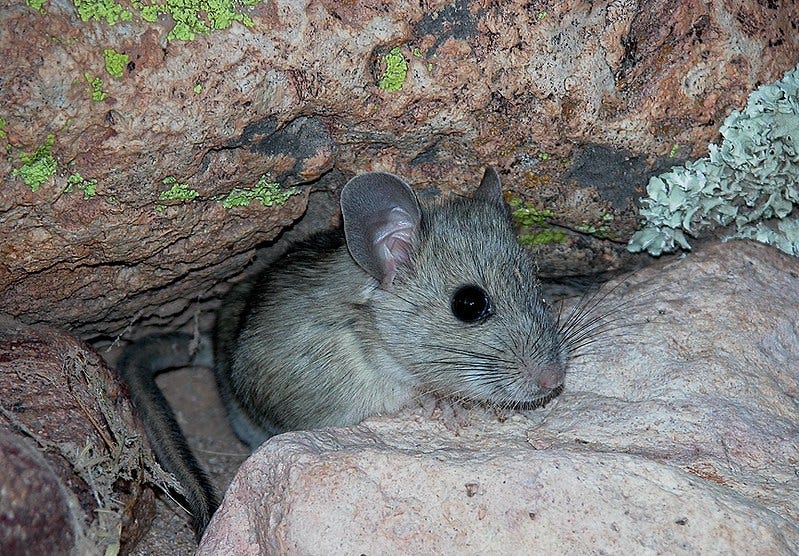
Packrats are also known as desert woodrats (Neotoma lepida), which is what I am going to call them from now on, and are medium-sized rodents up to 15 inches long, half of which is tail. They thrive throughout the desert west from eastern Oregon to Sonora, Mexico. They are nocturnal, solitary, and aggressive about defending their territory. They are also, unsurprisingly, compulsive collectors. They gather plant material, bones, feathers, rocks, tortoise poops, and human belongings such as jump rope beads.
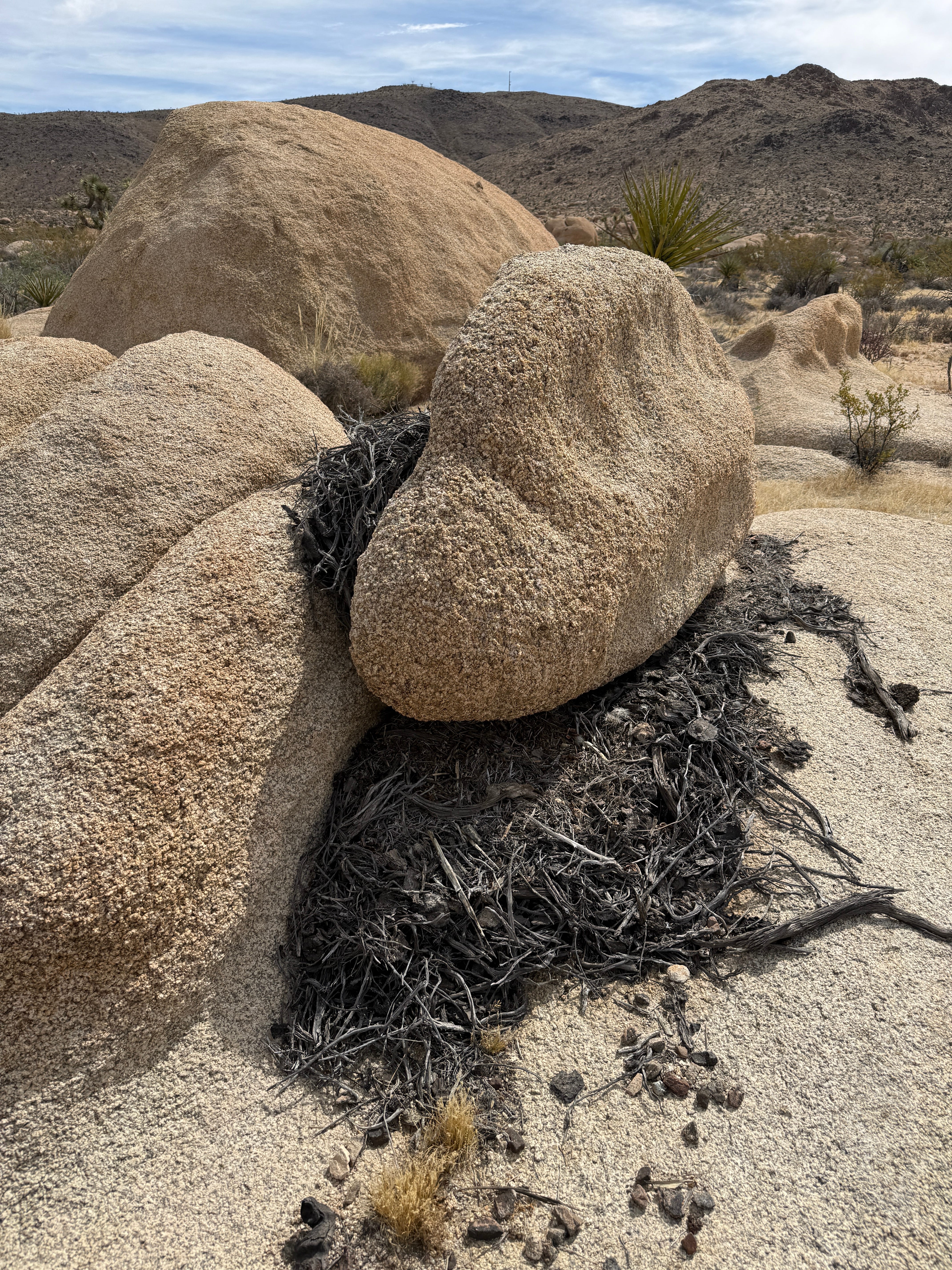
A midden is more than a trash pile. It’s a home, a fortress, and a pantry. The structure can have up to six entrances and eight interior chambers, including nesting areas and food storage. The spiny cholla pieces bristling on the outside make it much harder for a coyote or a snake to poke around for a rat snack. Inside, the temperature stays cooler than the desert air, and the humidity is higher. In a place where water and shade are life, a midden is a very smart piece of architecture. Maybe we should all be living in middens instead of houses and apartment buildings.
Here’s where it gets weird
Except for the urine. Desert woodrats often urinate on the debris piles; sugar and other substances in the urine crystallize as it dries out, creating a material known as amberat that can cement parts of the midden together, encasing pieces of plants, droppings, and other debris in an amber-like matrix.
As local writer Chris Clarke explains in a wonderful essay on desert woodrats, two scientists studying where no juniper trees can be found in the Nevada desert came upon juniper twigs cemented into amberat. The only thing was that no juniper trees could be found within twenty miles, and desert woodrats typically travel only a few hundred feet from home. Where had the juniper twigs come from? They came from the deep past, preserved in a nest maintained by generations of desert woodrats for more than 9,000 years when the area had been wetter and a little more lush.
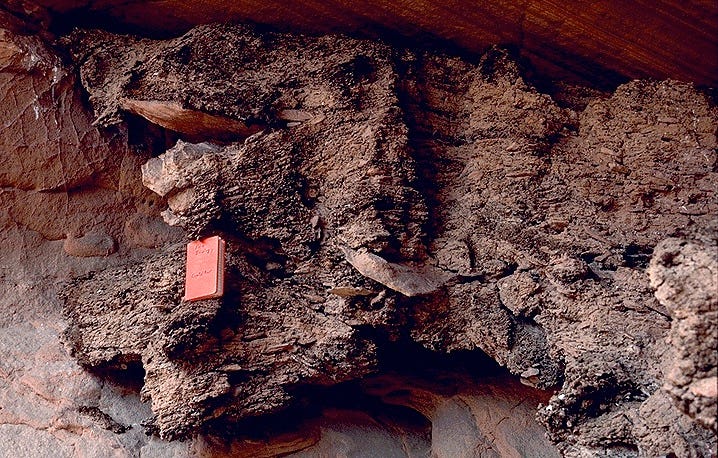
Since that discovery, scientists have examined thousands of middens across the American Southwest, including in and around Joshua Tree National Park. A 2006 study found middens in the park containing dozens of plant species, the oldest dating back 30,000 years. Because of woodrats, we now know that this desert was once a cooler, wetter landscape of grasslands and woodlands. The packrat’s hoarding habit turns out to be one of the greatest gifts to paleontology in history.
But middens are only part of the story. Recent research shows that the desert woodrat has some surprising adaptations.
A poisonous midnight snack
The creosote bush that dominates our landscape also happens to be toxic to most animals that try to eat it. The leaves are coated in a chemical cocktail of resins and compounds that are toxic to most animals. The desert woodrat eats it anyway, because what else is there?
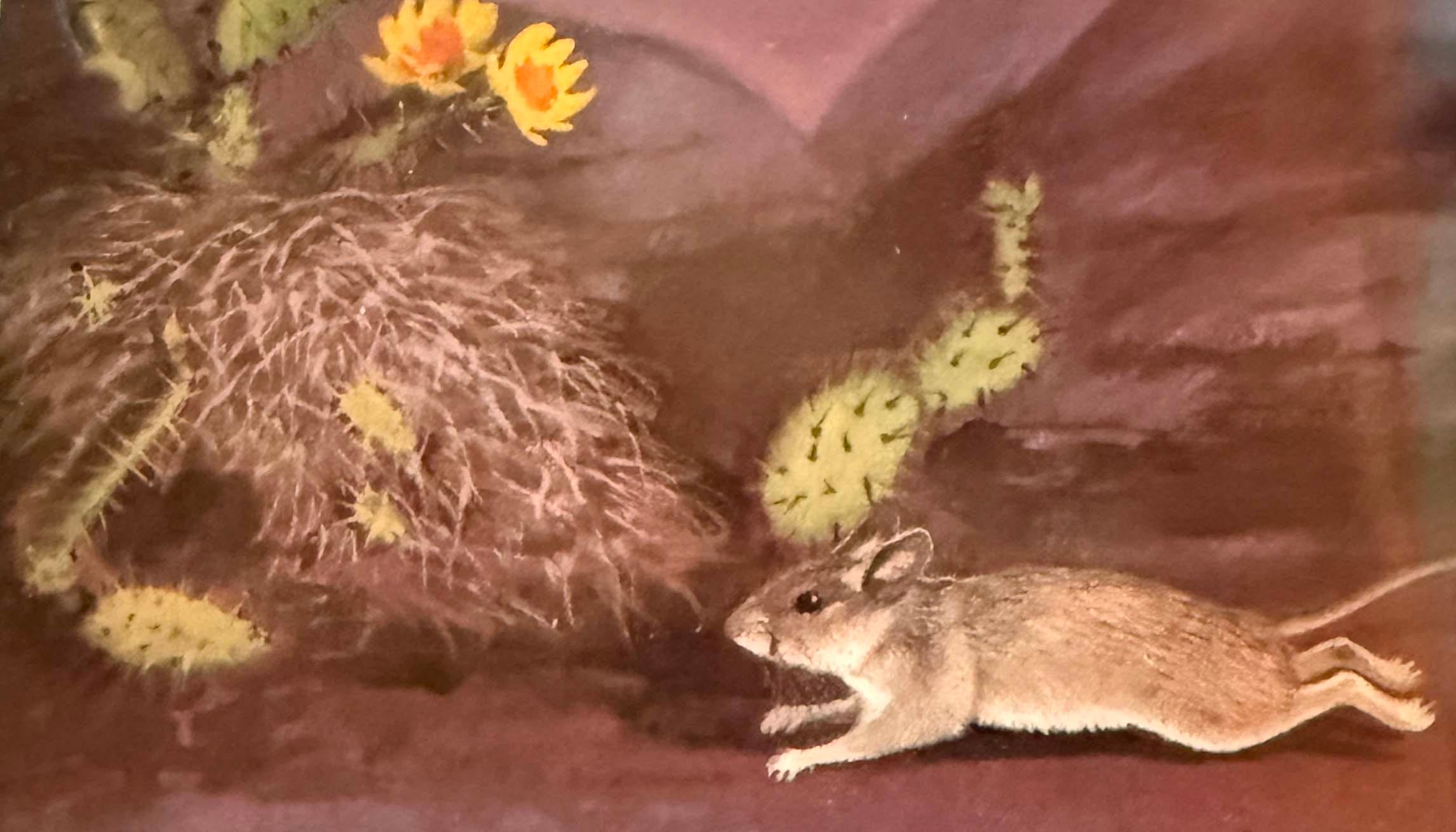
A 2025 study published in the journal Science figured out that rats’ superpower is being able to safely eat creosote. When creosote spread across the Southwest about 15,000 years ago, woodrats that happened to carry extra copies of certain detoxification genes were better able to survive eating it. Those individuals reproduced; their offspring carried the same advantage. Over generations, natural selection stacked the deck in their favor, until some individual woodrats now carry nearly forty copies of a single detox gene. Humans carry two copies of the closest equivalent.
Basically bulletproof
There’s more! We all know rattlesnakes are a real and present danger in this desert. A rattlesnake bite that would kill a house mouse in minutes might barely slow a desert woodrat down. These sturdy rodens can survive 500 to 1,000 times the venom dose that would kill a standard lab mouse. Recent research from the University of Michigan found that woodrats have twelve copies of a gene called SERPINA3, which makes proteins that block components of rattlesnake venom. Humans have one copy. And intriguingly, warmer temperatures seem to increase the rats’ venom resistance, meaning a woodrat in summer may be harder to kill with a bite than the same rat in cooler weather.
A Mojave green rattlesnake hunting behind the fountain in the video above.
And summer is when the rattlers come out….
Keeping up with climate change
And here’s one more 2025 study. By looking at ancient woodrat middens, museum specimens, and modern populations, researchers found that woodrat body size has tracked climate closely over the past 40,000 years and evolved quickly to keep pace with temperature and rainfall shifts. These rodents have larger bodies in colder periods, smaller in warmer ones. As temperatures rise today, they will likely shrink, with ripple effects on their behavior, health, and role in the ecosystem.
The woodrat is a small, brown, mostly invisible animal that spends its nights foraging within a hundred feet of home. It is unassuming and yet has evolved multiple independent solutions to some of the harshest conditions the desert offers like poison, venom, heat, and drought while simultaneously building structures that preserve the history of the landscape for tens of thousands of years.
What’s in your midden?
Some of the most amazing superpowers are the ones no one expects, including our own. The desert is very good at reminding us of this. You can walk past a midden a hundred times and see only a pile of sticks. Or you can stop, notice, and find 30,000 years of history waiting inside.2
A note on hantavirus: The desert woodrat is a known carrier of hantavirus, so use caution around middens near your home. If you need to clean up after a woodrat, dampen the area with a diluted bleach solution before handling any material and wear gloves and a mask. Hantavirus infections are rare in San Bernardino County, but they are serious.
“Midden” is what archeologists call ancient trash heaps.
If you were a packrat, what would your midden be made of? I think mine might be made of books. And pens. I have so many books. And pens. So so many pens.
Hi, new subscribers! Desert Trumpet understands you might not be interested in all of our coverage. That’s why it’s divided into separate newsletters allowing you to opt out of reporting that’s not important to you. For instance, you may want our Education news but not City Hall 29.
Here’s how to opt out: go to your Substack settings, scroll down to “subscriptions,” and select “Edit” for the Desert Trumpet. Simply uncheck the box next to the newsletters you don’t want to receive in your email inbox. You’ll still be able to access all coverage online if you change your mind.
Thanks to you, Desert Trumpet met our $10,000 paid subscription goal!!!
Not a paid subscriber yet? Did you know that paid subscribers receive discounts on our DT Social events and invites to DT Front Porch, intimate discussions featuring local officials and notable residents?
Upgrade to a $50+ paid subscription for a 10% discount.
Upgrade to $100+ for a 25% discount.
Sustaining subscribers at the $250+ level and above receive complementary tickets.
Leave your thoughts in the comments below. Please note that we do not allow anonymous comments. Please be sure your first and last name is on your profile prior to commenting. Anonymous comments will be deleted.
This coverage is free - please share!
Very cool! I’ve seen a midden on my walks.
Great article. Thanks. This is one of my favorite desert creatures. If it gives me trouble around the house eating wires, irrigation etc. it's because I stopped paying attention. Learning to live with them as opposed to struggling with them rewards by drawing you into the world that they eat and the world that eats them. Many of those creatures are our desert favorites.