Citizen Astronomer: April 2026
April’s Night Sky: Galaxy Season, Lyrid Meteors, and Spring Constellations

April brings softer evenings and a sky full of distant wonders. The bold constellations of winter have mostly slipped away, replaced by the quieter patterns of spring. This is the season of galaxies, subtle star clusters, and one of the year’s most elegant meteor showers.
It’s a great month to slow down, let your eyes adjust, and take in the deeper sky.
Spring Constellations Take the Stage
As darkness falls, the spring sky rises into view. Leo the Lion now stands high overhead, easy to spot thanks to the curved “sickle” pattern of stars and the bright point of Regulus.
Following behind Leo is Virgo, a sprawling constellation that takes a little more patience to trace. Its brightest star, Spica, shines with a cool blue-white light and is a great anchor point for exploring the surrounding sky.
To find it, follow the arc of the Big Dipper’s handle to Arcturus, then continue that same curve to Spica. It’s a classic stargazing trick and a satisfying one to try in person.
Galaxy Season Arrives
April is prime time for galaxy hunting. When you look toward Leo and Virgo, you’re looking out of the plane of our own galaxy and into deep space, where other galaxies become visible.
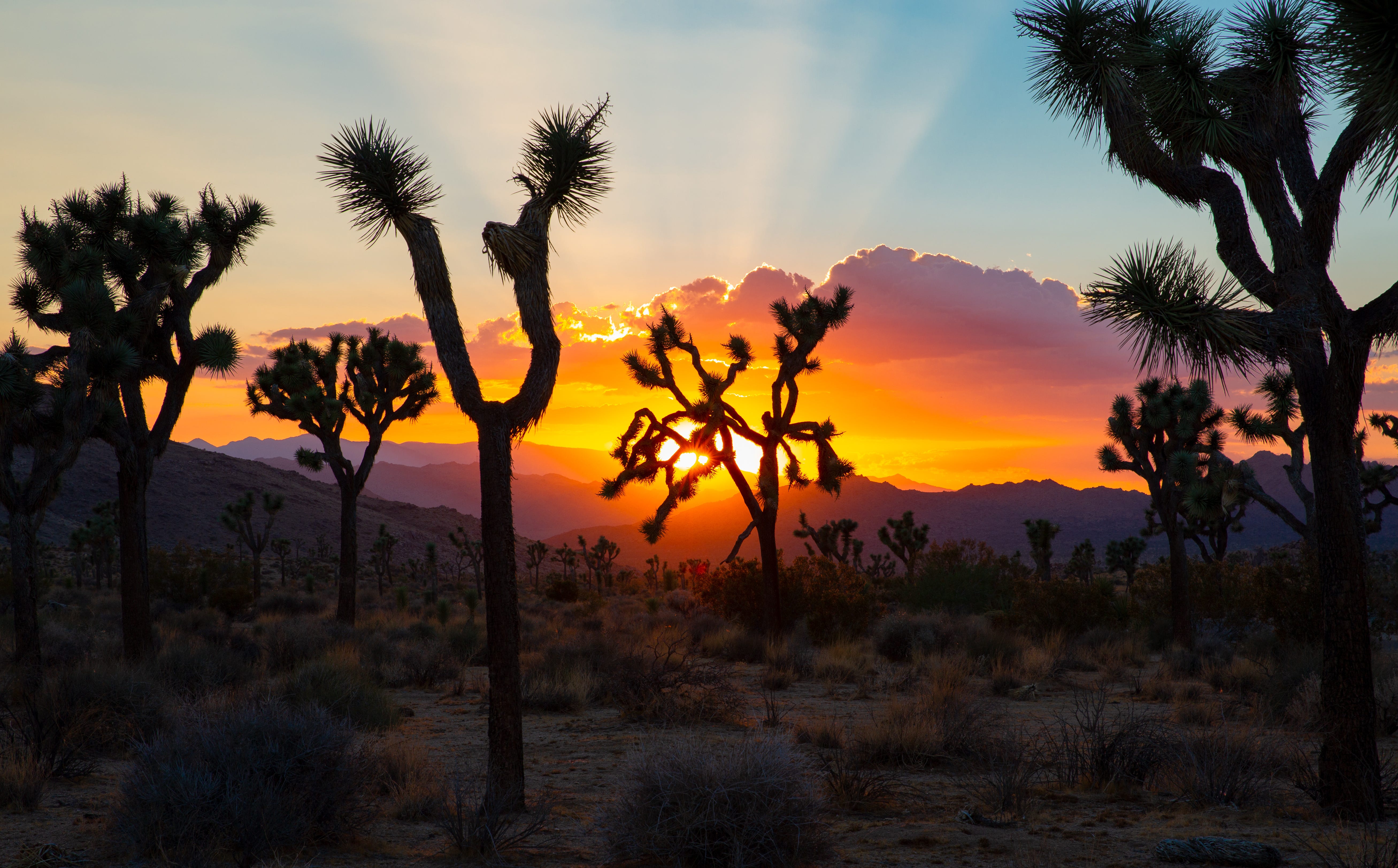
Under Joshua Tree’s dark skies, some of these distant galaxies can be spotted with binoculars or small telescopes as faint, soft patches of light.
The most famous is the Virgo Cluster, a massive collection of galaxies millions of light years away. You won’t see spiral arms or fine detail, but just knowing what you’re looking at adds a sense of scale that’s hard to beat.
Meteor Highlight: The Lyrids (April 21–22)
April’s meteor shower, the Lyrids, peaks on the night of April 21 into the early hours of April 22.
The Lyrids are known for producing around 10 to 20 meteors per hour, with occasional bright streaks. They’re not the most intense shower of the year, but they’re reliable and have a long history of observation.
The best time to watch is after midnight, when the radiant in the constellation Lyra climbs higher in the sky. You don’t need to look directly at Lyra though. Just find a comfortable spot, look up, and let your eyes wander.
Moon conditions this year are favorable for at least part of the night, so it’s worth stepping outside and giving it some time.
Planet Watch
Venus is the standout this month, shining brilliantly in the western sky after sunset. It’s the brightest object in the sky after the Moon and hard to miss, glowing like a steady beacon as twilight fades. This is a great time to catch Venus in the evening before it eventually transitions back to the morning sky later in the year. Venus doesn’t twinkle the way stars do, so if you see a very bright, steady light in the west after sunset, you’ve found it.
Jupiter continues to drift toward the western horizon and sets earlier each night. You can still catch it after sunset early in the month, but its viewing window is getting shorter.
Saturn is now firmly a morning object, rising before sunrise in the east. Early risers will have the best chance to spot it low on the horizon.
April’s Full Moon: The Pink Moon
The full moon rises on April 1st, traditionally known as the Pink Moon. The name comes from early spring wildflowers, not the color of the Moon itself.
Like any full moon, it will brighten the sky for a few nights, but it also brings beautiful light to the desert landscape. It’s a great excuse for an evening walk. Enjoy the moon shadows!
Binocular Highlights
April rewards patient observers, especially with binoculars:
Beehive Cluster (M44) in Cancer, still well placed in the evening sky
Leo Triplet area, where multiple galaxies sit close together
Coma Berenices star cluster, a loose, sparkling grouping that really comes alive in binoculars
Stargazing Tips for April
Use the New Moon period around April 17 for the darkest skies
Give your eyes time to adjust before searching for faint galaxies
Bring a blanket or chair if you’re planning to watch the Lyrids
Be patient. April skies reward slow looking more than quick scanning
April in Joshua Tree is less about bold, obvious sights and more about depth. It’s a month for galaxies, quiet constellations, and meteors that reward those who take their time.
The Desert Trumpet has enough funds to operate through June. We need your paid subscriptions to publish the coverage you depend on.
Become a sustaining subscriber by increasing your subscription to $100 per year! Want to make a one-time donation or are you able to give more than $100? Donate via Paypal!
If you aren’t already a subscriber, sign up here:
Leave your thoughts in the comments below. Please note that we do not allow anonymous comments. Please be sure your first and last name is on your profile prior to commenting. Anonymous comments will be deleted.
Thanks for reading! This post is public so feel free to share it.