
On the Agenda: San Bernardino County Board of Supervisors, August 18, 2026
A contested mining ordinance faces final adoption despite conservation-group objections — plus a $3M Joshua Tree parks overhaul, Measure I road funds, and the county's first AI policy.
By the San Bernardino County Board of Supervisors Resident Review Committee
The Board of Supervisors meets Tuesday, August 18, with closed session at 9 a.m. and public session at 10 a.m. in the Covington Chambers, 385 N. Arrowhead Ave., First Floor, San Bernardino. It is a short agenda for the Morongo Basin, but it carries one item of real consequence: the surface mining ordinance the Planning Commission recommended on July 9, which reaches the Board as Item 76. A $3 million park-improvement contract in Joshua Tree also appears on the consent calendar.
Public Comment
Residents can attend in person or comment remotely; registration to speak opens at 8:30 a.m. the morning of the meeting at publiccomment.sbcounty.gov. You’ll be asked to indicate whether you’ll participate in person or virtually (a phone number is required if virtual) and what items you wish to address. In-person registration is also available at kiosks outside the Board Chambers.2 Written comment can be submitted online: publiccomments.cob.sbcounty.gov or via email: BoardMeetingComments@cob.sbcounty.gov.
For context on how remote access from the Basin has narrowed over the past two years, see our earlier coverage.
A Closer Look
The Surface Mining Ordinance (Item 76)
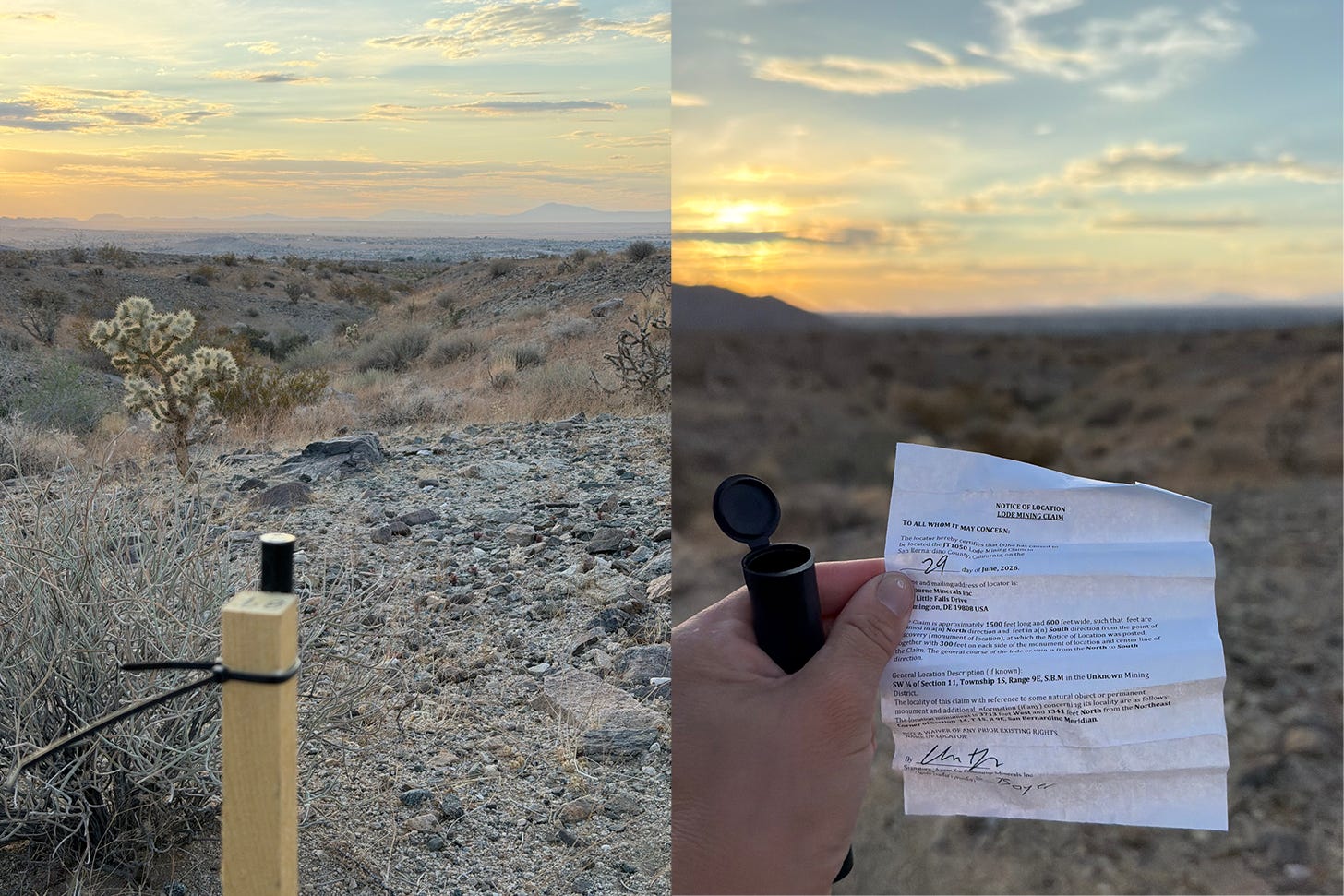
Video: Mining stakes in Wonder Valley and Twentynine Palms (Resident Review Committee)
The Board will hold a public hearing on an ordinance to repeal and reenact Chapter 88.03 of the County Development Code, which is the local rulebook for surface mining and land reclamation, and is being asked to adopt it the same day.
County staff frame the rewrite as a routine modernization to bring the ordinance, last substantively updated in 2007, into alignment with the state Surface Mining and Reclamation Act (SMARA). The staff report states the ordinance was drafted in collaboration with the mining-industry association California Construction and Industrial Materials Association (CalCIMA) following a November 2023 stakeholder meeting, and that the State Mining and Geology Board reviewed a draft in November 2025 and had no comments. The Planning Commission recommended approval 4-0-1 on July 9. Staff ask the Board to find the ordinance exempt from environmental review under CEQA Section 15061(b)(3), adopt it, and notify the state. Presenter: Paul Gonzales, Planning Chief.
We covered the July 9 Planning Commission hearing in our earlier reporting, including the public comment letter submitted to the Commission on July 8 by a coalition of four conservation groups, including the Center for Biological Diversity, Earthworks, the Sierra Club, and the National Parks Conservation Association, that oppose the ordinance as drafted.
The provision at the center of the dispute is a new “Federal Lands” subsection, 88.03.040(b), which states that the County may accept federal environmental documents as functionally equivalent to its own, and that a County permit “shall not be required” for mining that already holds a federal plan of operation or other federal authorization.
Critics say this lets a project with a Bureau of Land Management approval bypass County permitting and the CEQA review a permit would trigger. They connect the change to the proposed Music Valley Mine, a rare-earth exploration project by Australia-based Dateline Resources on BLM land near Joshua Tree National Park. Under SMARA, a mine normally needs three things from the County: a permit to operate, an approved plan to restore the land when mining ends, and a financial guarantee — essentially a bond — that the restoration will actually happen. Much of the dispute is over which of those three the federal-lands provision lets a mine skip.
Since then, the fight has moved from the Planning Commission to the Board, and the record has grown.
The Center for Biological Diversity, Earthworks, the Sierra Club, and the National Parks Conservation Association address the Board of Supervisors…and they respond

The same four-group coalition escalated its objections. In a new letter dated August 6 addressed to the Board of Supervisors rather than the Commission, the groups asked the Board to reject the ordinance unless specific changes are made or to continue the item for more public review. The coalition’s three requests each aim to keep one of those safeguards in place:
The first asks the County to rewrite the “permit not required” language so it clearly waives only the County’s zoning permit on federal land — not the cleanup plan or the financial guarantee.
The second asks the County to stop accepting a federal agency’s environmental studies in place of its own review, or add safeguards before doing so, arguing federal review no longer goes as deep as California’s.
The third targets a technical cross-reference the groups say could exempt small mines more broadly than state law allows.
The coalition letter adds two claims we had not previously reported. First, it states that in response to a Public Records Act request, the County, on March 31, 2026 produced no records at all of the mining-exploration projects it had informally exempted from permits under the 1992 state-federal Memorandum of Understanding, which is the same MOU the new ordinance codifies.
Second, the groups argue the MOU rests on the outdated premise that federal (NEPA) and state (CEQA) environmental review are equivalent, and cite 2026 federal rule changes they say have stripped NEPA of public-notice and comment steps. They also cite a 2024 case before the State Mining and Geology Board in which a mining applicant said the County treats the SMARA exemption on a per-”location” basis, allowing a roughly 10-acre disturbance to avoid review because no single spot reached one acre. We have not independently verified the Public Records Act response; the claim is the coalition’s.
The County has already declined the changes. In a memo to the Board dated August 11, the Land Use Services Department recommends adopting the ordinance with none of the coalition’s requested revisions. It argues the ordinance already separates the operating permit from the reclamation plan — so the cleanup plan and financial guarantee still apply on federal land even when the permit is waived — and that the “may accept” language is permissive, leaving the County free to conduct its own review case by case. The department states the County is “not proposing any changes that are more stringent than SMARA.”
Two provisions in the ordinance text warrant attention because they bear directly on public participation, and both confirm concerns raised at the July hearing. The ordinance states that a vested-rights determination, which is the County’s recognition that an operator holds a mining right predating current rules, “is not a ‘project’ within the meaning of CEQA” and is not subject to environmental review, meaning such a decision can be made without a CEQA study.
It also provides that “non-substantial” deviations from an approved reclamation plan are approved by the planning director through “Staff Review without Notice” procedures, without public comment. Separately, the ordinance adds a new section allowing solar and wind facilities on reclaimed mine land as an interim use, and sets administrative penalties of up to $5,000 per day for violations.
The public record raises a red flag. At the July 9 hearing, County staff reported receiving over 100 written public comments on the item, though staff characterized the majority as directed at a separate pending reclamation plan rather than the ordinance. Those comments do not appear in the Board’s August 18 packet, which contains only the coalition letter and three resident emails. They are also not attached to or reproduced in the Planning Commission staff report that the Board’s materials incorporate. The volume of public input the Commission received in July is not before the Board for the final vote.
The County reports more than 85 surface mines in its SMARA jurisdiction. If adopted, the ordinance takes effect 30 days later and must still be certified by the State Mining and Geology Board.
For the full background, see our prior coverage:
Our earlier reporting laid out the core objections to the ordinance:
Waiving County permits on federal land surrenders local control over mines to federal agencies.
Removing the County permit eliminates the trigger for CEQA environmental review and its public hearings.
The County publishes required legal notice only in the San Bernardino Sun, rather than in communities’ local papers of record — so affected residents across the county are unlikely to see it.
Projects like the proposed Music Valley Mine near Joshua Tree National Park could advance without close local scrutiny of water use, dust, and traffic.
Links to prior coverage:
San Bernardino County Planning Commission Recommends Giving Up Local Permitting Over Mines on Federal Land (July 13)
RECAP: Stop Music Valley Mine Community Information Meeting (July 23).
Joshua Tree Parks (Item 58)
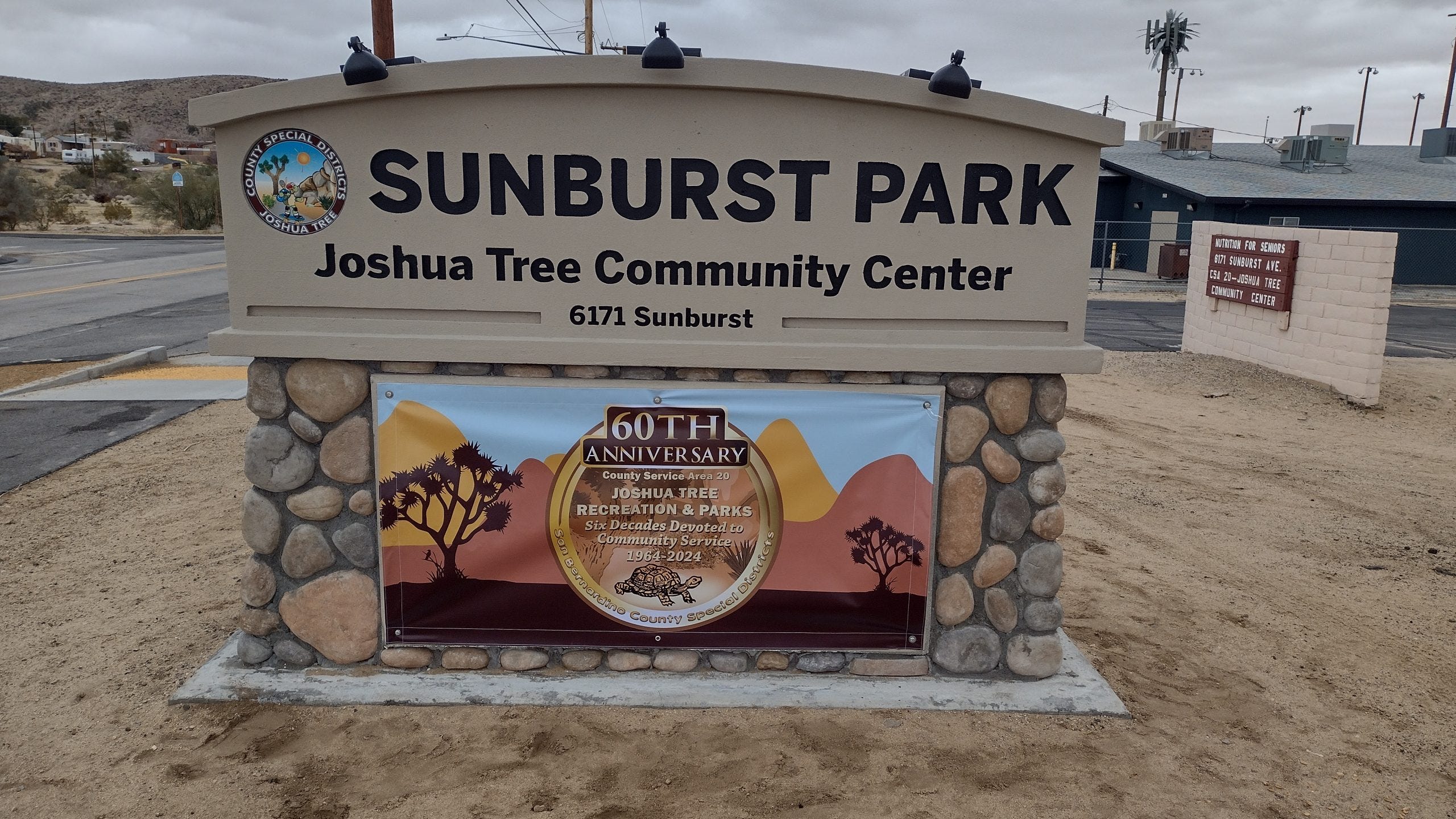
Acting as the governing body of County Service Area 20 (Joshua Tree), the Board is asked to award a construction contract to Three Peaks Corp. of Yucaipa for the Sunburst Park and Community Park Improvements Project, in the amount of $3,061,800, with a construction window of 180 calendar days, plus a $306,180 contingency fund. The item also asks the Board to approve three addenda to the bid documents.
The project is funded in full by a state Clean California Local Grant of $3,774,000 through Caltrans, with no County general-fund cost. The bulk of the work is at Sunburst Park (6171 Sunburst Avenue), which would receive:
two new playgrounds
an outdoor fitness “Ninja” course
a concrete pump track1
ADA-accessible walkways
replacement splash-pad turf
site lighting
an improved monument sign
decorative fencing, and landscaping
The smaller Community Park (6617 Easterly Drive) would get a new playground and shade sail. The County classified the work as exempt from CEQA as minor improvements to an existing facility. The pump track, at $605,000, is the single largest add-on item. The County advertised the work in the Hi-Desert Star and the San Bernardino County Sun in April; seven contractors bid, and Three Peaks was the lowest responsive bidder with no protests filed. Construction is anticipated from fall 2026 through spring 2027.
During bidding, the County issued three addenda: the first clarified the required contractor license and set mandatory pre-bid meetings; the second added design exhibits for the playgrounds, Ninja course, and pump track; and the third removed a ballfield landscaping item, moved the bid opening to June 17, and answered 45 bidder questions. Two of those answers matter for park users: Sunburst Park will stay open to the public throughout construction, with the contractor phasing the work, while Community Park will close during construction, though the preschool located there will keep operating.
The item runs on the consent calendar, meaning it is slated to pass in a single vote without discussion unless a supervisor pulls it.
Support Desert Trumpet’s coverage of the San Bernardino County Board of Supervisors — become a paid subscriber!
The Desert Trumpet’s reporting will always be free. That said, did you know that paid subscribers receive a discount on tickets to our DT Social 2 pool party on September 17 and invites to DT Front Porch, intimate discussions featuring local officials and notable residents?
Upgrade to a $50+ paid subscription for a 10% discount.
Upgrade to $100+ for a 25% discount.
Sustaining subscribers at the $250+ level and above receive complimentary tickets
Basin-Specific Items
Item 44 — Measure I five-year road plan. The Board is asked to adopt the 2026-27 through 2030-31 Capital Improvement Plan for Measure I Local Street Pass-Through funds, the voter-approved half-cent sales tax for roads. The funds are divided among six county subareas, including the Morongo Basin, and must be spent where collected. Within the Basin subarea, the plan programs one project over the five years: reconstruction and surface work (patching, cape seal, chip seal, leveling) on roads in Morongo Valley, with $1 million budgeted in 2026-27 out of a $3.25 million total estimated cost. The specific streets — roughly 50 segments around the 29 Palms Highway, Hess Boulevard, and Pioneer Drive grid — are itemized in the plan’s road list. The Basin subarea carries a $1.9 million balance and expects $2.2 million more over the period, of which roughly a quarter is currently programmed.
Note: this is the only Basin project in the five-year plan — no other Basin community appears in the 2026-31 list.
Item 58 — Joshua Tree park improvements (County Service Area 20). Award of a $3,061,800 construction contract to Three Peaks Corp. for the Sunburst Park and Community Park Improvements Project. See A Closer Look, above.
Broader Items with Basin Impact
Two Countywide measures on this agenda set policy that applies Basin-wide, though neither names a Basin community in its description.
Item 71 — County Policy Manual updates. Item 71 — County Policy Manual updates. The Board is asked to approve a package of policy changes across the County and several affiliated districts. Most are routine, including four travel-policy updates and a new employee service-pin program, but two are worth noting.
The first is a new Policy 09-08 establishing the County’s rules for artificial intelligence and generative AI. It sets a “human-in-the-loop” standard, requiring that AI augment rather than replace human decisions, and it encourages uses like drafting and summarizing documents, meeting transcription, and data analysis. It also bars certain high-risk uses unless the Board approves them, including facial and biometric identification, emotion analysis, fully automated decision-making, social scoring, and AI impersonation of a person’s voice or likeness.
Notably, the ban on emotion-analysis and biometric tools carves out an exception for AI-enabled security and surveillance cameras that detect “physical altercations, violence, weapons, intrusions, or hazardous conditions” — meaning the County reserves the right to use AI video surveillance for public-safety purposes. The policy requires annual review given how fast the technology is changing.
The second is an amendment to Policy 11-15, which delegates authority to County executives and department directors to approve public-works plans, advertise bids, sign permits, and determine whether a project is exempt from the California Environmental Quality Act — all without a Board vote. This is the mechanism the County used in April to clear the Joshua Tree parks project (Item 58) as CEQA-exempt. The amendment appears to broaden the roster of officials who can exercise that authority.2
Item 74 — Lobbyist transparency ordinance (final adoption). The Board is asked to adopt an ordinance adding Division 11 to Title 1 of the County Code relating to Lobbyist Transparency, Registration and Reporting. The ordinance was introduced on August 4 as Item 103 and returns for final adoption.
The next regular meeting of the San Bernardino County Board of Supervisors is scheduled for September 1.
This preview was produced with AI assistance, consistent with our AI Policy, and reviewed by the San Bernardino County Board of Supervisors Resident Review Committee. We provide it as a starting point for your own review of the agenda and its supporting documents, not as a substitute. Corrections and feedback are welcome.
Hi, new subscribers! The Desert Trumpet understands you might not be interested in all of our coverage. That’s why it’s divided into separate newsletters allowing you to opt out of reporting that’s not important to you. For instance, you may want our Education news but not City Hall 29.
Here’s how to opt out: go to your Substack settings, scroll down to “subscriptions,” and select “Edit” for the Desert Trumpet. Simply uncheck the box next to the newsletters you don’t want to receive in your email inbox. You’ll still be able to access all coverage online if you change your mind.
Leave your thoughts in the comments below. Please note that we do not allow anonymous comments. Please be sure your first and last name is on your profile prior to commenting. Anonymous comments will be deleted.
This coverage is free - please share!
A pump track is a looping, paved circuit of rolling bumps and banked turns that cyclists, skateboarders, and scooter riders ride without pedaling, using body motion to build speed
We were not able to confirm the specific changes against a redline of the January 2025 original; the county's staff report describes the amendment only as an update "for alignment with current processes."