
ON THE AGENDA: Twentynine Palms City Council Meeting, January 27, 2026
A packed consent calendar, possible FLOCK camera concerns from residents and a sales tax increase survey

For the sixth time in six months, Twentynine Palms City Council is opening its meeting with a closed session to discuss “Anticipated Litigation, Significant Exposure to Litigation, Gov. Code Section 54956.9(d)(2)". Unlike the January 13 meeting, the single source is not being shared with the public.
The 273 page agenda consists of 16 items, 14 of which are on the Consent Calendar.
PUBLIC COMMENT
You can comment on agenda items and issues important to you at every City Council meeting. Comments on agenda items take place during discussion of that item, while comments on non-agenda items take place near the end of the meeting. The Brown Act prevents Council from commenting on non-agenda items. To comment, just pick up a form at the entry desk, fill it out, and hand it to the Clerk, who usually sits just in front of the Council bench toward the right.
Here’s the list of Council email addresses to write if you can’t get to the meeting — be sure to email them prior to2 pm on the date of the meeting so they have time to read your email prior to discussion. You can also copy the clerk at cvillescas@29palms.org and ask that your letter be made part of the public record.
FLOCK camera concerns continue
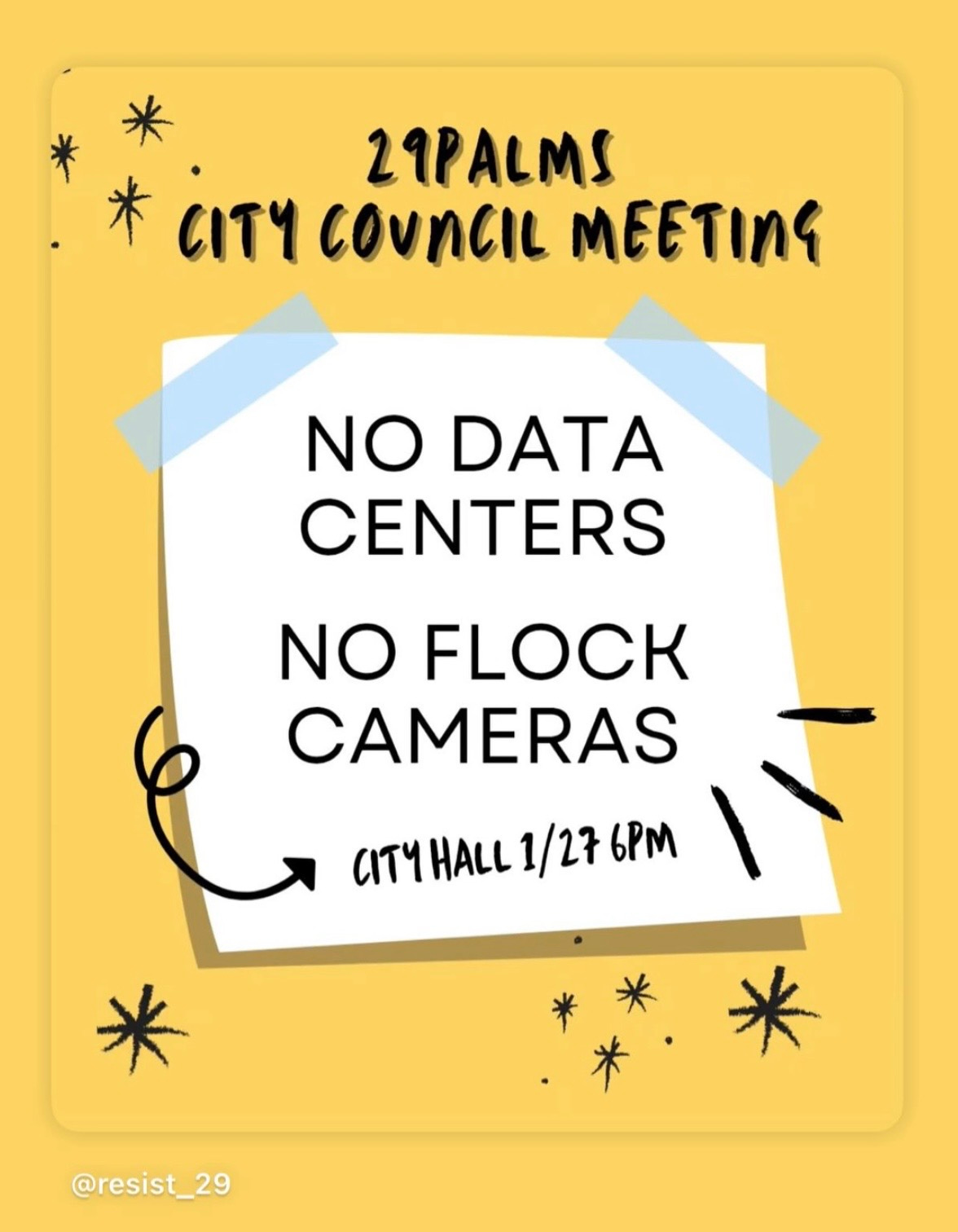
As was the case at the January 13 Council meeting, concerns about the FLOCK camera system located in Twentynine Palms are circulating on social media along with a call to attend this meeting. Because the item is not on the agenda, any comments will take place at the end of the meeting with other general public comment.
Desert Trumpet contacted the San Bernardino County Sheriff Public Information Officer (PIO) to ask how many cameras are currently installed, who controls system access and whether other enforcement agencies have access to the FLOCK system.
Jenny Smith, the current PIO, responded that the City purchasing the system is responsible for installation and maintenance of the cameras and that “the camera install project is at approximately 70% completion.”
Regarding access, the PIO went on to write:
Any entity who has bought the FLOCK program has access to the system. That doesn’t mean that a person who is not in law enforcement has access to all the data. There are limitations and different subscriptions.
When further clarification was requested the PIO added:
You may need to reach out to FBI to see if they have access to the FLOCK system. We cannot accurately answer that question. Our department regulates OUR users. Each account is specific to each entity that purchases the system. For us, there must be an authorized purpose to use the system, i.e. criminal investigation. You can reach out to FLOCK to clarify who has access to the system.
We have not yet reached out to FLOCK. To read the proposal for the license-plate cameras in Twentynine Palms, check out our coverage of the December 10, 2024, City Council meeting.
AWARDS, PRESENTATIONS, APPOINTMENTS AND PROCLAMATIONS
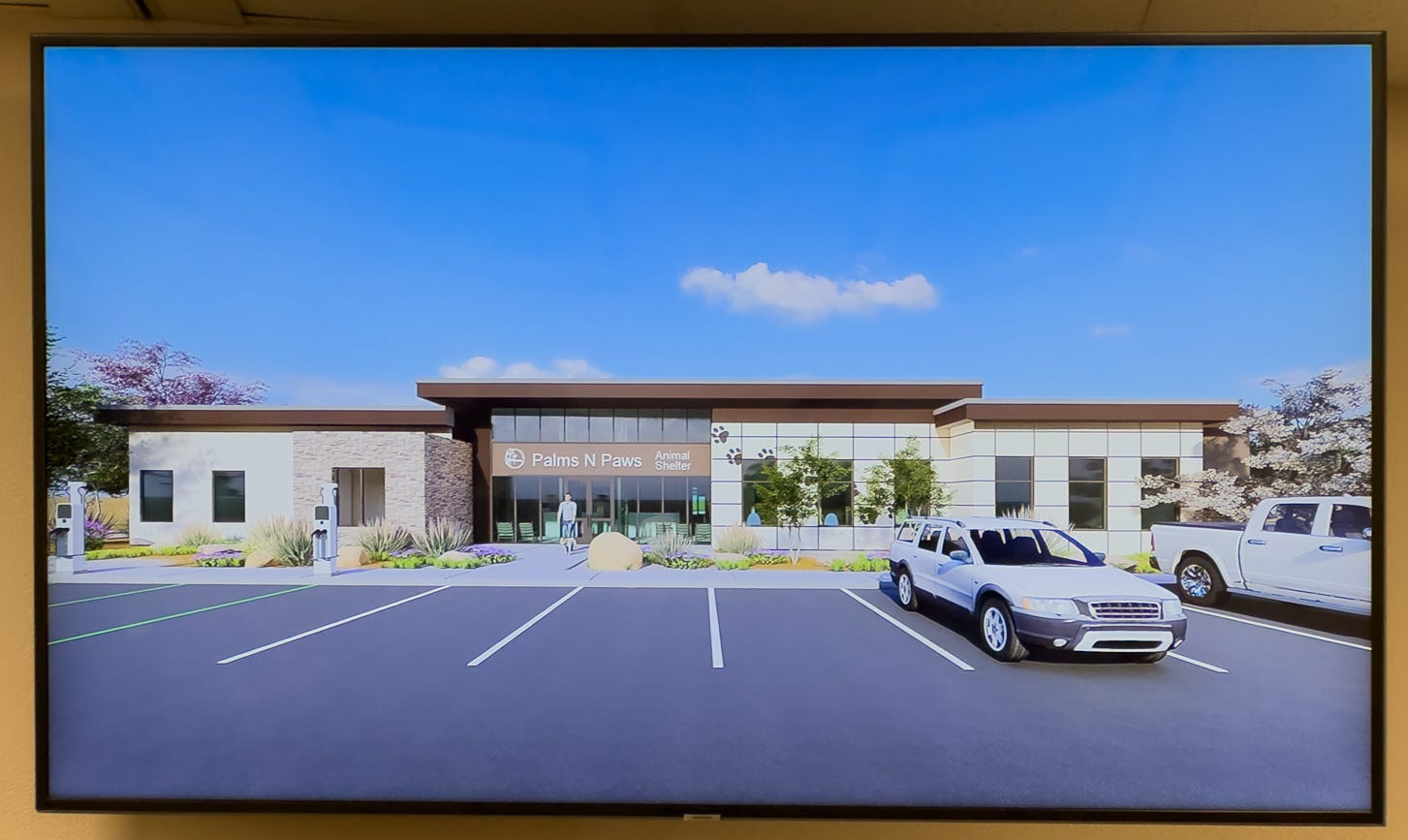
In addition to recognizing the Twentynine Palms High School Soccer team for trash clean-up, Council will hear an update on the animal shelter and a presentation on a grant received by Parks and Recreation from National Recreation and Park Association (NPRA). It should be noted that the timing of the Palms-N-Paws update is interesting since the final item on the agenda is the survey on the 1% sales tax Council hopes to pass to fund new animal shelter construction.
CONSENT CALENDAR
The Consent Calendar consists of items usually approved with a single vote. The public is given a chance to make public comment on these items prior to the Council motion, doing this effectively pulls an item for Council discussion. Fill out a comment form specifying the item you wish to address and submit it in person or send an email in advance regarding any of the items on this meeting’s Consent Calendar.
A few of the ten items are the usual mundane business and include the approve of minutes and a treasurer’s report. A 2026 City Council meeting schedule indicates no meeting cancellations; however, Council generally has a light summer schedule and cancels the meetings immediately preceding Thanksgiving and Christmas.
Other items include acquisition of road overlay materials, acceptance of finished work on the Elm Avenue Tenant Improvement Project for $189,500 in upgrades on a single-family home owned by the City, additional Channel Trail Bike path funding, a contract for ADA parking improvements at Luckie Park and an allocation of Community Development Block Grant funding to complete it plus a reminder about septic system maintenance round out the list.
Two items are of particular interest:
9 - The second reading of the development code amendments pertaining to Ancillary Activities, Businesses, and Entertainment. This item passed Council with little discussion at the January 13 meeting and we don’t expect it to be pulled from the calendar. Our coverage can be read in the January 13 agenda preview and recap.
14 - Five-Year Strategic Plan Final Draft Adoption. This item codifies two changes in language discussed at the December 9 meeting: the deletion of the Ofland Resort as receiving special consideration and the giving of special consideration to Theater 29 to clarify “the City's intent to pursue additional funding.”
To date, the final version of the plan has not received a comprehensive public airing. As was pointed out in public comment by MJ Fiocco at the December 9 meeting:
I have a question for you. I do not understand why the City Council is willing to spend $14,0001 for an engagement process for tax increase next year, but isn’t willing to do any public engagement in sharing its strategic plan? And I’d like to know what thinking goes into that, and what might be done to help citizens understand, through public engagement, where you’re trying to steer the city.
DISCUSSION AND POTENTIAL ACTION ITEMS
15 - Adopt a Resolution Establishing a Maintained Road List
The item was the subject of a brief study session at the December 16, 2025 Planning Commission meeting. Reporter Natalie Zuk summarized the history of the list:
The City inherited its maintained roads list from the County of San Bernardino when it incorporated in 1987. Lists of all maintained and unmaintained roads, which are tracked by the Public Works department, are available on the City website. City Staff reviewed which roads are maintained by the County, CalTrans, and the State of California, and is seeking to formalize its roads list.
Speaking at that meeting, Community Development Director Keith Gardner emphasized the need to formalize the currently informal process of adding roads to the list:
We have historically maintained things by practice, but we’re now formalizing this. That way it is going to be mapped and it’s going to be available for public review. So that way, there’s going to be no question as to what the city maintains and what the city doesn’t maintain.
Additionally, per the staff report, the City is receiving frequent requests for road repairs after “rain events” for roads “that haven’t been historically maintained or are entirely within private property.”
Staff is requesting that a lists of paved and unpaved roads to be maintained by the City be adopted by Council for the first time and suggested a process for adding additional roads to the maintained roads lists:
In order for a street to be added to this list, the following must occur:
1) All Rights-of-Way need to be dedicated to the City in the manner described in the General Plan.
2) The street must be constructed and paved up to City standards, including any potential curbs, gutters, and sidewalks
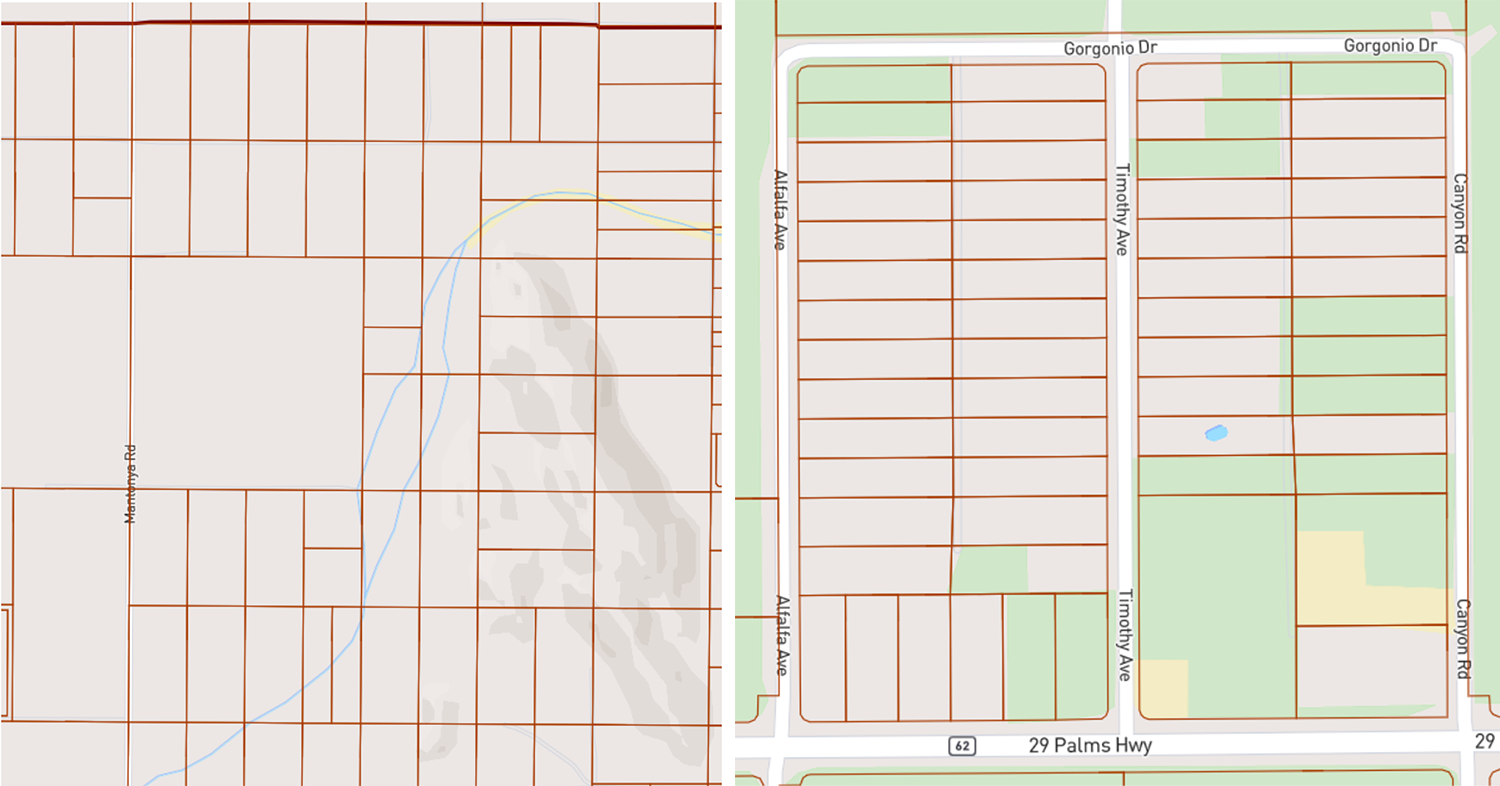
The staff report also provides two maps as examples of regions where there there are maintained and unmaintained roads. The map on the left, of a region on the west side of the City near Mantonya Rd. is an example of a area with undedicated roads that are not maintained, while the map on the right indicates that Gorgonio Drive, Alfalfa Ave, Timothy Ave, and Canyon Road are dedicated to the City and maintained. About the left hand map the staff report states:
If someone wished to subdivide or build upon on these parcels and wanted the City to maintain their access, dedications of property to the City for road purposes would have to occur, and then those dedications would need to ultimately connect to a City maintained street. It should be noted that Mantonya Road in this location is not dedicated to the City, and thus is not maintained by the City.
Once the list is adopted, all modifications will require Council approval.
Heading into the 2026 elections, Desert Trumpet has sustained a potential 50% cut in funding. Help us provide the coverage you’ve come to expect by becoming a paid subscriber or upgrading your paid subscription today!
16 - Preserving City Services: Community Survey Research Results Regarding a Potential 2026 Tax Measure.
Staff is recommending that City Council accept the Probolsky survey of 300 residents and confirm the contract for Clifford Moss for $58,000 for “strategic assessment, communications, and planning services relating to determining electoral feasibility for and preparing for a November 2026 revenue measure” per the agreement letter. An additional $25,000 is requested to cover “graphic design, printing, bulk postage, digital advertising, or USPS mailing fees” — costs that the staff report claims will be “based on our residents’ specific needs.” In other words, how much social media and how many mailers will residents “need” to be sold on the idea of a 1% sales tax?
Whether one agrees or not with the necessity of a 1% sales tax and the monies being spent to ensure passage of a ballot measure, it’s impossible to ignore the that the title of this item — “Preserving City Services”— presages the marketing campaign residents are likely to experience in the upcoming months.
As we’ve discussed previously in our analysis of the 2021 Probolsky Research report, surveys like the one just conducted on the 1% sales tax are also more about a marketing opportunity than they are about public opinion. We don’t have the space in this agenda report to repeat that level of analysis, but we will point toward some interesting statistics and as well as particularly misleading or onerous questions.
Basic statistics on resident impressions of needs and services
Probolsky questions weighed broader issues against personal impact, eventually yielding a result that matched the services mostly likely to be supported by the sales tax ballot measure.
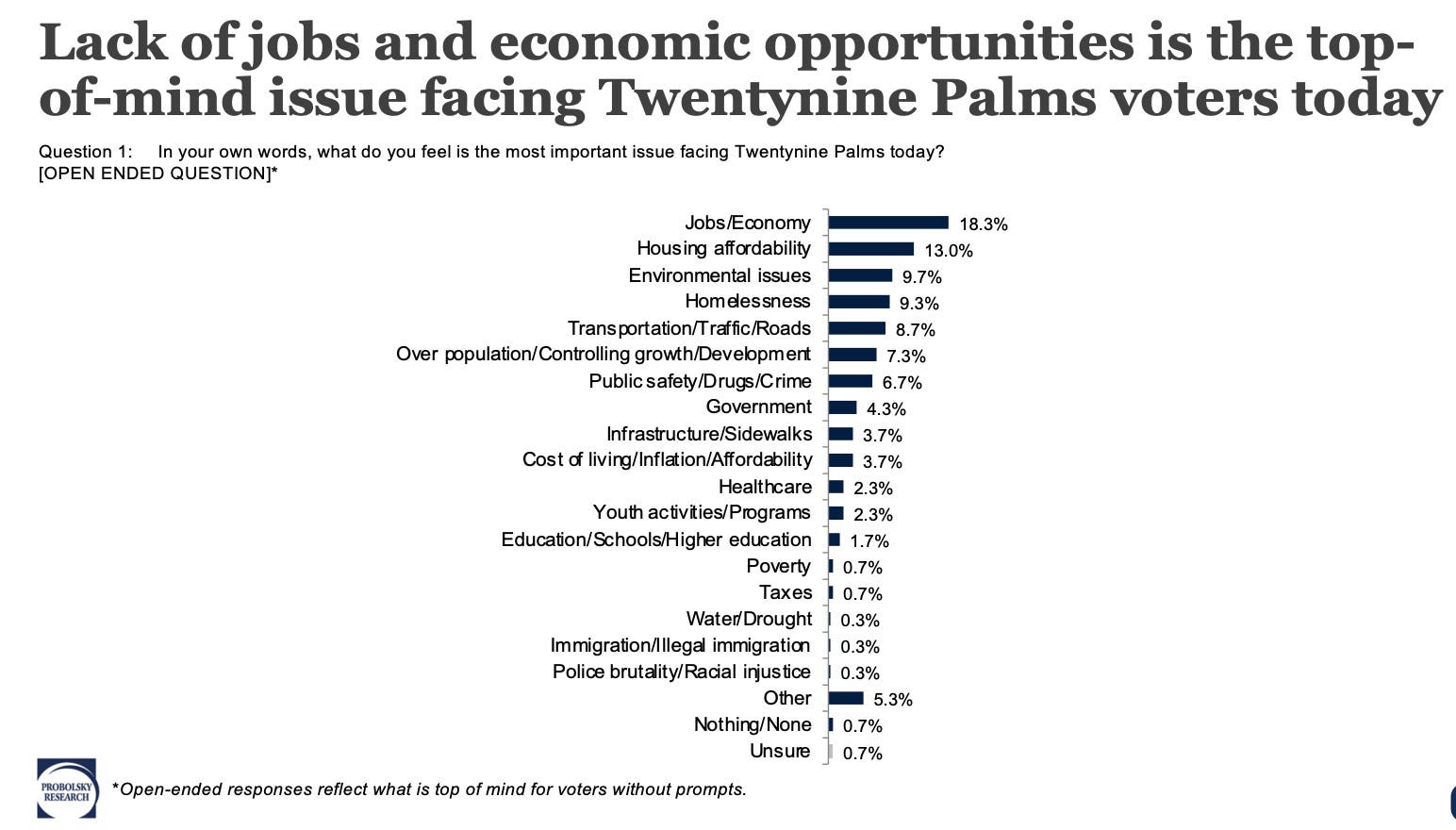
For the question, “In your own words, what do you feel is the most important issue facing Twentynine Palms today?” eighteen different topics were compiled by Probolsky from resident responses. The sales tax measure supporting City services would have little impact on the top three responses (percentage is followed by number of responses): Jobs/Economy (18.3% / 55) , Housing Affordability (13% / 39) and Environmental Issues (9.7% / 29).
However, the survey also supplied respondents with preloaded list of “what cities do” in which respondents checked all that were “very important to you personally” — and quantifying personal impact as opposed to broader issues gave a different result. The headline on this item reads “The top 3 priorities for residents are maintaining streets, public safety, and emergency preparedness.”
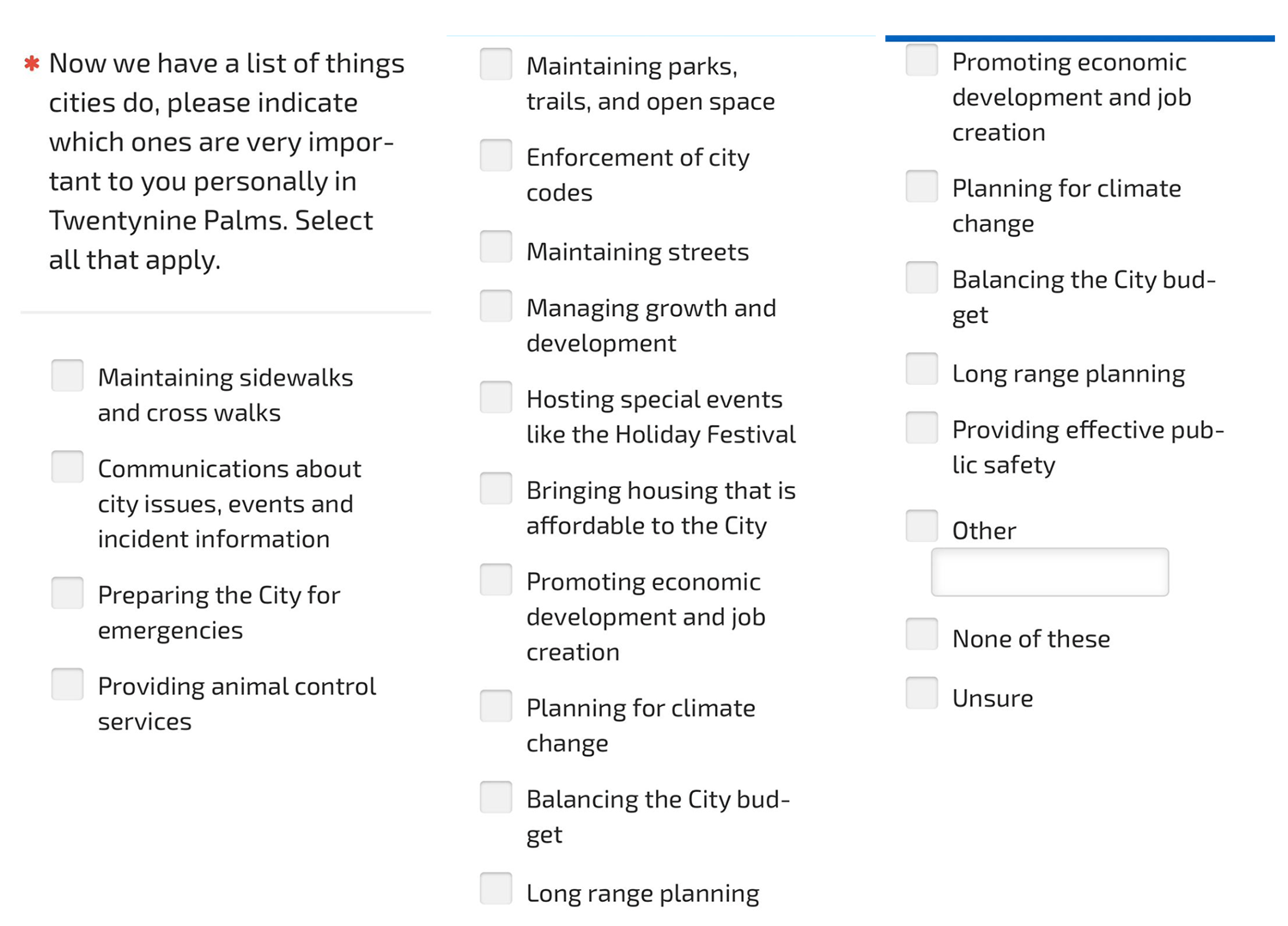
Viewing the same list, respondents were also asked, “Thinking of the same list of things cities do, please indicate which ones you are satisfied with in Twentynine Palms. This yielded a top three of “Providing animal control services” (46.3%), “Maintaining parks, trails, and open space” (36.7%) and “Hosting special events like the holiday festival” (34.3%). However, the headline doesn’t quite match the categories and drops “open space” from the second most popular result: “Residents are most satisfied with animal control, parks and trails, and community events.”
Misleading headlines
Several questions quantify an approval percentage as a headline, when the actual question is more nuanced and broken down into “strongly approve,” “somewhat approve,” “somewhat disapprove” and “strongly disapprove.” So the headline for “Do you approve or disapprove of the job the City is doing providing services to residents?” is “56% approve of the City’s performance in providing services to residents.” But that’s not accurate since the majority of respondents answered that they “somewhat approve” or “somewhat disapprove.”
Breaking the results down numerically: 167 residents “approved”; 83 residents “disapproved” and 50 residents were “unsure”. Breaking it down even further, 144 residents “somewhat approved” and 50 residents “somewhat disapproved” while another 50 were unsure. Meaning 244 out of 300 or 81% of residents responding were so-so or unsure in their opinions of city services — a very different headline. There are several other questions where the positive headline flips once the numbers are broken down.
The departments that are mostly clearly appreciated by residents are Parks and Recreation and Animal Control.
Questions with a cloaked agenda
Some of the questions are misleading. For instance, question 20 on page 74 reads:
This measure is designed to protect local families by exempting groceries and prescription medications, ensuring the tax does not apply to essentials. Residents can support needed improvements to City services without increasing the cost of basic necessities, keeping the impact low while delivering important benefits for the community. Does knowing this make you more likely to vote yes or more likely to vote no on the proposed sales tax measure?
The potential ballot measure itself does nothing “to protect local families,” however, since prescription medication and most grocery items are already exempt from sales tax. Instead, what this question accomplishes is to give the respondent a positive impression of the ballot measure, helping to sell it.
Perhaps one of the most problematic questions is on page 99: “Visitors and tourists would pay a large percentage of the proposed sales taxes generated in Twentynine Palms. This means non-residents help pay for our streets, police, and other services. Does knowing this make you more likely to vote yes or more likely to vote no on the proposed sales tax increase?” However, there are no data to support the claim that non-residents pay a large percentage of sales tax.
In fact, trying to sell a sales tax using the concept that visitors and tourists pay the larger percentage has been used previously, also despite the City lacking the data. In 2022, Desert Trumpet submitted a public information request on the 2021 survey, which had a similar query.

As a March 2021 email exchange between then-City Manager Frank Luckino and Probolsky Research President Adam Probolsky demonstrates, there are no data to support that tourists pay the bulk of sales taxes in Twentynine Palms.
Probolsky writes, “One important figure that will be helpful is the % of your sales tax that is generated from visitors / tourists. That can be a powerful message in selling the sales tax. Share it if you have the figure.”
Luckino replies, “Yeah, that is important, and do not have that analysis, as far as sales tax.”
Ex-City Manager Frank Luckino was a master at cloaking the true breadth of the survey by not mentioning the small 300-person sample size and referring to percentages as though all residents had the opportunity to respond. It remains to be seen how the decidedly less silver-tongued current City Manager Stone James will spin the survey results.
City Council meets on Tuesday, January 27 at 6:00pm at Twentynine Palms City Hall, 6136 Adobe Road, Twentynine Palms, CA 92277.
Thanks to our new paid subscribers, we are at $8500 in subscriptions, just $1500 short of our $10,000 goal. Upgrade your subscription from free to paid today for just $50 per year or $5 per month.
Are you able to give more than $100? Donate via Paypal!
Leave your thoughts in the comments below. Please note that we do not allow anonymous comments. Please be sure your first and last name is on your profile prior to commenting. Anonymous comments will be deleted.
Feel free to share this article!
While the final figure for promotion of the sales tax initiative is in flux, approximately $122,000 has been allocated.
Will the information on the methodology and costs associated with this project be shared with the public?