
OPINION: Five Days and Nights in Minneapolis
Mutual Aid in the Shadow of the Surge
By Jordan Hollingsworth
Taylor and I packed our overcoats and puffy jackets, thermal underwear and beanies, fleece mittens and wool scarves—left the wintry desert and arrived in Minneapolis to bright bluebird skies, warm sun, and shirtless runners on the bike path that runs along the Mississippi River. (Why we went: “Five Reasons I’m Going to Minneapolis.”)
All around us we witnessed a revolutionary kind of joy that persists even when the sun keeps winter hours and when the announced drawdown of federal law enforcement was, of course, a lie. We came to help however we could, listen to whatever residents told, and find tools to take home to the Hi Desert.
The Logistics of Love
Our work began in the routine chaos of a downtown high school, where nearly 90% of the students face significant economic disadvantages and Advanced Placement participation rates hit nearly 70%. Teachers and staff clearly excel as educators, but they are so much more; they are the backbone of their neighborhood’s survival.
In December, at the start of Operation Metro Surge, attendance at the school dropped up to 40%. The school’s staff immediately established a system to track the needs of hundreds of families. “It feels like a data center,” a teacher’s aide told us, showing off the spreadsheets she and her team had developed to keep tabs on requests from students and their families. “We got all this going in six weeks,” she said. “Students have started to come back, but so many people are afraid to go out or don’t have money to buy food.”
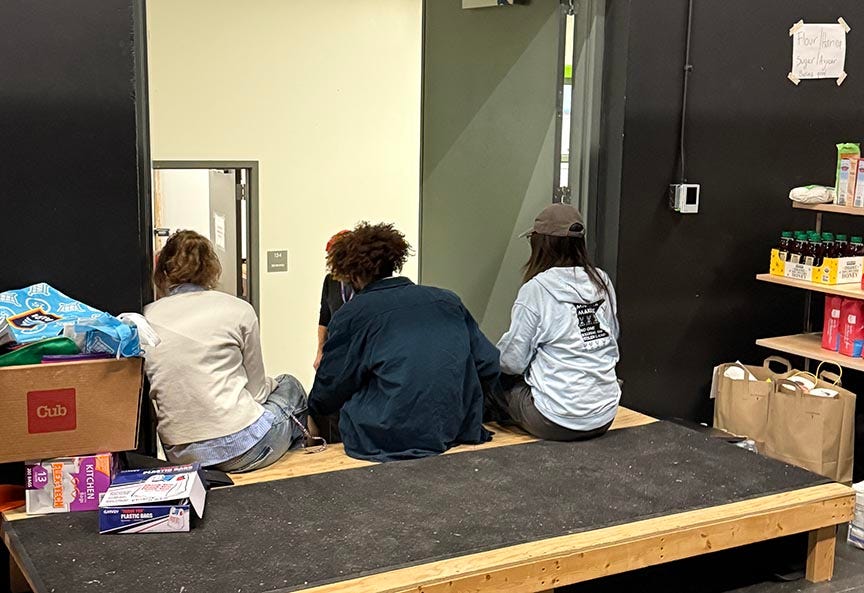
Taylor and I packed bags for students and families who, for fear of being snatched off the streets by Immigration and Customs Enforcement (ICE) and Customs and Border Protection (CBP), could not safely navigate a trip to the market. We filled sacks with staples: rice, spaghetti, meat, and canned fruit. We added “baby snacks,” a category of food one mom had requested that feels like a small luxury when every other item is a grim necessity. Watching Somali girls being silly as they helped, and seeing young men carry their heavy burdens with a somber, quiet responsibility, we saw a community that refuses to let its children be defined solely by their trauma.
Volunteers collected the bags to deliver to nearby homes. One teacher with Elvish runes tattooed on his collarbones said, “We are so tired of this shit.” Everyone we met seemed hypervigilant, listening for whistles from neighbors that signal ICE has been spotted, waiting for the next blow while trying to keep it together for their students.
The next day at the Sanneh Foundation, we joined a ten-person line to process crates of produce from Second Harvest food bank. In 2003, former U.S. Men’s National Team soccer star and Minnesota native Tony Sanneh founded a youth sports organization that has since evolved into a massive community support network.
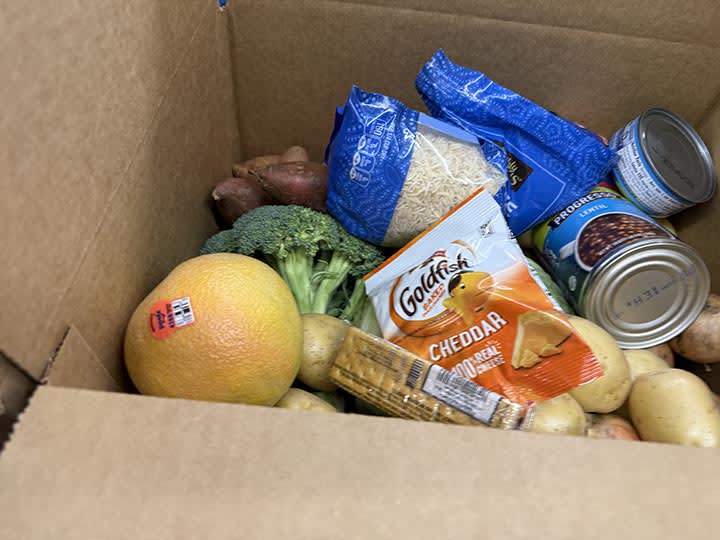
The coordinator said this was more than ordinary food insecurity and that they’d stepped up accepting contributions and donating food in a situation “manufactured by ICE.” I was first in an assembly line of a nine or ten volunteers filling cardboard boxes with cabbages, beets, sweet potatoes, onions, oranges, and apples. I ripped open 50-pound bags of cabbages, shucking off bruised or scraped outer leaves. “Cannonballs of justice,” I thought, imagining the people who were going to receive the boxes, making the cabbage as pretty as possible, treating them with dignity and respect—the cabbage and the community. Taylor added a dozen beets to the boxes, imagining people opening them and saying, “oh boy, beets!”
We sang along with the playlist, hits from the early oughts, Britney Spears’ “Oops, I Did it Again,” and my favorite, Outkast’s “Hey Ya”—“what’s cooler than being cool?”
“Ice cold!”
All right all right all right all right.
Tactical Joy and Satirical Resistance
Our friend Jules had made us feel welcome in Minneapolis and arranged for us to meet friends and family who had stories to tell. Jules is an artist who makes precise, colorful signs that pack a punch. She went home to Minneapolis from Joshua Tree, where she and her husband spend the winter, because, she said, “I couldn’t stand to see what’s happening to my city. It broke my heart.” She wanted to stand with her community and has created dozens of beautiful signs for whoever shows up to hold them.
Jules organizes protests that take place in her downtown neighborhood on Mondays and Fridays for just an hour, which eases burnout. Many of the drivers passing honk their honks in support, even city busses, firetrucks, and Ford F150s.
Some gatherings are joined by people wearing jolly inflatable frog costumes, a symbol of the resistance, along with signs painted with the Rebel Loon (the state bird of Minnesota) created by a local artist and based on the symbol of the Star Wars rebel alliance.1


I told a woman with a Loons not Goons sign that I’d come from California to witness and take part. She hugged me and burst into tears, “it’s been so heavy,” she said. “So heavy.” I walked with her and a man wearing a fox head and a tail, and we sang one of the anthems of the Singing Resistance, “we’ll all get there together, together. No one will be left behind this time.”
We had just missed the Dildo Distribution Delegation, which pelted state and federal agents leaving the Whipple Federal Building with sex toys from a crate of 500 provided by, people said, the Smitten Kitten. Videos of dildos stuck to and wobbling from the sides of tactical black SUVs made the federal surge look ridiculous rather than intimidating.
It was too much for law enforcement. Jerry, a stern-looking man in his 50s, told me that in the minutes after the dildo protest took place, Minnesota Highway Patrol officers grabbed him and threw him to the ground. Jerry wore a gas mask and ear protection—he said some of the law enforcement at the Whipple Building have LRADs, long-range acoustical devices that are as loud as a jet engine and that had already given him crippling tinnitus. The officers kneed him in the back and banged his head into the ground, and Jerry spent the night in the ER being treated for his injuries.
“I’ve lawyered up,” he said. “I’m a contractor. I can afford it. Assault. Criminal injury. I’m coming for them.”
The Shadow of the Whipple Building
Will Jerry get justice? Jonathan Ross, the ICE agent who allegedly shot Renee Good, walks free. So do CBP officers Jesus Ochoa and Raymundo Gutierrez, who allegedly shot Alex Pretti. Justice seems unlikely.
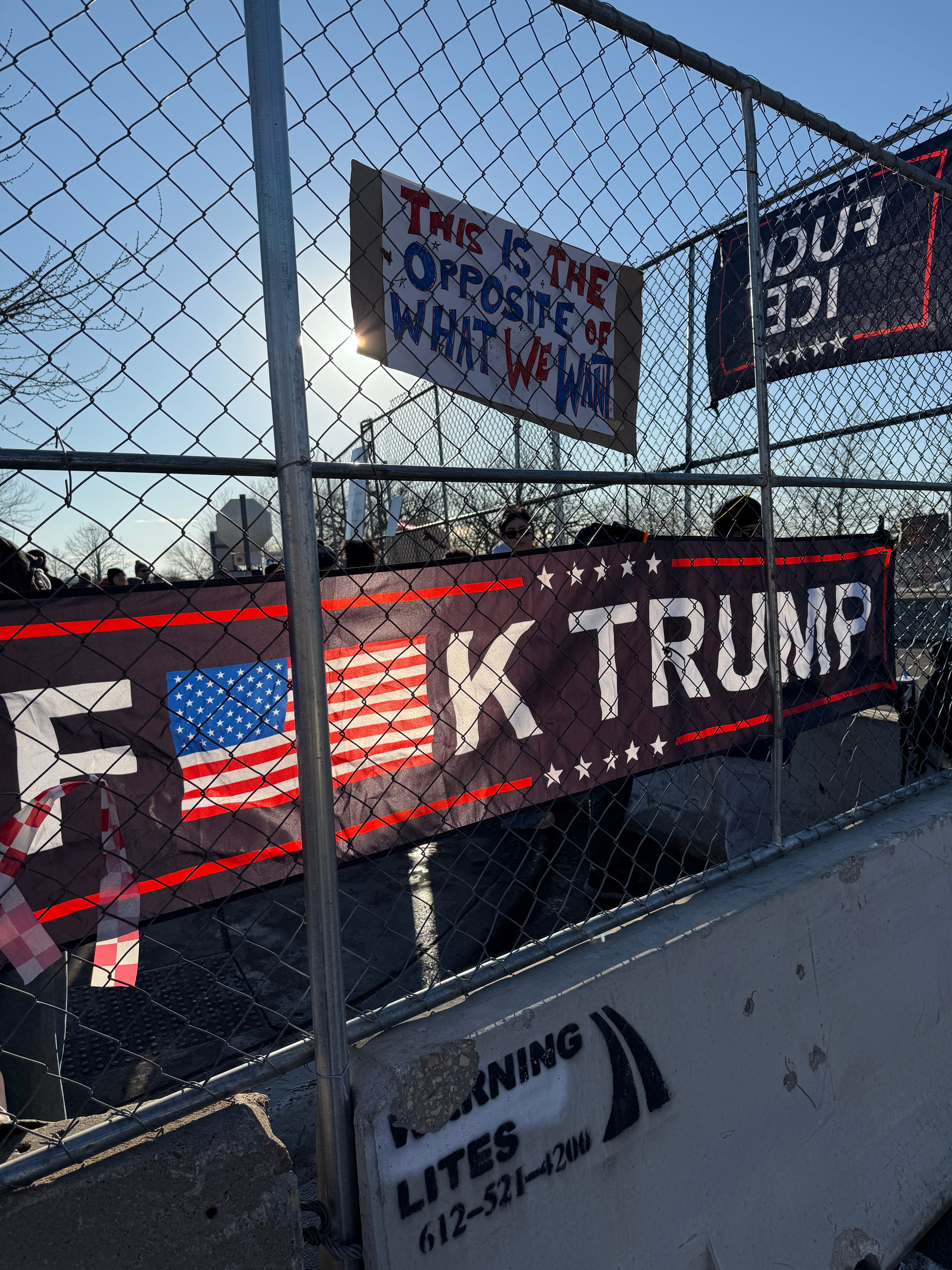
We took the light rail to the Bishop Henry Whipple Federal Building, not far from the airport. Cement barriers and tall chain link fences separate ICE, CBP, and the National Guard and protestors. Civilians patrol outside day and night, taunting law enforcement with bullhorns, sometimes reading scripted insults from clipboards. The feds cruise by in their big black SUVs, kitted out with cameras filming the crowds, capturing data, keeping tabs on their enemies.
Detainees are often released from the Whipple Building after midnight into the cold without warm clothing. Members of Haven Watch, a community foundation that rose up in January, give detainees coats to bundle up and burner phones then drive them home.
We met volunteers who continue to provide aid once people are back with their families and help them go back to their home countries if they want to — people who came to the U.S. looking for opportunities and safety and who were instead grabbed from school, from work, from the street.
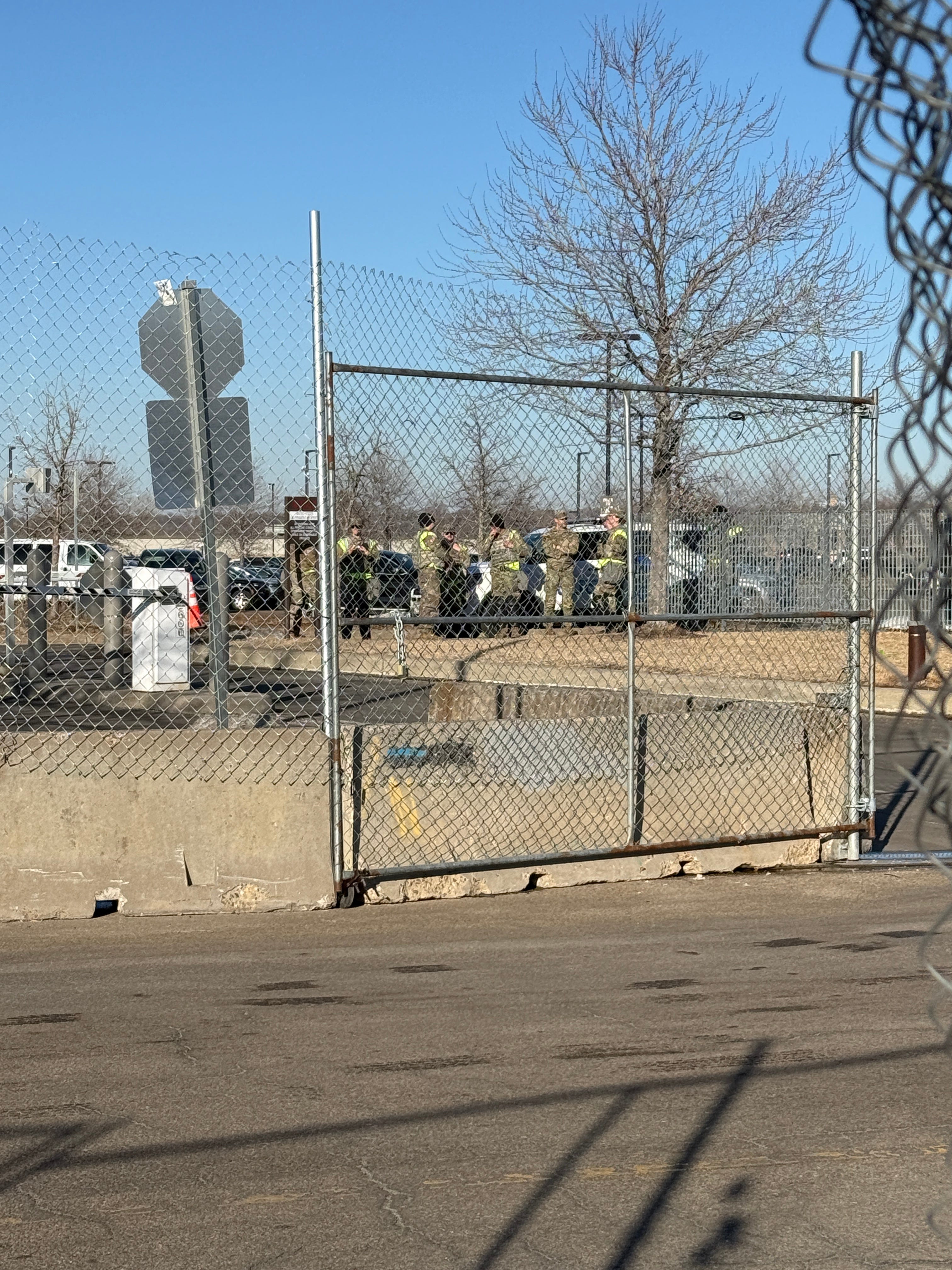
A squad of what the crowd took to be National Guard members gathered by a half dozen armored personnel carriers, glaring at the protestors and joking with each other. There are euphemisms the current administration uses for the federal influx of uniformed officers in mostly blue states): a “surge,” an “action.” What I witnessed in Minneapolis is war.
The Way Forward: A Radical Responsibility
We had brunch with Jules’s son Hank. He’s an observer in the Powderhorn neighborhood of Minneapolis, which had seen many ICE abductions until the troops moved into less-central neighborhoods, like the northeast area. Hank told us, “When ICE leave, they’ll drop a canister of tear gas just to be assholes.” He’d been tear-gassed several times.
He’d been nearby when Alex Pretti had been murdered and heard the commotion, the whistles, the yelling, the sirens. “It was the Border Patrol,” he said. “They’re the violent ones. They are used to bullying immigrants crossing the border.”
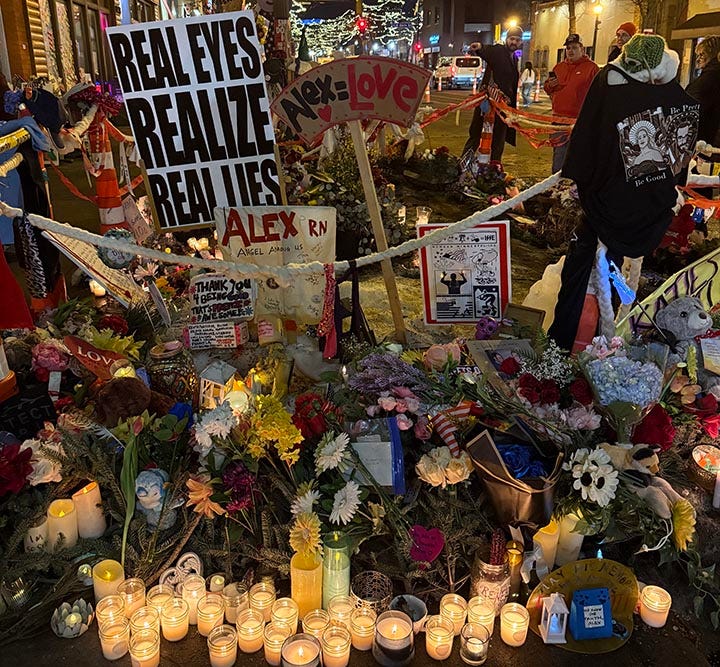
We had paid respects to Pretti the night before with our friends Dr. Montse and her wife Dr. Flores. . We silently walked around the neatly arranged stuffed animals and flowers, signs saying, “Alex, we got this” and the ubiquitous, “fuck ICE.” My heart felt as if it had been cracked open, and I sniffled into my mittens. Walking back to our car, Dr. Montse noticed a black SUV parked with the window rolled down, a man in camo watching mourners and passersby. I didn’t see him, but she, always vigilant did. “Hey,” he said. “What are you doing?” It didn’t seem friendly.
Alex and Renee Good were part of the fabric of this care network, people who believed in the radical possibility of a better world and acted on that belief every single day. Their deaths serve as a chilling reminder of the stakes involved when you choose to stand in the gap.
Hank said, “If you want to help, just go outside and meet your neighbors. Shop in your community. Help your neighbors and ask for help when you need it. People say, ‘you are on your own.’”
I thought about people who live in the desert. Many of us are here in the Morongo Basin cherish our independence and value our ability to be self-reliant. When our dogs get lost, when the streets flood, when we lose our SNAP benefits because of a government shutdown, however—we turn out for each other and lift each other up.
Hank sipped his coffee. “We are not on our own. I don’t believe that. We all have each other.”
The people of Minneapolis show us that mutual aid is not a hobby or a line item on a resume—it is a lifeline. They demonstrate that hope is not a feeling you wait for, but a series of actions you take. It is the act of ripping the ugly leaves off a cabbage; it is the act of loading a teacher’s car with groceries; it is the act of standing in front of the Whipple building and refusing to look away. Minneapolis teaches us that when the systems fail—or when they are intentionally designed to exclude—the people must become the system.

Resources
Almost everyone we talked to in Minneapolis eagerly shared links to their Signal chats and told us about trainings and actions taking place. Here are some of the resources we learned about.
ICE Out. This was the most robust ICE tracker, they said.
NDLON, the National Day Laborer Network, received kudos.
We found out about helping the high school through the First Unitarian Universalist Church, recommended by a man standing in line at the Phoenix airport to board the flight to Minneapolis.
Monarca is doing the heavy lifting of training observers and other helpers.
This Flock camera map was recommended.
Haven Watch show how to support detainees.
Stand with Minnesota has a comprehensive list of organizations to support.
The Sanneh Foundation provides food to immigrants and the unhoused
You Can Help master list on Reddit

Help us get to to $9,000 — we’re just $15 away!! Upgrade your subscription from free to paid today for just $50 per year or $5 per month.
Want to make a one time donation or are you able to give more than $100? Donate via Paypal!
Leave your thoughts in the comments below. Please note that we do not allow anonymous comments. Please be sure your first and last name is on your profile prior to commenting. Anonymous comments will be deleted.
Thanks for reading! This post is public, so feel free to share it.
Although Desert Trumpet policy requires editorials to be signed, the author is known to staff, and we have agreed to a pseudonym for reasons of safety. Names in the essay have been changed for the same reason.
These state bird designs have spread to most states including California. Extra points for not using AI. The design based on our state bird, the California quail, is not quite as fierce as some of the others.
An extraordinary piece of witness journalism - the image of packing 'baby snacks' as a small luxury against grim neccesity stayed with me long after reading. What you describe in Minneapolis is mutual aid functioning as a parallel infastructure of care that fills the void left by deliberate policy choices. I've seen similar grassroots networks form in my community during emergencies and it's always the same people, quietly showing up. Thank you for going and for writing this.