
RECAP: Flock Town Hall, Thursday, July 9, 2026
Privacy versus security—Morongo Basin residents demand answers on surveillance company's data security, County Sheriff transparency

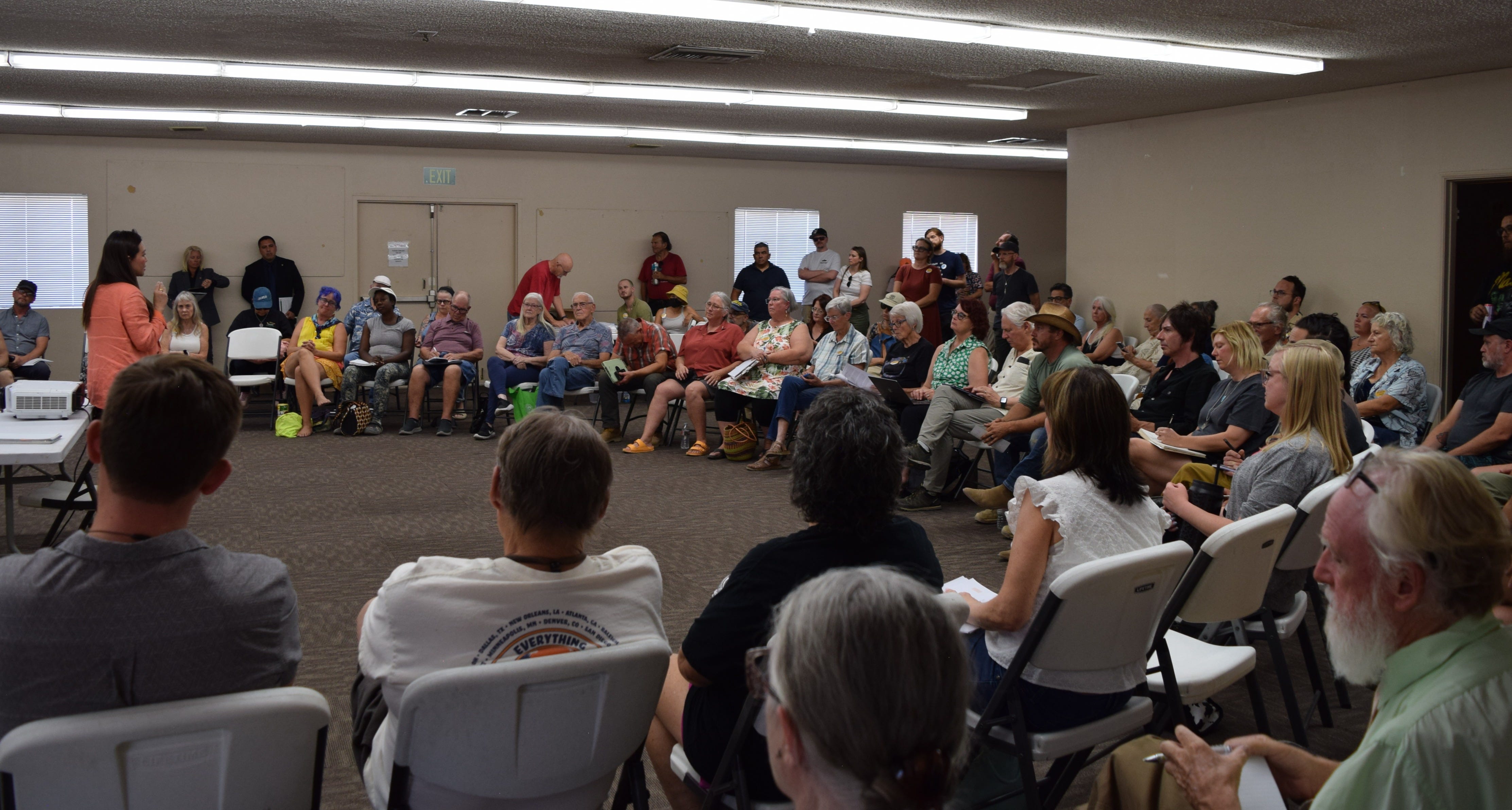
Few issues spark enough rage, passion, and sincere curiosity to fill a room with over 80 people on a 106-degree day in July. Flock Automated License Plate Readers (ALPR) is one of them.
This past Thursday, July 9th, Morongo Basin residents packed the Joe Davis Community Center in Twentynine Palms for a town hall on the Flock ALPR surveillance program. (The Desert Trumpet recently published two letters to the editor about the program and has extensively covered public comment at City meetings.)
Organized by Twentynine Palms Mayor Pro Tem Octavious Scott, key players invited to the town hall included Flock public affairs representative Lily Ho, San Bernardino County Sheriff Public Affairs Lieutenant Kari Klaus, Sheriff Information Services Division Captain Heather Forsythe, and some very impassioned residents.
Despite being a pressing community topic, with a local Change.org petition to remove Flock’s cameras garnering over 800 signatures, and an anticipated high meeting turnout, the discussion did not follow an agenda and lacked a formal moderator, adding disarray. Technical issues with the screen projector coupled with a handful of rowdy attendees and crowd interruptions contributed to this.
Those who made up the room were largely opposed to Flock’s practices, citing cybersecurity concerns, data privacy issues, and skepticism about law enforcement integrity. Facilitating the meeting was Mayor Pro Tem Octavious Scott, who often interjected to settle the impassioned crowd.
Mayor Pro Tem Scott opened the meeting by thanking those in attendance and encouraged everyone to be respectful:
The structure of this meeting is— we’re going to start off with some shared values, some concerns, issues that you might see with Flock, or things that you might like about Flock, and it’s meant to be very conversational. It’s not meant to be structured. It’s meant to put everybody on equal footing.
Scott then called on audience member Yiwen Tang who had a prepared question on heat maps and pattern of life activity. What followed was some apparent confusion in the flow of the meeting, and it was unknown whether or not Tang’s pointed question would get answered by the Flock rep. Audience interjections ensued.
It was then agreed upon that the meeting would launch with Flock representative Ho’s presentation followed by questions from the crowd. The roundtable proceeded in a more or less orderly way for the next two and a half hours.
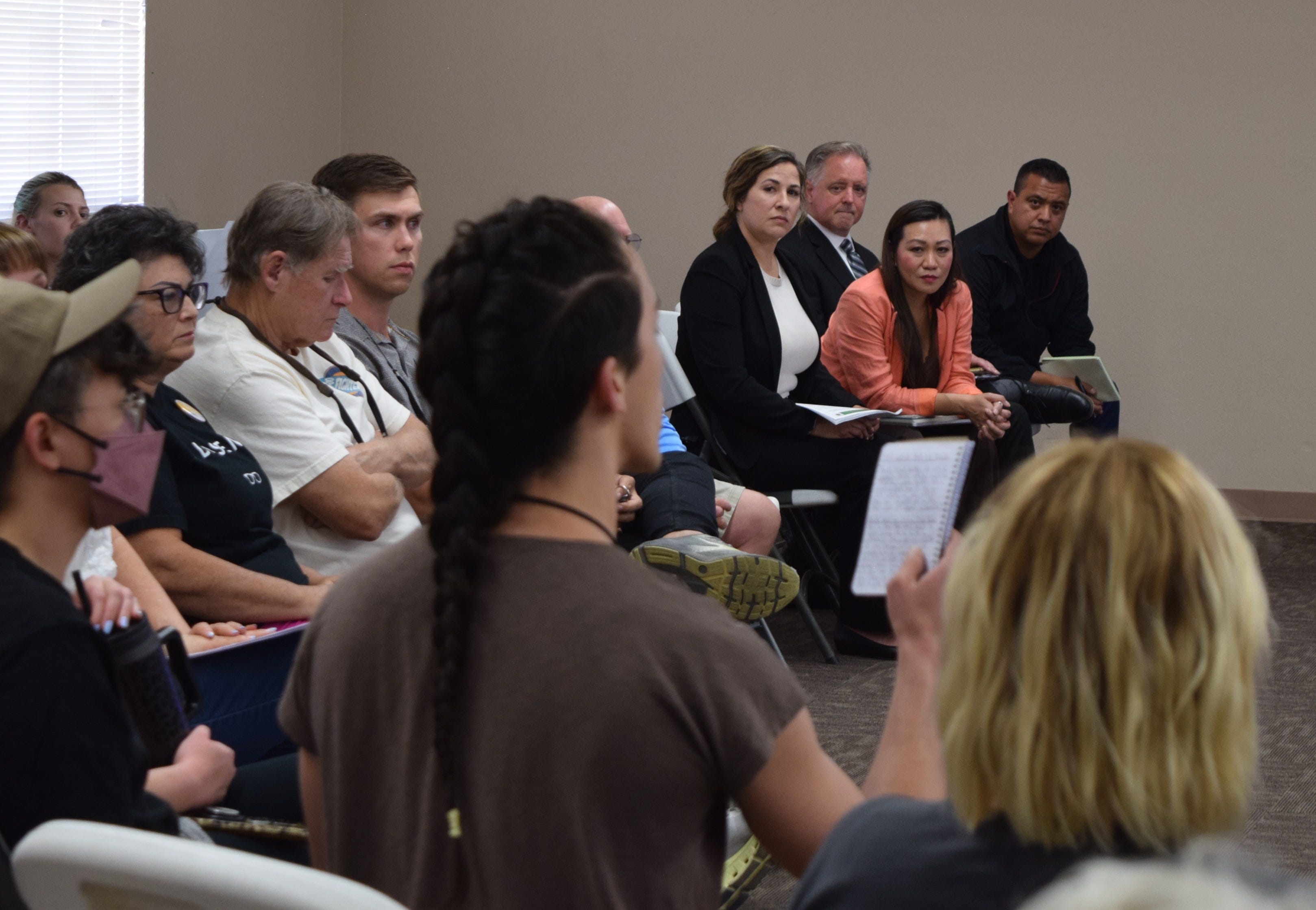
Ms. Ho was faced with the sisyphean task of winning over meeting attendees and quelling community concerns, something she had not accomplished by the end of the meeting.
The content of Ho’s presentation attempted to set the record straight on Flock’s software, capabilities, and proven track record of assisting in crime solving, explaining how the tech works and noting that searches require an offense type and case number. Ho stated that Flock does not use facial recognition software or AI tracking.
Ho explained that there is no permitted data sharing with agencies outside of California, describing this as a “digital guardrail,” but local agencies can choose who they share data with. eg. data shared between law enforcement agencies.
In response to critics that say the tech violates the 4th Amendment, Ho’s presentation had a slide that stated:
Appellate and federal district courts In at least fourteen states, including the 9th and 11th Circuits, have upheld using evidence from license plate readers as constitutional without requiring a warrant.
Attendees had done their homework and came with questions, case law, maps, and even cited Flock’s own website.
Concerns Over Data Privacy & Surveillance


Multiple speakers expressed unease at being tracked doing everyday tasks such as driving to church, a doctor, a friend’s house. They argued that constant logging of movement chills freedom of association and expression, regardless of guilt. Several invoked “pattern of life” heat maps, comparing the technology to tools used by authoritarian regimes as well as the U.S. military against enemies in Iraq and Afghanistan.
Some speakers said this surveillance violated the Fourth Amendment of the U.S. Constitution. Ho stated:
We can go through really long discussions about the Fourth Amendment. I’m not an attorney myself, but we can speak to it as well. But to sum it up, there’s over 60 case law supporting license plate readers, and that it does not offer a pattern of life.
When pressed by audience member Yiwen Tang, who quoted a webinar presented by Flock admitting to the software’s capabilities for storing pattern of life data, traffic patterns, and heat maps for between 14 and 30 days, Ho admitted:
Honestly, I have not seen what you’re looking at, so I can’t even comment on it.
Residents repeatedly questioned who ultimately controls stored data. Ms. Ho said data is stored by AWS data centers. A quick search shows that these are run by Amazon.
Concerns centered on breaches of Flock data, lack of multi-factor authentication enabling shared or hacked logins, and whether footage could be manipulated or accessed by unauthorized actors, including AI systems.
“Literally anything can be hacked,” admitted Ho.
ICE and Federal Data-Sharing Fears
Several attendees pressed on whether the Sheriff had signed memoranda of understanding to share data with U.S. Immigration and Customs Enforcement (ICE), referencing recent immigration detainments locally. Flock’s representative insisted no direct contracts exist with the Department of Homeland Security (DHS) or Customs and Border Patrol (CBP) and that California’s digital guardrail blocks out-of-state sharing. Skepticism about enforcement of that firewall persisted.
No Kings— County Sheriff Department Admits to Shortcomings
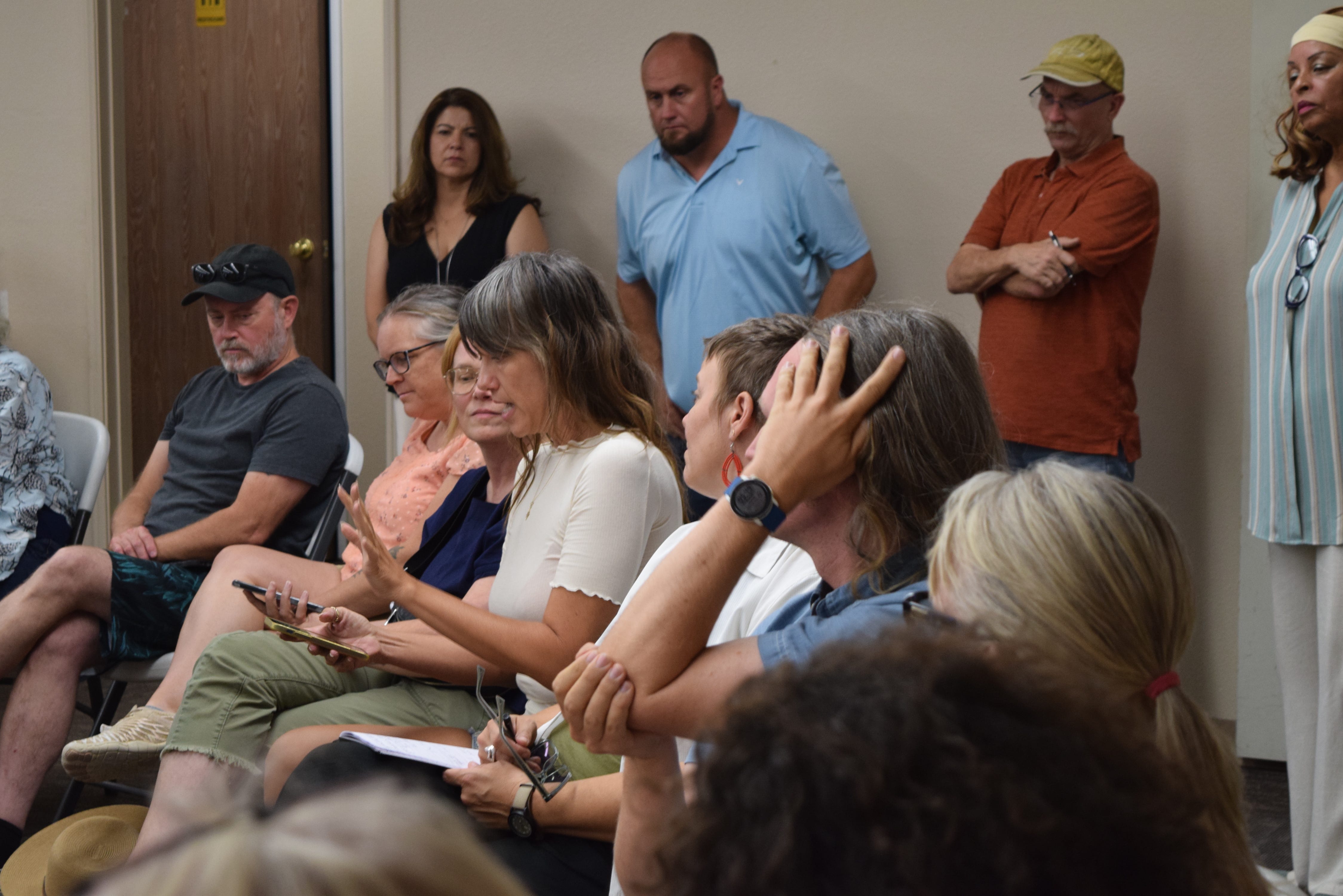
Lieutenant Klaus admitted that the Flock discussions have been a learning lesson for the Sheriff’s department, and that the department has contracted with other ALPR companies in the past. Regarding department data sharing, Klaus noted that once the department learned about this data sharing setting, they turned it off:
It was a learning time for our department… We don’t share any of our permissions or any of our data with anybody that’s not in the state of California or any federal agencies. We’ve gone a little one step further. We actually appointed an analyst that rechecks all of our settings twice a month to make sure that there’s a safeguard.
So far, residents of the cities of San Bernardino and Twentynine Palms are some of the only within the County to protest Flock systems. Fifty municipalities nationwide have suspended their Flock contracts. Two days after the town hall, the Los Angeles Police Department suspended its Flock contract on Saturday, July 11th, citing data privacy concerns.
From the audience, Dana Balicki asked about keyword searches by the San Bernardino County Sheriff’s Department:
Why did the Sheriff’s Department do a keyword search for “No Kings” on June 14 and for “ICE protest” on June 9, and that those searches were done without an event type or a case number—that would be helpful to know.
Balicki noted that audit logs allegedly show “five San Bernardino Sheriff Department officers running searches 24 hours a day,” suggesting password sharing between Flock account holders and County Sheriff’s Department personnel.
Captain Forsythe was adamant, “I can tell you that any searches that were done in that way were not adherent to our policy… So once that was caught, I could guarantee you there’s probably an administrative investigation, or there was.”
Klaus clarified that the search was conducted by a department intelligence analyst to investigate a crime that took place at or around a No Kings protest and that the department has since changed its search criteria policy:
We have our intelligence analysts that were running a specific plate for a crime that occurred at No Kings, and this was prior to our new policies. So they were allowed to put a reason why they are searching, and that’s the reason that they chose, which was not a very good reason.
According to the Los Gatan, community newspaper for the City of Los Gatos, whose local police department is now faced with its own civil suit regarding use of Flock camera software, between December 2024 and October 2025, Flock was used to search “50501 protests,” “Hands Off protest,” and “No Kings protests” by 19 law enforcement agencies nationwide.
Klaus and Forsythe both emphasized that public trust is a top priority for the County. Klaus said that the Sheriff Department’s transparency landing page would soon be updated to include detailed information on how Flock data is stored, shared, and safeguarded.
Will the department’s suggested solutions and policy changes be sufficient to address community concerns?
Law Enforcement Value for ALPR Data & Crime Solving Assistance
Sheriff’s personnel described recent cases in which Flock data provided real crime-solving value. Sergeant Daniel Berumen of the Morongo Basin Sheriff’s Station talked about his use of ALPR technology throughout his career. Berumen highlighted Flock’s role in apprehending a serial killer caught crossing state lines, a recent homicide investigation in Wonder Valley, and domestic violence cases in which license plate data provided crucial suspect leads.
Berumen maintained that the use of ALPR technology could help save investigative time when other department resources are scarce.
Resident Lynette Ramirez saw the potential benefit of the technology, and recounted seeing signage throughout town for missing people when she first moved to the Mojave.
We’re kicking off our summer subscription drive! Help the Desert Trumpet reach 1600 subscribers by spreading the word!
Longtime resident Pamela Holmes recounted a suspicious man watching a school playground, and a hit-and-run that badly injured her son, arguing that safety concerns for kids and pedestrians outweigh privacy objections :
We’re looking at safety versus right to privacy. I have the right to be safe.
Other meeting attendees continuously emphasized that they were not against solving crimes— the issue was with Flock itself. Attendee Alexandra Aikens shared:
I don't think anyone in this room is against solving homicides, is against catching pedophiles... My own cousin was one of those bodies found in Wonder Valley, so I am very aware of what it's like to be a victim of crime out here.
Critics countered that ALPR technology has led to wrongful stops and arrests at gunpoint of innocent people, that most domestic violence is committed by known intimates rather than strangers caught by cameras, and that the safety narrative Flock promotes is empirically weaker than officials claim, given mixed crime-reduction research.
New Contract Terms Shift In Flock’s Favor


Resident Pat Flanagan printed maps of Flock camera locations throughout the desert, including Yucca Valley and Palm Springs, showing the reach of the Flock camera network beyond Twentynine Palms.
Citing ACLU research, Ms. Flanagan detailed how Flock’s 2026 contract dropped a prior no-sale clause, granted Flock a perpetual license to reuse data even after contract termination, and added arbitration clauses under Georgia law that make it harder for cities to exit.
Noting his background in software development, Benjamin Alley inquired how the sheriff’s department would rebuild public trust if systems became “accessible, corrupted.”
Community Issues With Transparency, City Manager Cole Speaks Out


Speakers criticized inadequate public notice of the original November 2024 Flock contract vote and the roundtable itself (citing an over-reliance on Facebook and not meeting newspaper public notice windows), months-long delays answering public records requests, and a broader sense that the City Council and Sheriff’s Department have not earned community trust to wield such a powerful tool responsibly.
Esther Thomas, identifying as a zillennial, admonished the City’s community engagement attempts:
If I personally was not on Facebook, I would have no idea of this meeting. I'm a younger person. I understand that Facebook is not as popular these days for the younger people.
When audience members raised concerns that the prior city manager Stone James had intended to push the contract renewal date further down the line, City Manager Kevin Cole denied it, saying the contract renewal is set for January or February, with Council discussion likely anticipated in November or December.
I wasn’t city manager back when it was originally voted on. I am now.
Though not a City employee at the time of its passage in November 2024, Cole admitted that the City could have done better community outreach back when they initially discussed the Flock contract:
[We could] probably do a better job of letting people know. We do have a Facebook and an Instagram page. We can let people know when our meetings are. If people are interested, which everybody in this room showed up today is obviously interested, please look for when our meetings are happening. Come down, be part of the process. We want you there. We want to hear from the public.
Calls for Local Control, Citizen Oversight

A compromise position emerged: residents said they might be able to accept cameras if data stayed locally stored, access was tightly restricted to specific case numbers, and a citizen advisory or oversight committee reviewed searches and policy. Nonetheless, many audience members expressed distrust of Flock, the Sheriff’s department, and the City that the roundtable did not allay.
Residents want real crime-solving tools, but they also want proof that Flock's cameras won't be misused, hacked, or shared with agencies like ICE. City officials and Sheriff's Department representatives promised more transparency before the contract renewal early next year. Whether that's enough remains uncertain. For now, Morongo Basin residents plan to keep showing up, keep asking questions, and keep pushing for local control over how their data are stored, accessed, and protected.
Hi, new subscribers! The Desert Trumpet understands you might not be interested in all of our coverage. That’s why it’s divided into separate newsletters allowing you to opt out of reporting that’s not important to you. For instance, you may want our County news but not City Hall 29.
Here’s how to opt out: go to your Substack settings, scroll down to “subscriptions,” and select “Edit” for the Desert Trumpet. Simply uncheck the box next to the newsletters you don’t want to receive in your email inbox. You’ll still be able to access all coverage online or readd them later if you change your mind.
Become a paid subscriber!
Subscribing to the Desert Trumpet will always be free. That said, did you know that paid subscribers receive discounts on our DT Social events and invites to DT Front Porch, intimate discussions featuring local officials and notable residents?
Upgrade to a $50+ paid subscription for a 10% discount.
Upgrade to $100+ for a 25% discount.
Sustaining subscribers at the $250+ level and above receive complimentary tickets
Share your thoughts in the comments below. Please note that we do not allow anonymous comments. Please be sure your first and last name is on your profile prior to commenting. Anonymous comments will be deleted.
Share this post—it’s free!