
RECAP: Stop Music Valley Mine Community Information Meeting
The National Parks Conservation Association and the Mojave Desert Land Trust join forces to engage the Hi-Desert Community in mine pushback -- plus a recap of recent developments


This is going to be a long one, but it’s important, so grab a fresh cup of coffee and a cookie (preferably from Campbell Hill) and dig in! The article includes a report on a presentation given by the National Parks Conservation Association (NPCA) and the Mojave Desert Land Trust (MDLT), questions and answers that came up during the meeting, separate research from the Desert Trumpet, and a list of things the NPCA and MDLT suggest you can do if you want to push back against the Music Valley Mine.
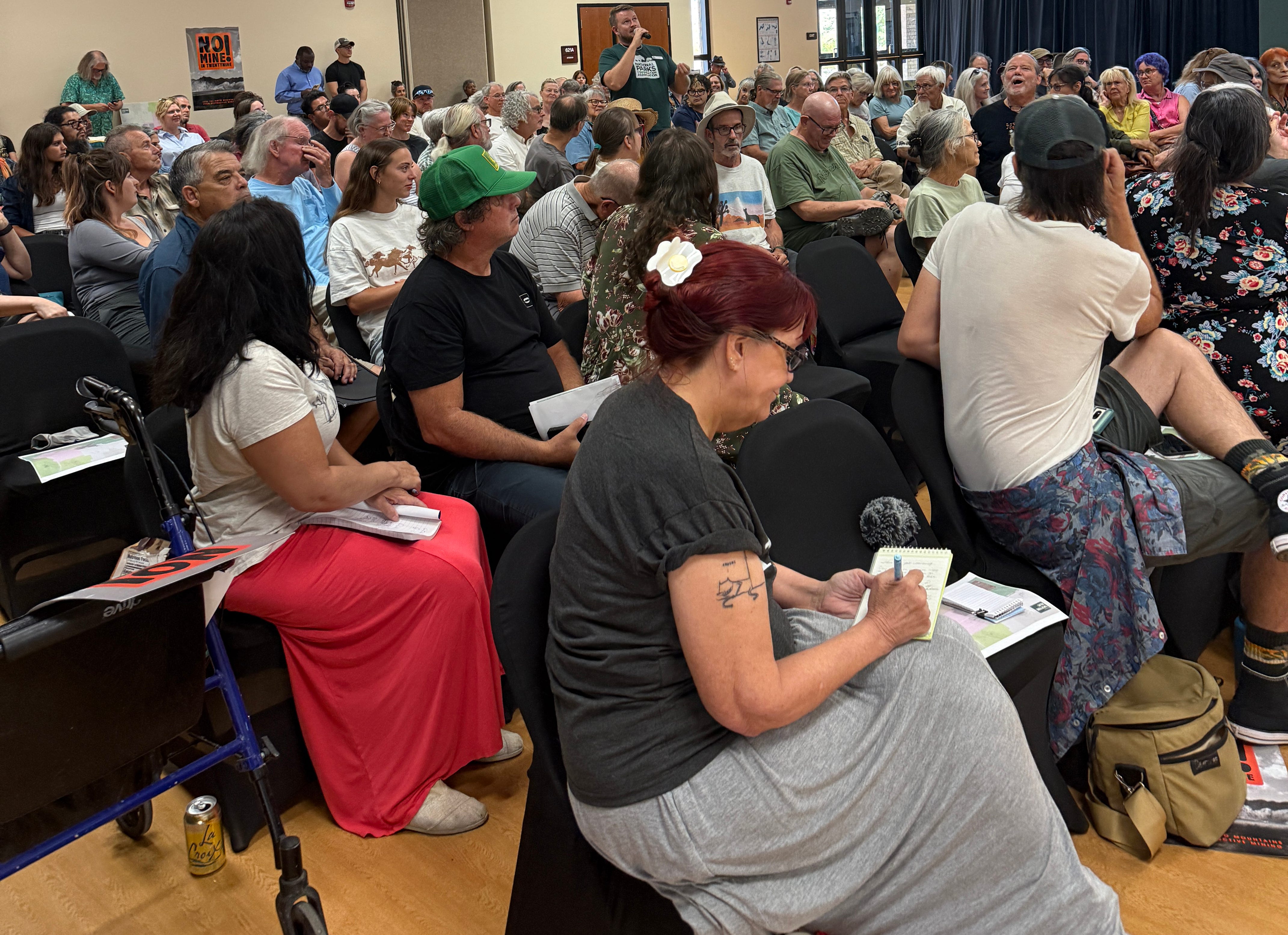
A packed room of Morongo Basin residents turned out on July 15 to learn about Music Valley Mine, a proposed rare earth element mining project staked on public land just outside Joshua Tree National Park and just inside the boundaries of Twentynine Palms.
The town hall was hosted by the NPCA and the MDLT, two conservation groups that have been raising alarms about the project since early this year and which used the meeting to inform Hi-Desert residents about actions they can take.
NPCA’s California Desert Program leads, Mason Osgood and Chance Wilcox, ran the meeting alongside MDLT public policy staff Krystian Lahage and Dr. Michelle Benedum. All four made clear they are not against mining in general, but said this particular project run by this particular company does not belong so close to a national park and a fast-growing gateway community.
What’s at Stake in Music Valley
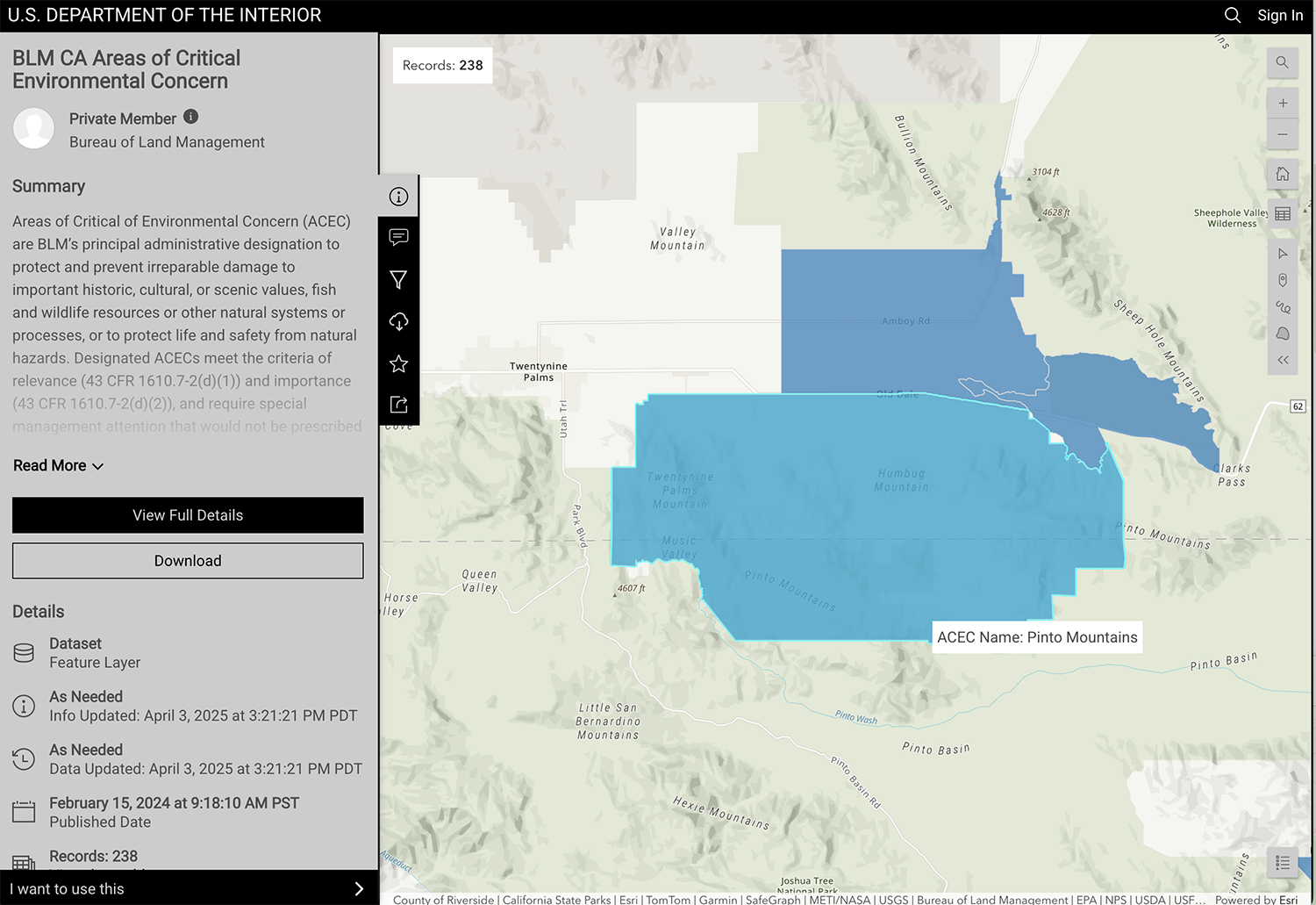
The Music Valley Mining Project will scrape lands for rare earth minerals within a Bureau of Land Management (BLM) Area of Critical Environmental Concern (ACEC) that overlays most of the Pinto Mountains Wilderness. The wilderness was intended to protect lands adjacent to Joshua Tree National Park, and the areas of critical environmental concern protect “historical, cultural, and scenic values” and have been highlighted lately to safeguard Mojave desert tortoise habitat.
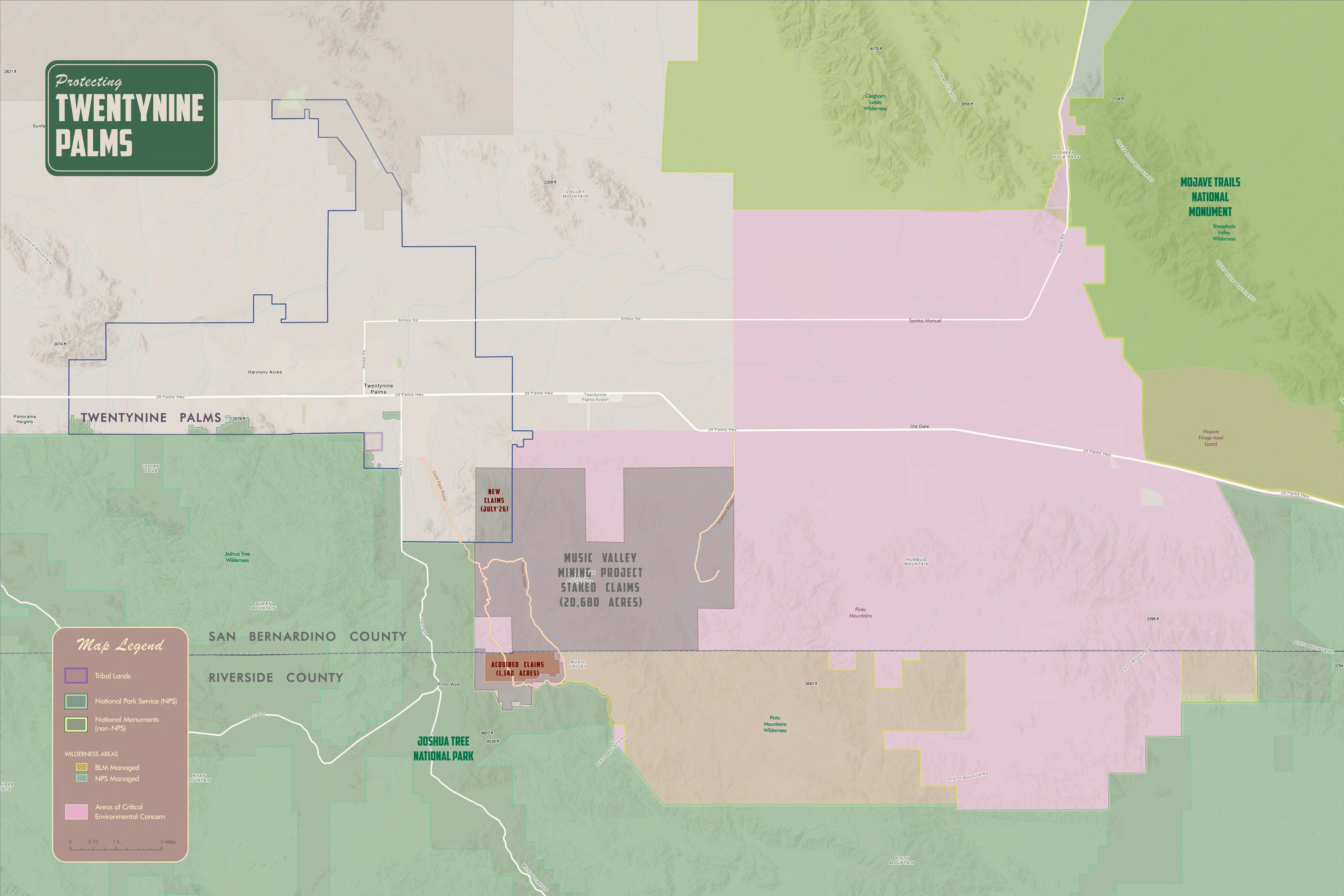
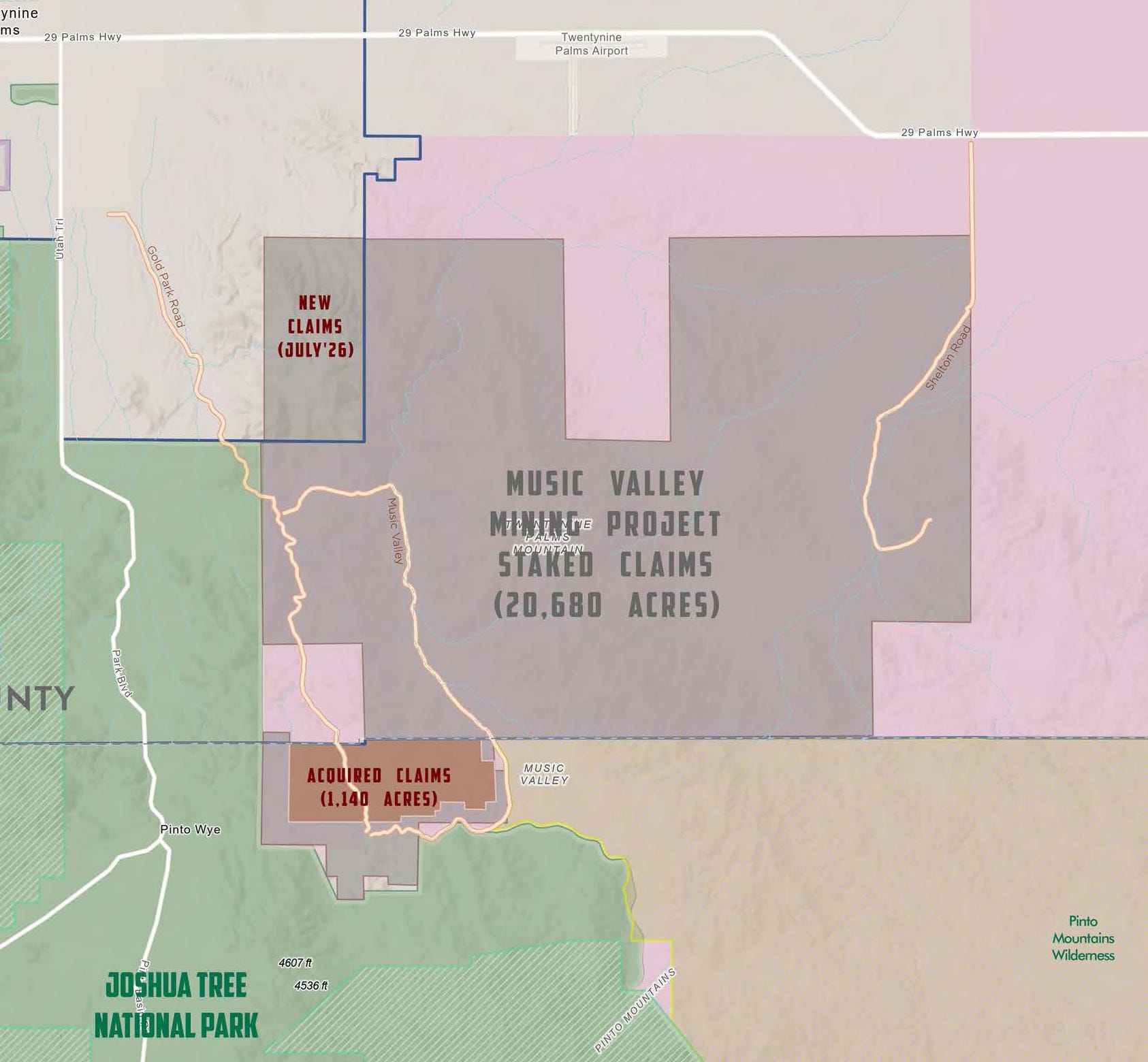
Dateline Resources, a mining company based in Sydney, Australia, has staked what the NPCA estimates at roughly 20,000 acres of claims1 within Music Valley mostly to search for heavy rare earth elements used in electronics, magnets, and military equipment. The claims stretch close enough to the park that, as Osgood put it, a person can stand at a claim stake and see the Joshua Tree North Entrance station. In June, new claims crossed the boundary of the City of Twentynine Palms itself.
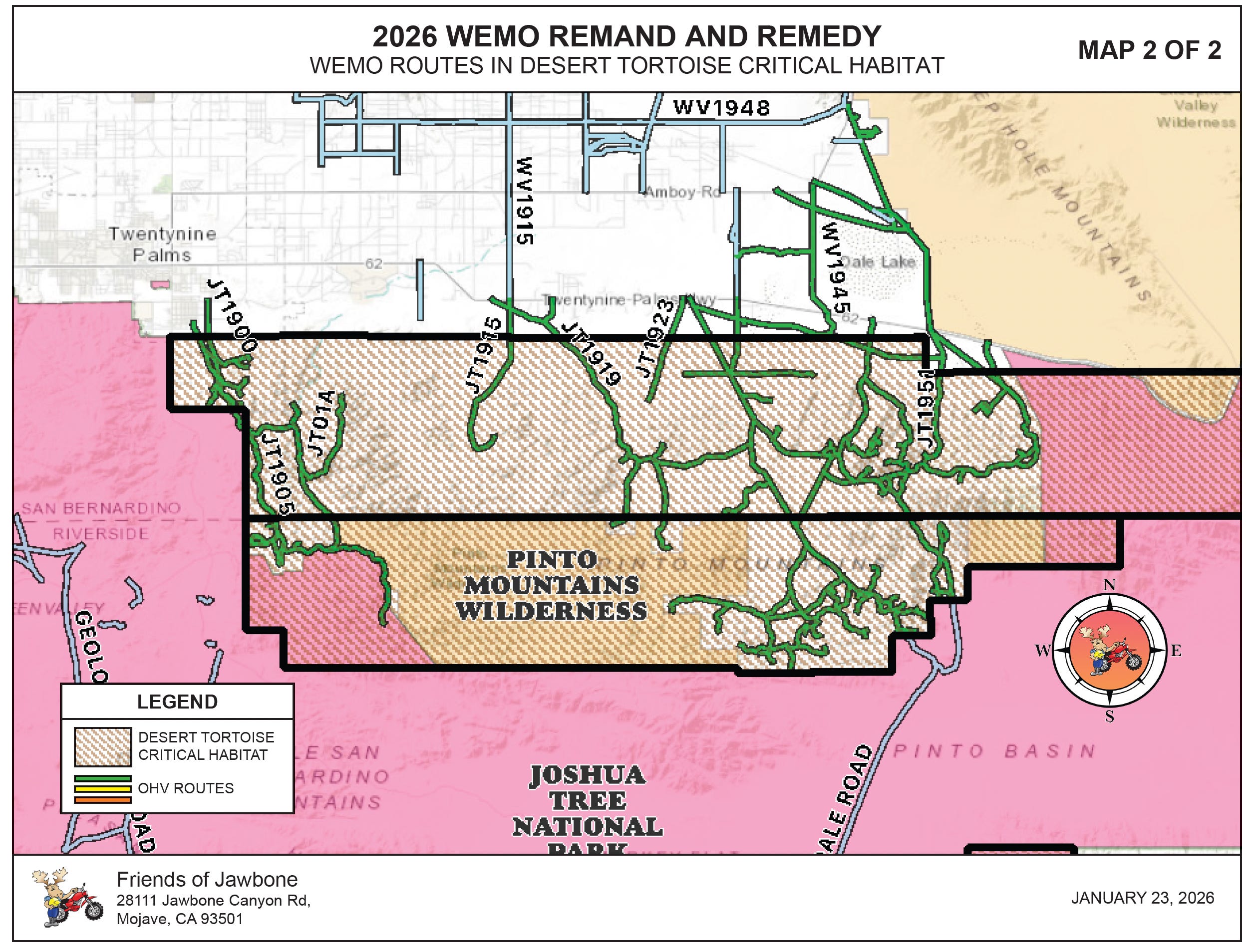
No mine permit application has been filed for Music Valley and, by the agencies' own accounts, no government entity has been formally asked to review it. The BLM, which manages the land through its Barstow Field Office, told the Desert Trumpet it has "not received a plan of operations" for the project. San Bernardino County and the City of Twentynine Palms each say they have not been notified by the BLM or by the company.
So far the activity is limited to staking and exploration: Under the 1872 Mining Law, which has barely changed in over 150 years, anyone can stake a claim for about $200 and then begin exploration, including drilling and road-building, often with little public notice. And because the claims sit on federal land, most permitting would run through that federal process rather than local government (see the jurisdiction question below). Wilcox and Osgood said the road most likely to serve the mine, Gold Park Road, runs directly through the Twentynine Palms Hansen Tract neighborhood.
Video of mining claim off of Gold Park Road in the area marked “new claims” on the NPCA map, in the vicinity of Utah Trail. Video scans to Hansen Tract and Sky’s the Limit. (Anonymous reader).
The Company Behind the Claims
Much of the meeting focused on the company behind the claims: Dateline Resources, which Chance Wilcox called “a junior mining company” based in Australia. Wilcox walked the crowd through Dateline’s history at Colosseum Mine, an old gold mine inside Mojave National Preserve. The mine closed in 1993, but water at the site still shows high sulfate levels more than 30 years later.
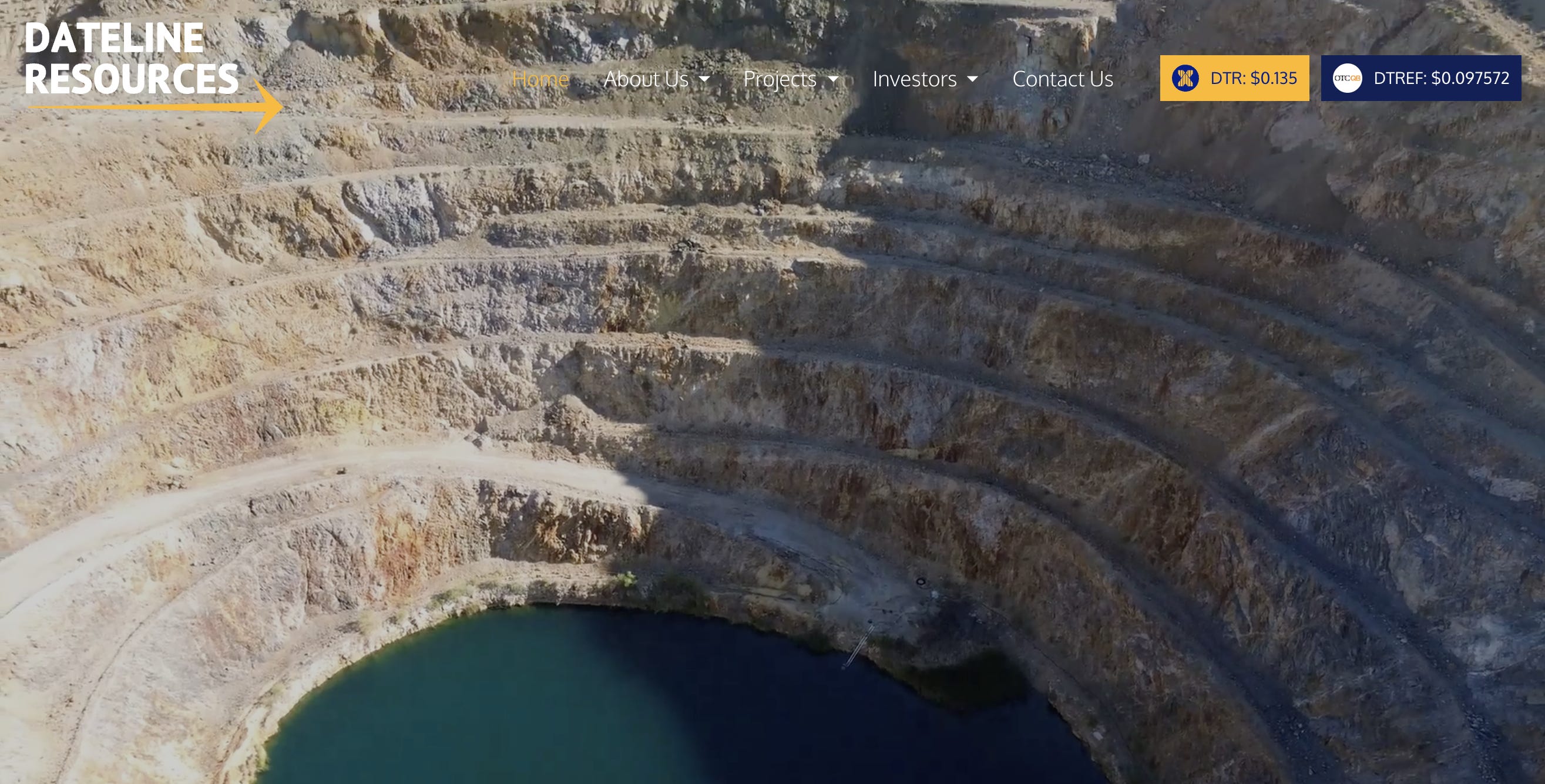
When Dateline bought Colosseum in 2021, it began bulldozing and building new roads without a valid permit from the National Park Service (NPS), according to Wilcox. The NPS ordered the company to stop and demanded more than $200,000 in damages. Wilcox said that dispute quieted down after the 2024 election, and the NPS later withdrew its permit demands as the new administration pushed to fast-track mineral production. Bulldozing at Colosseum has continued since.
Wilcox also noted that Dateline is pursuing a strontium project inside Mojave Trails National Monument and is the subject of two ongoing lawsuits, one over how it acquired the Music Valley claims and one filed by NPCA against the Department of the Interior.
San Bernardino County Planning Commission Recommends Giving Up Local Permitting Over Mines on Federal Land
The Desert Trumpet reported on the July 9 San Bernardino Planning Commission hearing that recommended that the County Board of Supervisors adopt a full repeal and reenactment of the development code chapter that is the local rulebook for surface mining.
Its key change adds a new “Federal Lands” section stating that a County permit “shall not be required” for mining activity that already has federal approval, meaning a green light from the Bureau of Land Management would let a project skip County review entirely.2 Of the 32 people who spoke at that hearing, none supported the change; about a third specifically raised Music Valley. The commission voted to recommend the rewrite anyway, and it now heads to the Board of Supervisors.
Four conservation groups — the Center for Biological Diversity, Earthworks, the Sierra Club, and the National Parks Conservation Association — submitted a legal letter to the San Bernardino County Planning Commission urging denial, arguing the federal-lands carve-out illegally surrenders the County's state-law permitting and environmental-review duties. In a step groups typically take when preparing to sue, the groups remind the County to preserve its records. (The full letter is attached.)

The Desert Trumpet’s research also shows a wrinkle in the jurisdiction question. County staff told the Planning Commission that the Music Valley Mine is “located within Riverside County” and outside the County’s authority — but Dateline’s own June 2026 press release describes the project as spanning “Riverside and San Bernardino Counties,” and a map comparison by the Desert Trumpet suggests the newest claims fall inside the Twentynine Palms city limits. Community Development Director Keith Gardner concurs that the area appears to fall within City limits, which lie entirely in San Bernardino County — this is also supported by the NPCA map.
Location, though, doesn’t settle who would actually review the mine. Because the claims sit on federal BLM land, neither the County or the City is the lead permitting agency: the County’s proposed ordinance would waive the County permit for operations that already have federal approval, and the City says it would not be the lead agency for a mine on federal land within its boundary. So even if the claims sit inside San Bernardino County or Twentynine Palms, the mining itself would be authorized federally, leaving the County a role mainly in after-the-fact reclamation and the City with little formal say.
The County also faced criticism over how it publicized the hearing itself: legal notice ran once, in a valley-side newspaper roughly 90 miles from the affected desert communities, rather than in any of the Morongo Basin’s own papers. Some residents said they learned of the meeting only a day or two beforehand. A Wrightwood contingent of 13 speakers turned out at the same hearing over a separate project, the Lone Pine Canyon Road Quarry, but raised nearly identical complaints about rushed process and limited notice — suggesting the ordinance fight extends well beyond Music Valley.
In an interview with z107.7 FM on July 10, Supervisor Dawn Rowe conceded the lack of notice on the change in County code:
…shame on the County. We could have done a better job of saying this is coming and what it means to the basin… that didn’t happen.
What Organizers Are Asking Residents to Do
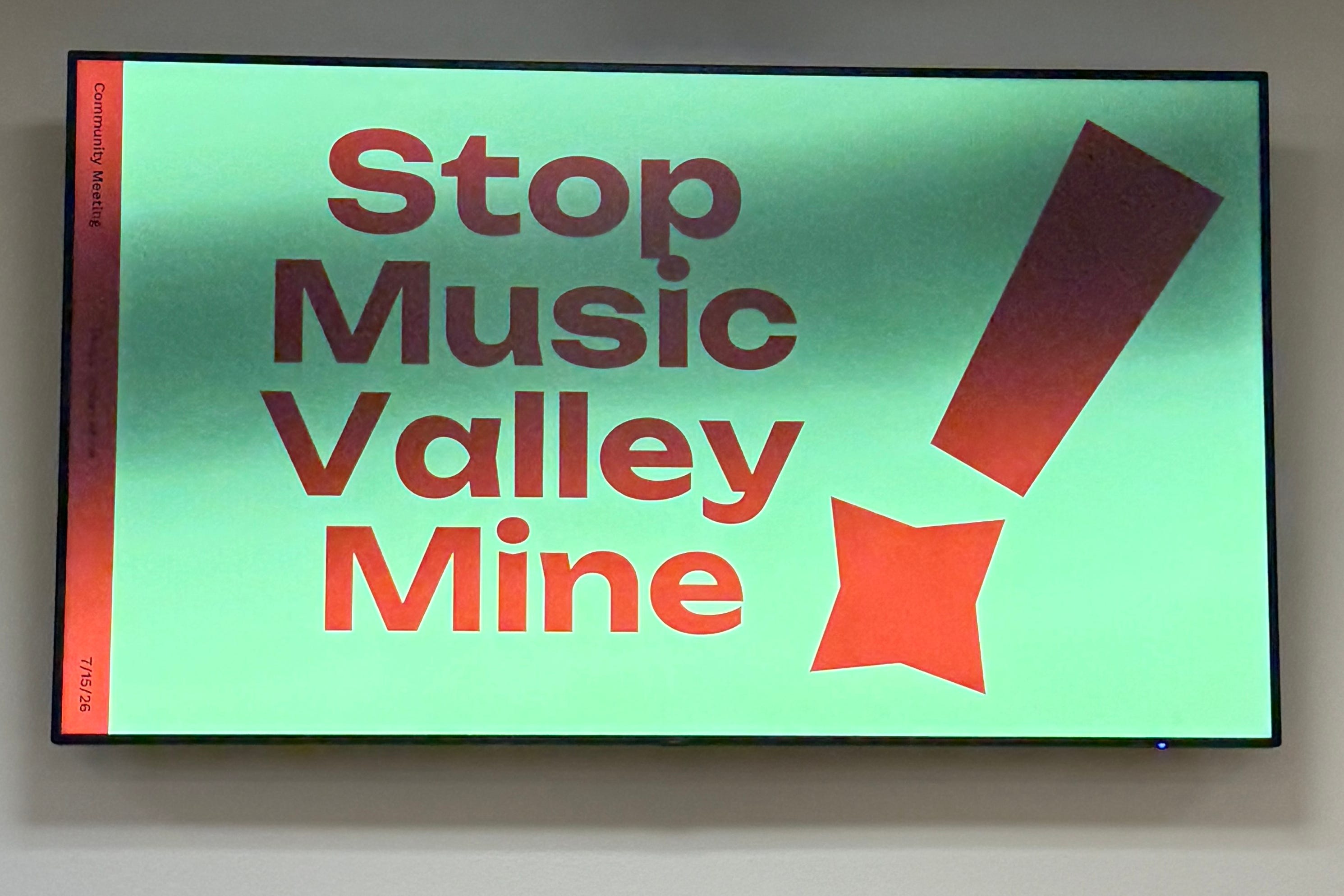
Because NPCA and MDLT see little chance of a fair hearing from the federal BLM under the current administration, they are urging residents to focus their energy locally. That means attending City Council meetings, pushing for a moratorium on mining traffic on City-controlled roads such as Baseline, Utah Trail, and Gold Park Road, and contacting water districts about mining's water demands. It also means showing up to the San Bernardino County Board of Supervisors meeting where the ordinance change will be considered and insisting that a form of local review, including public hearings, be called out in the proposed code revision. The meeting is tentatively scheduled for August 18. A petition addressed to the Board of Supervisors was circulating at the meeting.
Attend the Twentynine Palms City Council meetings on July 28 and August 11 and 25 and speak against the Music Valley mine. Our preview of the July 14 Council meeting includes tips for commenting using the new remote system as well as the new guidelines for comment length.
Attend or comment at the San Bernardino County Board of Supervisors meetings on August 4 and August 18 at 10 a.m. at the Covington Chambers, 385 N. Arrowhead Ave., First Floor, San Bernardino. Residents can also comment remotely. Guidelines for public comment to the County are here.
Sign up for updates from the National Parks Conservation Association: mosgood@nspca.org
We’re kicking off our summer subscription drive! Help the Desert Trumpet reach 1600 subscribers by clicking the button below and receiving Desert Trumpet in your inbox!
Audience Questions and Answers
Questions and answers have been edited and shortened for readability.
Q: Beth Sheffield: Is it true that the bulk of the mining claims are in Riverside County, not San Bernardino?
A: Chance Wilcox: Dan Walsh, the geologist for the county, said [at the July 9 San Bernardino County Planning Commission meeting], “Well, on a technicality, Music Valley Mine is not in San Bernardino County,” which is a half-truth. The patented claims, the claims that they own that they bought, are in Riverside County, but the bulk of all the new claims are all in San Bernardino County, which means that San Bernardino County has more to lose than Riverside County does.
Q. Beth Sheffield: So I think with the redistricting plan that they did recently for voting, does that mean that that area is actually going to be in Raul Ruiz’s district?
Yes, it is entirely in Representative Ruiz’s district [California District 25]4. Representative Jay Obernolte [California District 23] has taken a lot of photos with Dateline Resources and put them in his newsletter5…. Representative Ruiz has been particularly responsive when it comes to desert protections and understanding proper siting. We’ve had a great relationship with him, and he knows about the project.
Q: (Audience member): Are you putting any resources into legally challenging what the County would be doing if they adopt the proposal as it now has been recommended by the planning committee?
A: Wilcox: We are a national organization that’s subject to a lot of bureaucracy, and I can’t answer that question. But what I can say is that we always consider legal action when it comes to it. But right now, it just passed the Planning Commission and still has to go to the Board of Supervisors. So you all have a voice at that Board of Supervisors meeting, and we’ll see what happens there.
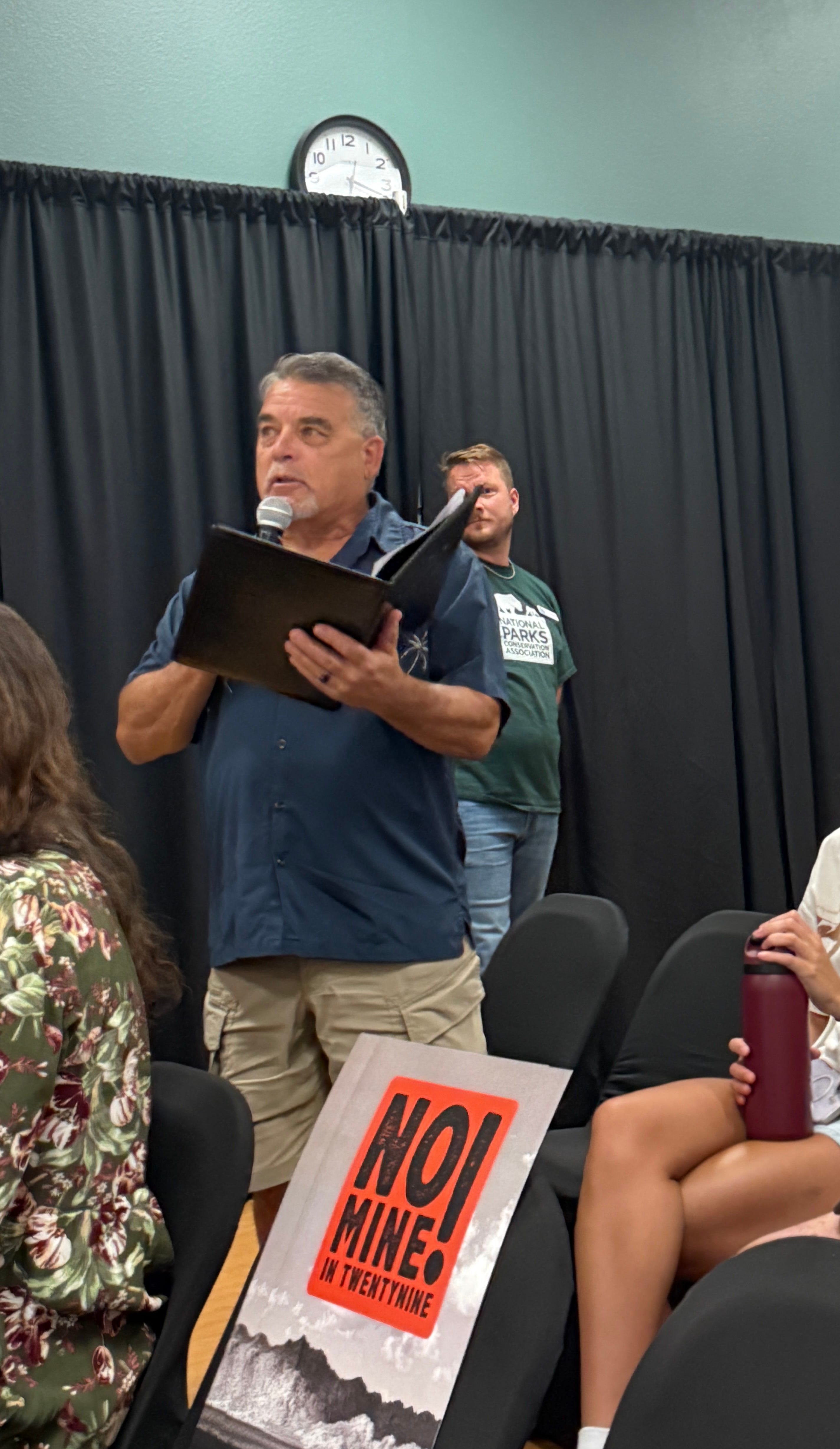
Q: Daniel Mintz (Mayor of Twentynine Palms): I have a couple of questions for 29 Palms specifically. The claim has to go through the City of Twentynine Palms, for the portion that’s in our City boundary. We have not heard from these folks at all, officially or unofficially. When you mentioned the claim for the portion that’s in the City of Twentynine Palms, will that claim have to come to us and not through the County?
A: Mason Osgood Yeah, that’s a good question. I don’t know exactly what your land use could say for projects like this, but if there are conditions in the City of Twentynine Palms land use code that a development project has to go to you guys and get some permits for road use and truck use, air quality use, then yes, they would go to you. Though if there’s not current land use codes under your jurisdiction…
Q. Daniel Mintz
We have mining codes.6
A: Mason Osgood
Then yes, you’re correct.
A: Chance Wilcox
The thing is that we don’t know because we’ve never seen this before. I think this also proves that this company in particular is very bold because we haven’t seen a mining company stake claims in a city. It just is not very common.
Q: Daniel Mintz
You were saying about the EIR [Environmental Impact Report] and CEQA, they would they would have to go through the federal government after the state CEQA and the state EIR.
A: Mason Osgood
So if they are moving toward the full mine process, they would have to go through the state of California CEQA process as well.
Q: Daniel Mintz
You know we turned down that solar farm in the city limits, but now that company took it back to the state, so we’re hoping we can beat them at that. So, do you guys hear any more about that? That’s going to be coming up. Make sure you use your voice for that too, because we turned that down.
A: Chance Wilcox
The City also owns the roads, and they need to use the roads. And the road goes through the Hansen Tract. If City does feel as though it’s in the best interest of the people for this, another action item is also to put a moratorium on the use of roads for mining activities within the City.
Q: Ruth Nolan: Is there information on possible pollution or air quality impacts? Could this become a Superfund site? Are they required to clean up? And what kind of pollution specifically?
A: Mason Osgood: There are certainly air impacts when it comes to large-scale mining, and we’re happy to provide some studies that have been done on other mines that operate in the Western United States. If this company does go through the full mine, they have to go through the whole Air Quality Control Act, Clean Air Act permitting, and that’s where they address a lot of those issues.
A: Chance Wilcox: With this federal administration right now, we’re seeing a lot of fast tracking of mining environmental impact statements as well. I’ve also heard that they are starting to use AI to write the environmental impact statements, so there’s also a big concern about accuracy right now with this administration.
With Colosseum, there is water pollution…after they closed in 1993, we’re still seeing high sulfate levels in water, and then with dust too, with all of the activity. This is not new. There are a lot of different mining projects throughout the desert that we’re still engaged on.
One project I point to is called Conglomerate Mesa, which is next to Lone Pine up in the Owens Valley. They have gone through pretty much this entire process for the last 10 years, if not more, at this point, and the BLM just made a decision.
When we talked to the coalition that worked on that project [Protect Conglomerate Mesa], they said, “The community has a voice. Talk to the counties. Talk to the City. Talk to everyone and prove that you do not want this.” Because at the end, no matter where this goes, it proves during the environmental impact statements and the assessments that the community had a voice, and that the community said, “Hey, we don’t want polluting.”
Q: Catherine Powell: Is it important for a large contingent to go to the next County Board of Supervisors meeting on August 18 or the central budget meeting on this issue? Have folks talked to the tribes? What documentation do you have about the rare earth mining site near the border of California?
A: Chance Wilcox: We are starting conversations with the tribe. First and foremost they’re always involved in everything we do, so we don’t have a specific statement from them yet or a specific stance. So I want to say that we are in conversation.
Mountain Pass does have good documentation. Mountain Pass is a weird situation. I only point to it as like an example of what this [Music Valley], could be. But it’s entirely on private property. They own all of that. They don’t have to go through any of the federal processes there besides pollution. But Mountain Pass does have documentation of pollution. That’s something that we can really point to as being a bad decision when it’s so close to people [ Music Valley] because Mountain Pass is not that close to people.
Q: (Wonder Valley resident): Are there access roads through Wonder Valley?
A: Chance Wilcox. One thing we didn’t mention because the main claims that they purchased are right here, which are accessed by Gold Park. Shelton Road is over here, so their new claims that they’ve staked are accessed by Shelton Road as well, which is concerning. If the City puts a moratorium on road usage for mining, it still leaves Shelton vulnerable, and that’s one thing that needs to be with the County in particular is that they may need to do the same thing as the City.
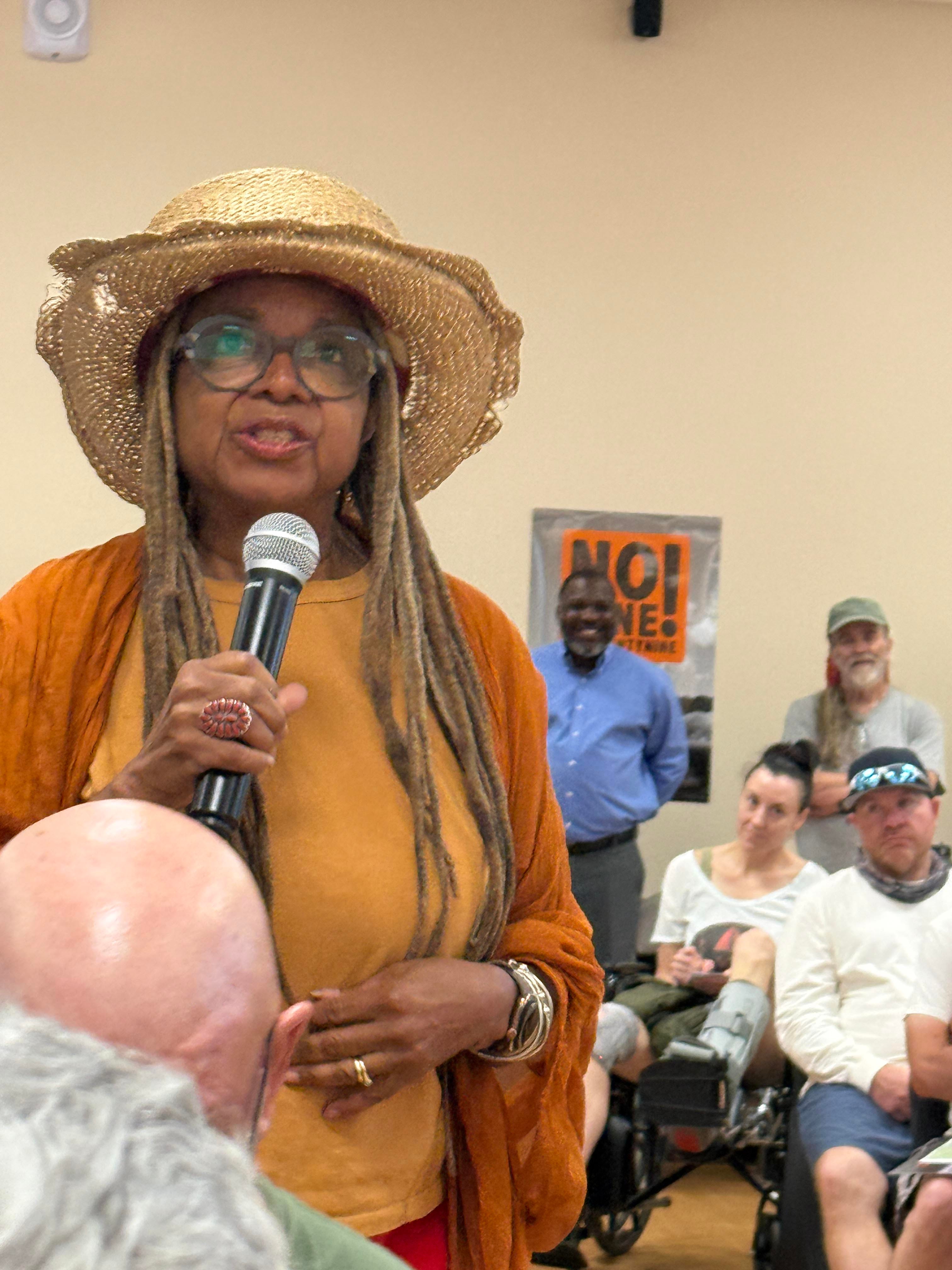
Q: (Audience member): Is there something we can do to get the Board of Supervisors’ attention — would petitions help?
A: Krystian Lahage. Yes — there’s a petition addressed to the Board of Supervisors on the ordinance. NPCA and MDLT are also hosting community and business mixers to build pressure. [See petition link above]
Q: Audience member: How can residents target Dateline’s investors to slow the project down?
A: Chance Wilcox: I think that you might hear from some people that they think that this is all a ploy for investment, that this company is seeking to throw all of its money into other projects like Colosseum.
But don’t get too comfortable with that idea. I think that making a fuss is important. That showing up and utilizing the media in the proper way is also important.
Thankfully, Twentynine Palms has a broad array of levels of media. You have so many different people in this room who can portray exactly what you’re thinking and feeling and acting as a community, and so showing up in numbers is going to be important and engaging media, and that’s also where we come in.
Dateline is very open on their investment page on their website. They say everything that they’re doing all the time. But there is one thing that they hide, and it is the location of their mining activity next to national parks. They have hidden it in all three of their projects in the California desert and so broadcasting that and their relationship to Joshua Tree and Mojave Preserve and Mojave Trails National Monument is very, very important. In your comments, point out the relationship to national parks because they know they’re hiding it.
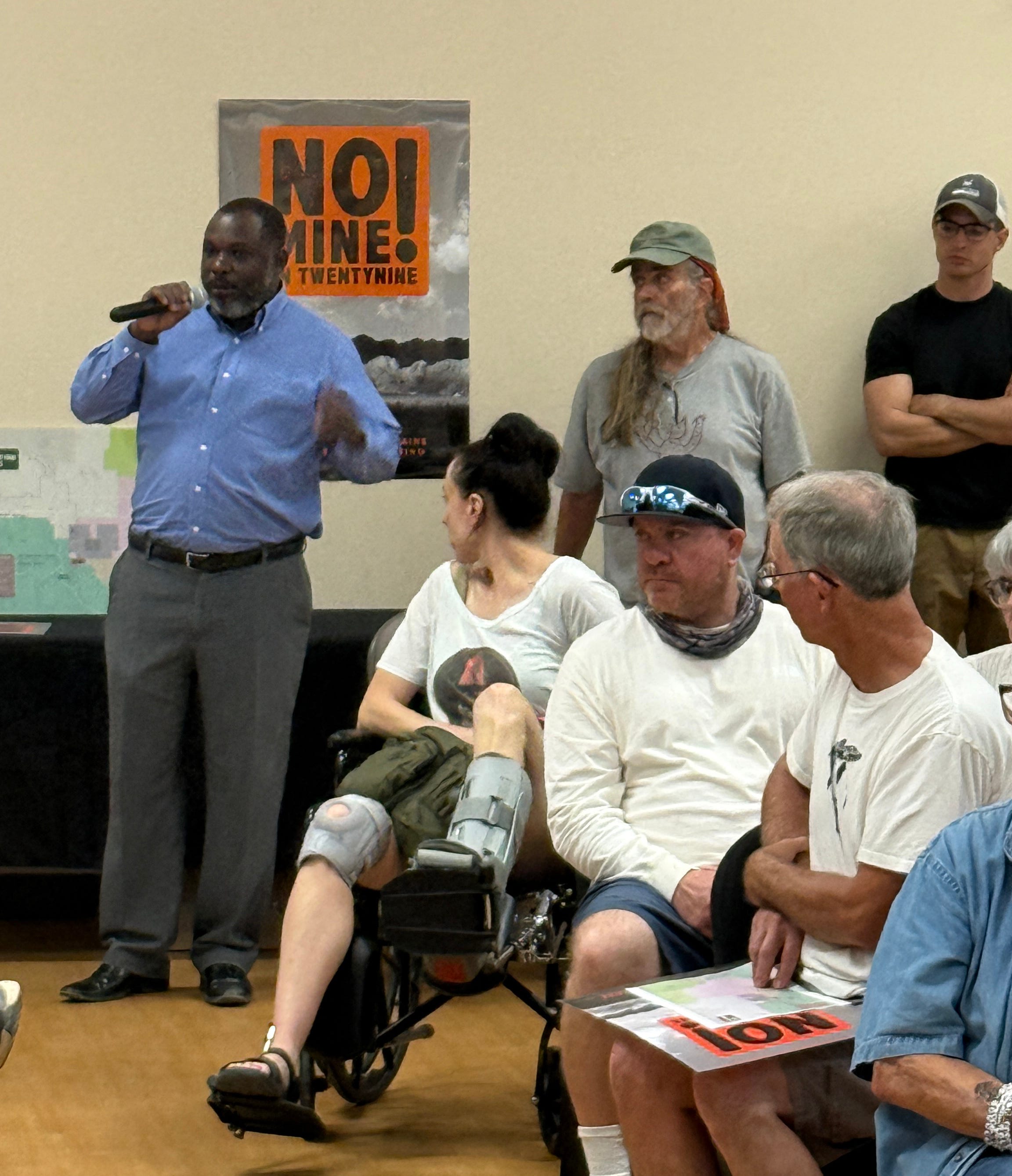
Q: Octavious Scott (Mayor Pro Tem, Twentynine Palms) I actually represent District 4, which encompasses the Hansen Tract neighborhood, and I just wanted to take this time to answer some questions from concerned constituents and let them know I think it is very important that we agendize this for a City Council meeting. I’m not sure of that by August 11th, but I definitely intend on trying to put this on the agenda.
It’s inconsistent with the general plan of the City of Twentynine Palms. We rely on tourism. We rely on Joshua Tree National Park, and you know we’ve already seen some development that has hindered that vision of our City. So I think it’s important that we be a little bit proactive this time and ensure that we protect neighborhoods, especially the Hansen Tract, as it’s a gateway to Joshua Tree National Park. I want to thank you for all you guys coming — the National Park Conservation Association, Mojave Land Trust — out here. Thank you guys for putting this on. Your City is listening.

Play Bingo and support nonprofit local journalism. Join us at the Red Dog Saloon on Monday, July 27 at 6:30pm for Desert Bingo — proceeds benefit the Desert Trumpet!
References
Reporting & commentary
Los Angeles Times, “Next to Joshua Tree National Park, a mining company is staking its claim for rare earth minerals,” March 30, 2026. [insert LAT URL]
Cindy Bernard, “San Bernardino County Planning Commission Recommends Giving Up Local Permitting Over Mines on Federal Land,” Desert Trumpet, July 13, 2026.
Kurt Schauppner, “Australian company plans rare earth mining near Joshua Tree National Park,” The Desert Trail (Hi-Desert Star), July 9, 2026.
Peyton Daley, “Rare earths mining takes a heavy toll. Is it worth moving mountains for a domestic supply?” Stanford University, & the West, January 31, 2026.
Friends of Jawbone, “Federal Court Orders OHV Route Closures in Mojave Desert,” February 4, 2026.
Interviews & podcasts
90 Miles from Needles, “Don’t Mine 29! Australian Company Threatens Joshua Tree,” podcast.
Z107.7 FM, “Will there be a mining operation in the Pinto Mountains outside Twentynine Palms?”
Z107.7 FM (Gary Daigneault), “Up Close with Dawn Rowe,” interview with Supervisor Dawn Rowe. [insert URL]
Company documents
Dateline Resources Limited (company website).
Dateline Resources Limited, “Dateline Expands Music Valley HREE Project,” ACCESS Newswire, June 22, 2026.
Dateline Resources Limited, “Dateline Returns Widespread REE Mineralisation at Music Valley,” via Yahoo Finance, July 15, 2026. [insert correct URL]
Government records & primary documents
San Bernardino County Planning Commission, “Agenda and Staff Report, Item 3 (PMISC-2026-00029),” July 9, 2026.
City of Twentynine Palms, Development Code, Chapter 19.58 (Surface Mining and Land Reclamation Permit) and §§ 19.20.030, 19.18.020, via Municode.
Bureau of Land Management, Pinto Mountains Wilderness.
Bureau of Land Management, Areas of Critical Environmental Concern (program overview).
Bureau of Land Management, “BLM CA Areas of Critical Environmental Concern” data layer (Pinto Mountains ACEC).
Bureau of Land Management, West Mojave Route Network Project.
Bureau of Land Management, Mineral & Land Records System (MLRS).
Desert tortoise WEMO remand-and-remedy court order, “Order,” January 23, 2026.
The White House, “Fact Sheet: President Donald J. Trump Takes Immediate Action to Increase American Mineral Production,” March 2025.
Osbourne Minerals Inc., Notice of Location, “JT1057” Lode Mining Claim, June 29, 2026, San Bernardino County (field photograph).
Correspondence with San Bernardino County Land Use Services, the City of Twentynine Palms Community Development Department, and the Bureau of Land Management (Barstow and Palm Springs–South Coast field offices), July 2026.
Legal references
General Mining Law of 1872; BLM surface-management regulations, 43 CFR Part 3809.
Surface Mining and Reclamation Act (SMARA), California Public Resources Code § 2710 et seq.; CEQA Guidelines, 14 CCR § 15061(b)(3).
California Coastal Commission v. Granite Rock Co., 480 U.S. 572 (1987).
NOTE: Desert Trumpet staff members Cindy Bernard, Kat Talley-Jones, and Heidi Heard are on the organizing committee of Indian Cove Neighbors, which filed a lawsuit on the Ofland Resort with co-litigants the Center for Biological Diversity (CBD) who are mentioned in this article.
This report was produced with some AI assistance, reviewed, edited, and fact-checked by humans. Please see our AI policy.
Hi, new subscribers! Desert Trumpet understands you might not be interested in all of our coverage. That’s why it’s divided into separate newsletters allowing you to opt out of reporting that’s not important to you. For instance, you may want our Education news but not City Hall 29.
Here’s how to opt out: go to your Substack settings, scroll down to “subscriptions,” and select “Edit” for the Desert Trumpet. Simply uncheck the box next to the newsletters you don’t want to receive in your email inbox. You’ll still be able to access all coverage online if you change your mind.
Support Desert Trumpet’s coverage of the Music Valley Mine — become a paid subscriber!
The Desert Trumpet’s reporting will always be free. That said, did you know that paid subscribers receive discounts on our DT Social events and invites to DT Front Porch, intimate discussions featuring local officials and notable residents?
Upgrade to a $50+ paid subscription for a 10% discount.
Upgrade to $100+ for a 25% discount.
Sustaining subscribers at the $250+ level and above receive complimentary tickets
Leave your thoughts in the comments below. Please note that we do not allow anonymous comments. Please be sure your first and last name is on your profile prior to commenting. Anonymous comments will be deleted.
This coverage is free - please share!
More precisely, per the BLM as reported on Mining.au, “The company filed 973 claims in February, covering about 19,380 acres.”
The impact of this change is disputed. As noted above, the County likely could not use a permit to block mining on federal land. Federal law generally preempts local governments from prohibiting federally authorized mining on federal land. However, that preemption isn't total: under the U.S. Supreme Court's 1987 Granite Rock decision, state and local governments may still impose reasonable environmental regulation on mining on federal land. So rather than waiving its permit, the County could keep a local review-and-notice step, one that would preserve public notice, hearings, and enforceable conditions, and retain the County's clearer authority over the reclamation plan (which state mining law requires even for mines on federal land, and which carries its own CEQA review and public process), the non-federal portions of any operation, and County roads. Such a review would not be a veto over a federally approved mine, but it would keep residents informed and give them a formal say. Losing the County permit also would not necessarily eliminate CEQA review, which could still be triggered by other required state approvals for the reclamation plan, or an incidental-take permit from the California Department of Fish and Wildlife, since the desert tortoise is a state-listed species. Exactly how far these state and local reviews reach onto federal land is unsettled and contingent on the facts of each specific case.
The petition refers to the County’s permitting authority, an authority it does not have for federal lands. However, as stated in footnote 2, the County could opt to retain local review.
In a separate interview on the 90 Miles from Needles podcast, Wilcox described Twentynine Palms and the Music Valley project area as moving into Rep. Raul Ruiz's district (California's 25th) through redistricting "next year" — an indication that the congressional boundaries for this area are in flux.
The photo Wilcox referenced of Rep. Jay Obernolte with Dateline Resources appears on Obernolte's Facebook page, so we linked to that.
The City of Twentynine Palms does have mining regulations: Development Code Chapter 19.58 requires a Surface Mining and Land Reclamation Permit, and the zoning code allows mining only as a conditional use requiring City Council approval in the Open Space (OSR) and Community Industrial (IC) districts. Those City rules, however, govern mining on non-federal land; the City's Community Development Director told the Desert Trumpet the City "typically has no land use authority" over federal land and would be a "responding agency, not a lead agency" for a project on BLM land. What the City clearly does control is its own infrastructure, so it could regulate mining-related truck traffic on City-maintained roads such as Gold Park Road, one of the local levers organizers are urging. (Air-quality permitting for a mine, by contrast, would fall to the regional Mojave Desert Air Quality Management District, not the City.)