
RECAP: Twentynine Palms City Council Rejects Solar Farm in 3-1-1 Vote, March 23, 2026
“This is not something I can support.” —Twentynine Palms Mayor Daniel Mintz

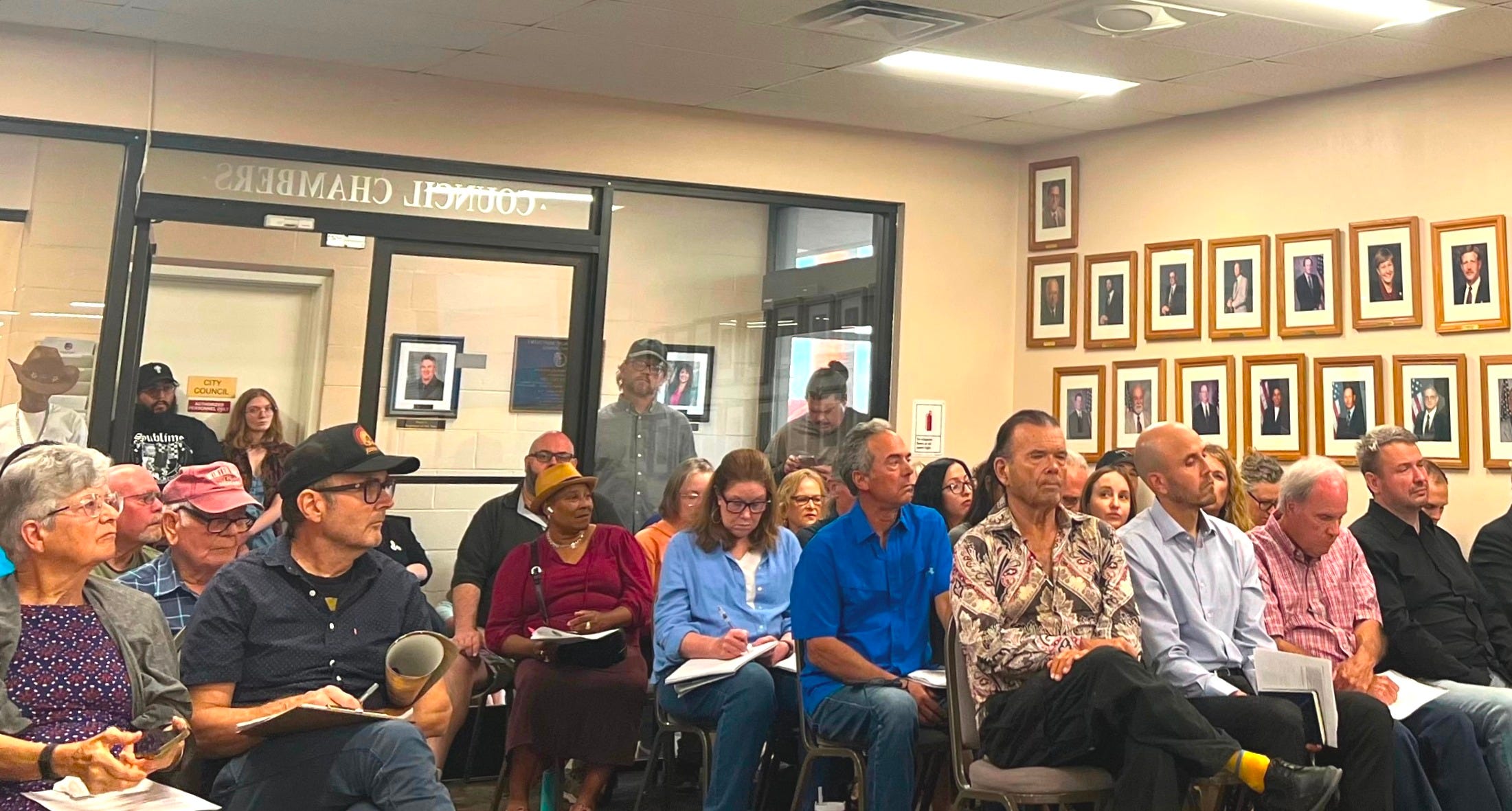
Clocking in at just over three and a half hours, the turnout at Monday’s City Council meeting sent a message to industrial solar farm developers E-Group PS—take a hike. With all seats full and an overflow audience that was standing room only, it was abundantly clear that the evening’s discussion topic of building a 184-acre solar farm on the northwest end of town was a pressing issue for many.
Our agenda preview of the meeting is available here; video footage of the meeting can be found here.
For Awards and Presentations, Council commended Planning Assistant Diane Olsen on her retirement and heard a positive grant update from Reach Out Morongo Basin Director Robin Schlosser. They also approved the Consent Calendar and closed out construction for a veterans housing project on Elm Avenue. Then, Council took on the agenda item that was on everybody’s minds—the E-Group PS solar project. Councilmember Steven Bilderain recused himself from this topic due to the project’s proximity to his residence.
Solar Project by the Numbers
The E-Group PS project—also sometimes known as the Harmony Acres Solar Project 1—consists of a 184-acre industrial-solar facility on two parcels that total 477 acres north of Two Mile Road and west of the northernly extension of Noels Knoll Road. Passage of the development entailed rezoning part of the property from residential to a new land use category— Renewable Energy—and rezoning the rest to accommodate higher density housing.2
Community Development Director Keith Gardner introduced the project and said that based on very rough estimates and assumptions calculated by the City’s finance and legal team, the City could expect $8,296,098 in benefits package and sales tax revenue3 over the 30-year lifetime of the project. Currently, large-scale solar projects are not subject to property tax in the state of California.
Our previous coverage of the solar project is linked here.
The Developer’s Case
E-Group representative Robert Smith, an attorney with K&L Gates LLP, opened with the project’s main selling point: the proposed community benefits package, which allotted $105,000 to the City annually during construction, and up to $150,000 annually once the project was fully operational, with an operating contingency of 30 years.
Smith’s presentation stated that the City could expect a potential $2,475,000 in property tax revenue from the project. This figure was listed despite SB 710, which was just renewed in the 2025-2026 state legislative session and exempts large-scale solar projects from having to pay property taxes until 2031.
California has renewed this exemption repeatedly over its 25-year history, suggesting a pattern of extension, making it unlikely the property tax exemption on solar projects will actually sunset in 2031.
Regarding sales tax revenue, Smith argued that within five years of operation, E-Group would become the single largest individual taxpayer in the city. Smith proposed:
We’ve also recommended to staff and certainly this is a question that we need to discuss with the City Attorney, but we’ve said we’d be comfortable to include a provision in the Development Agreement that says that the developer will use its commercially reasonable efforts to maximize the sales tax revenue for the city.
This despite the Development Agreement already having been penned out and ready for a Council vote that night.
The AB 205 Caveat


The elephant in the room was AB 205, signed into state law in 2022, which gives the California Energy Commission (CEC) the potential authority to issue permits for solar photovoltaic facilities with a generating capacity of at least 50 megawatts, overriding local approval process.
As confirmed in a letter by CEC Program Manager Eric Knight, the current project proposed by E-Group does not meet the required specifications to qualify for AB 205. To meet that AB 205 requirement, Smith claimed all E-Group would have to do is add more inverters to the solar rows. The comment carried far more nuance, however, than a simple fix. Smith elaborated:
We don’t need to expand the acreage. We don’t need to change anything about the project beyond that. We do not need to expand the project footprint. All that would require a revision to four pages of the EIR in front of you tonight. We could probably do it in a couple hours. Again, we don’t want to go to the CEC, but could we prepare a project that would be submitted for CEC approval that meets it? My answer is easily. And again, this is not a site limited project. We have 484 acres under lease. So for whatever reason, if the CEC wanted us to expand or required us to expand to greater acreage, we have more land under lease to do so.
Smith’s claim was speculative as only 241 acres was proposed for rezoning to “Renewable Energy” with the balance being used to satisfy SB 330, due to the loss of residentially zoned land.
Regarding potential exposure to valley fever and dust mitigation concerns, Smith said developers have offered to provide HEPA filters to all residents within 1.5 miles east of the project site for the entire duration of construction to reduce dust impacts. However, as Aidan Marshall, who spoke on behalf of Citizens for Responsible Industry, later pointed out during public comment, this offer was also not included in the Conditions of Approval nor the Mitigation Monitoring and Reporting Program, and therefore, the City’s legal enforceability was tenuous at best.
On the efficacy of HEPA filters in reducing valley fever exposure, Marshall stated:
Our expert toxicologists submitted numerous reports demonstrating that these do very little to address the spread of these small lightweight spores that would be affecting both workers and residents.
Another public commenter, Gina Kohn, further reiterated the risks of valley fever:
A family member of mine who lived about a quarter of a mile from a 600-plus acre development site in Rancho Mirage contracted valley fever last year and passed away a week ago from this debilitating illness. I share this not for sympathy but because it underscores the seriousness of the risk we are discussing.
Council Questions for the Developer: No Guarantee of Local Jobs
Mayor Pro Tem Octavious Scott asked:
What mechanism are you using to guarantee that you’ll use locals for the construction jobs? I understand there’s 200 jobs. How are we going to guarantee that some of those jobs come into Twentynine Palms?
An argument those in favor of the project had made was that it would bring much-needed construction jobs and employment to the residents of Twentynine Palms. However, this argument was quickly shut down by Smith, when he mentioned E-Group was already negotiating with an out-of-area union. Smith said:
Currently in the development agreement there is no language that requires them to be located here, and we are in negotiations with a union that has at least wanted us to sign a project labor agreement. They’re represented by counsel here tonight. And so if those negotiations were successful, that may implicate how many people here are local.
Councilmember McArthur Wright expressed concerns with the residential zoning that would surround the solar farm development.
I need more clarification on this because you want it rezoned for single family [residential] just to meet a quota, but would you build a house there?
“We’re not residential housing developers.” rebutted Smith.
Wright pressed the issue:
No, I’m talking about you individually. Would you build a house there and live next to a solar farm? Because that’s basically what you’re asking. If we rezone that to Residential-1, and then we build residential homes on that lot, that’s what we’re asking families to do.”
Smith, “That’s correct. It’s already residentially zoned though, so we’d be increasing the…potential allowable density for that area. But that’s again already a residentially zoned area.”
“Yeah, but you didn’t answer the question,” said Wright.
Smith chimed, “Whether I would personally build a house there? I sort of like the house I’ve got, so I’m probably just going to stay with my current house.”
“Is that house in 29?” Wright continued.
“No,” said Smith.
Councilmember April Ramirez, who was the sole vote in favor of the project by the end of the proceedings, established through a series of yes/no questions that Smith is an attorney who specializes in high-impact legal fights against local and state agencies regarding land use. She cited three U.S. Supreme Court cases decided over 30 years ago: Nolan v. California Coastal Commission (1987), Dolan v. City of Tigard (1994), and Lucas v. South Carolina Coastal Council (1992) that rule that government regulations (such as the City’s ban on industrial-scale solar facilities) can constitute an unconstitutional "taking" of private property requiring compensation.
By showing on the record that Smith is an attorney who specializes in fighting local and state agencies on land use, and then naming those three specific cases, Ramirez was signaling that if the project was rejected, the City could get sued by E Group—and lose.
Public Comment: Majority In Clear Opposition
Unlike the turnout for the Ofland Resort development vote in July 2025, where some of the community and many members of the City’s former leadership advocated for approval, the opposition to the proposed E-Group solar project was far more palpable.
26 public commenters spoke against the project and five were in favor.


Mayor Daniel Mintz reported a number of emails had been submitted to Councilmembers in opposition to the project and also mentioned an informal petition had been submitted to him just moments before the meeting that had collected more than 40 signatures in favor of the project.
Public comment opened with resident Mary Kay Sherry, who reminded Council of the 2012 ordinance that Council passed that had banned industrial-scale solar projects. Sherry displayed a large photo of two desert tortoises that live on the property.
Exemplifying how political opinions can shift over time, Sherry read a letter that was submitted to council by George Mulopulos in 2012 in support of the City-wide industrial scale solar ban. Mulopulos is the principal of Proactive Properties LLC, which is currently leasing the property to E-Group. Part of the 2012 letter, signed by Mulopulos, states:
… It does not seem wise for the city to assist in creating a 3rd area of Industrial zoning, in a residential area, when the city already has ample, unused, industrial zoned land.
Resident Cindy Bernard, editor of Desert Trumpet, said that the developer has been obfuscating the number of successful solar projects they operate and encouraged the City to trust the California Energy Commission:
Let’s see what the state will do. We have to trust that the CEC is going to protect us, because I think they will.
Herb Mark, resident since 1964, addressed the issue of revenue:
I ask that you guys stop looking at E-Solar as a cash cow to solve your problems. Your flat revenue projection or whatever it may be– they’re not a cash cow — it’s pennies on the dollar. You guys are trying to trade pristine desert for dollars. Don’t do it.
Resident Stephanie Ballard spoke on the endangered desert tortoise:
I live in 29 Palms, three miles from this proposed solar project. The reason I’m here right now is to advocate for those with whom we share this land — and that is the desert tortoises. Already endangered, their fate is threatened by developments like this proposal. This location is tortoise habitat, and many do live there. Some also die there, as I recently witnessed. I was driving up Lear Avenue one morning and I saw the remains of this unfortunate creature.
Ballard struck a chord as she displayed an image of a desert tortoise that had been killed by a vehicle on Lear Avenue, just west of the proposed project site.
Speaking in favor of the project were Evan Cuellar, of Indian Cove, and George Mulopulos, Kayla Neeley, resident Dane Austin, and Johnnie Ray Ward Jr., former MUSD School Board candidate.


Ward spoke on the reliable revenue the project entailed for the City:
The loud voices we usually hear are not the majority. It’s the loud minority. Nine-to-five, two-to-three job working families, children they have to go home to — they don’t have time to write letters or attend meetings. We see the burned down buildings, the shacks, the eyesores.
Joseph Candelaria, born and raised in Twentynine Palms, was opposed to the project, saying he does not wish for his children to grow up next to solar farms or data centers, and called the community benefits package of $105,000 small money, equating it to half of the City Manager’s salary. Candelaria, with added humor, closed:
Because I did work 40 hours this week, and I’m still here.
Hannah Romsberg, who has previously monitored construction projects, called developers untrustworthy and asked why the City would consider doing business with someone who keeps lying to them. Romsberg expressed concerns with the amount of mass grading required for the project, calling the land unsuitable for a solar project:
This is going to present an issue to our most vulnerable neighbors — our elderly neighbors, including retired veterans, children, people with upper respiratory issues. So it’s not just the valley fever, it’s the dust in general because of this mass grading.


Reiterating the concern of dust was Erin Flanagan, who read a letter penned by ecologist Pat Flanagan:
Once excavated, the soil fluffs by 15 to 50%. So the 264,000 cubic yards become 400,000 cubic yards. Unfortunately, this redistributed dirt, no longer nourishing soil, would not support growth of the promised stabilizing plants, no matter how much they water and stomp on it.
Two Planning Commissioners, Jim Krushat and Alexander Garcia, also spoke out against the proposed project. Krushat raised the point of abundant solar projects in the surrounding area:
The California Energy Commission has greater resources and more time — 271 days. We got 107. And I don't think it's automatic to assume that the California Energy Commission would approve the project. We have a high density of solar fields in the area and that would go into consideration.
Commissioner Garcia said:
We work for you guys. We don’t work for corporations. And this is Twentynine Palms. We’ve been here our whole lives.
40-year Joshua Tree resident David Fick, spoke on behalf of the Morongo Basin Conservation Association, who helped advise on a $19 million shaded solar parking structure at Copper Mountain College as well solar parking installations at more than 15 Morongo Basin Unified Schools, encouraged Council to deny the project:
Call their bluff — because they’ll probably implode. Their project will not be feasible to go forward. They need 40 to 50 acre-feet of water minimum in all the soil moving and compaction. Just keep the ban, keep the integrity.
Phillip Smart, 12-year resident, drove the point home.
I never thought I’d use the phrase “not in my backyard,” but how about “not in our backyard?” I don’t get why these people would choose a community that has an ordinance against their project when there’s whole freaking Southern California available to them. And $105,000 a year — what’s the budget for paper towels for the city? You can spend $105,000 pretty fast on anything. I drove out to that place. It’s a pristine hillside — creosote, the whole bit. Just what we love about this. Why does it have to be in our little community? I don’t get it.
Further Council Discussion and the Final Vote
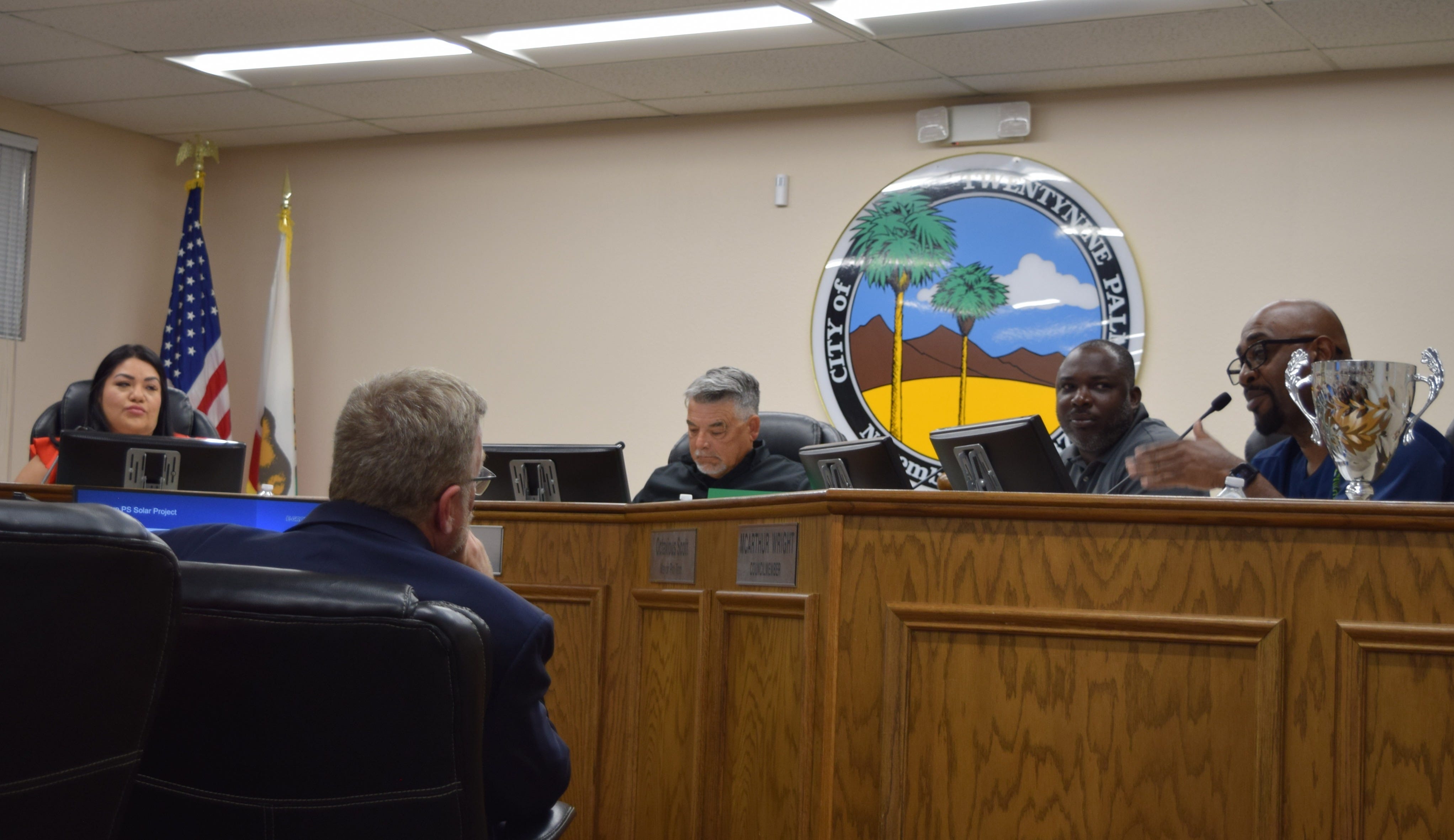
Assistant City Attorney Jennifer Farrell and the City CEQA (California Environmental Quality Act) Consultant, Nicole Criste of Terra Nova Planning & Research, were present to answer Council questions.
Regarding AB 205, Mayor Mintz inquired with staff on the EIR being changed to add new inverters and the public process. Criste confirmed that the EIR could be recirculated if there were significant changes made, which would be determined by the City.
Developer representative Smith said the EIR would go through the CEC, which Criste rebutted, implying the City has more influence over the state approval process than developers:
Under CEQA, the CEC is a responsible agency only if the City certifies the EIR first. If the City does not act on the EIR, then the CEC has no opportunity to be a responsible agency, and I just want to make that clear.
Mayor Mintz pushed back on the developer’s claims that the City has a ban on all solar, citing the numerous solar installations that can be found at the City’s public schools. He spoke about his justification for voting in favor of the City’s industrial solar ban back in 2012, saying he could not support this project.
I've struggled with this because when I asked Mr. Gardner to show me all the lots around it, basically they'll be useless because no one's going to want to build a house living in the city next to a bunch of solar panels.
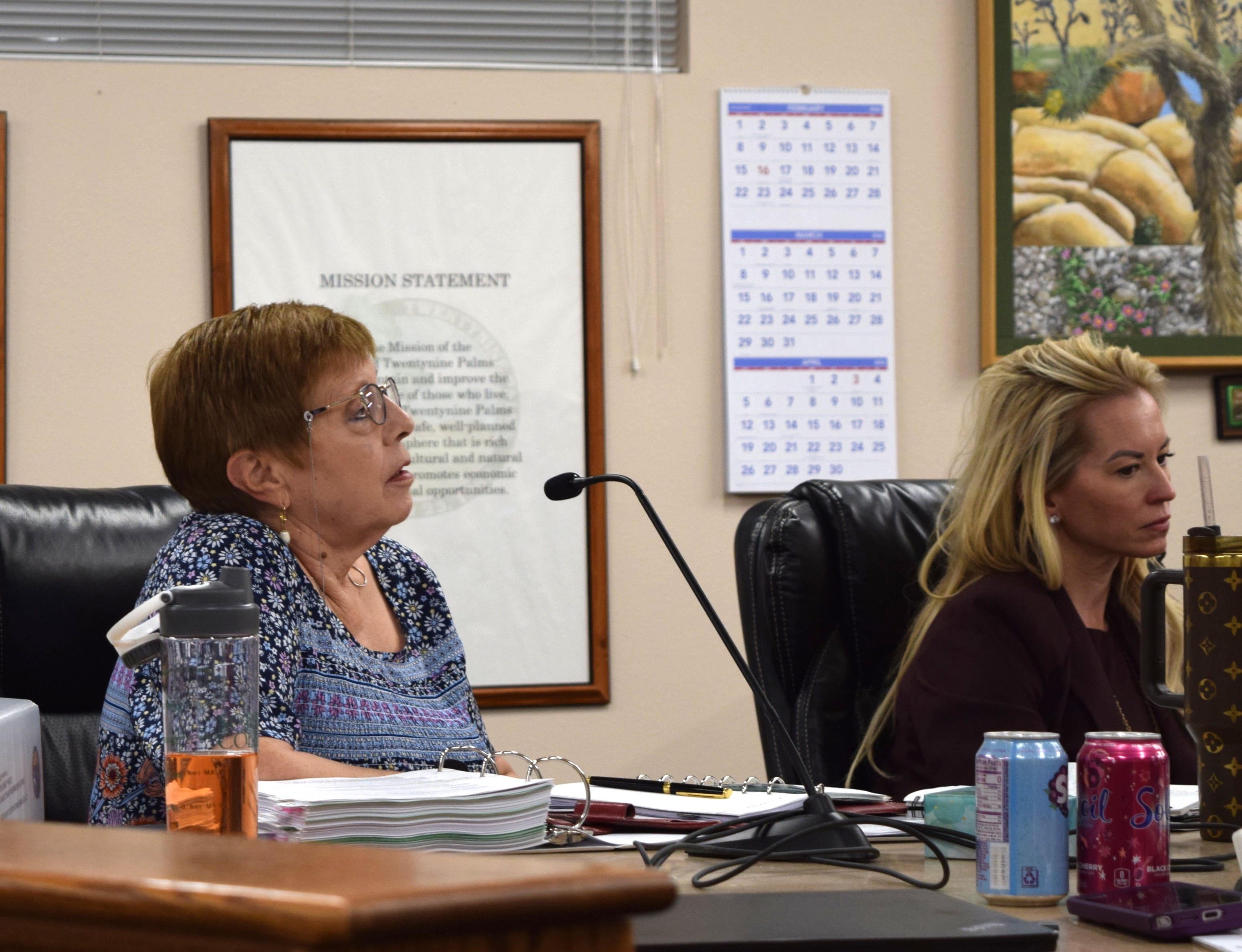
Councilmember Scott asked Assistant City Attorney Farrell if approving the project meant the City was rescinding this ban, which Farrell confirmed it would not. Scott expressed his wish to uphold the City General Plan.
Councilmember Ramirez used the passage of AB 205 as justification for her project support then raised an issue that was seemingly targeted at a specific speaker from the public:
AB 205 is what the people wanted. That is what the people voted for for the state of California. Number one. Number two, Dr. Mulopulos, your property is your property and you are free to do what you want with it. It is your constitutional right. I have some people here telling me that I need to not sell out and “Where’s my integrity?” and I have a really hard time weighing that when those same people talking about integrity can find themselves on Megan’s Law website.
As mentioned by Mayor Pro Tem Scott in a social media post following the Council vote, State Senator Shannon Grove, who represented Twentynine Palms at the time, voted against AB 205— meaning the people of 29 Palms, as represented at the state level, voted against it.
Ultimately, the motion to deny the solar project was posed by Wright, and seconded by Scott; motion to deny passed 3-1-1 with Ramirez as the sole dissenting vote.
The next City Council meeting will take place Tuesday, April 14, at 6 pm.
Desert Trumpet has sufficient funds to operate through June. We need your paid subscriptions to publish the coverage you depend on.
Upgrade your subscription from free to paid today for just $50 per year or $5 per month. Want to make a one-time donation or are you able to give more than $100? Donate via Paypal!
Leave your thoughts in the comments below. Please note that we do not allow anonymous comments. Please be sure your first and last name is on your profile prior to commenting. Anonymous comments will be deleted.
Thanks for reading! This post is public so feel free to share it.
The developers call it the Geneva Solar Project for unknown reasons.
Due to SB330 State housing law requirements
Revenue from the sale of energy produced to Southern California Edison.
A couple of corrections to what Ms. Ramirez stated:
1) There was no public vote on AB 205. It was instead passed by the state legislature, therefore it cannot be said that it represents what "the people" wanted;
2) What Dr. Mulopulos can do with his property is constrained by local and state restrictions and issues related to zoning. Hence the need for and EIR, a recommendation from the Planning Commission, and the City Council vote.
Furthermore, it is unfortunate that Ms. Ramirez feels the need to smear her own constituents. A City Councilmember should be more charitable toward those they represent. Her behavior is unprofessional.