
RECAP: Twentynine Palms Planning Commission, February 17, 2026, Part 1
E-Group Solar representatives face tough questions from skeptical commissioners

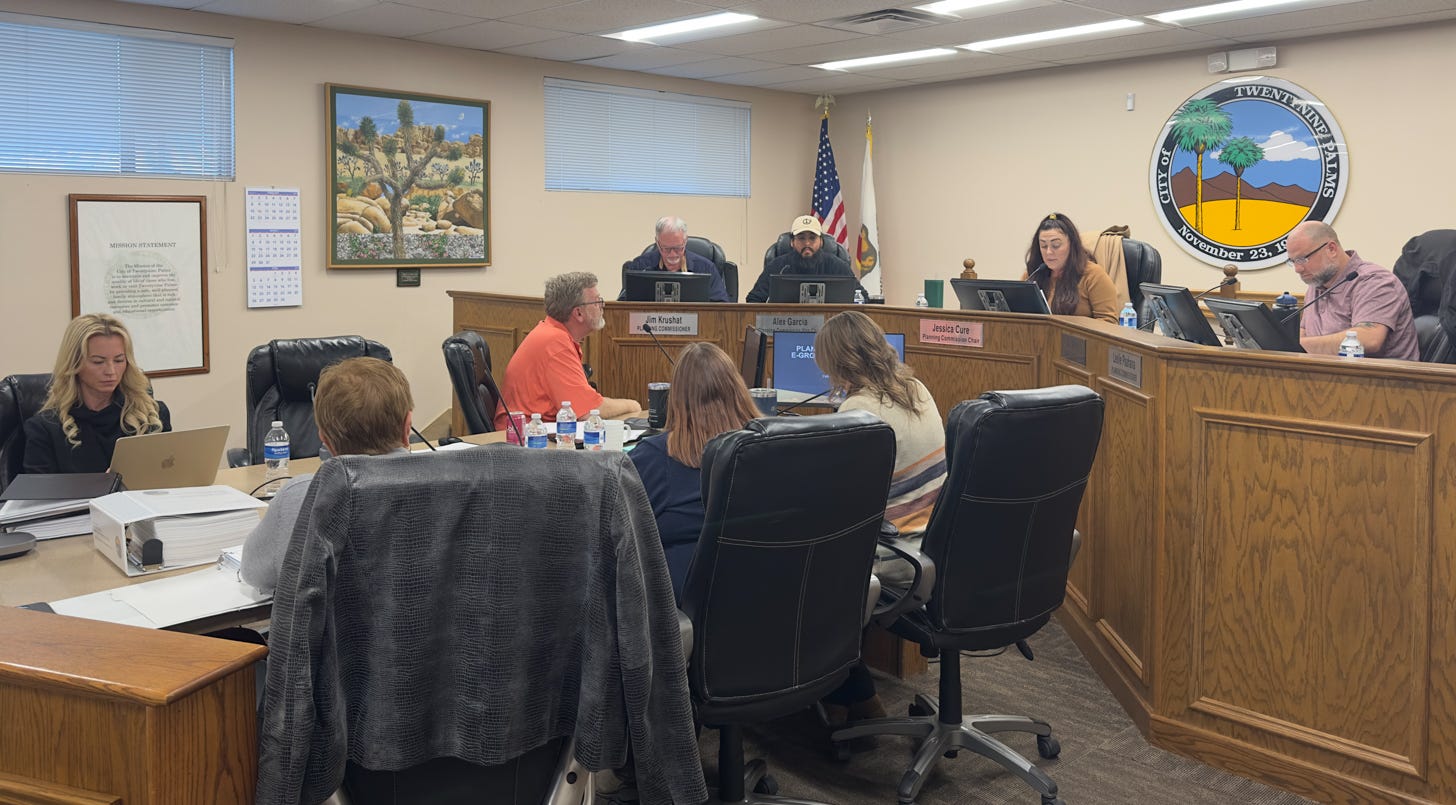
Desert Trumpet Editor Cindy Bernard summarizes the meeting.
In a two-hour and 45-minute marathon that ended with a continuance to their March 3 meeting, the Twentynine Palms Planning Commission lobbed questions at representatives of the E-Group Solar Project and considered in-person public comment from 21 residents and letters from five more.
Four of five Commissioners were in attendance, with Commissioner Leslie Paahana out with an excused absence. In addition to usual staff attendees Community Development Director Keith Gardner, Planning Assistant Shelley Green and Assistant Planner Diane Olsen, Assistant City Attorney Jennifer Farrell and Terra Nova Representative Nicole Criste were also present.
For reference:
The meeting kicked off with the approval of minutes from two prior meetings. In general public comment, Alex Barron reiterated his January 20, 2026 question about the process of asking for changes to the municipal code. Community Development Director Keith Gardner replied that there is an application form to request changes and that he would reply in writing.
PUBLIC HEARING: E-GROUP SOLAR PROJECT
The E-Group Solar Project is planned for a 477-acre site that is currently residentially zoned. It is located north of Two Mile Road, south of the City limits, west of the northerly extension of Noel’s Knoll Road, and east of the northerly extension of Canyon Road. Should the project be approved, the northern 241 acres would be designated a new “E-Zone” with solar panels occupying approximately 184 acres of the new zoning designation. As was learned at the meeting, E-Group will not acquire the parcels—a lease with large landowner George Mulopulos via Proactive Properties LLC will remain in place for the life of the project. Mulopulos has not divulged the revenue Proactive is receiving through that lease.


The project was presented by Robert Smith, from K&L Gates LLP, the law firm representing E-Group PS LLC. Peter Bobro, a principal of E-Group, was also present as were representatives from consulting firms contributing studies in the Draft Environmental Impact Report (DEIR).
Because of the length and depth of the meeting, we’ve decided to break our recap into two parts: Part 1 will cover non-CEQA topics: AB205, the Community Benefits Package and the potential timeline. The discussion of environmental impacts and public comments will be covered in part 2.
A common complaint among Commissioners was the lack of sufficient time to review the 383-page agenda packet, which was partially released on Thursday, February 12, then amended with 14 more pages the next day. This was in addition to the 1,000-plus page DEIR, which was posted on the City website in December 2025.
Community Benefit Package: “The juice just ain’t worth the squeeze”
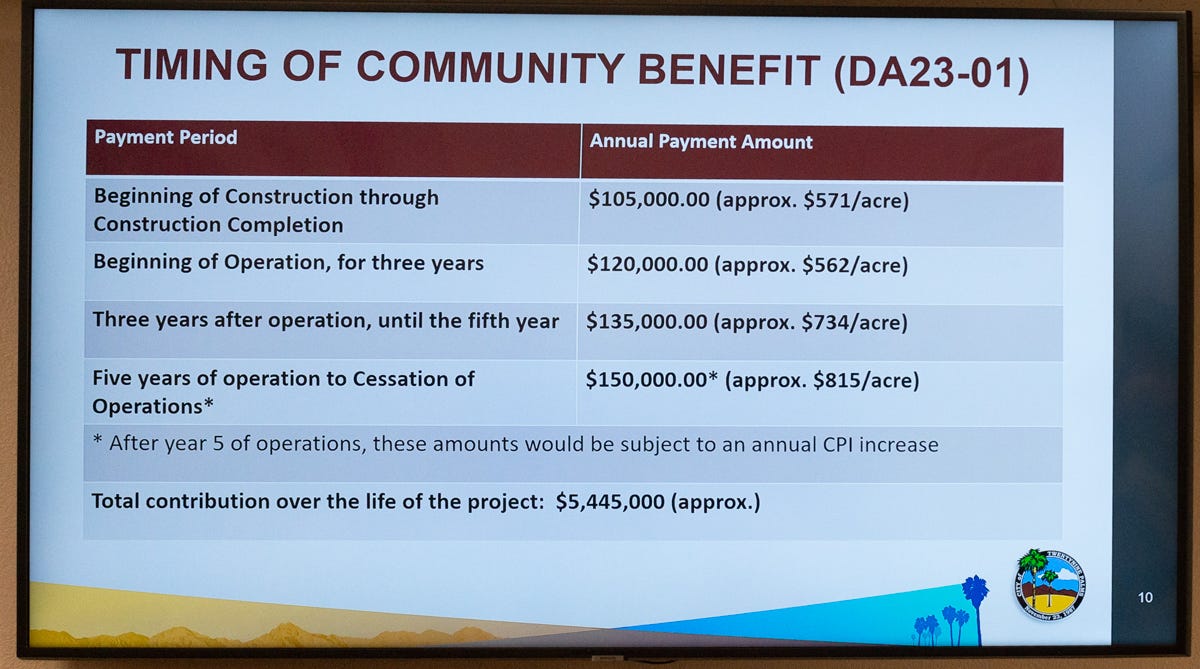
Theoretically, the passage of California Assembly Bill 205 in 2022 makes it possible for E-Group PS, the project’s developer, to bypass the City and pursue state-level permitting through the California Energy Commission (CEC) because of the urgency of climate-friendly energy solutions. This threat has been wielded by E-Group since their initial approach to the City, which prompted some lively discussion among the commissioners and Smith. As Commissioner Krushat put it:
You know the reason why we’re here is because of AB 205. I mean, if they’d come and our development code stayed [i.e. the City’s ban on industrial-scale solar within the City limits], we would have said no, and this project wouldn’t be going forward. Because of the AB 205, we’re here to discuss this program.
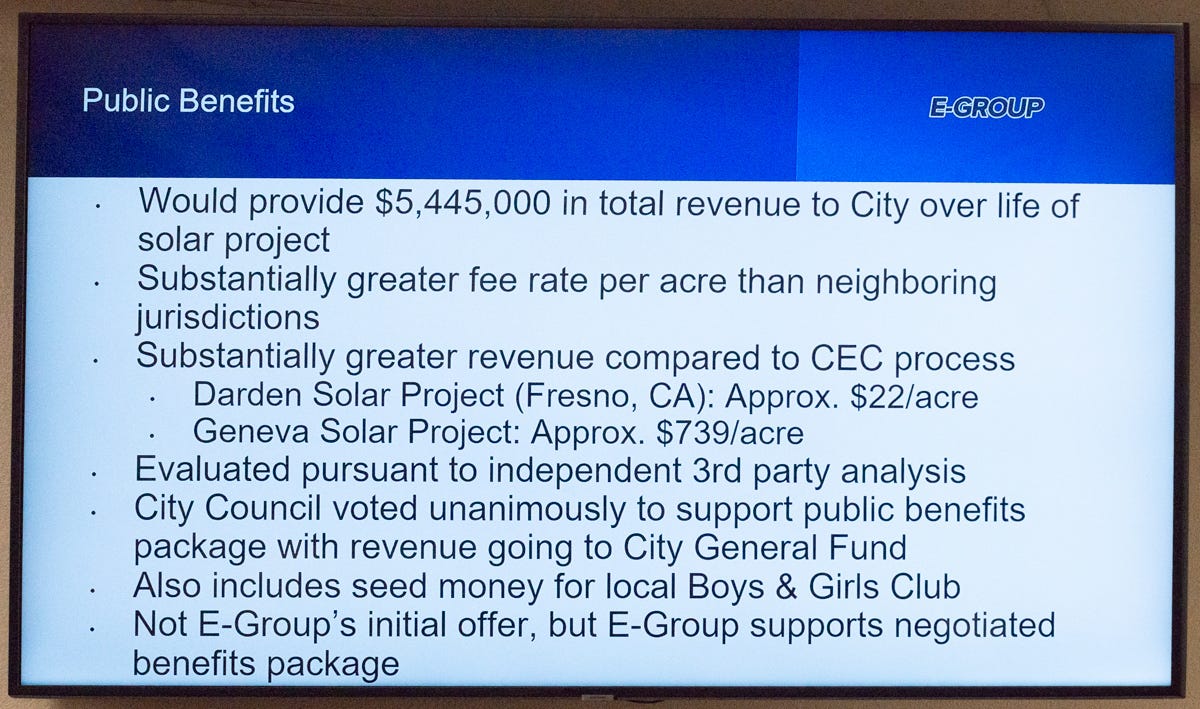
While Gardner indicated that the benefit package had the “blessing of City Council,” he failed to make clear that the package had only been loosely discussed in a workshop at the June 24, 2025 meeting and was never actually voted on. Smith, on the other hand, presented a slide that contained an outright misstatement that “City Council voted unanimously to support public benefits package.…” This vote never took place, which we have confirmed through a review of City Council minutes subsequent to the workshop.
It also should be noted that the per-acre figures quoted by the City appear to be based on the approximately 184 acres occupied by the solar panels and not on the 241-acre E-Zone parcel, which would yield smaller per-acre figures of $436 per acre in the first year and $622 per acre at five years of operation until cessation.
Comparable benefit packages from other locations were presented with a per-acre figure to justify what E-Group was offering as favorable. However, while comparisons based on per-acre numbers might seem relevant on a superficial level, there is not enough information provided to accurately evaluate the examples—not even the scale of the solar installation was listed. The amount of a benefit package might be affected by other factors such as jobs created and long-term economic benefit as well as site factors including whether a zoning change was required, if it is being built on previously disturbed or pristine land, and proximity to neighborhoods, conservation areas or national parks.

Help us to to $9,000 — we’re just $15 away!! Upgrade your subscription from free to paid today for just $50 per year or $5 per month.
Want to make a one time donation or are you able to give more than $100? Donate via Paypal!
During the E-Group presentation, Smith compared the Community Benefit Package being offered to Twentynine Palms with the package negotiated by the developer and California Energy Commission for the Darden Solar Project located in Fresno County —the first to pass though the AB 205 process.1 Should Smith have mentioned the site’s details, the specious nature of the comparison would have been revealed. The Darden Solar Project is a 9,500-acre project that is the world’s largest solar and battery storage site and is situated on disturbed former agricultural land, unlike the E-Group Solar Project, which is on pristine desert land adjacent to an existing neighborhood.
While Smith discussed that the benefit package for Fresno, $2 million over ten years (as compared to $5.5 million over 30 years here), he did not mention that it is also creating 2,000 local construction jobs with an estimated economic benefit to the local community of $169 million over 35 years. The E-Group Solar Project is creating 200 construction jobs with no guarantee they will be local — Smith made it clear they would not be putting that guarantee in the benefit package — and no estimate of long-term economic benefit to the community has been stated. Also, the Darden developers by-passed local government and went straight to the CEC — there is little relationship between the two projects.
There was also confusion about whether Planning Commissioners had the authority to discuss the benefits package, caused partly by the false belief that the package had been ratified by Council. Commissioner Max Walker was especially adamant about the Planning Commission’s lack of authority. Was it their job to simply weigh whether the current compensation package was sufficient to offset community impacts or was that solely the providence of City Council? Yet the package was presented to the Planning Commission, so one would assume they should be able to discuss it.
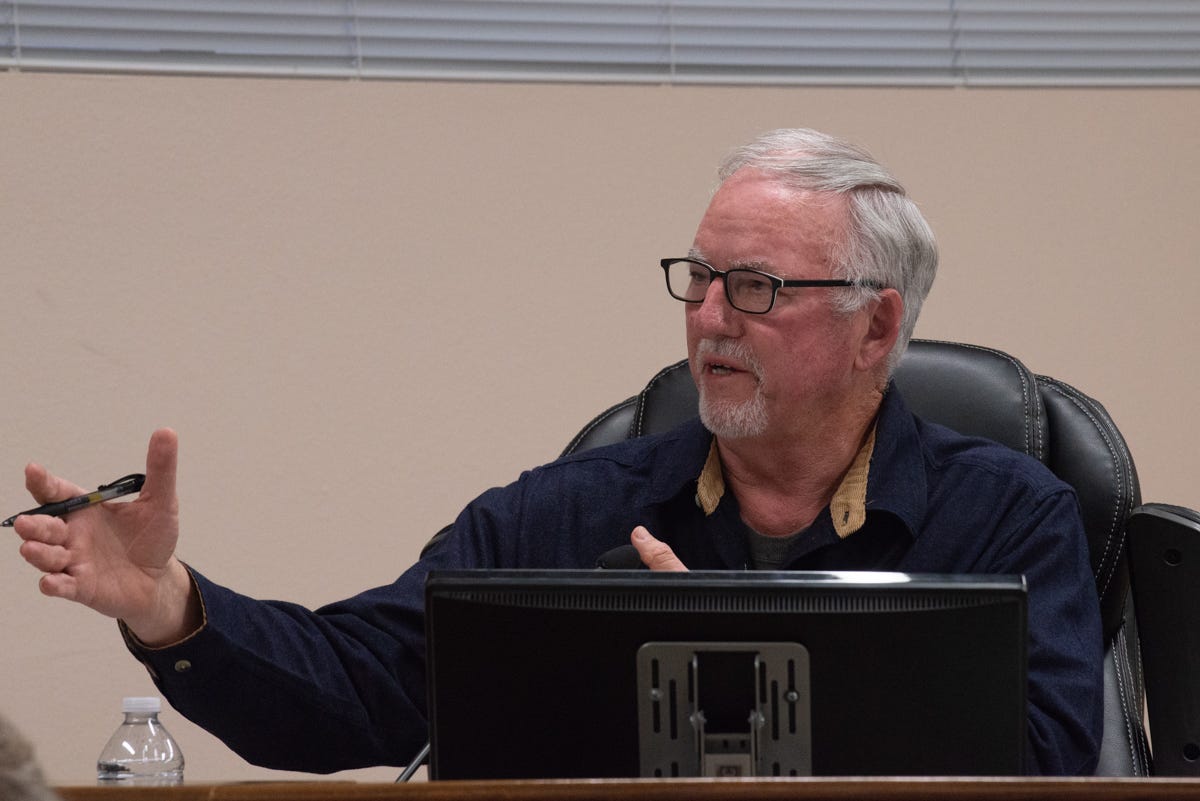
Commissioner Jim Krushat came prepared to challenge the offered benefit package with his first question for Smith being, “Do you have a projected revenue from this solar field?” To which Smith said no and wondered if Krushat was looking for the net figure. Krushat insisted, “I’m sure you did a business plan.…” Smith again demurred, “That’s difficult to be able to predict publicly.” After some back and forth Krushat went on to explain his position, concluding with, “the juice just ain’t worth the squeeze”:
So we have an outfit that’s coming in. And what happens over here is they’re going to adjust our desert, tear up our desert, they’re going to put in the field. They’re going to get in revenue around $4.5 million to 6 million, and we’re going to get $100,000 a year. And I try to translate that, and for me, that’s like 538 feet of improved growth [approximating the amount of physical improvements $100,000 actually covers].
And $5.4 million [offered by E-Group] that’s over 30 years. So that’s $186,000 a year. Okay, that’s like 1% of our budget. Okay, so that’s where my concern is — I know what they’re getting, and I’m looking at what we’re getting, and it just seems way under. And that’s where my real problem is, is the community benefits package.Now, if we said no to this, and we said, Okay, we’re going to roll the dice. You go to AB 205, they still have to come back to a community benefits package with us — how much input we have, that depends. There’s some people saying, Oh, you get no input into that. And I don’t know if that’s entirely true. So again, that’s my concern. I see what they’re getting, and I see what we’re getting, and there’s a big dichotomy — the juice just ain’t worth the squeeze.
Later in the discussion Krushat indicated that if a vote were held on the project that evening, his vote would be no.
While Krushat’s criticism of the existing package appeared to lean toward “rolling the dice” with the state, with Chair Cure and Vice Chair Alex Garcia also expressing skepticism about the benefit package being offered, Commissioner Walker remained adamant that the City should work with E-Group:
They are choosing to want to do business with the City of Twentynine Palms. They’re saying, “I’m willing to not go to the state and spoon feed you some medicine you really don’t like, because I’m going to cut the benefit package in two thirds, because it took me a lot more time and money to get this done.”
What About Code Compliance?


Chair Jessica Cure, who came prepared with a long list of questions, wondered:
Are the mitigation measures for dust, drainage, and erosion enforceable for the full operational life of the project? Specifically, who is responsible for monitoring the compliance?
Nicole Criste of Terra Nova and CEQA consultant for the City responded:
The permitting from AQMD [Air Quality Management District] for construction is an ongoing requirement that ultimately the City will have. If the project during operation were to have issues, it would be a code compliance issue.
Cure then wondered, if it’s a code compliance issue, what part of the community benefit package “goes back into enforcing these things?”
Gardner proceeded to dance around a straight answer, at first reiterating that the package goes into the general fund, then discussing potential penalty figures for fines and citations which might be levied against the property owner.
Cure pressed again:
How much of this money ends up getting used by the City to have to enforce or spend on the project for the community [ordinance] to be followed versus the fines being issued?
And Gardner continued to evade or not understand to code compliance question:
The applicant will also have to pay for billing and safety inspection fees, which are a cost recovery and so they don’t have to pay a variety of inspection fees and permit fees as it goes along so that is basically cost covering.
The question of how the project would be monitored for compliance, and who would pay those costs was never fully answered.
A Tight Timeline
Chair Cure asked about the anticipated timeline for the project. Smith made it clear that beginning construction by July 4,2 even if it was potentially offsite, was crucial for receiving needed federal tax credits and providing a community benefits package:
I would just say that the amount of money that we have committed to the city and public benefits, I mean, there’s a certain amount that’s going to require the project to pencil out, and if we don’t have the millions of dollars of investment tax credits available, that’s a concern for how much we can provide the City.
Smith then qualified that statement, adding that the IRS has been unclear on the definition of “beginning construction”—that it’s more than “site preparation or grading” but “it’s like actually installing some rows of solar panels.” He added that “beginning construction” could mean “prefabricating...specialized equipment at an off-site location that can eventually be installed on the project site.” How off-site production would affect local jobs was not mentioned.
Nicole Criste had expressed hope that the DEIR would be finalized by the end of February and Smith mentioned having sufficient time to get the credits if “the City were to approve the project next month” with the March 10 City Council meeting appearing to be the target date. However, the Planning Commission discussion being continued to March 3 means the EIR won’t be finalized and voted on by Planning in February, complicating the ideal timeline.
Smith further indicated that California Fish and Wildlife could also hold up construction with slow processing of the take permit for the desert tortoises found on site, but he hoped to get through grading and permit approvals “in the next couple of months.” Should the E-Group Solar Project be approved, he thought beginning construction in the third quarter of 2026 was likely, with completion taking approximately nine months.
Coming in Part 2 on Monday: Environmental Impacts and Public Comment
Heading into the 2026 elections, Desert Trumpet has sustained a potential 50% cut in funding. Help us provide the coverage you’ve come to expect by becoming a paid subscriber or upgrading your paid subscription today!
Leave your thoughts in the comments below. Please note that we do not allow anonymous comments. Please be sure your first and last name is on your profile prior to commenting. Anonymous comments will be deleted.
Thanks for reading! This post is public, so feel free to share it.
The tax credits are being phased out as a part of the “Big Beautiful Bill.” However, per this article, “Projects that begin construction after July 4th, 2026, are still eligible for tax credits so long as they are placed in service by December 31st, 2027.”
"Gardner proceeded to dance around a straight answer, at first reiterating that the package goes into the general fund, then discussing potential penalty figures for fines and citations which might be levied against the property owner." Spot on! lol. Gardner doing what Gardner does best, dancing around a straight answer.
Again the city disregards the often mentioned "long range plan" that is forseen for the city, one of the hoped for goals being using residentially zoned land for "neighborhoods".
with the rezoning of residential zoned parcels for glam coamping of Ofland and now rezoning for solar fields, they change the outlook for a few pieces of silver, Judas-like.
it seems like the town land west of Staters is open for any money making scheme that comes along. our only "residential neighborhood" is Indian Cove subdivision and now a commercial glam campground will be "nextdoor" to that.
i purchased my home after viewing the closely adjacent land was zoned residential and expected homes to be lived in by full time residents, neighbors. Soon after moving in, the city allowed a multi-million dollar Airbnb to be built on nearby resisential land that would never be inhabited by a resident, thus being a commercial enterprise. now, two more slaps in the face with MORE rezoned land for commercial enterprises.
As i stand in my front yard looking down into the valley from high near the foothills, in my view are now this Airbnb, two large commercial solar fields and soon to be another, plus a commercial electrical substation.
The residential zoned land seems to be viewed as "expenadable" to the whims of money hungry council members and city manager. My plan so far has been to purchase 30 acres around me to buffer my home from the whims. it feels like "taxation without representation" which was the incentive of creating this country. I receive NO city provided benefits such as improvements or road maintainance. All talk of such items are only of concrete walkways, road maintainance, etc of dowtown areas.