
RECAP: Twentynine Palms Planning Commission, March 3, 2026
Split vote sends controversial solar project to City Council without a clear recommendation

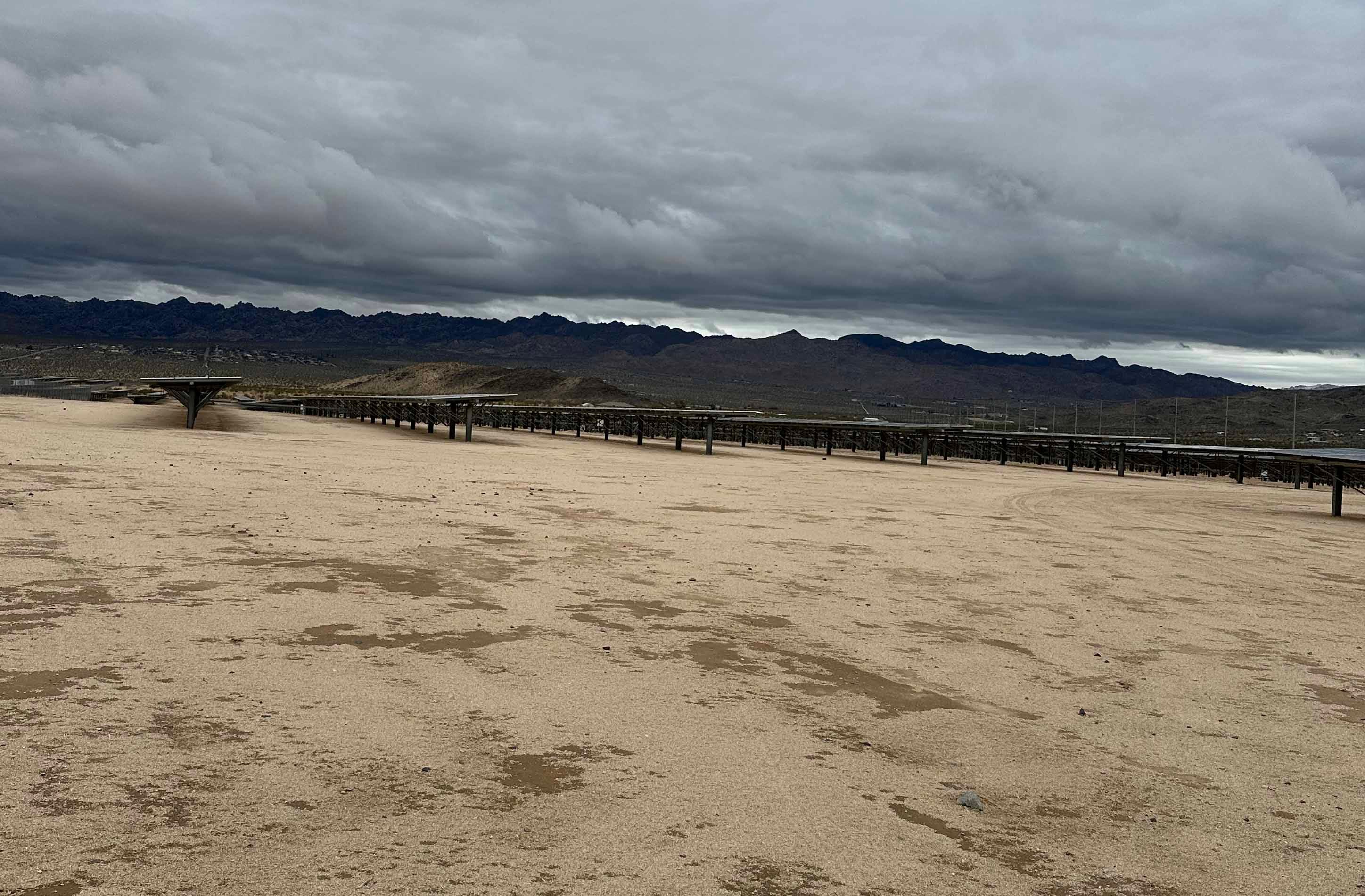
At its March 3 meeting, Planning Commissioners were asked to consider the controversial recommendation from City staff that they transfer their decision-making authority to the City Council on the proposed E-Group Solar Project.
E-Group’s attorney returned with new renderings of views, valley fever statistics, and an offer of HEPA filters for downwind neighbors. Fifteen residents lined up to comment, most of them opposed. When the dais finally took over, the divisions were clear. The Commission ended the night deadlocked and forwarded a split recommendation to City Council with no clear direction. The City Council meeting will take place on Monday (note change in usual date), March 23 at City Hall.
All Commissioners were present. In addition, Community Development Director Keith Gardner, Planning Assistant Shelley Green and Assistant Planner Diane Olsen, Assistant City Attorney Jennifer Farrell, and Terra Nova Representative Nicole Criste were also present.
For reference:
The City’s agenda
Our agenda preview
Video of the meeting
Recaps of the February 17 Planning Commission meeting: Part 1 and Part 2
PUBLIC HEARINGS
Staff and E-Group PS Presentations
Keith Gardner gave a framework for the evening’s meeting. He said that the Staff’s recommendation, given the size, scope, and policy implications of the project, was for the Planning Commission to transfer decision-making authority to the City Council. If the Commission wishes following the recommendation, he said, the Commission could pass along any comments, concerns, or suggestions about the project. What Gardner didn’t say is that those comments would not carry the weight of a vote.
He also suggested that the Commission could adopt a resolution recommending that the City Council certify the Environmental Impact Report (EIR), but he did not point out that the EIR had yet to be finalized.1
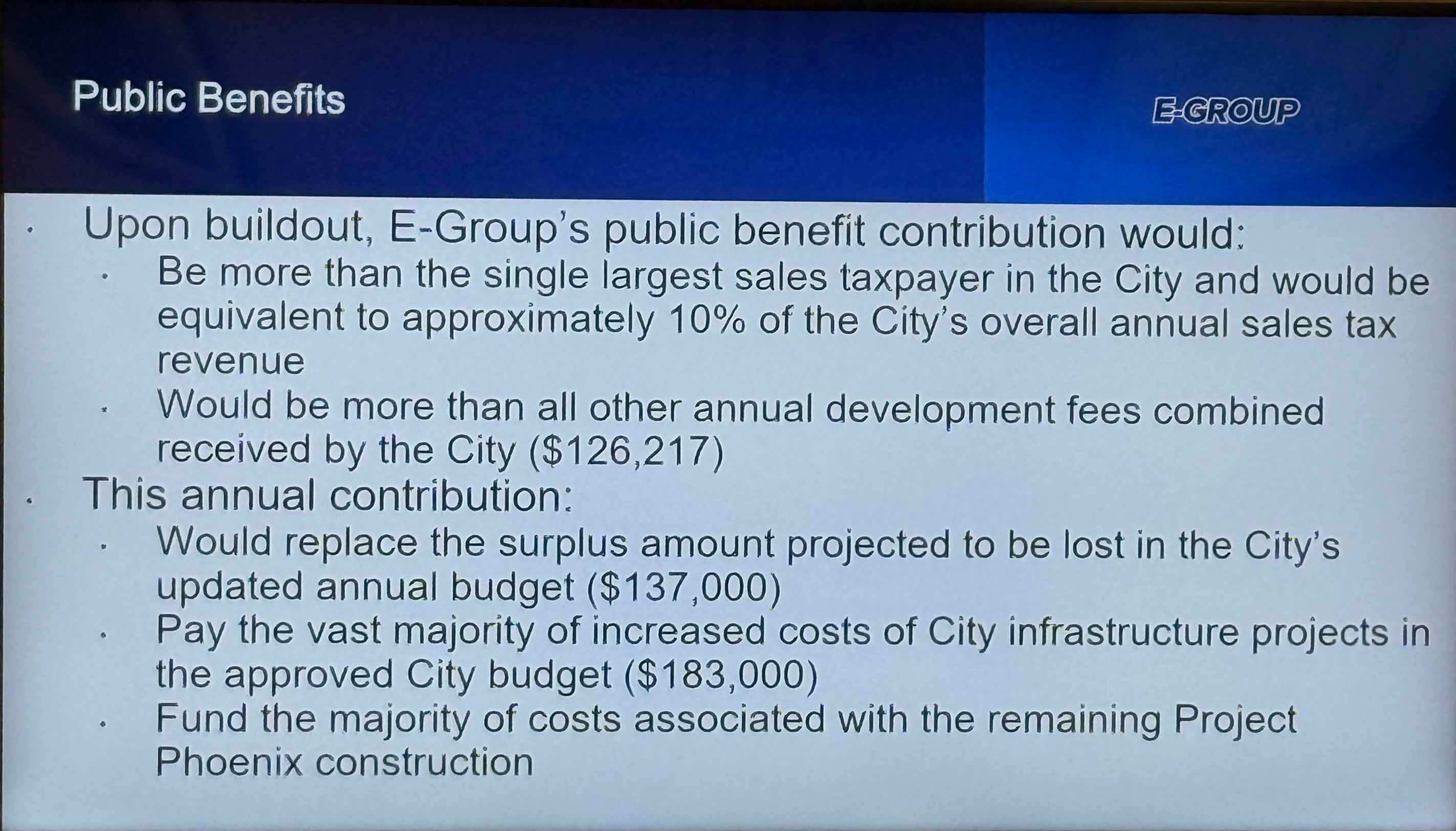
Robert Smith, the attorney who represents E-Group PS, responded to Commissioners’ and residents’ comments from the February 17 Planning Commission meeting. He emphasized the solar farm’s potential to become a top financial contributor to Twentynine Palms. Smith highlighted that E-Group is already giving back, citing $4,000 for food distribution through Hope Project, a program of CLEP, the nonprofit arm of the Sanctuary Church. He also mentioned 80 books on STEM subjects donated to the public library, and $3,600 donation, again to the Hope Project, for their upcoming Color Run.
Leadership of the Sanctuary Church2 supported the project at the February 17 meeting and at this meeting. Last month, Bishop Perry Ford and Dr. Sylvester Cullum spoke generally about benefits to the community that are not part of the benefits package. Church leader Dr. Shanese Risper also spoke at this meeting in support of E-Group (more below).
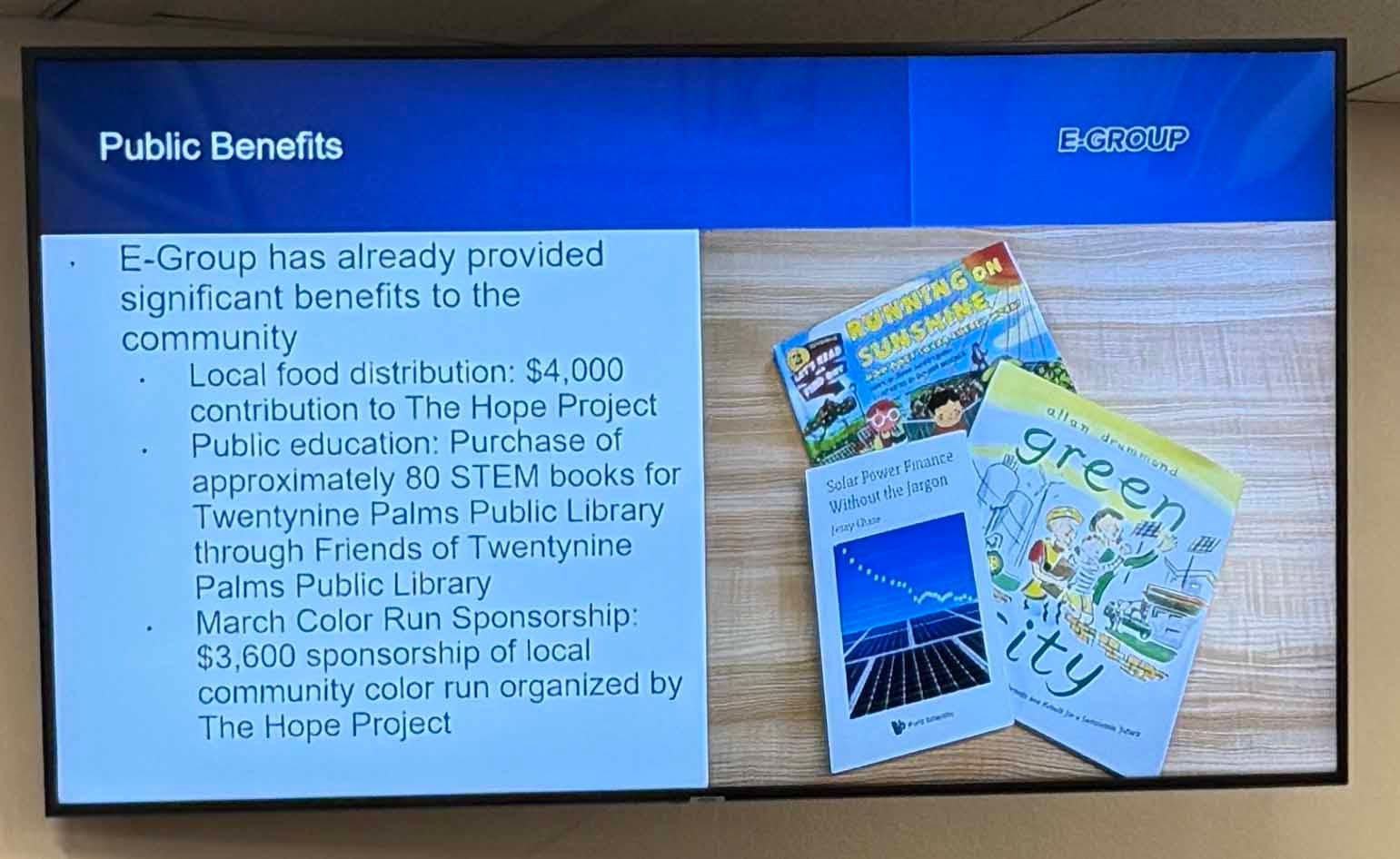
Smith focused on the project’s long-term economic impact. He stated that the development would immediately become the City’s largest taxpayer, contributing roughly 10% of the City’s annual sales tax revenue. Over its 35-year lifespan, the project is expected to cover more than $180,000 in infrastructure costs, filling budget gaps projected by the City Council.
Addressing environmental concerns, Smith shared renderings from of how the solar facility would look from the 49 Palms Oasis trail in Joshua Tree National Park as well as from Indian Trail Road north of the site. He maintained that the visuals of the project would be “largely subsumed by the surrounding foreground environment.”
Regarding water, he promised a dust-suppression program during the 40-day grading period. He estimated the project would use 1.3 acre-feet of water—only 3% of what other recently reviewed projects require—and noted that water would be trucked in by a third party to avoid depleting the local supply.
Smith argued that the valley fever risk from the solar project is real but manageable, and should not be a reason to block the project. He pointed to state health data showing that San Bernardino County had only 178 confirmed or suspected cases in 2024, compared to nearly 3,900 in neighboring Kern County — about 20 times more. Early 2026 data, he noted, shows numbers declining.
Smith also pushed back against the idea of a “zero risk” policy (despite no suggestion of one), arguing it would effectively shut down all development in Twentynine Palms.
But if there were such a policy, would basically bring development in the City of 29 Palms to a halt. Any new road or infrastructure requires grading of undeveloped areas….It also eliminates the development of residential housing or any other expansion of the City in areas that are currently developed. And that's, you know, a very significant concern.
On worker safety, Smith argued that dust exposure is already regulated at the state level, and that E-Group would require contractors to use dust masks and proper equipment during grading.
For nearby residents, Smith offered a mitigation measure: E-Group would provide HEPA air filters and replacement filters to all homes within 1.5 miles east of the site — downwind of prevailing winds — for the entire duration of construction. (He made no mention of protecting against dust issues caused by grading after construction.)
Questions from Planning Commissioners
Planning Commissioner Jim Krushat made a forceful argument against approving the E-Group Solar Project.
His core point: Twentynine Palms has had a moratorium on commercial solar fields since 2012, and not a single resident, elected official, or community group ever challenged it. That moratorium exists for a reason, he said — the community doesn’t want industrial solar inside City limits. State law AB 205 is the only reason the project is even being considered.
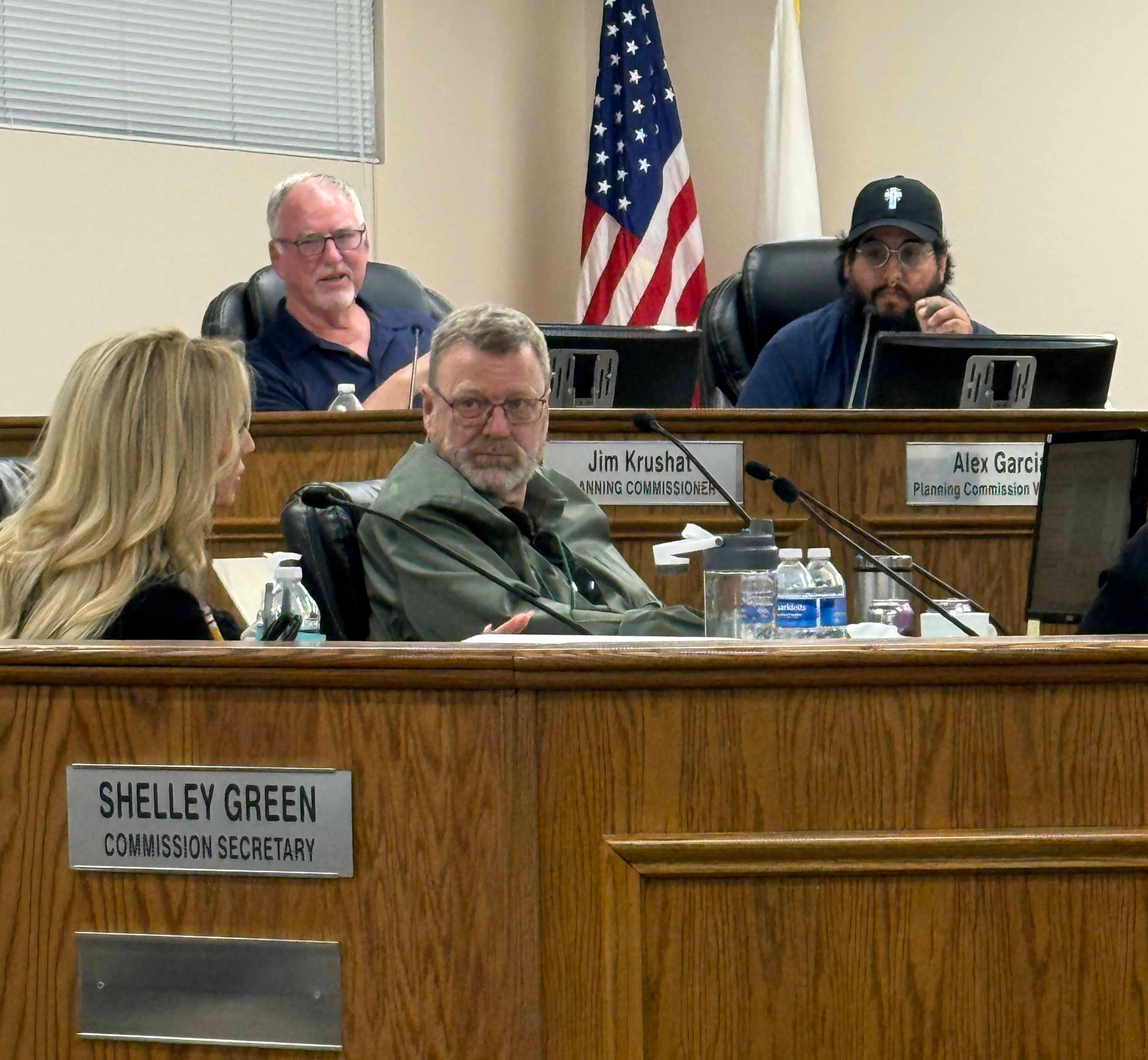
On the community benefits package, Krushat was dismissive. The annual payment is small, undesignated, and would disappear into the general fund. The City isn’t hurting for money.
Most strategically, Krushat argued that rejecting the project isn’t the end of the road — it sends the project to the California Energy Commission, which has far more expertise to scrutinize it properly.
Let me give you an analogy. If somebody came to my yard and said, I’m going to tear your yard up, and I’ll give you $20 a month. But if I have to go to the state and get permission to do it. I’m only going to give you $10 a month. I still get my yard torn up. So why aren’t we fighting for the citizens of 29 Palms and saying, “Okay, let’s stick to the moratorium and see where it goes?”
Commissioner Krushat also asked, as he had on February 17, “what is your projected revenue? I don’t think it’s unusual to ask.” The Ofland Resort, he said, “told us exactly what they expected and what we could expect.”
Smith’s argued that unlike a hotel, where projected revenue can be calculated from room rates, a solar project’s revenue depends on a future power purchase agreement that doesn’t exist yet. Without a buyer, any revenue projection would be “pure speculation.”
When pressed, Smith offered no numbers of his own, instead redirecting to a third-party analysis the City commissioned, which he said showed the community benefit payment compares favorably to similar solar projects elsewhere.
Downplaying the profits E-Group would make from the sale of electricity, Commissioner Max Walker asked about maintenance costs once the project is finished:
On the Base we’re replacing one of the solar farms. Replacing the inverters costs roughly $5 million...and they’ve only been in place 10 plus years. Imagine the maintenance is going to be expensive, and people are thinking they’re going to be making millions upon millions of dollars, but I don’t necessarily know if that’s true. The profit margin isn’t that great.
Smith’s response on maintenance costs pivoted quickly to a broader argument about how expensive the project is to build in the first place — framing high upfront costs as context for why the community benefit package is what it is.
He cited rising steel prices, SCE interconnection upgrades, and site grading as major expenses. Federal restrictions on tax credits added further financial pressure. He added:
The mitigation costs associated with the project, because of the desert tortoise restoration and habitat mitigation, are in the millions of dollars which will depend on the alternative about that’s3 required by CDFW and US Fish and Wildlife, there’ll be at least a million, if not more.
Smith never actually answered the question about ongoing maintenance costs. Instead, his response read more like a justification for the modest community benefit package — essentially arguing that the developers have significant costs of their own.
PUBLIC COMMENTS
Many commenters reiterated the points they made in the February 17 meeting. We have highlighted new speakers and arguments.


Dr. Shanese Risper, Evangelist at the Sanctuary Church, spoke first. She praised E-Group as a potential long-term community partner. As noted above, the Sanctuary Church, through the Hope Project, has received more than $7,000 in donations from E-Group. In addition, the Church has an existing financial relationship with the City, which has been advocating for the solar project.
George Mulopulos, the landowner leasing the property to E-Group, noted that:
The two parcels involved in this project were purchased in 2004 and since then, more than a dozen solar companies have expressed interest in developing this property. Why? Because of its proximity to the Carodean substation. It is one of the most viable solar locations in our region.
He said that no homebuilders have ever shown serious interest, and that the project brings real revenue unlike nearby solar fields outside City limits. He dismissed opposition as largely coming from non-residents. Mulopulos, it should be noted, lists his residence as Las Vegas on LinkedIn. His support carries an obvious financial conflict of interest as the property owner.
Other commenters including Dane Austin and Paul Nugent, as well as students Kayla and Reina,4 spoke in favor of the solar project and repeated their past statements or offered general support without substantive arguments.
Pat Flanagan, Jeff Johnson, David Fick, Kurt Kepler, and Mary Kay Sherry amplified their comments from February 17, sometimes responding directly to points made by the E-Group attorney. John Talley-Jones noted the new solar field being built on County land on Lear Road and argued that the City should not rush to meet E-Group’s tax credit deadline.


Aiden Marshall spoke on behalf of Citizens for Responsible Industry, Marshall argued the project remains premature because the City has not complied with CEQA, and that the draft and final EIR both failed to adequately analyze significant health, public safety, and biological resource impacts.
Russ Kohn raised the point that E-Group has no operating solar fields anywhere in the United States, meaning Twentynine Palms would essentially be their first project. He questioned why the City would approve a major industrial project from an unproven developer and compared it to hiring a contractor without references.
I take issue with the person who said most of the people were not residents of the City. I know many people. We’re all residents here. I live in 29 palms. My wife and I know plenty of people. And he was incorrect. We do live here and we care for this town.
Cindy Bernard, editor of the Desert Trumpet, accused E-Group’s attorney of misrepresenting a City Council vote in a public hearing — calling it a significant ethical lapse for a lawyer. She dismantled the project’s comparable “comps,” noting the Darden Fresno facility cited is 9,500 acres, generates 2,000 jobs, and $160 million in community benefits — making it an entirely inapt comparison. She argued the push to transfer authority to City Council was a direct response to the Planning Commission asking hard questions, characterized it as a deliberate end-run, and urged Commissioners to continue their work at their own pace rather than E-Group’s. Addressing the Commission, Bernard said:
You were doing great work last week. All of you were asking really great questions. Continue to do that work. Take the time you need. Whatever timeline they have, that’s their timeline. It’s not our timeline.
The Planning Commission’s Vote
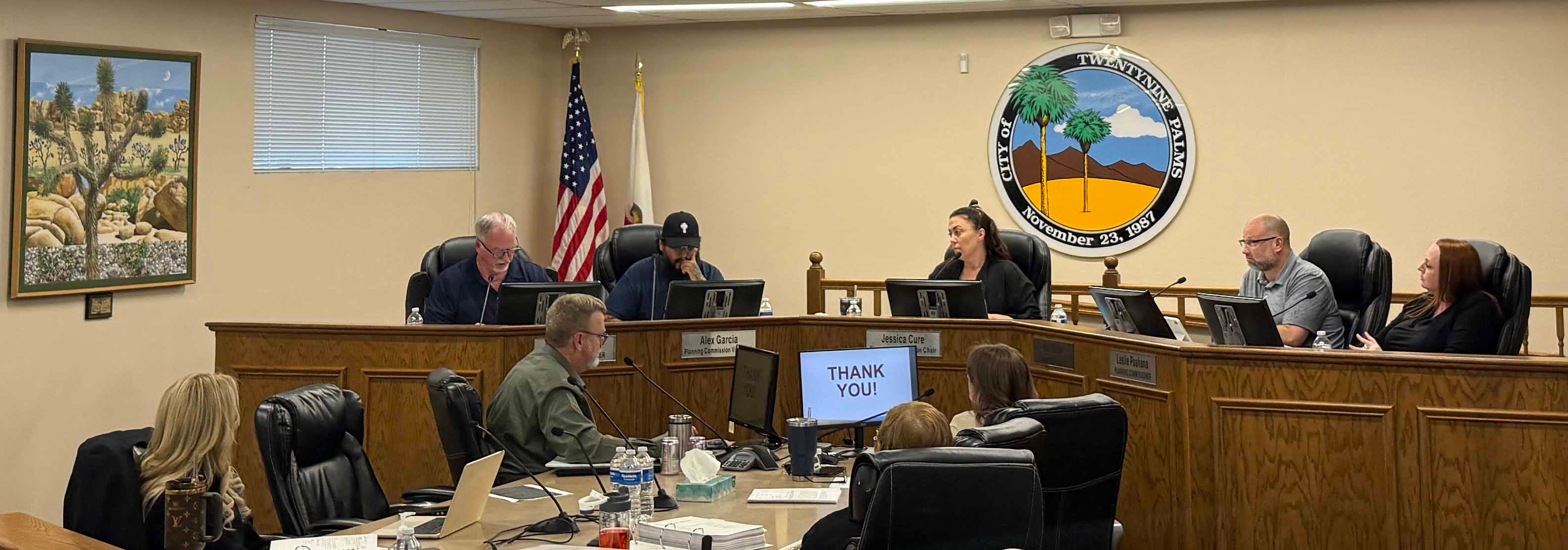
Following public comment, the Commission’s discussion and vote revealed deep divisions. Commissioner Krushat noted the City has maintained a moratorium on commercial solar fields since 2012, that no one had previously moved to overturn it, and that the annual benefit amount would not represent a significant addition to the City budget. He outlined three possible outcomes if the Commission and council denied the project:
E-Group withdraws,
the California Energy Commission reviews and denies it, or
the CEC reviews and approves it with potentially less benefit to the City.
Commissioner Garcia stated he knew residents downwind of the project who depend on clean air, that dust mitigation would be insufficient, and that the benefits package was inadequate given the scope of land disturbance.
Chair Jessica Cure sought clarifications on whether AB 205 specifies AC or DC output. AB 205 gives the California Energy Commission exclusive jurisdiction over solar projects at or above 50 megawatts, bypassing local approval. The question is whether that 50 megawatt threshold is measured in AC or DC power output — because the project’s DC capacity apparently exceeds 50 megawatts while its AC capacity does not.
City Attorney Farrell stated the statute does not specify AC or DC, and that the state would likely interpret it to favor their policy mandate regardless. Since the meeting, the Desert Trumpet has received confirmation from the CEC that the 50 -megawatt threshold refers to AC generating capacity5 Community Development Director Gardner confirmed the project’s capacity is measured in DC.
On the benefits package, Gardner stated that City Council had reviewed it and given consensus to move it forward. As we noted in our coverage of the February 17 meeting, although Council discussed the benefits package, but did not formally vote to approve it or move it forward.
After much discussion and much confusion, two Commissioners (Walker and Leslie Paahana) voted in favor of approving the general plan amendment, rezoning, development code amendment, conditional use permit, development agreement, and certification of the environmental impact report — and a Commissioner and Vice Chair (Krushat and Alex Garcia) voted in favor of denying all of those same items — with Chair Cure neutral.
CITY DEVELOPMENT DIRECTOR’S REPORT
Director Gardner briefly reported a City building to the north is being renovated.
SELECTION OF THE PLANNING COMMISSION CHAIR AND VICE CHAIR
Three motions were made. First, Krushat nominated himself as chair and suggested that current Vice Chair Garcia repeat in that position saying “I think Alex having an extra year will give him the experience he needs to step in the position [of chair]”— that motion failed 2-3, with Krushat and Garcia in favor, Paahana, Cure, and Walker opposed. Second, Cure nominated Paahana as chair and Garcia as vice chair — that motion also failed. Third, a motion was made to select Walker as chair and Krushat as vice chair — that motion passed unanimously, this despite Garcia having grown a great deal in his role on the Planning Commission.
Walker then adjourned the meeting.

Help us get to to $9,000 — we’re just $15 away!! Upgrade your subscription from free to paid today for just $50 per year or $5 per month.
Want to make a one time donation or are you able to give more than $100? Donate via Paypal!
Leave your thoughts in the comments below. Please note that we do not allow anonymous comments. Please be sure your first and last name is on your profile prior to commenting. Anonymous comments will be deleted.
Thanks for reading! This post is public, so feel free to share it.
The Desert Trumpet reported on CLEP and its request that the City help fund its food pantry HERE. In November 2024, we reported HERE on the City’s choice of the religious nonprofit to partner on the EPA Environmental and Climate Justice Community Change grant. (The Trump Administration terminated all 80 Track I grants in May 2025 and subsequently used the One Big Beautiful Bill Act in July 2025 to rescind the program’s remaining unobligated funds.)
It’s not clear from the City’s video recording what Smith is saying here.
Last name redacted because both young women are students and appear to be minors.
A resident shared an email from the CEC that states: “Thank you for contacting the CEC. The 50 -MW threshold refers to AC generating capacity—the maximum continuous electrical output that can actually be delivered to the grid—not the DC module or nameplate rating. This interpretation aligns with long‑standing CEC practice, which defines “generating capacity” in AC terms for all jurisdictional thresholds. A 38 -MWac solar project does not qualify for opting into the CEC’s exclusive licensing authority under AB 205.”
Excellent reporting, as usual. I’m especially appreciative of the research done on the AC-vs-DC question. Sounds like this project would not qualify for CA state intervention, and that is good news for residents of 29 Palms. Thank you, Desert Trumpet! - Beth Sheffield