
The E-Group Solar Project Heads to the California Energy Commission. The Councilmember Who Supports It Pushes for Council Reconsideration.
E-Group Attorney Overstates CEC Confirmation as Solar Fight Moves to State Level


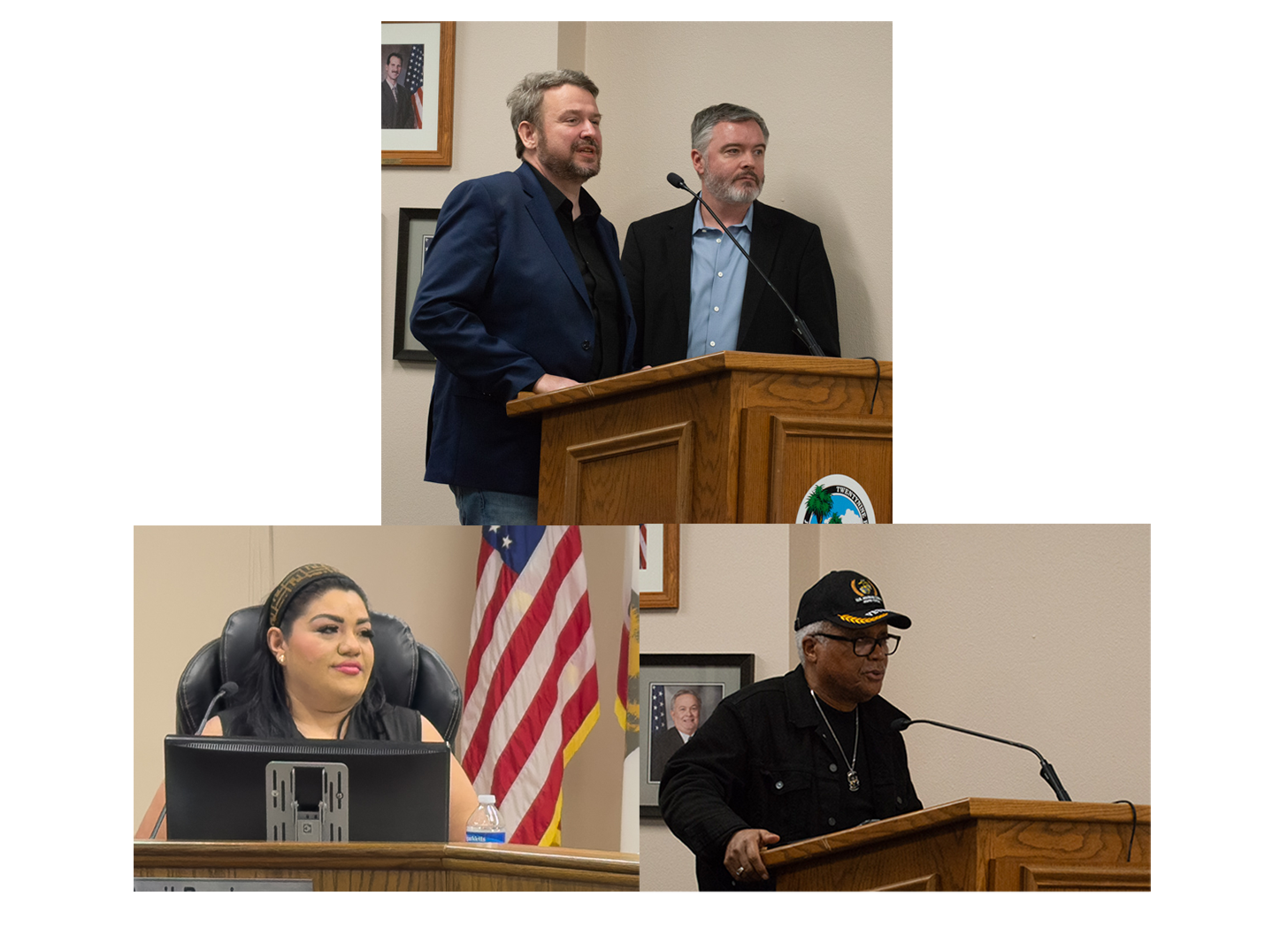
An email sent to the City last week claims the California Energy Commission has cleared the path for AB 205 approval. The underlying correspondence tells a more limited story — and raises questions about an undisclosed relationship between the project’s sole council supporter, a church she attends and the developer.1
On March 31, one week after the Twentynine Palms City Council voted 3-1-1 to reject the E-Group PS solar project on March 23, Robert Smith, the developer’s attorney, sent an email to City Manager Stone James declaring that the California Energy Commission (CEC) had confirmed that a reconfigured project was eligible to proceed through the state approval process under AB 205 — bypassing the council’s vote entirely.
Smith’s email, which was also sent to the Desert Trumpet, claimed E-Group had already begun the CEC process by requesting a required pre-application meeting. The Desert Trumpet contacted the CEC to verify that claim. As of April 2, the CEC said no contact had been made. Contact was apparently first made on or around April 3 — after the Desert Trumpet’s inquiry. Given that discrepancy, the Desert Trumpet then decided to hold off on reporting until we were notified by the CEC that an application had actually been filed by E-Group.
On Friday, April 10, Z107.7 reported on a March 27 letter from CEC attorney Jared Babula to E-Group’s attorney Robert Smith, characterizing it as the state asserting its own jurisdiction over the project. The Babula correspondence was originally an attachment to Robert Smith’s March 31 email, which was not mentioned in the Z107.7 reporting. Councilmember April Ramirez—the sole vote in favor of the project—cited the Babula letter in an interview with Z107.7 saying she intends to bring the matter back at the April 14 council meeting.
Our reporting raises questions about an undisclosed relationship between Ramirez and a Twentynine Palms church organization that received more than $7,600 from E-Group before the vote.
The Email to the City
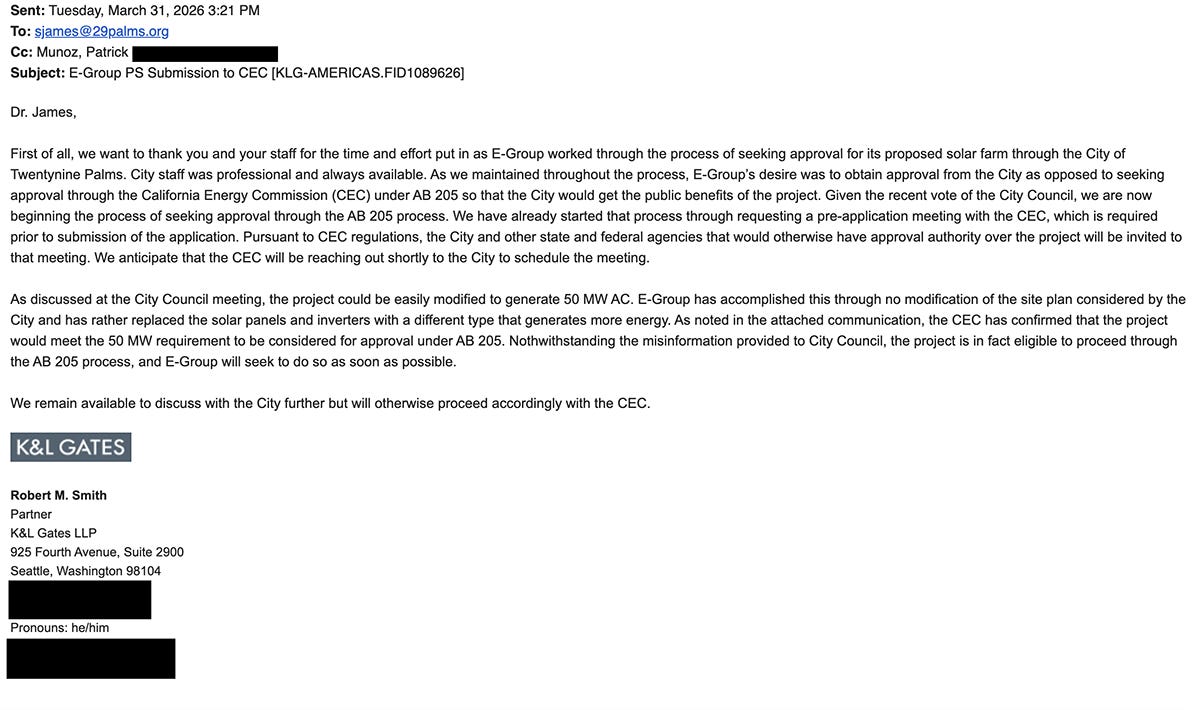
The March 31 email was sent by Robert Smith of K&L Gates LLP and cc’d to City Attorney Patrick Muñoz. In it, Smith announced that E-Group had already requested a pre-application meeting with the CEC, describing it as a required step before filing a formal application. He wrote that the project had been modified to generate 50 MW AC — the threshold required for CEC jurisdiction under AB 205 — and that “the CEC has confirmed that the project would meet the 50 MW requirement to be considered for approval under AB 205.”
Smith attributed the council’s rejection to “misinformation provided to City Council” — a characterization that appears directed at the residents and public commenters who overwhelmingly opposed the project at the March 23 meeting, where 26 speakers argued against it and five spoke in favor.
What the CEC Actually Said
The communication Smith cited as CEC confirmation is a March 27 letter from Jared Babula, an attorney in the CEC’s Chief Counsel’s Office, to Smith himself. The Desert Trumpet has reviewed that letter in full.
In it, Babula confirmed that a photovoltaic facility with an AC output of over 50 MW would meet the statutory definition under Public Resources Code section 25545(b)(1) and would be subject to CEC jurisdiction — provided the developer “properly filed an application with the CEC as set forth in the CEC’s regulations.” Babula directed Smith to the CEC’s Opt-In certification program for further information.2
Babula’s response was a conditional answer to a narrow question. Smith had sent the CEC a revised technical specifications sheet and site plan, asking only whether the modified project, on paper, met the statutory definition. Babula confirmed it did — but made no determination about whether the project would actually receive CEC certification, whether the application would be deemed complete, or whether the CEC would ultimately approve it.
The modified project, according to E-Group’s own technical summary, is designed to produce exactly 50.10 MW AC — a margin of one-tenth of one megawatt above the threshold. The same document shows the project’s output dropping below 50 MW at sustained ambient temperatures above 50 degrees Celsius, or 122 degrees Fahrenheit, due to inverter derating in extreme heat.
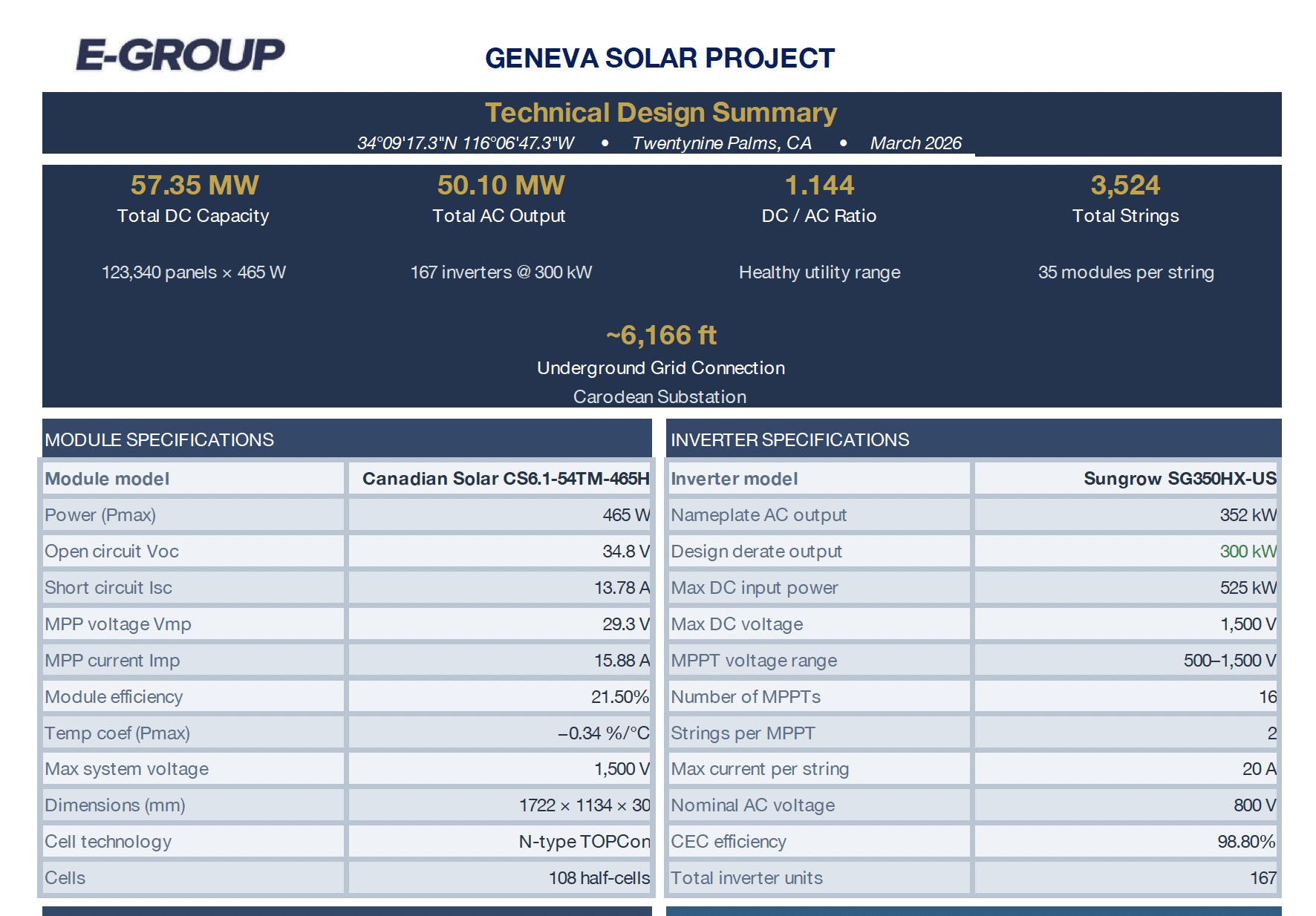
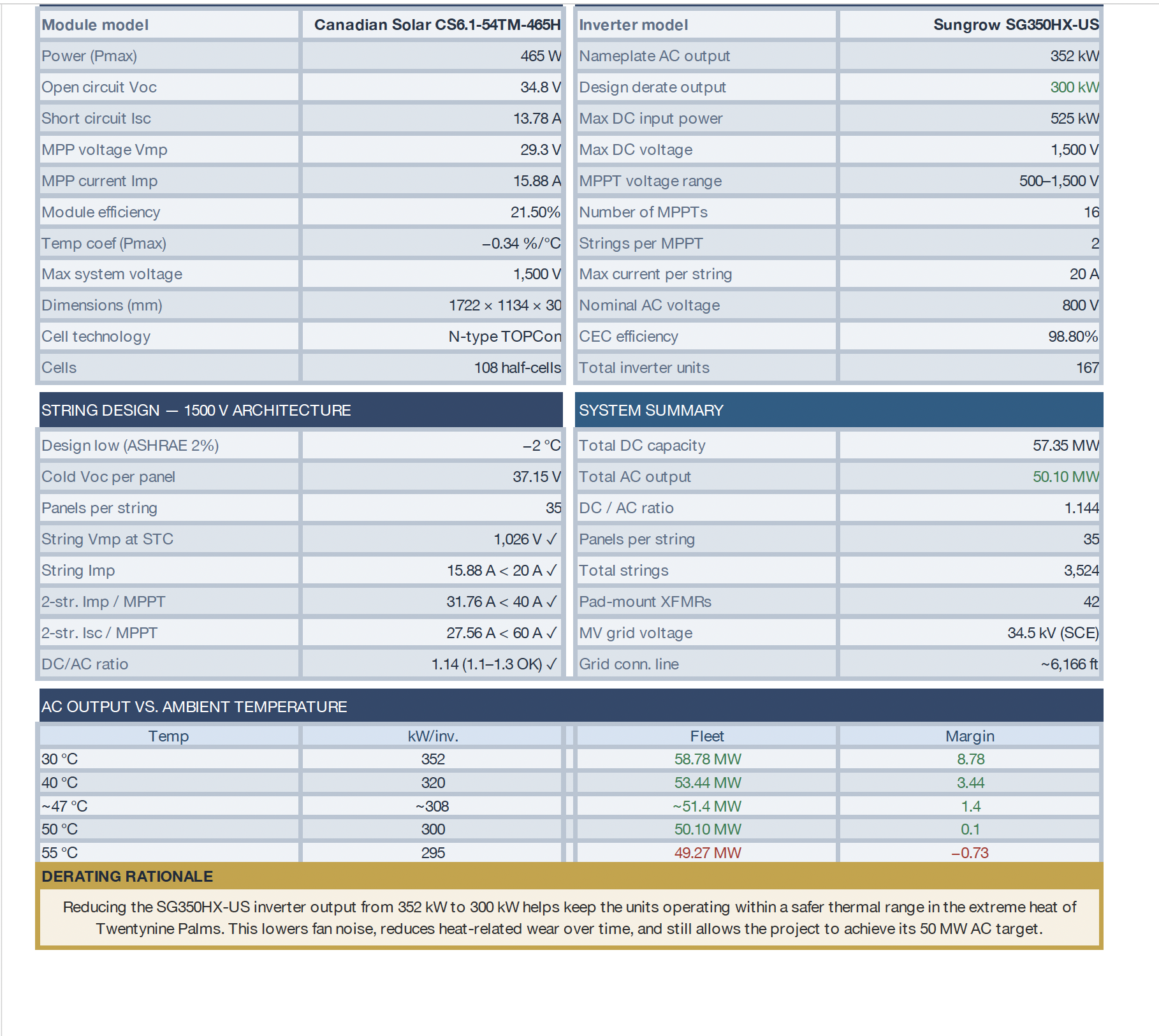
Smith’s email also states the revised project involved “no modification of the site plan.” This is supported by the site plan attached to the Smith-Babula correspondence, which is dated May 2023. But it also indicates that the project rejected by City Council remains unchanged.
The Pre-Application Claim Is Speculative
Smith’s March 31 email to James stated that E-Group had “already started that process through requesting a pre-application meeting with the CEC, which is required prior to submission of the application.”
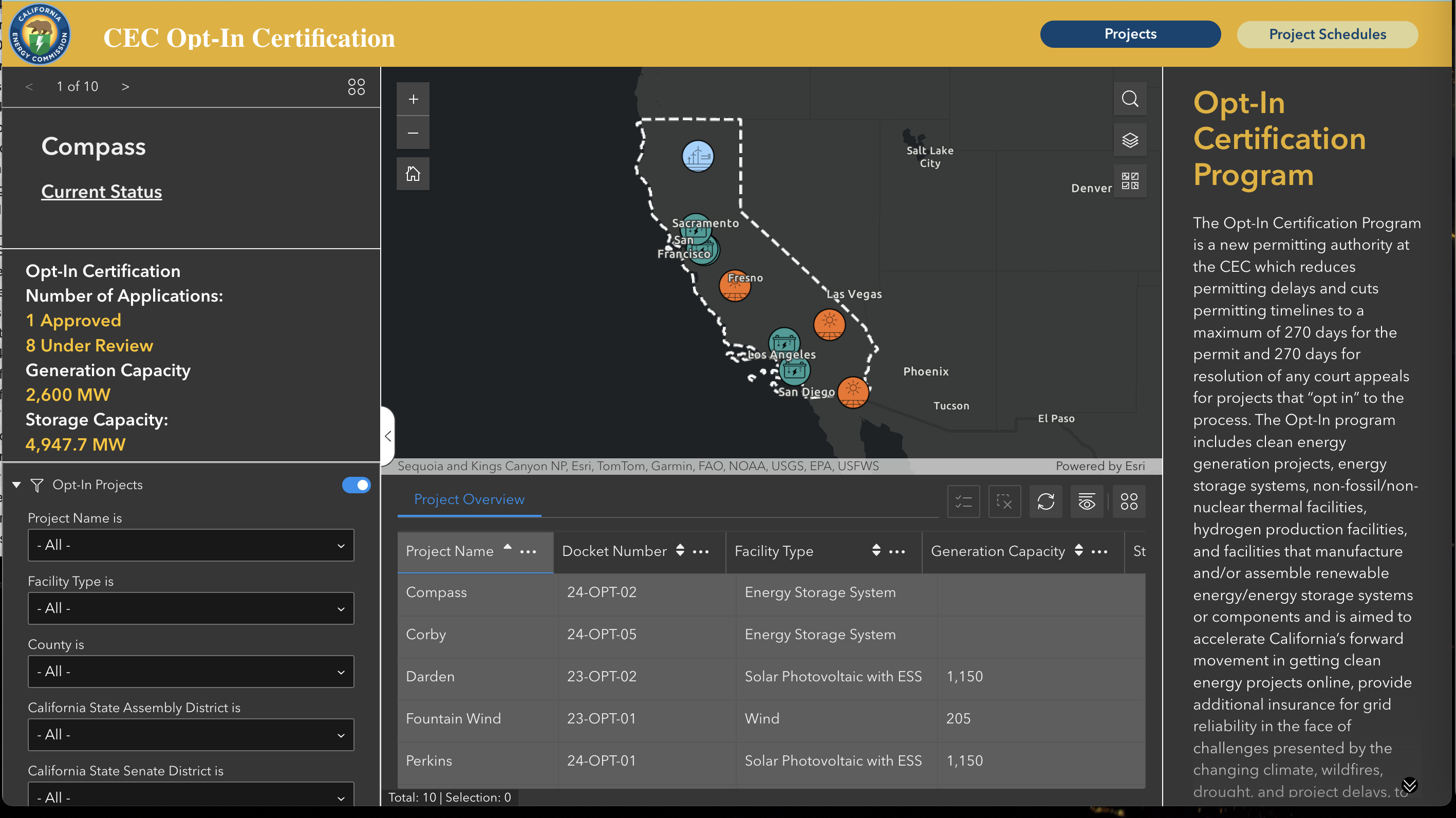
In other words, at the time Smith wrote to the City on March 31 claiming the process had already begun, the CEC had received no outreach from E-Group. Contact was not made until at least April 3 — three days after Smith’s email, and the day after the Desert Trumpet began asking the CEC directly.
The Project Has a Long Road Ahead at the CEC
CEC jurisdiction and CEC approval are not the same thing. Meeting the definition that triggers the state process is the beginning of a lengthy review, not the end of one. Even setting aside the pre-application timeline, the path through the CEC is far from automatic. As CEQA consultant Nicole Criste noted at the March 23 council meeting, the CEC can only serve as a responsible agency under CEQA if the City certifies the Environmental Impact Report first. If the City declines to act on the EIR, the CEC’s role as a responsible agency is constrained.
Planning Commissioner Jim Krushat raised the broader point at the same meeting:
The California Energy Commission has greater resources and more time — 271 days. We got 107. And I don’t think it’s automatic to assume that the California Energy Commission would approve the project. We have a high density of solar fields in the area and that would go into consideration.
Ramirez Plans to Bring It Back to Council — and Disputes the Public Record
The Smith email to James is not the only development in the days following the council vote. In the Z107.7 interview Councilmember April Ramirez — the sole vote in favor of the project — said she intends to raise the CEC letter at the April 14 council meeting and push for reconsideration:
I fully intend to bring this up at the next council meeting along with the hundreds of letters from constituents that I have received asking for us to reconsider this. That day that they voted no, there were more people that wrote in in favor of it, almost twice as many as the people that were against it, and they still voted no.
The public record at the March 23 meeting tells a different story. 26 residents spoke in person against the project; five spoke in favor. Mayor Daniel Mintz reported that he had received numerous emails in opposition. Ramirez cited two petitions — one with 45 signatures and one with 20 to 30 — submitted in support of the project. The March 23 meeting drew a standing-room-only crowd that was, by all accounts, predominantly opposed.
Ramirez also told Z107.7 that the Brown Act requires Councilmembers to weigh written communications the same as in-person testimony. While the Brown Act does require that written public comments be accepted and considered, it does not establish that an informal petition of 45 unverified3 signatures carries equivalent weight to 26 in-person speakers in a quasi-judicial land use proceeding.
Ramirez further argued that the council’s “no” vote would discourage future developers: “What it really does, ultimately, it signals to any other developer or solar project or anything that wants to come here, ‘Don’t even waste your time with the city, just go straight to the state.’” That argument tracks closely with the legal pressure E-Group has wielded since 2023, when the AB 205 threat first emerged as leverage to push the City toward approval.
What is not acknowledged in the Z107.7 article or by Ramirez is that the Council vote did not appear to be based on whether or not the solar project would proceed to the state or on most of the offered public comment. Instead, Mayor Daniel Mintz, accompanied by Councilmember McArthur Wright, had unique perspectives. Mintz was concerned about the devaluations of adjacent residential parcels while Wright queried:
Would you build a house there and live next to a solar farm? Because that’s basically what you’re asking. If we rezone that to Residential-1, and then we build residential homes on that lot, that’s what we’re asking families to do.
After some evasion, Smith eventually admitted, “I sort of like the house I’ve got, so I’m probably just going to stay with my current house.”
Lack of Disclosure Raises Questions
Councilmember Ramirez’s continued public advocacy for the project comes without disclosure of a relationship between E-Group and an organization connected to her church4.
Sanctuary Church is a Pentecostal/Apostolic congregation in Twentynine Palms led by Bishop Perry Ford. Its official 501(c)(3) nonprofit arm is the Community Learning and Equipping Project, Inc. — known as CLEP — whose officers are all Sanctuary Church pastors. The City’s own staff report on the E-Group project described CLEP as the “non-profit arm of Sanctuary Church.” CLEP serves as the fiscal sponsor of the Hope Project, a food distribution program that is the public-facing community program of the church.
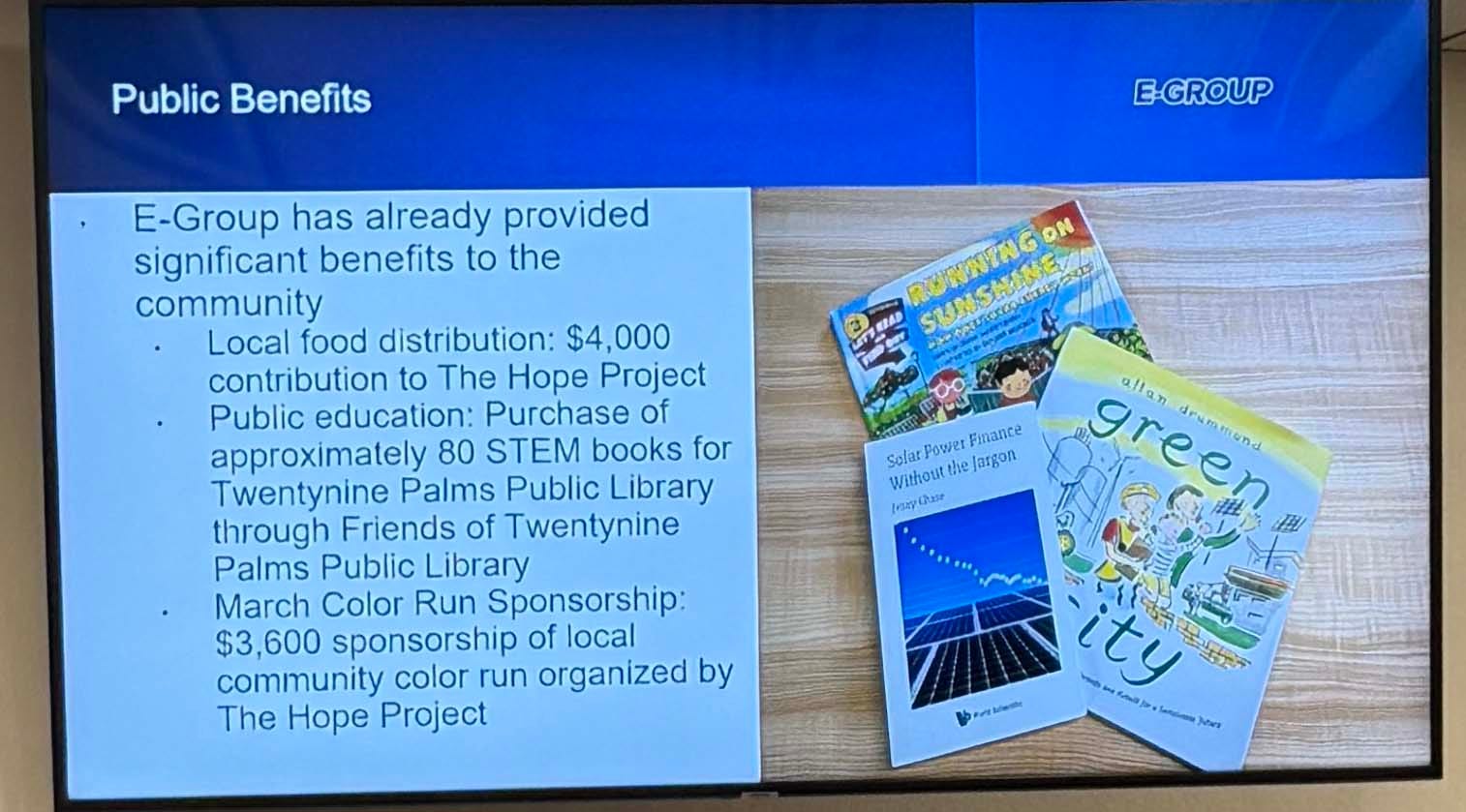
According to documentation presented by E-Group at the March 3, 2026, Planning Commission meeting, E-Group PS made more than $7,600 in donations to the Hope Project — $4,000 in direct contributions and $3,600 to help sponsor a color run.
E-Group listed these donations on a presentation slide as “public benefits already provided to the community.” That presentation came twenty days before the council vote. Bishop Perry Ford, a leader of Sanctuary Church, had spoken in favor of the project at the February 17 Planning Commission meeting — the first public hearing on the project — two weeks before the donations were publicly disclosed.
The Desert Trumpet has reviewed video footage from Sanctuary Church services on March 29 and April 1 that show Councilmember Ramirez in attendance.
Ramirez cast the only “yes” vote at the March 23 council meeting without disclosing any connection to Sanctuary Church, CLEP, or the Hope Project. Whether Ramirez’s relationship to Sanctuary Church and its nonprofit arm created a legal obligation to disclose or recuse under California’s conflict of interest rules or the Political Reform Act is a question the Desert Trumpet is not in a position to answer.
What the documented record shows is that a developer seeking a favorable vote made financial contributions to an organization connected to a Councilmember’s church, that those contributions were presented publicly as evidence of community benefit a few weeks before the March 23 Council meeting, and that the Councilmember cast the only vote in the developer’s favor without any public acknowledgment of the relationship. That record will be in the room when Ramirez takes her seat at the April 14 council meeting and moves to bring the project back.
Councilmember Ramirez declined to comment, stating in an email she has been legally advised not to speak to the Desert Trumpet. The next Twentynine Palms City Council meeting is Tuesday, April 14, at 6 pm.
Sentence updated shortly after publication with the addition, “a church she attends.”
The CEC’s Opt-in dashboard is here. Only three solar projects are under review, and all are much larger than the Geneva Solar Project, the formal name for the E-Group PS project.
Petitions typically need to be certified by a City Clerk or Registrar of Voters for any standing, and signatures should be verified to confirm residency status.
In a Facebook thread that was posted by Lynette Ramirez (no relation of April Ramirez) on Saturday, April 11, April Rameriz disputes that the Sanctuary Church is “her church”: “that’s not my church, I actually go to a lot of churches in the area.” Area business Wing n It replies, “yes, you go to that church, some of my family goes there.” (Added 4/12/26)
The Desert Trumpet is within $300 of meeting our $10,000 paid subscription goal!!! We need your paid subscriptions to publish the coverage you depend on. Basic subscriptions are $50 per year or $5 per month.
Become a sustaining subscriber by increasing your subscription to $100 or more per year! Want to make a one-time donation or are you able to give more than $100? Donate via Paypal!
Leave your thoughts in the comments below. Please note that we do not allow anonymous comments. Please be sure your first and last name is on your profile prior to commenting. Anonymous comments will be deleted.
Thanks for reading! This post is public so feel free to share it.
Oh, sorry! I forgot. This is Beth Sheffield. Lazy girl that I am, I don’t want to change my profile, but I can add my name to the post. I’ll try to remember to sign any future posts. 😄
It doesn't make any sense to me to bring it back to city council when citizens were very clear during this meeting that they do not want this project. If there were hundreds of written comments, it does not seem like they were submitted to the city. Because they read a list of names during the meeting saying that those were the individuals they had received written comments from.