
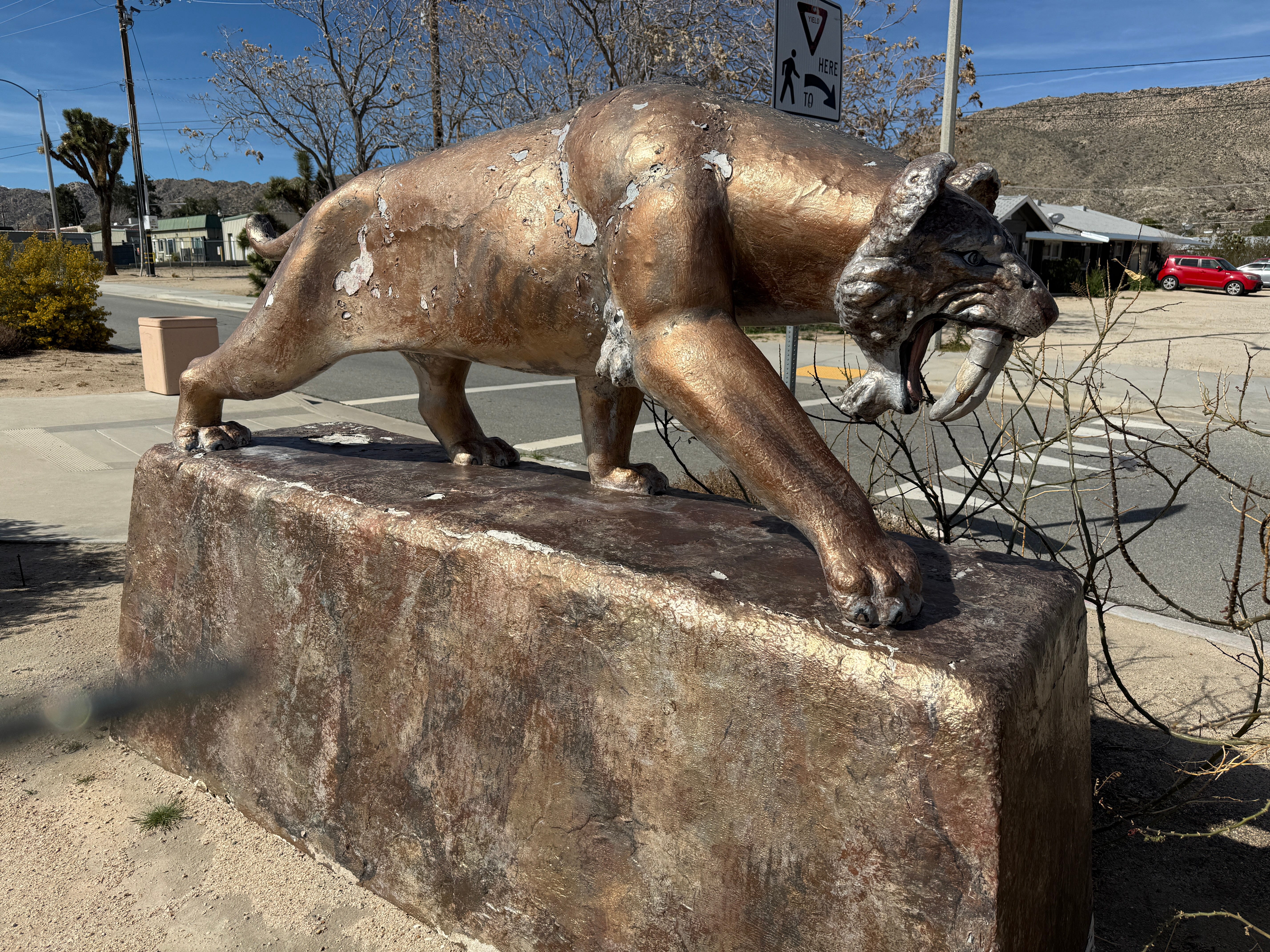
As my nephew and I drove through Yucca Valley, he pointed out of the truck’s window and asked, “Why is there a saber-toothed tiger statue over there?”
Having worked on exhibits at the Rancho La Brea Tar Pits, I couldn’t help but correct him, and I went into pedantic auntie mode. “It’s a saber-toothed cat,” I said. “AKA Smilodon fatalis.” But his question stuck with me. Why is there a statue of a Pleistocene predator in the middle of Yucca?
It turns out the statue in Remembrance Park (at the corner of Apache Trail and Highway 62) was sculpted by Frank (Antone) Martin, the same artist who created the famous Desert Christ Park. He perhaps hoped it would skulk by the Lake Pit next to what is now the Tar Pits museum and LACMA but instead gave the statue to Yucca Valley in 1952. Today, it stands as a guardian for the Veterans Memorial Circle, a fierce protector of those we remember. But it also serves as a reminder that this desert used to be a very different place.
Smilodon: The Hi Desert’s Heavyweight Hunter
Smilodon is perhaps the most iconic animal of the Ice Age. While the statue in Yucca Valley is made of concrete, these powerful predators were once very real flesh-blood-and-toothed residents of what is now the Mojave.
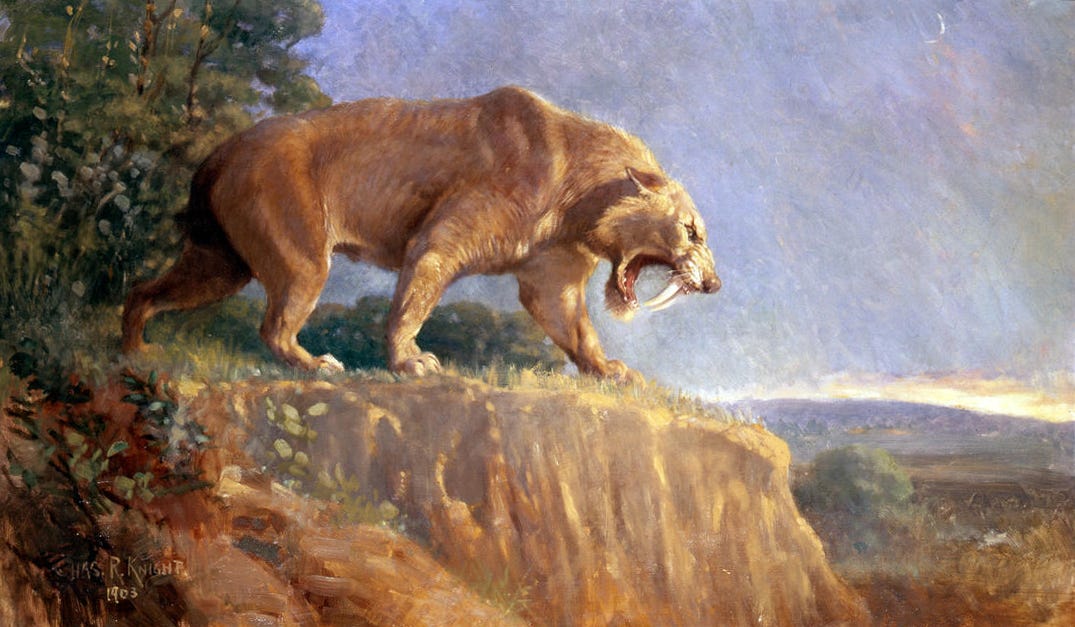
About 11,000 years ago, the climate here was cooler and wettter. Instead of the dry brush we see today, the landscape was a mix of lush grasslands and woodlands. This was the perfect hunting ground for the Smilodon. Unlike modern lions or cheetahs that rely on long-distance chases, the saber-toothed cat was built for power, not for speed. It had a heavy, muscular frame and exceptionally strong front legs used to pin down large prey.
Its most famous feature, of course, was its teeth. Adult males had serrated canines that could grow up to seven inches long. (Kitten Smilodons had adorable saber milk teeth.) Paleontologists believe adults used these sabers to deliver a precise, fatal bite to the soft throat of their prey after the animal had been pinnd down.
They were the apex predators of their time, keeping the populations of ancient horses (we talked about them in last month’s Wildlife Wednesday) and bison in check. When the great herds disappeared at the end of the Ice Age, the Smilodon followed them into extinction, leaving only fossils and statues behind.
What do the La Brea Tar Pits, a lumbering Ice Age giant, and the spiky silhouette of Joshua Tree National Park all have in common? Read on.
The Joshua Tree’s Long-Lost Buddy
“Did you know,” Tim said as we hiked through Queen Valley in the park, “that Joshua trees evolved to have their seeds spread by giant ground sloths in their poop?” Tim has his stories, which we don’t always believe, but it turns out this one is true.
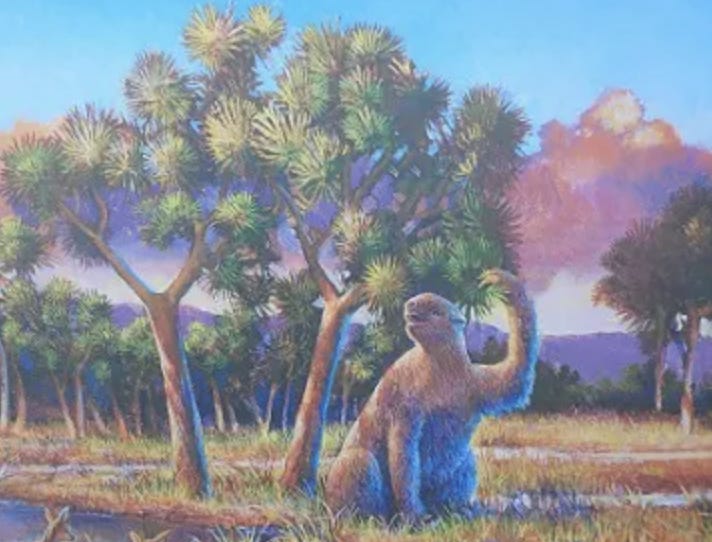
The Shasta ground sloth (Nothrotheriops shastensis)—another one of my pals from the La Brea Tar Pits—was the size of a large bear. While modern sloths are small and live in trees in Central and South America, this sloth lumbered on the land, and one of its favorite snacks was the fruit of the Joshua tree.
The sloth stood nine feet tall on its hind feet and could easily reach the fruit. It would mosey ten miles or more as it searched for food and deposit the seeds in a fresh piles of fertilizer. Because the sloth was so big and traveled such long distances, it helped the Joshua trees spread far and wide.
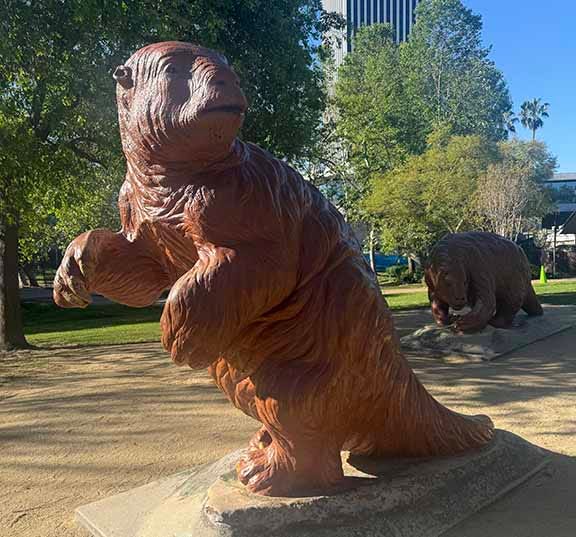
When the Shasta ground sloth went extinct about 11,000 years ago (likely due to the end of the Ice Ages and possibly the arrival of human hunters), the Joshua tree lost its best friend. Today, the trees rely on smaller rodents to move their seeds, which is why Joshua trees don’t spread as quickly or as far as they used to. When you look at a Joshua tree, you are looking at a plant that is still waiting for a giant sloth that is never coming back.
What About Dinosaurs?
Whenever we talk about fossils and extinct animals, the first question people usually ask is: “Where were the dinosaurs?”
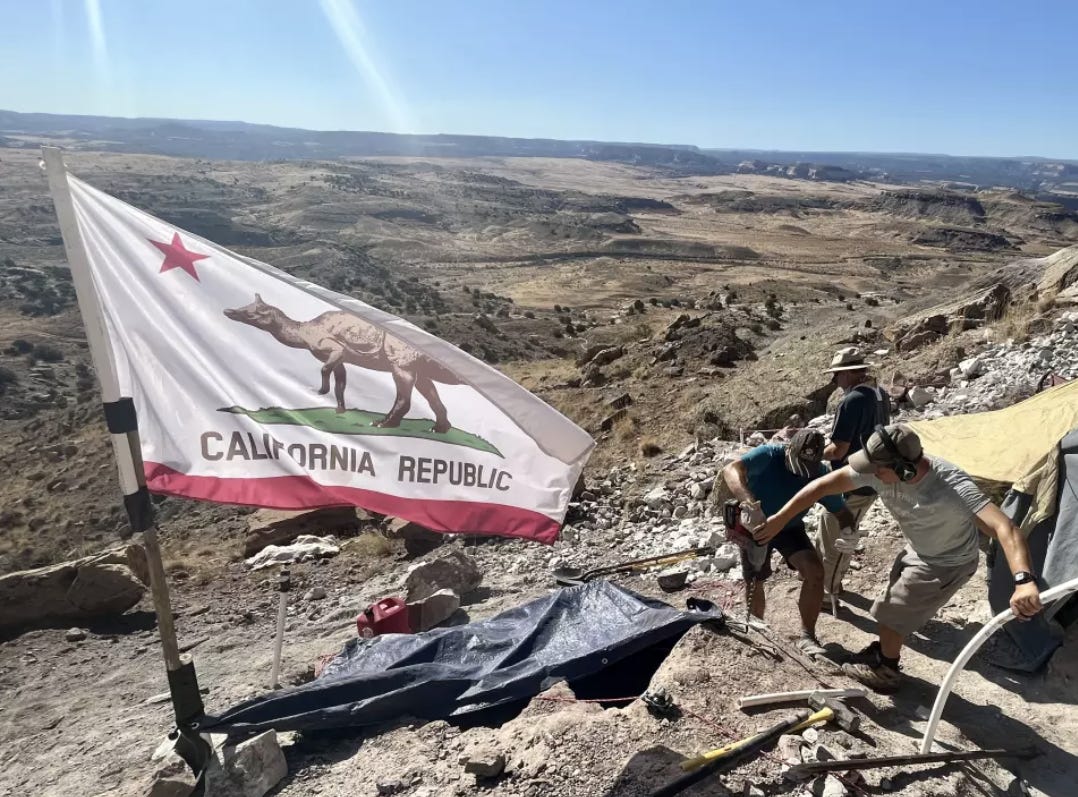
It is a bit of a heartbreaking answer for local dinosaur fans: we don’t find many dinosaur fossils in California. To understand why, we have to look at the geology of the region. Most of the rocks we see in Joshua Tree National Park and the surrounding valleys are igneous (volcanic) or metamorphic. These rocks are formed under intense heat and pressure—conditions that would destroy any bone or shell long before it could become a fossil.
Dinosaurs lived during the Mesozoic Era (252 to 66 million years ago), millions of years before the recent Ice Age of the Smilodon and the ground sloth. During much of the time dinosaurs were walking the earth, the land that would become most of California was either deep underwater or undergoing massive volcanic activity as plates shifted.
However, if you go just a bit further afield into the eastern Mojave, you can find evidence of even older life. Before the dinosaurs, the area was home to trilobites—small, armored sea creatures that scurried across the ocean floor more than 500 million years ago.1
A Landscape of Ghosts
The next time you are in the park, try to imagine the ghosts that inhabit the landscape. Imagine a Shasta ground sloth reaching up to grab a Joshua tree fruit, or a Smilodon crouching in the tall grass of a cooler, greener valley, stalking a wild horse. And when you see that unlikely Smilodon statue in Yucca Valley, look at it not just as a local landmark but a bridge to a past that still shapes the world we travel through.
You can hunt for trilobite fossils in the Trilobite Wilderness. It’s on BLM land, and you are allowed to keep the fossils you collect. It’s a very fun thing to do with kids; just observe the usual desert protocol—have plenty of water, keep track of everyone, and know when you are overheating.

Help us get to to $9,000 — we’re just $15 away!! Upgrade your subscription from free to paid today for just $50 per year or $5 per month.
Want to make a one time donation or are you able to give more than $100? Donate via Paypal!
Leave your thoughts in the comments below. Please note that we do not allow anonymous comments. Please be sure your first and last name is on your profile prior to commenting. Anonymous comments will be deleted.