
ON THE AGENDA: Twentynine Palms City Council Meeting, Tuesday, June 9, 2026
The year's seventh closed session, a second reading on Council pay raises, a public-records bill worth watching, and a 1% sales tax measure moving toward the November ballot


The June 9 City Council meeting is mostly routine, but not entirely. The Council opens with yet another closed session, holds a public hearing that comes with a residential trash-rate increase, considers a resolution backing a state public-records bill, and gives direction on a 1% sales tax measure headed for the November ballot, with a formal vote set for June 23. The full agenda packet is available here. The closed session starts at 5:30 pm and the regular session begins at 6 pm.
1. Anticipated Litigation, Significant Exposure to Litigation, Gov. Code Section 54956.9(d)(2)(1 case)
The meeting opens, for the seventh time in 2026, with a closed session. The stated basis is significant exposure to litigation under Government Code § 54956.9(d)(2), with no further detail in the published agenda. Of the City’s six closed sessions earlier this year, three (April 9, 14, and 27) concerned the City Manager transition following Stone James’s April 9 resignation, and those ultimately surfaced in public: the Council accepted James’s resignation on a 5-0 vote and later appointed Kevin Cole.
The litigation sessions have been harder to follow. Consulting legal counsel in closed session is squarely permitted under the Brown Act; what is worth watching is how these items are described on the agenda and what, if anything, is reported afterward. The February 10 session cited a threat to public services and a consultation with the City Attorney. The January 27 session, like the one set for June 9, was listed only as anticipated litigation, “one case,” and afterward the Council reported nothing. The exception was January 13, when a last minute revised agenda named the matter directly: the Indian Cove Neighbors’ challenge to the City’s facility fee waiver policy.1
The Brown Act requires closed-session items to be described on the agenda with their statutory basis and certain actions to be reported out afterward, though how much detail those require depends on the circumstances. Across these sessions, the City has generally provided the minimum: a bare citation going in, and little or nothing coming out.
PUBLIC COMMENT
You can comment on agenda items and issues important to you at every City Council meeting. Comments on agenda items take place during discussion of that item, while comments on non-agenda items take place near the end of the meeting. The Brown Act prevents Council from commenting on non-agenda items. To comment, just pick up a form at the entry desk, fill it out, and hand it to the Clerk, who usually sits just in front of the Council dais toward the right.
Council email addresses and public comment information can be found on our resources page. Be sure to email prior to 2 pm on the day of the meeting so they have time to read your email prior to discussion. You can also copy the clerk at cvillescas@29palms.org and ask that your letter be made part of the public record.
AWARDS, PRESENTATIONS, APPOINTMENTS AND PROCLAMATIONS
Item 2 is a presentation by the Public Arts Advisory Committee (PAAC), the City Council-appointed body that supports public art programming and maintains the City's permanent art inventory. No staff report is included and no subject is described.

CONSENT CALENDAR
The Consent Calendar consists of items usually approved with a single vote. The public is given a chance to make public comment on these items prior to the Council motion. Fill out a comment form specifying the item you wish to address and submit it in person, or send an email in advance regarding any of the items on this meeting’s Consent Calendar.
Items 3 and 4 are routine: a procedural step allowing Council to adopt Ordinance No. 328 (the salary increase, addressed under Item 6) by title only rather than reading it aloud, and approval of the minutes from May 26, City Manager Kevin Cole’s first regular meeting.
Item 5. Approval of Warrant Register Totaling $2,424,428.26
The warrant register covers all payments issued by the City during a given period; this meeting's register totals $2,424,428.26, covering payments issued between May 12 and June 3, 2026. A few line items stand out. Clifford Moss LLC, the sales tax campaign consultant, received $16,352.49, roughly double its reported monthly rate. This could reflect two billing periods or additional scope, but the agenda packet provides no explanation.
Also appearing is a $9,000 payment to Culper Consulting LLC, the firm of Yucaipa Deputy Mayor Justin Beaver. As reported in the May 12 recap, outgoing City Manager Stone James contracted the firm to produce a code enforcement manual days after announcing his resignation. The City Attorney issued a work stop order shortly after, and Stone James pulled the Council approval item from the agenda the same day the payment cleared, meaning the $9,000 was paid without formal Council authorization for the policy governing the production of the manual.
Item 6. Second Reading of Ordinance No. 328 — City Council Salary Increase
The second and final reading of Ordinance No. 328 comes after its initial reading at the May 26 meeting, where it passed unanimously. If adopted, it would raise Council members’ monthly compensation from $465 to $700, the first increase in 24 years. The increase takes effect following the November 2026 election. For a deeper-look at the Council salary discussion, check out our previous coverage from the March 10 recap.
Item 7. Information on the Importance of Periodic Septic System Maintenance
The recurring septic system maintenance education item is a standing fixture at every meeting as part of the City's collaboration with the Twentynine Palms Water District on groundwater quality. As the May 26 recap noted, resident Heather Drake urged Council to extend septic enforcement to rental property management companies, citing personal experience with a management firm that failed to maintain systems in properties she had rented and later purchased.
Item 8. Three-Year Granicus Subscription Agreement — Visit 29 Palms TBID
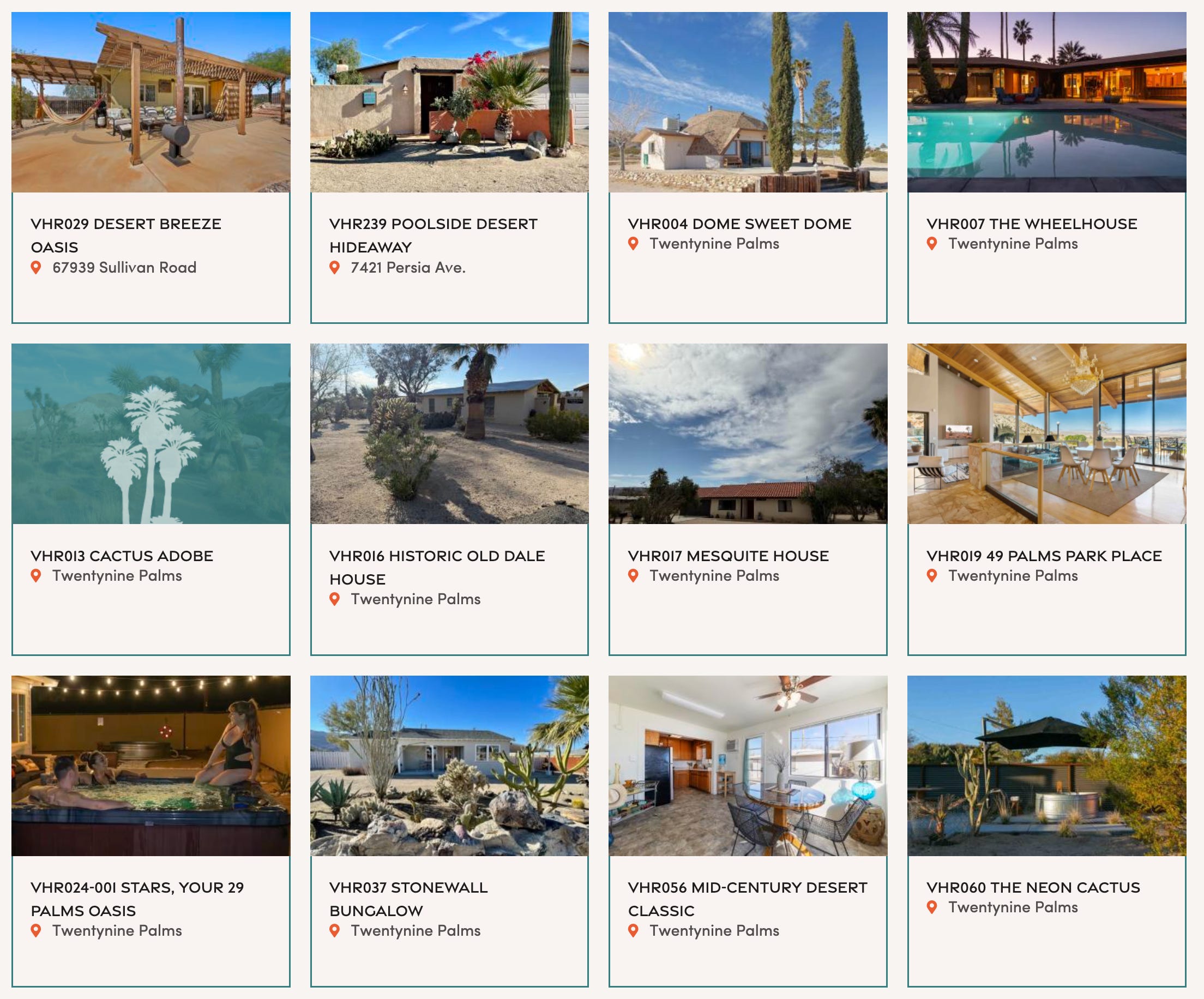
The Tourism Business Improvement District’s marketing website, Visit29.org, runs on the Simpleview platform, now provided by Granicus. This item renews the subscription for three years, beginning at $26,449.46 in year one and rising to $29,094.41 and then $32,003.85 — roughly $87,500 over the full term. Funding comes from the TBID’s budget, not the General Fund.
The renewal was placed on the TBID Advisory Board’s consent calendar on March 19 and now appears on the City Council’s consent calendar, meaning a three-year contract is on track to be approved at both bodies without public deliberation unless a Councilmember or resident request discussion on the item.
It also carries some recent history. At the TBID's January 29 meeting, lodging partner Susan Peplow raised concerns in public comment about the rollout timeline for the platform's new business portal and the value of the events calendar as a resource for lodging partners and local businesses. A review of Visit29.org this week found the events calendar current and 102 lodging listings, suggesting the calendar and listings concerns have started to be addressed, despite the lodging listings representing about one-third of what’s available.2
Item 9. Emergency Repair of Luckie Park Well
The southeast well at Luckie Park failed in February 2026, prompting an emergency repair completed by Chambers Choice Drilling to keep the park’s irrigation, restrooms, and pool running. Once underway, the work turned up additional problems, pushing the cost to $28,231, beyond the City Manager’s spending authority and requiring the vendor to be paid before Council could act. Council is now being asked to ratify the expenditure after the fact. The cost falls within the $50,000 budgeted for well repairs in the General Capital Projects Fund for FY 2025-26.
Item 10. SB1 Road Project List for FY 2026-27
The Road Repair and Accountability Act of 2017 requires the City to adopt a resolution each year identifying which road projects will be funded with SB 1 gas tax revenues. The City anticipates approximately $795,609 in SB 1 funds for FY 2026-27. The money will pay for asphalt overlay totaling about 22,000 linear feet, with work scheduled from July 2026 through June 2027, across 12 street segments:
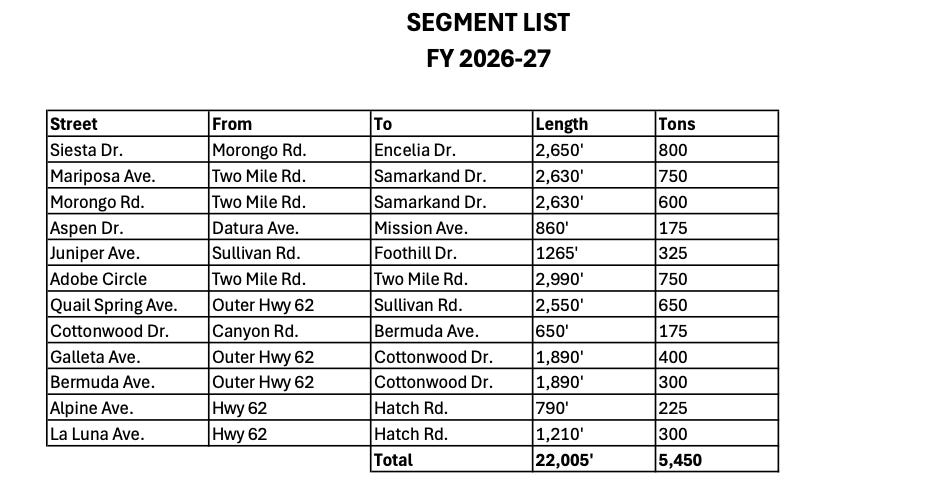
Per the staff report, the City’s pavement condition index is currently above the SB 1 benchmark of 80 and rated “good.” Cities must maintain that threshold to remain eligible for the funding.
PUBLIC HEARING
11. Placement of Solid Waste Service Charges on the County Property Tax Roll
This is the meeting’s only public hearing. Each year the City must pass a resolution authorizing San Bernardino County to collect Burrtec’s residential solid waste charges through the property tax roll, a practice in place since 2005 that the City Attorney’s staff report says saves residents money over direct billing. The County began requiring annual re-authorization in 2025.
The hearing is not a vote on the rates themselves. According to the staff report, standard residential service will rise by $3.18 per month effective July 1, 2026, and most of that increase happens automatically under the City’s existing franchise agreement with Burrtec, without Council action. It includes a 3.09% cost-of-living adjustment, $2.10 representing the third year of a four-year phase-in of state-mandated organic waste recycling costs under SB 1383, and $0.43 in added recycling costs.
The single component actually before the Council is a 1.07% increase, about $0.28 per month for standard residential service, to cover Burrtec’s costs of complying with SB 1383’s organic waste procurement mandate. The staff report presents the $3.18 figure as the overall change to residential rates on July 1, so this $0.28 charge appears to be one part of that total rather than an addition to it.
DISCUSSION AND POTENTIAL ACTION ITEMS
12. Support for AB 1821: California Public Records Act Amendment
AB 1821 would amend the California Public Records Act (CPRA), the state law that gives the public the right to obtain government records. Current law requires an agency to determine whether requested records are disclosable and to notify the requester within 10 days, a window understood under state law to mean 10 calendar days. AB 1821 would change that to 10 business days and would similarly shift the permitted extension under unusual circumstances from 14 calendar days to 14 business days.34
As of late May 2026, the bill had passed the Assembly and moved to the Senate, which means it is not yet law. The Council is being asked to adopt a resolution supporting it. City Manager Cole will present the item; no staff report is included in the published agenda packet, which is unusual for an action item and leaves the public and Council members without written analysis before the vote.
For residents who have submitted records requests to the City of Twentynine Palms, the response window may already look like what the bill proposes: City Clerk Cindy Villescas has consistently treated the deadline as 10 business days rather than 10 calendar days, giving the understaffed City more time to respond.
The Desert Trumpet has a direct interest in this legislation: it regularly files public records requests with the City and other local agencies, and the bill’s deadline change would apply to those requests. There is some irony in the Council being asked to put the City’s name behind a public-records law when its own compliance with that law has been challenged at past meetings. At the May 26 meeting, for instance, Desert Trumpet Editor-in-Chief Cindy Bernard raised the issue with Council members during public comment:
The Desert Trumpet submits public information requests as a part of our investigative reporting. While a few of you do a great job of supplying the documents legally required by the California Public Records Act, others of you are less forthcoming. You know who you are. In fact, documents produced in response to one of our requests show that a council member directed City staff to filter our records response using only quote exact keywords, a practice inconsistent with the City’s obligation under the California Public Records Act.
The past City Manager was not a fan of CPRA compliance — is this agenda item a sign of change?
13. Sales Tax Ballot Measure — Polling Results and Ballot Language
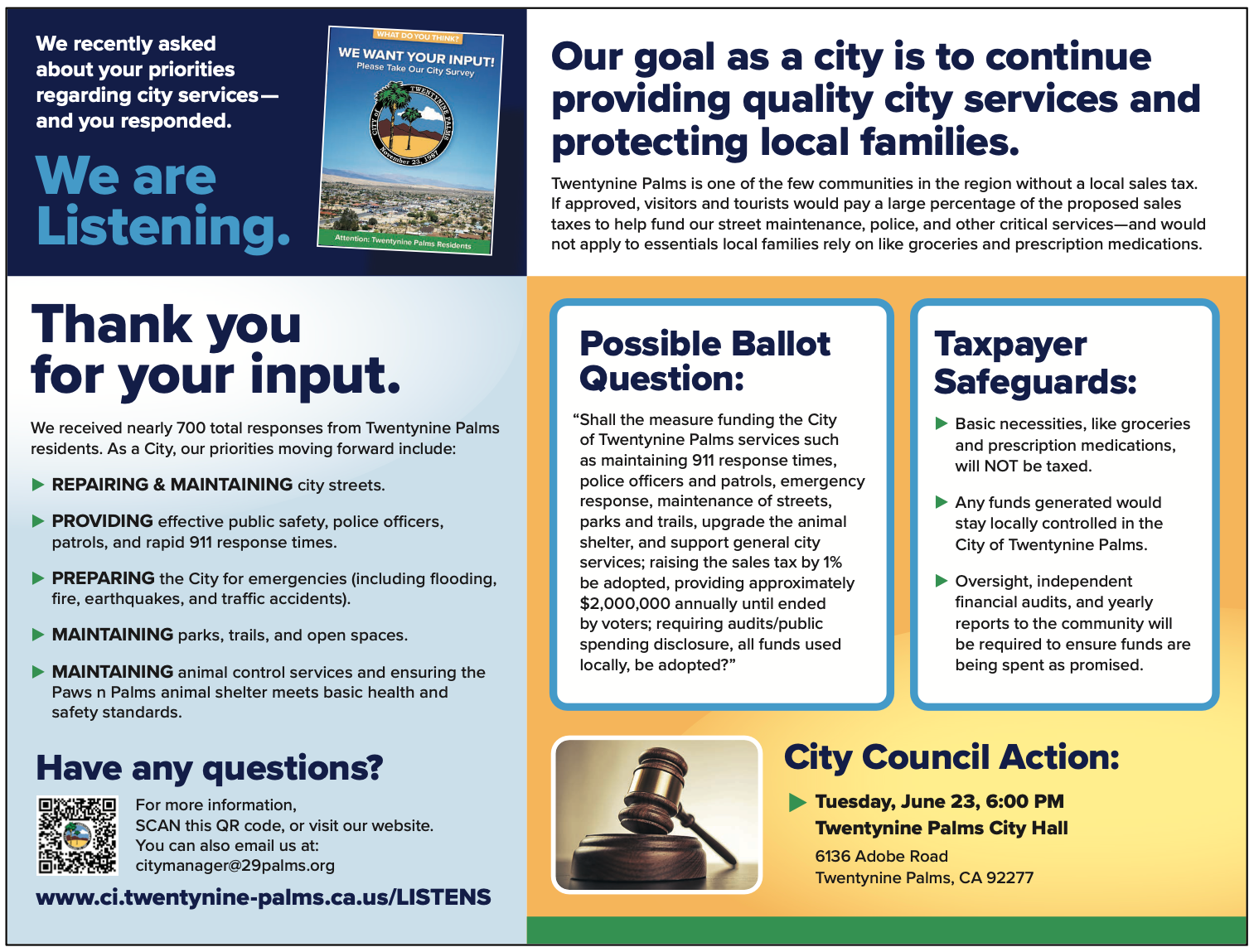
The City is asking Council to provide direction on placing a 1% local sales tax measure on the November 2026 ballot; a formal vote on ballot language and a placement resolution would return to Council on June 23. According to the staff report, the City faces structural pressure on the General Fund, with operating expenses, led by law enforcement costs, growing faster than revenues. The Sheriff’s Department contract for FY 2026-27, approved at the May 26 meeting, rose 7.4% over the prior year — an increase of $429,052, bringing the total to $6,220,995. The campaign’s FAQ, produced by Clifford Moss LLC, says the contract rose 10% this year, with no math shown.
The outreach has proceeded in phases. Beginning in 2023, the City conducted two community surveys. At its October 14, 2025 meeting, Council approved a $122,250 package: a Probolsky Research survey plus funding for a political consulting firm to promote a possible measure, with the consultant’s role made contingent on the survey’s results. Staff originally recommended the Lew Edwards Group, but Council substituted Clifford Moss LLC at Councilmember April Ramirez’s suggestion. Probolsky completed its survey on January 17, 2026, and then a citywide mailer went out to more than 5,000 voter households, generating 682 responses and 542 written comments; digital advertising produced 184,000 impressions and 13,455 clicks. A second mailer, signed by then-City Manager Stone James, went out in May.
The draft ballot question reads:
Shall the measure funding the City of Twentynine Palms services such as maintaining 911 response times, police officers and patrols, emergency response, maintenance of streets, parks and trails, upgrade the animal shelter, and support general city services; raising the sales tax by 1%, be adopted, providing approximately $2,000,000 annually until ended by voters; requiring audits/public spending disclosure, all funds used locally, be adopted?
As a general tax, the measure’s revenue would flow to the General Fund and could be spent at the discretion of whichever Council is seated, which is also why it needs only a majority to pass rather than the two-thirds a dedicated tax requires. That structure sits awkwardly against how the measure is being presented. Several claims in the City’s outreach materials warrant scrutiny:
A general tax presented as dedicated spending. The ballot question and both outreach documents list specific uses — 911 response, police patrols, streets, parks, animal shelter upgrades — but as a general tax, none of those uses is legally binding; the money can be spent on anything. The FAQ concedes as much.
A claim the City has never substantiated. Both the fact sheet and the mailer assert that “visitors and tourists would pay a large percentage” of the proposed tax. No data supporting this appear in the packet. When the same talking point was used during the City’s earlier sewer-tax campaign, records obtained by the Desert Trumpet showed the then-City Manager, asked for the figure behind it, acknowledged the City did not have that analysis.
Grocery and prescription “protection.” The FAQ frames exempting groceries and prescriptions as a safeguard built into the measure. Most groceries and prescription drugs are already exempt from California sales tax statewide, regardless of any local measure.
Unsourced statistics. The fact sheet claims a pavement condition index “20% above the average of all Coachella Valley cities” (Twentynine Palms is in the Morongo Basin, not the Coachella Valley), and an animal-shelter “save rate nearly 3x higher than the national average.” Neither figure is sourced.
A regional claim stated as fact. The materials assert the City is “one of the few communities in the region without a local sales tax,” which the packet does not substantiate.
One omission is its own kind of disclosure. The item is titled to present polling results, but the Probolsky report is not in the packet. When Council first accepted the survey on January 27, the full Probolsky Research report, including methodology, sample, and a margin of error of plus or minus 5.8 percent, was included in the agenda packet, available to the public before the meeting. The June 9 packet contains only the Clifford Moss fact sheet, FAQ, and mailer. The underlying poll is absent.
The City’s current sales tax rate is 7.75 percent, with no local component. Staff asks only that Council receive the report and provide direction; the final ballot language and placement resolution return for a vote on June 23.
FUTURE COUNCIL INITIATED ITEMS
The following 14 items are queued for future Council action or discussion:
Shade structures around Freedom Plaza and a possible art fixture announcing the location.
Discussion of a policy regulating the use of City Attorney resources.
Discussion on creating a “Recognized Neighborhood Program.”
Discussion on the new federal holidays to coincide with the City’s holiday schedule.
Discussion on the use of City funds for grants and the potential reallocation of housing and homeless funds to grants.
Discussion on creating guidelines for the use of City Hall meeting rooms by elected and appointed officials for official City business.
Discussion on the next steps of reallocating $1.3 million for housing.
Discussion of Code Enforcement, compliance with Proposition 36, and a pathway to meeting new guidance issued by Governor Newsom.
Discussion about annexing parcels APN 0634-05-124 and 0634-05-109, also known as Set Free Ranch.
Discussion of a possible safe passage with CalTrans around Donnell Hill.
Discussion on a collaboration with Liberty Military Housing to update the City’s RHNA numbers.
Study session regarding the FLOCK cameras.
Expedited item to discuss Cooling Center hours.
Review and revision to Municipal Code Chapter 5.08 related to cannabis uses, to bring the City into compliance with new state legislation. Requested by Councilwoman Ramirez, seconded by Councilmember Bilderain, per the May 26 minutes.
Run for City Council! Districts 3 (Mintz), 4 (Scott), and 5 (Wright) are up for election. The nomination period for candidates begins July 13, 2026 and ends on August 6, 2026. Contact City Clerk Cindy Villescas for details and check out our article on How to Run for City and Town Council for general guidelines.
Hi, new subscribers! Desert Trumpet understands you might not be interested in all of our coverage. That’s why it’s divided into separate newsletters allowing you to opt out of reporting that’s not important to you. For instance, you may want our Education news but not City Hall 29.
Here’s how to opt out: go to your Substack settings, scroll down to “subscriptions,” and select “Edit” for the Desert Trumpet. Simply uncheck the box next to the newsletters you don’t want to receive in your email inbox. You’ll still be able to access all coverage online if you change your mind.
Thanks to you, Desert Trumpet met our $10,000 paid subscription goal!!!
Not a paid subscriber yet? Did you know that paid subscribers receive discounts on our DT Social events and invites to DT Front Porch, intimate discussions featuring local officials and notable residents?
Upgrade to a $50+ paid subscription for a 10% discount.
Upgrade to $100+ for a 25% discount.
Sustaining subscribers at the $250+ level and above receive complementary tickets
Leave your thoughts in the comments below. Please note that we do not allow anonymous comments. Please be sure your first and last name is on your profile prior to commenting. Anonymous comments will be deleted.
This coverage is free - please share!
Members of the Desert Trumpet staff live in the Indian Cove neighborhood and are involved with Indian Cove Neighbors. See the publication’s coverage policy.
Visit29’s lodging page lists 15 Hotels, Motels, & Inns and 87 Vacation Home Rentals as of June 6, 2026.
Under Government Code § 7922.535, “unusual circumstances” is a defined term, not open-ended discretion. It applies only to the extent reasonably necessary to process a request: the need to retrieve records from field offices separate from the one handling the request; the need to examine a voluminous amount of distinct records sought in a single request; the need to consult another agency or department with a substantial interest; and the need to compile data or write a program to extract records.
This article originally stated that AB 1821 would authorize fees for staff time spent searching for public records. That provision appeared in the previous version of the bill, but was removed by the April 6, 2026 amendment. As currently written, AB 1821 addresses only response timelines.